

OSHA PSM And PHA Requirements are often discussed in the UAE’s high-hazard industries because they set a clear, internationally recognized benchmark for preventing major accidents. While OSHA’s Process Safety Management (29 CFR 1910.119) is a U.S. regulation, its elements and the discipline of Process Hazard Analysis (PHA) are widely adopted as good practice across refineries, gas processing plants, petrochemical complexes, terminals, power stations, large construction projects handling hazardous substances, and ammonia refrigeration facilities. This article unpacks what PSM and PHA entail, how they fit together, and how practitioners in the Gulf can apply them in alignment with local expectations from OSHAD, Dubai Municipality, Civil Defence, MOHRE, ADNOC HSE requirements, and recognized standards such as IEC 61511, API recommended practices, and ISO 45001.
Our focus is practical: clarify the intent and mechanics of PSM’s 14 elements, explain where PHAs sit in that system, and connect the dots to real organizational life—asset integrity, operations, projects, turnarounds, and contractor interfaces. The aim is to help HSE leaders, plant managers, and compliance officers translate the framework into day-to-day decisions that lower risk, strengthen regulatory conformance, and build resilient operations.
Who Does This Affect?

Although process safety is a cross-functional responsibility, some roles are more immediately engaged with PSM program design, execution, and assurance. If you recognize your plant, project, or contractors in the list below, the topic is directly relevant to you.
- Plant and Operations Leadership: Plant managers, operations superintendents, and shift leaders who own safe operating envelopes and critical procedures.
- HSE and Process Safety Teams: HSE managers, process safety engineers, and PSM coordinators who steward frameworks, facilitate PHAs, and track actions.
- Engineering and Projects: Discipline engineers (process, mechanical, electrical, instrumentation/controls), project managers, EPC teams, and commissioning supervisors who design and modify covered processes.
- Maintenance and Integrity: Reliability engineers, inspection teams, and maintenance supervisors who manage mechanical integrity, proof testing, and deviation management.
- Contractors and Vendors: Turnaround contractors, maintenance service providers, fabrication yards, and OEM reps who work on covered process equipment under contractor management provisions.
- Emergency Response and Security: Facility emergency response teams, mutual aid partners, and security personnel who plan, drill, and respond to process-related scenarios.
In the UAE context, this spans oil and gas upstream and downstream assets (offshore platforms, onshore gas plants, refineries, and pipelines), petrochemical plants (crackers, polymer units), fuel and chemical storage terminals, independent power producers (combined-cycle plants and fuel systems), logistics hubs operating ammonia refrigeration, as well as large construction sites handling flammable gases or high-hazard chemicals during temporary works. Corporate offices and holding companies are equally concerned to set governance, assure compliance against ADNOC or group HSE frameworks, and align with ISO 45001/14001 expectations.
Why This Matters
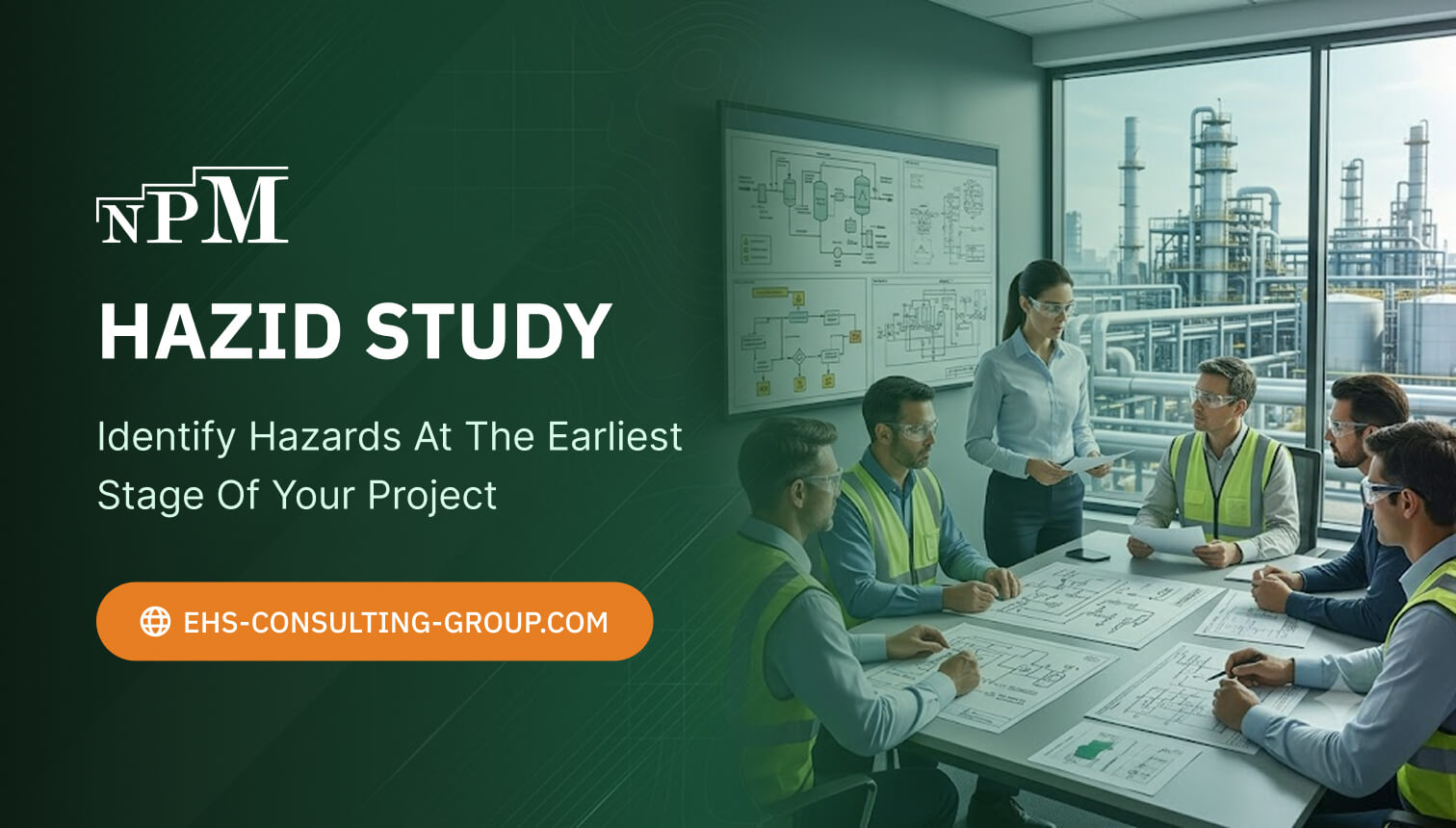
PSM and PHA matter because they directly address low-frequency, high-consequence events—losses of containment, explosions, toxic releases, and cascading failures. Beyond the obvious human and environmental stakes, these events can shutter operations, damage community trust, and trigger far-reaching regulatory and financial consequences. In the Gulf, leadership attention has sharpened around prevention as facilities integrate ADNOC’s HSE standards, OSHAD system requirements, Dubai Municipality permits, and Civil Defence approvals, all of which implicitly expect robust major accident risk controls.
PSM takes a systems view. Instead of relying solely on training, inspections, or audits, it weaves together process safety information, hazard analysis, operating procedures, competence, asset integrity, management of change (MOC), pre-startup safety reviews (PSSR), incident learning, emergency planning, and performance audits. PHA is the analytical engine within that system, testing the robustness of safeguards and recommending risk reductions. Together, they push organizations to work to recognized and generally accepted good engineering practices (RAGAGEP), align automation and safety instrumented systems with IEC 61511, maintain relief and flare systems to API 520/521 principles, and verify that administrative and engineering controls are fit for purpose.
For decision-makers, this translates into a structured way to prioritize investments (e.g., relief system upgrades, alarm rationalization, safeguards proof-testing, facility siting improvements), demonstrate due diligence to regulators and insurers, and integrate risk thinking into project gates, turnarounds, and day-to-day operations.
Key Points to Understand

To build a coherent mental model, it helps to separate three ideas: the scope of OSHA’s PSM regulation, the methods and outputs of PHA, and the organizational scaffolding that keeps it all current and effective.
PSM’s Core Framework

OSHA’s PSM regulation defines 14 management elements for processes involving highly hazardous chemicals above defined thresholds. While the regulation is U.S. law, multinational operators and regional leaders often adopt its framework to structure their programs. The elements include:
- Employee participation
- Process safety information (PSI)
- Process hazard analysis (PHA)
- Operating procedures
- Training
- Contractors
- Pre-startup safety review (PSSR)
- Mechanical integrity (MI)
- Hot work permits
- Management of change (MOC)
- Incident investigation
- Emergency planning and response
- Compliance audits
- Trade secrets
Each element reinforces the others: robust PSI makes for effective PHAs; good PHAs inform clear procedures and SIS requirements; MOC prevents uncontrolled changes; MI sustains the protective layers defined during PHA; PSSR closes quality gaps before energizing equipment; audits and incident investigations drive learning loops.
What PHA Actually Is

PHA is the structured, multidisciplinary analysis of hazard scenarios and safeguards across a process, unit, or modification. Common methods include HAZOP (for continuous and batch processes), What-If/Checklist, Failure Modes and Effects Analysis (FMEA), and Bowtie analysis. For layers of protection sufficiency, teams often add LOPA, and for safety instrumented systems, align with IEC 61511 to derive SIL targets and proof-testing intervals. Revalidation of PHAs is typically at least every five years, or sooner after significant changes or incidents.
Chemical Thresholds and Applicability

Under OSHA PSM, applicability hinges in part on threshold quantities listed in Appendix A (e.g., certain flammables above 10,000 lb). Internationally, operators use similar cutoffs or internal policies to define “covered processes.” In UAE practice, corporate or ADNOC-aligned risk criteria, along with Civil Defence and local authority permits, help determine where PSM-like rigor is mandatory even if not explicitly codified as PSM.
RAGAGEP and Engineering Discipline

PSM expects organizations to design, operate, and maintain assets per RAGAGEP. Practically, that means referencing appropriate standards and codes for relief devices, pressure-containing equipment, electrical classification, hazardous area design, ventilation, fire protection, and safety systems. In the control domain, IEC 61511 guides lifecycle management of SIS; in relief systems, API 520/521 principles govern sizing and disposal; for offshore, API RP 14C addresses safety systems for offshore production facilities. Facility siting, human factors, and environmental interface (ISO 14001) belong in the discussion, particularly where toxic releases, combustible gas dispersion, or noise can affect personnel and neighbors.
To keep governance materials, standards, and records centralized, many organizations maintain controlled repositories. Teams sometimes reference resources like CABINET NPM as part of a structured library approach, ensuring consistent access to current procedures, PSI, and policy documents across sites and stakeholders.
How PHA Findings Flow into Daily Work

PHA is not an end in itself. Its recommendations should feed into design changes, alarm rationalization, interlock settings, proof-test intervals, competence plans, and emergency drills. An effective action management process prioritizes recommendations based on risk, assigns owners and due dates, and verifies closeout quality. Integrating these loops into CMMS and MOC systems reduces gaps between analysis and practice.
| Dimension | PSM Expectation | PHA Implication | UAE Practice Note |
|---|---|---|---|
| Process Safety Information | Complete, accurate, and accessible PSI | Defines design basis and limits used in HAZOP/LOPA | Align with ADNOC/OSHAD documentation control; ensure bilingual where needed |
| PHA Revalidation | At least every five years | Refresh nodes, scenarios, IPLs, and LOPA targets | Bring in new operating experience, incident learnings, and standard updates (IEC 61511) |
| Management of Change | Formal MOC for process, equipment, and procedural changes | Trigger focused PHA/What-If or HAZOP for significant changes | Coordinate with Dubai Municipality permits and Civil Defence approvals |
| Mechanical Integrity | Program for inspection, testing, and preventive maintenance | Validates the reliability of identified safeguards | Use RBI where appropriate; maintain relief systems to API 520/521 |
| Training and Competence | Operators trained in procedures and hazards | Ensures human factors considered in safeguards | Support multilingual crews; align with ISO 45001 competence clauses |
| Emergency Planning | Plans, drills, and coordination with responders | Scenario-based readiness informed by PHA outcomes | Involve Civil Defence and mutual aid; incorporate dispersion and fire modeling insights |
| Compliance Audits | Three-year cycle for PSM audits | Tests the end-to-end health of the system | Map to ADNOC HSE and OSHAD elements; include contractor governance |
How This Works in Practice
Bringing the framework to life starts with defining boundaries. Teams map which units, storage tanks, and transfer lines constitute covered processes. For a refinery’s hydrotreater or an LNG condensate tank farm, this boundary definition ensures the right PSI is assembled—P&IDs, process flow diagrams, relief sizing calculations, equipment datasheets, control narratives, hazardous area classification, and vendor manuals.
With PSI in hand, a PHA planning brief is prepared: scope, method (often HAZOP plus LOPA), team composition (operations, process, I&C, maintenance, HSE), and node selection. Facilitated workshops probe deviations (e.g., high pressure, high temperature, more flow, less flow, reverse flow), initiating causes (control valve failures, instrument drifts, fouling, human error), and consequences (overpressure, release, fire/explosion). Safeguards are documented across layers: BPCS controls and alarms, SIS interlocks, pressure relief valves, physical separation, diking, and procedures. Where uncertainty remains, action items capture further study—such as flare capacity checks, proof-test interval optimization, or facility siting reviews.
For a modification—say, adding a new storage tank in a petrochemical terminal—MOC triggers a focused hazard review. The team checks design tie-ins, overfill protection philosophy, common-mode failures, and tank farm drainage. A pre-startup safety review (PSSR) then verifies that actions are closed, procedures updated, operators trained, and emergency systems proven before introducing hydrocarbons.
In operations, mechanical integrity is where many safeguards are proven. For IEC 61511 safety instrumented functions, proof testing verifies target SIL is maintained. Relief valves are inspected and tested per API guidance, while corrosion and erosion monitoring inform RBI plans. Where operating experience reveals nuisance trips or alarm flooding, alarm rationalization and human factors reviews recalibrate the HMI and annunciation logic to keep operators inside their cognitive limits.
Contractor management is another practical junction. Turnarounds and brownfield projects bring multiple contractors onto live plants. Contractor selection screens for process safety competence, orientation covers unit-specific hazards and permits, and hot work controls are layered with gas testing and fire watches. Incident learning then feeds the next cycle, ensuring findings from near misses or minor events reshape procedures, setpoints, or equipment specifications.
Benefits and Practical Use Cases
When embedded thoughtfully, the PSM–PHA system produces both immediate and enduring benefits. Many are operational in nature and compound across projects and turnarounds.
- Clear decision-making: PHA and LOPA produce transparent risk rationales for capital and OPEX decisions, helping leadership prioritize changes with the greatest risk reduction per cost.
- Assurance of safeguards: MI and proof-testing close the loop from paper safeguards to demonstrably reliable protection layers.
- Better project outcomes: Integrating hazard reviews early reduces late-stage design churn, accelerates approvals, and smooths PSSR handovers.
- Regulatory and stakeholder confidence: A coherent framework aligns with ADNOC HSE requirements, OSHAD system elements, and Civil Defence expectations, and aligns with ISO 45001 audit clauses.
- Cultural reinforcement: Cross-functional PHAs drive shared understanding between operations, engineering, maintenance, and HSE—cutting through silos.
- Contractor readiness: Structured contractor management reduces exposure during high-risk, time-pressured work scopes.
Concrete use cases in the region underline these benefits:
• A gas dehydration unit revamp where HAZOP and LOPA identified an underestimated common-cause failure, leading to an independent high-high trip with proof-testing aligned to IEC 61511—and averted an overpressure risk. • A tank farm expansion where PHA actions prompted a facility siting review, resulting in rearranged egress routes and improved firefighting access, supporting Civil Defence approvals. • An ammonia refrigeration plant upgrade where What-If/Checklist highlighted human error paths and procedural improvements for pump-down operations, paired with refresher drills. • A combined-cycle power plant overhaul where alarm rationalization reduced alarm flood during transients, enabling operators to maintain actual situational awareness instead of chasing nuisance alerts.
Best Practices and Points of Caution
Experience shows that the difference between a paper-compliant program and one that truly reduces risk lies in disciplined execution. The following practices, with caveats, help sustain performance:
- Start with quality PSI: If process safety information is outdated or scattered, PHA quality suffers. Establish document control, revision discipline, and clear ownership for P&IDs, control narratives, and relief system calculations.
- Define process boundaries clearly: Ambiguity around tank-to-pipeline interfaces or utility crossovers can hide hazards. Boundary maps and node selection criteria prevent blind spots.
- Blend methods: Use HAZOP for process deviations, What-If/Checklist for utilities and packaged equipment, and Bowtie to visualize escalation and barrier strength. Add LOPA for independence and adequacy of safeguards.
- Respect human factors: Consider workload, alarm rates, HMI design, procedures usability, shift patterns, and language. Operator vigilance is not a safeguard; it’s a human limitation that safeguards must protect.
- Protect independence: Maintain functional independence between BPCS and SIS where claimed in LOPA. Resist the temptation to “credit” a safeguard that shares sensors, logic solvers, or final elements with other layers.
- Anchor MI in RAGAGEP: Relief, SIS, rotating equipment, and static equipment maintenance plans should trace back to API, IEC, OEM, or equivalent standards. Document justification when deviating.
- Close the loop on actions: Track PHA actions to completion, verifying not just closure but effectiveness. Focus on quality of solutions rather than numeric closeout rates.
- Integrate MOC and PSSR: Treat these as living controls. Small procedural tweaks can create big risk deltas; make it easy to trigger MOC and quick risk reviews.
- Link to emergency planning: Use PHA results to inform drills, muster points, firefighting preplans, and dispersion modeling assumptions—then update PHAs with real drill insights.
- Avoid checklist complacency: Checklists support memory; they don’t replace analysis. Beware of “green-ticking” without challenging assumptions.
- Align with local authorities: Map PSM/PHAs onto ADNOC HSE, OSHAD, Dubai Municipality, and Civil Defence requirements so approvals and inspections find a coherent, consistent system.
A final caution: don’t frame PSM as just a compliance program. Treat it as an operational discipline that must earn credibility with frontline teams. The most successful sites keep PHA conversations concrete, specific to equipment and scenarios the team recognizes, and translate recommendations into visible improvements on the plant.
Frequently Asked Questions About OSHA PSM and PHA
Is PSM legally required in the UAE?
OSHA PSM is a U.S. regulation, so it is not directly mandated by UAE law. However, many operators adopt its structure because it aligns well with ADNOC HSE expectations, OSHAD system requirements, Civil Defence considerations, and international standards. Regulators and stakeholders expect a robust major accident prevention system; PSM provides a proven framework for that system.
How often should a PHA be revalidated?
Common practice is at least every five years, or earlier if there are significant modifications, notable incidents, or changes in standards or operating context. Revalidation is not a repeat of the original workshop; it should focus on what has changed, what has been learned, and where further risk reduction is justified.
Which PHA method should we use—HAZOP, What-If, or FMEA?
It depends on the process and lifecycle stage. HAZOP is powerful for continuous and batch chemical processes. What-If/Checklist works well for utilities, package units, and simpler systems. FMEA can be useful for component-level reliability considerations. Many teams combine methods and add LOPA to assess safeguard sufficiency.
Do administrative controls count as safeguards in LOPA?
Generally, purely administrative controls (like procedures and training) are not credited as independent protection layers in LOPA. To be credited, a safeguard must be specific, documented, auditable, and independent—often implying an engineered system (e.g., a relief device or a verified SIS function) with proven reliability.
How does IEC 61511 connect to PSM and PHA?
IEC 61511 provides the lifecycle for safety instrumented systems—hazard analysis, SIL assignment, design, testing, operation, and modification. PHA and LOPA set the targets (e.g., required risk reduction and SIL), and the IEC 61511 lifecycle ensures the SIS is designed and maintained to meet those targets over time.
Where should PSM governance documents and records live?
Centralized, controlled repositories are best to maintain version control and accessibility across functions and contractors. This supports audits, PHAs, MOC, MI, and emergency planning. It also helps ensure that teams are working from the same current procedures, drawings, and setpoints.
What triggers MOC and when is a quick hazard review enough?
Any change that can affect process safety—equipment, process conditions, materials, software, or procedures—should trigger MOC. For low-risk, well-understood changes, a focused What-If review may suffice. For higher-risk or complex changes, a node-specific HAZOP or equivalent is prudent, followed by PSSR before start-up.
How do we integrate contractors into PSM?
Screen contractors for competence with process safety expectations, orient them to unit-specific hazards and permits, and verify supervision. During high-risk work like hot work or confined space entries, maintain layered controls and real-time gas monitoring. Post-job reviews capture learning into future PHAs and procedures.
Conclusion
OSHA’s PSM framework and the discipline of PHA give organizations a common language and a structured mechanism to prevent major accidents. For UAE operators engaging with ADNOC HSE frameworks, OSHAD, Dubai Municipality, and Civil Defence, this approach bridges international best practice with local approvals and expectations. As covered above, the value lies in the connections: quality PSI feeding insightful PHAs; MOC and PSSR translating change into controlled risk; MI proving safeguards; and audits and incident learning refreshing the system. When teams keep human factors, independence of protection layers, and RAGAGEP at the center, the result is not just compliance—it’s resilient operations and clearer decisions at every stage of the asset lifecycle.
To go further on this topic, NPM’s broader Process Hazard Analysis Services UAE page covers this in more depth.
Explore NPM’s References
NPM’s references illustrate how a disciplined, practical approach to process safety delivers results across diverse operating environments and cultures. Our portfolio spans oil and gas upstream platforms and onshore terminals, downstream refineries and petrochemical complexes, bulk liquid storage facilities, power generation assets, manufacturing sites, and large logistics hubs with ammonia refrigeration—each with unique hazards, regulatory contexts, and stakeholder expectations. In our body of work, readers will see how PHA outcomes informed engineering changes that later passed PSSR with confidence; how alarm rationalization and human factors reviews helped operators maintain control during upsets; how proof-testing strategies were right-sized to maintain IEC 61511 targets without overburdening maintenance; and how emergency response planning drew directly from credible PHA scenarios. The throughline is rigor plus practicality: credible analysis that translates into real improvements on the plant, supported by strong governance and action tracking. Because NPM works worldwide, our references reflect different standards baselines and regulator interfaces, but a consistent philosophy—make hazards, safeguards, roles, and assumptions explicit so teams can decide and act with clarity. If you are evaluating how to align a multi-site program or to integrate PSM principles into a single complex facility, our past projects provide concrete, transferable lessons for both leaders and frontline practitioners.
For more information about our references, visit Our References.
Speak With NPM
If you have questions about how to apply PSM and PHA in your facility, or how to align international practice with local approvals and standards, our team is happy to discuss practical approaches. Whether you are initiating a new PHA cycle, preparing for a turnaround, or integrating MOC and PSSR into projects, a short conversation can help clarify priorities and sequencing. We keep the focus on what is workable for your operating context and workforce.
For any further questions or to speak with our team, Contact Us.