
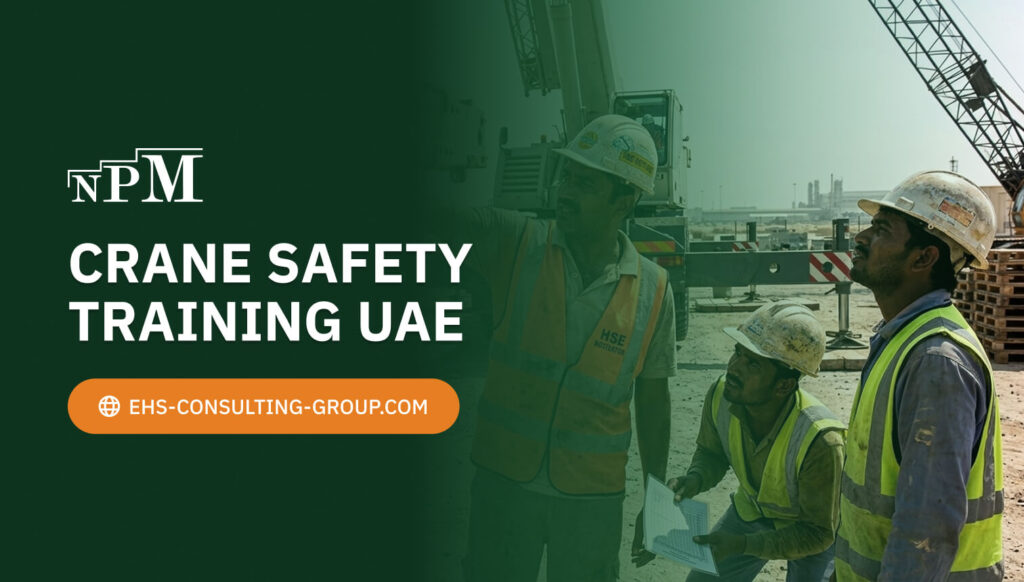
Crane Safety Responsibilities span legal duties, engineering judgment, and frontline decision-making across construction sites, refineries, offshore platforms, manufacturing halls, logistics yards, and power plants in the UAE. Clear accountability for planning, authorising, operating, and supervising lifting activities prevents dropped loads, overturns, structural failures, and contact with overhead utilities. For HSE managers and operations leaders, understanding how responsibilities are apportioned under UAE requirements and global best practice is not a theoretical exercise; it is a daily control that keeps people safe, protects assets, and keeps projects on schedule.
Who Does This Affect?

Responsibility for safe lifting operations extends beyond the crane operator. It is a network of roles that must interact coherently through a management system. In the UAE industrial context, this includes:
- Duty holders and employers who own or control the workplace, including EPC contractors, plant owners, and principal contractors managing multi-contractor sites.
- Appointed Persons or Lifting Engineers who plan lifts, specify configurations, and verify technical feasibility and controls.
- Lifting Supervisors and Foremen who coordinate the crew, enforce exclusion zones, and make go/no-go decisions at the workface.
- Crane Operators who execute the lift within the limits of the crane, the approved plan, and site conditions, with stop-work authority.
- Riggers/Slingers and Banksmen/Signalers who prepare loads, select and inspect slings and hardware, and provide clear, agreed communications.
- Competent Persons and Third-Party Inspectors who perform thorough examinations and statutory certifications of cranes and lifting accessories.
- HSE teams, Permit-to-Work coordinators, and SIMOPS managers who align lifting with adjacent operations, hazardous energy isolation, and emergency plans.
- Logistics and Yard Managers who control laydown areas, traffic routes, ground conditions, and stacking plans for heavy modules.
- Project Managers and Construction Managers who define schedule-critical lifts, resource interfaces, and contingency arrangements.
These roles operate under the oversight of regulators and standards: OSHAD requirements in Abu Dhabi, Dubai Municipality codes, MOHRE obligations, Civil Defence expectations where public safety is involved, and industry-specific expectations like ADNOC’s lifting and hoisting Codes of Practice. Internationally recognized references such as ISO 9927 (crane inspections), ISO 4306 (terminology), EN 13000 (mobile cranes), ASME B30 series, API RP 2D for offshore cranes, BS 7121 for crane operations, and OSHA 29 CFR 1926.1400 family provide additional benchmarks that UAE organizations frequently align with in corporate procedures.
Why This Matters

When lifting responsibilities are ambiguous, a project inherits hidden risk. Common loss scenarios—dropped loads striking workers, crane tip-over due to underestimated ground bearing pressure, collision between tower cranes, or boom contact with power lines—often share a root cause: gaps or overlaps in responsibility. Clarity prevents assumptions. It ensures the right person makes the right decision at the right time with the right information.
Beyond preventing harm, clear responsibilities underpin compliance. UAE jurisdictions require competent planning, supervision, and inspection of lifting equipment and operations. Authorities may verify whether a lift plan exists, who approved it, whether the crane’s certificate is valid, and whether operator competence is documented and current. For oil and gas operators, alignment with ADNOC HSE requirements, Life Saving Rules, and contractor HSE governance is expected. For construction, tower crane zoning, anti-collision systems, and erection/dismantling supervision must be demonstrably controlled. Manufacturing and power plants must evidence periodic inspection of overhead cranes and lifting accessories under a robust system aligned with ISO 45001.
Finally, lifting is a high-impact productivity lever. Avoided rework, preserved schedule float, and efficient sequencing emerge when roles are defined, communications are disciplined, and technical controls are applied consistently. In other words, clarity in responsibility is a safety, compliance, and performance multiplier.
Key Points to Understand

1) Governance and the legal backbone
Responsibility starts in the management system. Organizations define roles within their HSE and operations manuals, integrate responsibilities into the Permit-to-Work (PTW) system, and codify requirements for lift planning, authorisation, and verification. In Abu Dhabi, OSHAD-SF Codes of Practice outline duties for lifting equipment, competence, and inspection; Dubai Municipality and MOHRE expectations similarly demand documented control. Many organizations map to BS 7121’s role model (Appointed Person, Crane Supervisor, Crane Operator, Slinger/Signaller) and align with ISO 9927 and ASME B30 for inspection regimes. Strong document control ensures superseded lift plans are withdrawn and only the approved revision is in use; some teams reference governance resources like CABINET NPM when considering how to structure policy and controlled documentation across multi-site operations.
2) Role delineation and accountability
Clarity is built on precise role statements, authority limits, and evidence of competence. The “Appointed Person” (or Lifting Engineer) is accountable for technical adequacy of the plan and confirming the crane configuration, load path, and controls. The Lifting Supervisor controls the workfront: crew briefings, exclusion zones, and adherence to the plan. The Operator retains authority to stop if conditions deviate or if instructions conflict with safe operation. Riggers/Signalers verify slinging arrangements and communicate using agreed hand signals or radio protocols. The Competent Person ensures thorough examinations occur at defined intervals and after exceptional circumstances, with defects tracked to closure. HSE and PTW leads ensure SIMOPS and energy isolation risks are controlled.
3) Lift categorisation and approval gates
Not all lifts carry the same risk. Organizations commonly define categories such as routine, non-routine, and critical lifts, with increasing engineering depth and approval levels. Criteria may include load weight as a percentage of crane capacity, proximity to live plant or public areas, complexity (multiple cranes, blind lifts), environmental conditions, and consequence of failure. Critical lifts typically require independent verification of calculations, management review, and a rehearsal or dry run.
4) Engineering fundamentals: capacity, configuration, and stability
Duty-of-care includes verifying crane charts for the specific configuration (boom length, radius, counterweight, jib), considering dynamic effects (wind, slewing, acceleration), and any derations from attachments or lifting on rubber. Ground bearing pressure and the adequacy of mats or steel plates must be calculated and verified; soft backfill, underground services, or underground voids require additional engineering checks. Out-of-level conditions reduce capacity and increase side loading; limits should be defined and measured. On offshore assets, dynamic amplification, vessel motion, and environmental loading require alignment with API RP 2D and operator standards.
5) Lifting accessories control
Slings, shackles, hooks, plate clamps, and spreader beams require unique identification, SWL/WLL markings, and inclusion in a registry. Accessories should undergo periodic thorough examination, with non-conforming items quarantined. Color-coding systems can simplify field control, but permanent IDs and traceable certificates remain mandatory for critical accessories like modular spreaders. Selection must consider angle factors, D/d ratios for wire ropes, and edge protection to prevent sling damage.
6) Pre-use checks, examinations, and maintenance
Pre-use inspections by operators and rigging teams complement periodic thorough examinations by a Competent Person. After exceptional events (shock loading, overload alarms, collision, major repair), an additional examination is prudent. Maintenance intervals and OEM requirements must be followed, with records maintained for auditability. ISO 9927 and ASME B30 provide practical guidance on inspection scope and frequency for different crane types, including mobile, tower, overhead traveling, and jib cranes.
7) Communication protocols and exclusion zones
Standardised hand signals and radio protocols reduce ambiguity. Channels are assigned, radios are tested, and backup signals agreed in case of interference. Exclusion zones are established using barriers and spotters, with “no go” areas beneath loads and swing paths. Tag lines control load orientation where feasible. If lifting over occupied areas cannot be avoided, additional controls must be risk assessed and authorised by senior management.
8) Environmental limits and SIMOPS
Wind limits (often based on OEM values and adjusted for sail area), visibility thresholds, lightning, and dust conditions must be codified. SIMOPS with hot work, vehicle traffic, or process operations require coordination. Overhead power lines mandate safe clearance distances and, where possible, isolation and earthing. In refineries and petrochemical plants, lifting near live units may require gas testing, temporary shielding, and alignment with process safety management practices (HAZID, Bowtie analysis) to confirm barriers are adequate.
9) Emergency response and stop-work authority
Responsibilities extend to incident preparedness: establishing emergency lowering or securing procedures, identifying rescue routes for personnel lifts (where authorized), and clarifying who initiates emergency communications. Everyone on the crew must have stop-work authority, with psychological safety reinforced so that operators and riggers can call a halt without fear of reprisal.
| Responsibility Area | Employer/Owner | Appointed Person | Lifting Supervisor | Crane Operator | Rigger/Signalman | Competent Person/Inspector | HSE/PTW |
|---|---|---|---|---|---|---|---|
| Define policy & roles | A | C | C | I | I | C | C |
| Lift plan & calculations | I | A/R | C | I | I | C | C |
| Workfront control | I | C | A/R | C | C | I | C |
| Operate crane safely | I | I | C | A/R | C | I | I |
| Slinging & signaling | I | C | C | I | A/R | I | I |
| Inspection & certification | C | I | I | I | I | A/R | C |
| SIMOPS & PTW alignment | C | C | C | I | I | I | A/R |
| Emergency response | C | C | A/R | C | C | I | C |
Key: A = Accountable, R = Responsible, C = Consulted, I = Informed.
How This Works in Practice

Translating principles into everyday control begins with planning. For a refinery exchanger change-out, the Appointed Person verifies the weight from as-built drawings plus contingency for fouling, checks the crane’s configuration for the furthest radius, calculates ground bearing pressures for the mat design, and identifies a load path that avoids live pipe racks. The Lifting Supervisor confirms the crew’s competence and preps the workfront, verifying barricades, radio checks, and a weather window. The Operator conducts pre-use checks, verifies anti-two-block and load moment indicators, and participates in the pre-lift briefing. The Rigger selects slings, verifies certificates and IDs, protects slings from edges, and fits tag lines.
On tower crane operations at a high-rise, responsibilities extend to zoning and anti-collision. Engineering determines cranes’ operating envelopes, prohibited zones, and peer-to-peer anti-collision settings. The Lifting Supervisor enforces hook time allocations and prevents overload from unplanned tandem lifts. Erection and dismantling demand additional controls: a specific method statement, OEM supervision or qualified erectors, and a clear chain of command during critical phases.
In offshore lifting, the deck supervisor coordinates with the crane operator to account for vessel heave; the lifting plan incorporates dynamic amplification factors and a sea-state limit. Maintenance teams ensure load indicators are calibrated under API RP 2D guidance. For container handling in logistics yards, responsibilities include traffic segregation, twistlock checks, and interlocks. In a power plant turbine hall, overhead traveling cranes require routine inspection of rails and end stops; the Lifting Supervisor must ensure no one works on the mezzanine beneath the load path. Manufacturing lines with frequent small lifts benefit from standard lift plans for repetitive tasks, backed by periodic HAZID reviews to capture incremental changes.
Across these contexts, documentation control remains essential. The crew must use the version of the plan that matches current site conditions. Deviations—change of crane, increased load weight, restricted laydown—trigger management of change. The Lifting Supervisor halts, the Appointed Person reassesses, and authorisations are reissued before resuming.
Benefits and Practical Use Cases

When responsibilities are explicit and embedded in routine practice, organizations realize tangible gains:
- Fewer incidents: Clear go/no-go criteria and stop-work authority reduce pressure-driven errors and near misses.
- Audit-ready compliance: Records of competence, inspections, and plan approvals align with OSHAD, Dubai Municipality, MOHRE, and ADNOC expectations.
- Improved schedule reliability: Standard lift plans for repetitive lifts and independent checks for critical lifts decrease late-stage surprises.
- Asset protection: Verified ground bearing pressures and correct accessory selection prevent mechanical damage.
- Better contractor coordination: Defined interfaces reduce conflict and confusion in multi-employer worksites.
- Barrier assurance: Bowtie mapping for lifting hazards clarifies prevention and mitigation measures, supporting QRA insights where relevant.
Practical use cases include:
- Creating a critical lift review board that convenes engineering, operations, and HSE to validate the highest-risk lifts.
- Deploying a unified lifting equipment registry, with QR-coded certificates and auto-reminders for thorough examinations.
- Standardizing radio call protocols and emergency words across all contractors to ensure common situational awareness.
- Embedding routine “dry runs” for complex blind lifts to confirm clearances and communications before committing to the actual move.
- Implementing anti-collision zoning and interlocks for tower cranes, aligned to BS 7121 practices.
- Integrating lifting operations into SIMOPS dashboards so that hot work, confined space entries, and crane movements are sequenced rather than overlapped.
Best Practices and Points of Caution

To convert policy into dependable field results, consider the following practices:
- Define and communicate role boundaries in concise, accessible language; test understanding during toolbox talks.
- Use a lift categorisation matrix that triggers proportionate engineering and approval gates.
- Calculate outrigger and crawler track bearing pressures; select mats based on verified ground conditions, not assumptions.
- Treat last-minute changes as management-of-change events; stop, reassess, and re-authorise as needed.
- Set and enforce environmental limits based on OEM guidance and sail area; monitor wind speed at boom height where practicable.
- Control the area: barricade load paths, keep personnel clear, and use tag lines appropriately.
- Standardise hand signals, establish radio discipline, and confirm communications during pre-lift briefings.
- Keep a current registry of cranes and accessories with unique IDs, SWL/WLL, inspection due dates, and certificates.
- Align lifting responsibilities with broader OHSMS (ISO 45001) and process safety controls where lifting interfaces with live plant.
- Rehearse emergency actions: who calls what, how to secure or lower a load, and how to evacuate the area.
Caution points frequently observed in the field include:
- Complacency on “repeat” lifts that bypass pre-lift checks.
- Multilingual crews without common signal protocols, leading to miscommunication.
- Underestimating the effect of out-of-level setup on crane capacity.
- Ignoring subsurface risks such as voids, culverts, or recently backfilled trenches.
- Relying on nameplate weights without adding contingency for contents, moisture, or tooling.
- Failing to adjust for wind sail area on large panels, scaffolds, or modular assemblies.
- Permitting lifts over occupied areas without senior-level authorisation and controls.
- Allowing unverified accessories into service due to missing or illegible markings.
Frequently Asked Questions About Crane Safety Responsibilities
Who is legally responsible for a lift on a UAE worksite?
Responsibility is shared, but not equally. The employer or duty holder must provide safe systems of work, competent personnel, and compliant equipment. The Appointed Person (or equivalent Lifting Engineer) is accountable for the technical adequacy of the plan, the Lifting Supervisor manages the workfront and crew, and the Operator is responsible for operating within limits and stopping when unsafe. Regulators expect that these duties are defined in writing and that competence and authorisations are demonstrable.
How often must cranes and lifting accessories be inspected?
Pre-use inspections should occur before each shift or lift as defined by the organization. Thorough examinations by a Competent Person occur at defined intervals depending on equipment type, duty, and jurisdictional requirements. Many organizations align with ISO 9927 and ASME B30 guidance: typically, cranes at least annually (or more frequently based on duty), and lifting accessories at set intervals with additional checks after exceptional events. Always verify local regulatory requirements and your asset owner’s standards.
What defines a critical lift?
Criteria vary, but common triggers include: high percentage of crane capacity, tandem or multiple-crane lifts, lifting over live plant or occupied buildings, blind or complex lifts, unusual or unknown load stability, or major consequence if a load is dropped. Critical lifts demand deeper engineering review, independent verification, elevated approval, and often a rehearsal.
What must be included in a lift plan?
A robust plan typically includes: scope and categorisation, roles and responsibilities, crane configuration and capacity charts, load details and COG assumptions, slinging and rigging method, ground bearing calculations and matting, exclusion zones and communications, environmental limits, interface with PTW/SIMOPS, step-by-step method, contingency actions, and approvals. Drawings or sketches showing load path, obstructions, and set-up areas are essential.
How are wind limits established for lifting?
Start with OEM limits for the crane and attachments, then adjust for sail area and lift complexity. For tower cranes, specific in-service and out-of-service wind thresholds apply; for mobile cranes with large panels, limits may be significantly lower than general OEM values. Plans should define monitoring methods (e.g., anemometers at boom height) and decision authority for stopping work as conditions change.
Can the crane operator overrule the lifting supervisor?
Stop-work authority applies to all. While the Lifting Supervisor controls the workfront, the Operator must refuse to proceed if any instruction conflicts with safe operation, the lift plan, or their judgment. This is not a power struggle; it is a safety principle. The team then reassesses the situation, and the Appointed Person updates the plan or clarifies controls.
How should ground bearing pressure be verified?
An engineering calculation compares expected outrigger or track loads to ground bearing capacity, factoring in mats or steel plates. Site investigation data, previous records, or geotechnical assessments inform allowable pressures. Recently backfilled or saturated ground, underground services, and edge effects near pits or trenches require conservative assumptions and, when in doubt, enhanced matting and verification.
What about lifting near live process units?
Additional controls align with process safety frameworks. Coordinate with operations through PTW, conduct a HAZID, consider Bowtie barriers (e.g., exclusion zones, shielding, gas testing), and establish recovery measures if the load must be lowered rapidly. Senior management should authorise any lift over critical equipment or occupied areas, with contingency plans and emergency routes defined.
Putting It All Together
Crane lifting is not just a mechanical act; it is a coordinated risk control that depends on people carrying out well-defined duties under a clear management system. Earlier, we mapped out who is involved—from employers to riggers—and why clarity matters for safety, compliance, and productivity. We examined the technical backbone of responsible lifting—capacity, stability, ground bearing pressure, and accessory control—and translated it into daily practice through planning, briefings, communications, and stop-work authority. With a proportionate lift categorisation model, disciplined documentation, and SIMOPS alignment, teams create a stable environment in which good decisions are routine rather than heroic.
To go further on this topic, NPM’s broader Crane Safety Training UAE page covers this in more depth.
Our References
NPM’s portfolio reflects decades of applied lifting and hoisting expertise integrated within broader HSE and operational excellence programs. Our teams have worked worldwide with operators, EPCs, and contractors in oil and gas (onshore and offshore), petrochemicals, construction (including high-rise and infrastructure), manufacturing, logistics and ports, and power generation. Across these settings, we have helped organizations embed role clarity for lifting operations, rationalize lift categorisation matrices, develop and verify critical lift plans, standardize radio and hand-signal protocols across multilingual crews, and integrate lifting with SIMOPS and Permit-to-Work processes. Our experience includes aligning corporate lifting standards with benchmarks such as ISO 9927, BS 7121, EN 13000, ASME B30, and API RP 2D, while ensuring conformance with UAE regulatory expectations like OSHAD, Dubai Municipality, MOHRE, and applicable industry operator requirements.
Beyond the technical details, our references illustrate how responsibility clarity accelerates execution. Whether it’s improving ground bearing verification on sprawling construction sites, setting up robust inspection regimes for overhead cranes in brownfield plants, or establishing critical lift review boards for complex refinery turnarounds, the common thread is practical governance that crews can follow under real-world pressures. These engagements highlight quantifiable improvements—fewer near misses, reduced rework, tighter schedule adherence, and cleaner audits—alongside a stronger safety culture. If you are exploring how to elevate your lifting governance, we invite you to review projects that mirror your context and challenges so you can see how structured responsibilities translate into safer, more reliable operations.
For more information about our references, visit Our References.
Speak with NPM
If you have questions about role definitions, lift categorisation, or how to align lifting with PTW and SIMOPS at your facility, our team is available to discuss practical approaches. We are glad to share perspectives on what works in complex, multi-contractor environments and how to build competence and accountability that last. For any further questions or to speak with our team, Contact Us.