
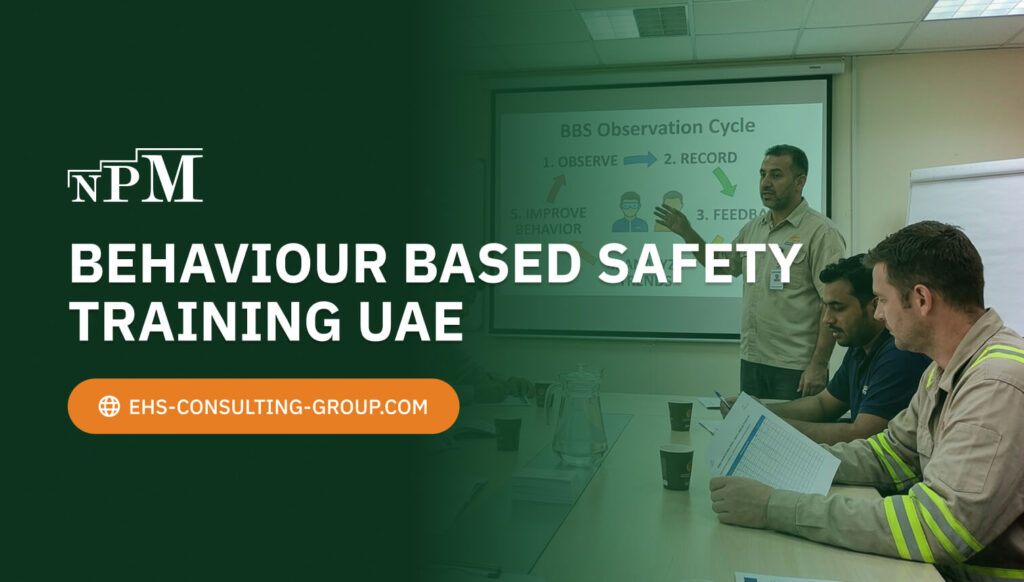
“What Is Behaviour Based Safety?” is a question that often surfaces in boardrooms and toolboxes across high-risk operations in the UAE. At its core, behaviour-based safety (BBS) is an approach that focuses on observable actions at the front line, the conditions that influence those actions, and the feedback and reinforcement loops that make safe practices more likely next time. It is not a replacement for engineering and procedural controls; instead, it complements established risk management practices—HAZOP, LOPA, Bowtie analysis, permit-to-work, isolation standards, and emergency response—by strengthening the human performance layer that ultimately makes those controls effective. For HSE leaders navigating ISO 45001 requirements, ADNOC HSE expectations, OSHAD SF obligations, Dubai Municipality codes, and Civil Defence approvals, understanding how BBS fits into an integrated safety management system is a practical necessity, not a nice-to-have.
Who Does This Affect?

Because BBS touches the everyday decisions people make on the plant floor, the construction site, the quayside, or the power station, it concerns a wide range of stakeholders—well beyond the HSE department. In high-risk sectors, the people who shape and act within the “moment of risk” must share a common view of what safe looks like, and how to reinforce it consistently.
- HSE managers and compliance officers responsible for ISO 45001 alignment, regulatory inspections, and internal audits.
- Plant managers, operations superintendents, and offshore installation managers accountable for production targets and safe throughput.
- Front-line supervisors, permit issuers, and control room operators who influence task planning, toolbox talks, and permit-to-work quality.
- Maintenance, turnaround, and shutdown planners whose sequencing and resource decisions shape human factors and error traps.
- Construction project directors, site engineers, and safety officers managing dynamic risks on towers, tunnels, and heavy-civil works.
- Logistics managers overseeing warehouse operations, forklift traffic, marine berths, and road transport interfaces.
- Power generation teams coordinating turbine outages, LOTO, confined space entries, and live-line work.
- Contractors and subcontractors who often perform high-risk tasks and must align to client life-saving rules and critical controls.
BBS also concerns HR and learning functions that steward competency frameworks, along with procurement teams who embed safety expectations into contractor prequalification and performance clauses. When these stakeholders align on the “why” and “how” of behaviour-focused observations, coaching, and reinforcement, BBS evolves from an HSE initiative into an organizational capability.
Why Does This Question Matter?

Most industrial incidents involve a combination of control weaknesses and human decisions in context. The Bowtie model illustrates this clearly: preventive and mitigative barriers can be bypassed by normal variability, production pressures, or a single poor decision at the task interface. While engineering, design, and procedural rigor remain the first lines of defense per the hierarchy of controls, the reliability of those barriers often depends on human performance—how permits are written, how isolations are verified, how lifting plans are executed, and how deviations are escalated.
Understanding BBS matters because it gives leaders a structured way to influence the conditions that shape front-line choices. In the UAE, regulatory and client expectations reinforce this need. OSHAD SF emphasizes leadership, worker participation, and control of operational risks. Dubai Municipality and Civil Defence approvals hinge on both hardware compliance and how people enact procedures on site. ADNOC HSE frameworks expect visible leadership, effective critical controls, and robust leading indicators. BBS, done well, supplies a disciplined mechanism to observe, learn, and reinforce safe habits as leading indicators of control health.
There is also a strategic reason: integrating BBS with process safety improves the fidelity of leading indicators. For example, rather than only counting safe/at-risk behaviors generically, organizations can focus observations on life-saving rules, high-energy hazards, and critical control verifications tied to HAZOP/LOPA outcomes and IEC 61511 safety instrumented function assumptions. This alignment elevates BBS from a “nice” culture program to a direct contributor to major accident prevention.
Key Points to Understand

Before considering rollout mechanics, it helps to anchor key concepts that distinguish effective BBS from superficial “card-filling” exercises.
The ABC Model and Reinforcement
Many successful programs use the ABC model: Antecedent (what sets up behavior), Behavior (what a person does), and Consequence (what happens immediately after). In practice, this means:
- Clarifying the desired behavior in specific, observable terms—e.g., “Use a spotter when reversing a forklift” rather than “be careful.”
- Arranging antecedents—clear procedures, visual cues, pre-job briefs—to make the safe action the easy action.
- Providing timely, credible consequences, especially positive reinforcement and coaching, so safe choices are more likely to be repeated.
Reinforcement quality is central; praise or thank-yous that are specific, immediate, and authentic will shape culture more effectively than generic slogans or delayed recognition.
Observation and Feedback Loops
A BBS observation is a structured conversation around a real task, with the intent to learn and coach. The observer focuses on what’s going well as much as what could be improved, notes the conditions shaping choices, and closes with mutual commitments. Aggregated, anonymized themes feed into weekly and monthly reviews that inform actions—perhaps redesigning a tool, adjusting a sequence, or clarifying a procedure. This loop—observe, analyze, act, and communicate back—turns data into improvement and builds trust.
Just Culture, Not Blame
Trust underpins BBS. If workers fear punitive consequences for raising concerns or admitting confusion, observations will be superficial and data will be distorted. A just culture differentiates between human error, at-risk choices, and reckless violations, pairing accountability with fairness. It welcomes “good catches” and near-miss reports, using them to strengthen controls rather than to assign blame.
Data That Matters
Counting observation cards is not the point. High-value BBS data is specific, tied to risk, and actionable. Link observation categories to your risk register, life-saving rules, and critical controls. Use simple, consistent definitions so that “line of fire” or “energy isolation” means the same thing to every observer. Track both participation (who is observing, where, and how often) and quality (richness of notes, closure of actions, recurrence of themes). Align with process safety indicators—consider API RP 754 thinking—so that behaviour insights help validate barrier health.
Integration with Established Methods
BBS is most effective when it complements, not duplicates, existing systems. Tie observation focus to HAZOP deviations, LOPA assumptions, Bowtie threats, confined space and lifting critical controls, and permit-to-work checks. Align terminology with ISO 45001 so leadership, participation, and operational control clauses are visibly enacted. Where safety instrumented systems per IEC 61511 manage high-consequence scenarios, BBS can help verify human interfaces remain robust—alarm response discipline, bypass management, and shift handover quality.
| Behavior Category | Typical Safe Behaviors | At-Risk Examples | Applicable Sectors |
|---|---|---|---|
| Energy Isolation (LOTO) | Verify zero energy; apply personal locks; test before touch | Group lock only; missing try-test; temporary bypasses | Power generation, manufacturing, petrochemical |
| Line of Fire | Use exclusion zones; spotters during lifting; body positioning | Standing under suspended loads; reaching into pinch points | Construction, offshore, logistics |
| Working at Height | 100% tie-off; inspected anchor points; edge protection | Improvised anchors; uninspected lanyards; removed guardrails | Construction, maintenance, storage terminals |
| Permit-to-Work Quality | Joint site visit; gas testing; clear isolations; SIMOPS coordination | Desk-issued permits; missing signatures; conflicting tasks | Refineries, onshore gas plants, power stations |
| Manual Handling | Use of aids; team lifts; planned path; body mechanics | Twisting with load; solo carry of heavy items | Warehousing, construction, fabrication |
Clear definitions and risk-based categories like these help ensure that observation time is invested where it matters most, rather than spread thinly across low-consequence conditions.
Maintaining rigor also relies on simple, shared documentation. Many organizations standardize their BBS forms, guidance, and review templates through internal document control. As a practical note, a centralized repository such as CABINET NPM can support version control and accessibility of program charters, observation checklists, and coaching guides, helping teams keep one source of truth as procedures evolve.
How Does This Work in Practice?

Applying these principles operationally requires adapting to site realities. Consider an onshore gas plant preparing for a maintenance shutdown. The team identifies critical tasks—scaffolding, vessel entry, isolation, and lifting—and defines specific, observable behaviors linked to each. Supervisors and selected craftspeople receive short, practical sessions on conducting respectful observations and giving clear, positive feedback. During the shutdown, observers target high-energy tasks, document both strengths and improvement areas, and log themes daily. A short, end-of-shift huddle reviews the top three insights and closes the loop by adjusting plans for the next day.
On a high-rise construction site, BBS might focus on edge protection, tie-off, housekeeping on floors, loading platform controls, and crane-lift communication. Dynamic conditions mean observation emphasis shifts as the structure grows; early phases may prioritize excavation and piling interfaces, later phases focus on façade works and interior fit-out hazards. Because workforces are often multilingual, visual cues and brief, scenario-based coaching work better than policy quotations. Incorporating the midday break for heat stress compliance, adjusting shift schedules during Ramadan, and coordinating with Civil Defence requirements are practical considerations that influence how and when observations occur.
In logistics, a warehouse might target forklift-pedestrian interface, battery charging areas, racking integrity, and manual handling. Observers concentrate on specific patterns—pedestrian crosswalk use, horn-at-intersection behavior, spotter utilization for reverse maneuvers—and supervisors reinforce positive examples in toolbox talks. Meanwhile, data themes drive simple engineering fixes: convex mirrors at blind corners, floor tape refresh, or changed pallet stacking rules. The blend of behavior feedback and small design improvements compounds quickly.
Power generation facilities often emphasize LOTO discipline, turbine access control, chemical handling, and live electrical work. Observation feedback helps validate that isolation points are clearly labeled, test-before-touch is culturally ingrained, and that work packs include task-specific energy diagrams. When trending shows recurring confusion around a particular manifold isolation, the plant updates the drawing, tags valves more clearly, and refreshes the pre-job brief—all prompted by BBS insights.
Benefits and Practical Use Cases

When embedded into normal supervision and reinforced by leadership, BBS delivers tangible outcomes. The value is clearest when observations target high-hazard tasks and the organization consistently closes the loop on insights.
- Better leading indicators: Observation themes tied to critical controls provide real-time signals of barrier health, complementing process safety metrics and incident rates.
- Reduction in recurring deviations: Specific coaching and design tweaks address the causes behind repeated at-risk behaviors.
- Improved permit quality: Joint site visits and focused checks raise the quality of permits and reduce conflicting SIMOPS.
- Stronger contractor alignment: Shared, practical definitions of “safe” enable consistent expectations across multi-employer worksites.
- Visible leadership credibility: Leaders who observe respectfully, reinforce positively, and act on feedback build trust and reporting culture.
Concrete use cases underline these benefits:
During a refinery turnaround, a rise in “line of fire” at-risk notes around flange breaks triggers a quick countermeasure: standardized barricades, updated lift plans for exchanger bundles, and refreshed coaching on body positioning. The next week’s observations show a sharp increase in safe body placement and a drop in minor pinch injuries. Offshore, a campaign to address dropped-object risks couples BBS observations with hardware audits; coaching on tool tethering, plus redesigned staging on laydown areas, reduces near misses drastically during crane operations.
In a manufacturing plant, BBS data reveals that miscommunication at shift handover correlates with errors in startup sequences. A small tweak—five-minute standardized verbal handover with a checklist—cuts startup deviations. In a power station, consistent coaching on “test-before-touch” during LOTO, paired with visual verifications, measurably increases compliance and reduces energization scares. Across these examples, the common thread is practical, front-line engagement that converts learning into targeted system and behavior improvements.
Best Practices and Points of Caution

Experience shows that the details of execution matter. The following points help leaders avoid common BBS pitfalls and keep the program anchored in risk and respect.
- Make it risk-based: Prioritize behaviors tied to high-consequence hazards and life-saving rules. If observation time is precious, spend it where the energy is highest—confined spaces, lifts, heights, energy isolation, process upsets.
- Coach more than you count: Avoid reducing BBS to quotas. A smaller number of high-quality, respectful observations beats high-volume, low-value card ticking.
- Keep definitions sharp: Standardize behavior categories and examples. Use photos and scenarios in briefings so everyone shares the same mental model.
- Close the loop: Communicate the top insights weekly and show the actions taken. When workers see feedback leading to change, participation rises.
- Protect trust and privacy: Use anonymized, aggregated themes for reporting. Separate just-culture coaching from disciplinary processes for willful violations.
- Integrate with systems: Link observations to your risk register, HAZOP/LOPA assumptions, and ISO 45001 processes. Keep BBS visible in management reviews.
- Invest in observers: Equip supervisors and craft champions with simple coaching techniques—specific praise, open questions, and clear, non-judgmental language.
- Design for multilingual teams: Use visuals, demonstrations, and simple phrasing. Validate understanding by asking workers to “show and tell,” not just nod.
There are cautions to note. A punitive tone will suppress genuine learning. Setting observation quotas without leadership support leads to rushed, superficial interactions and data that does not drive change. Ignoring trends—or failing to resource corrective actions—will erode credibility. Finally, don’t let behavior data mask system issues; when patterns point to design or procedural shortcomings, invest in engineering or process fixes rather than coaching the symptom repeatedly.
Governance supports sustainability. Establish a simple charter that clarifies scope, roles, review cadence, and data handling. Keep documentation current and accessible, ensuring observers use the latest guidance and forms. A controlled repository, whether on a corporate intranet or a dedicated platform like CABINET NPM, helps maintain version control and makes it easy for rotating crews and contractors to stay aligned with the current standard. Just as importantly, build BBS review into existing leadership routines—monthly management reviews, contractor forums, and toolbox talks—so it is not an add-on but part of how work is led.
Frequently Asked Questions About Behaviour-Based Safety
Is behaviour-based safety a substitute for engineering and procedural controls?
No. BBS complements, but does not replace, the hierarchy of controls. Engineering design, isolation, interlocks, and procedures remain primary. BBS strengthens how people apply those controls, spot weak signals, and sustain good habits during real work. It is most valuable when focused on high-energy hazards and critical controls.
How does BBS align with ISO 45001?
BBS provides practical mechanisms for ISO 45001 clauses on leadership and worker participation, operational control, and performance evaluation. Observation and coaching embody participation and competence, while trend reviews and action tracking feed management review. When linked to the organization’s risk register, BBS becomes a living part of the management system rather than a standalone initiative.
What observation frequency is effective?
Quality beats quantity. Set a rhythm that supervisors can sustain—often a few focused observations per week per leader—prioritizing high-risk tasks and new or complex work. Monitor participation to ensure coverage across shifts and contractors, but avoid rigid quotas that can drive superficial interactions and poor data quality.
How should BBS address a multilingual, multicultural workforce?
Use visuals, demonstrations, and scenario walk-throughs, keeping language simple and concrete. Confirm understanding by asking workers to demonstrate or explain the safe step in their own words. Rotate peer observers from different nationalities to improve trust and ensure that cues and examples resonate across cultures.
What metrics should we track to evaluate BBS effectiveness?
Track participation and coverage (who is observing, where, how often), quality indicators (specificity of notes, closure of actions), and risk alignment (proportion of observations on high-consequence categories). Over time, correlate BBS trends with permit quality, near-miss rates, and process safety indicators linked to critical controls. The goal is not a high count, but meaningful, actionable insights that precede improvements in outcomes.
How do we maintain a just culture while addressing repeated at-risk behaviors?
Separate coaching from discipline. For repeated at-risk choices, examine system contributors first—tools, time pressure, procedures, or layout. If willful violations occur, apply fair accountability mechanisms. Communicate the distinction clearly so workers trust that BBS is for learning and improvement, not surveillance and punishment.
Can BBS help with major accident hazard management?
Yes, when BBS is risk-informed. Focus observations on behaviors that verify critical controls—gas testing quality, SIMOPS coordination, isolation integrity, lift planning, and alarm response. Align categories and checklists with HAZOP, LOPA, and Bowtie outputs so frontline insights validate the assumptions behind barrier performance.
How should contractors be integrated into BBS?
Include them from the outset with shared definitions, aligned life-saving rules, and joint observations during high-risk tasks. Provide simple, common tools and feedback loops that work across employers. Recognize good practices publicly to reinforce one culture across all parties on site.
Conclusion: From Individual Actions to System Reliability
Returning to the question we began with, the essence lies in understanding that behaviour-based safety is a structured way to shape the conditions and reinforcement that make safe actions the default. The ABC model, observation and coaching loops, just culture principles, and risk-based focus turn everyday work into a continuous learning system. When linked to established methods—HAZOP, LOPA, Bowtie, permit-to-work, and ISO 45001—BBS becomes an amplifier for barrier reliability rather than an add-on. The examples across refineries, high-rise projects, logistics hubs, and power plants show that the real power of BBS is practical: precise coaching, small design changes, and closed-loop learning that steadily displace recurring deviations.
For HSE and operations leaders in the UAE context, aligning with OSHAD, Dubai Municipality, Civil Defence, MOHRE requirements, and ADNOC HSE expectations, this approach provides credible leading indicators and visible leadership engagement—both crucial to sustaining performance. Ultimately, the question is not whether BBS is “nice”; it is whether your organization is reliably converting front-line insights into strengthened controls and safer outcomes. If the answer is anything less than confident, the path forward is to simplify, focus on risk, and reinforce respectfully.
To go further on this topic, NPM’s broader Behaviour Based Safety Training UAE page covers this in more depth.
Explore NPM’s References
NPM’s references showcase how these principles translate into measurable improvements across complex industrial environments worldwide. Our portfolio spans upstream and downstream oil and gas facilities, petrochemical complexes, high-rise and infrastructure construction, discrete and process manufacturing, large logistics terminals, and conventional and renewable power generation. In these settings, the blend of risk-based behaviour focus, strong coaching practice, and integration with established risk studies has delivered credible leading indicators and practical, closed-loop improvements. Readers exploring our references will find examples of observation programs aligned to life-saving rules and critical controls; leadership routines that keep BBS visible in management reviews; and targeted system changes—simplified permits, clearer isolation diagrams, more robust lifting plans—that emerged directly from front-line insights.
What distinguishes these references is not only the variety of contexts but the consistency of principles: clear definitions of safe work, respectful engagement, and follow-through on trends. You will see how multilingual workforces were engaged through visuals and demonstrations; how contractor ecosystems aligned around common expectations; and how observation themes corroborated process safety assumptions made in HAZOP and LOPA. Our track record underscores a simple truth: when BBS is woven into the fabric of operations—rather than run as a standalone initiative—organizations build both culture and reliability. We invite you to review these examples to inform your own journey, whether you are seeking to strengthen permit-to-work quality, reduce dropped objects offshore, improve forklift-pedestrian control in warehouses, or sustain LOTO discipline in power facilities. The breadth of cases reflects the adaptability of behaviour-based methods when grounded in real risk and supported by consistent leadership practice.
For more information about our references, visit Our References.
Speak with NPM
If you have questions about how behaviour-focused methods could align with your existing controls, risk studies, and operational routines, we are glad to discuss practical next steps. Whether your priority is a shutdown, a construction ramp-up, or improving day-to-day supervision, a short conversation can clarify where to focus. For any further questions or to speak with our team, Contact Us.