
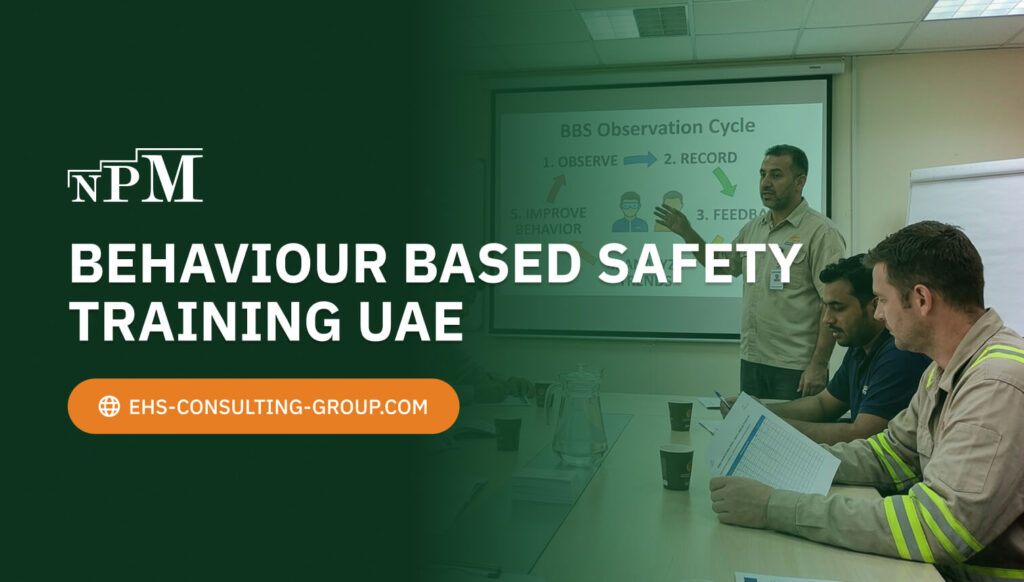
Behaviour Based Safety Program for Construction Project is often perceived as a checklist activity, yet when understood and applied correctly it becomes a rigorous, data-led way to reduce serious incidents on complex UAE job sites. In construction environments—whether high-rise towers in Dubai, oil and gas brownfield works in Ruwais, or infrastructure corridors in Abu Dhabi—behavioural choices at the point of work can either reinforce barriers or erode them. This article unpacks how a behaviour-based approach fits into the realities of construction delivery, interfaces with standards like ISO 45001 and ADNOC’s Life-Saving Rules, and supports the practical management of high-risk activities such as lifting operations, work at height, hot work, excavations, and temporary works.
Rather than a slogan or standalone campaign, a behaviour-focused program treats observable, repeatable actions as leading indicators. It positions supervisors, foremen, and craft workers as co-authors of safer performance by making the “what good looks like” visible, coachable, and measurable. When combined with strong engineering controls, good planning (JSA/TRA and method statements), and effective management systems (PTW, LOTO, MOC), the behaviour-based lens helps identify weak signals before they become injuries or schedule-disrupting events.
What follows is a practical exploration built for HSE and construction leaders who want to move beyond posters and temporary slogans toward a sustainable mechanism that embeds safer practices across contractors, subcontractors, and transient work fronts.
Who Does This Affect?

Because construction is multi-employer and fast-moving, a behaviour-focused approach touches nearly every stakeholder on site. Specific roles and groups include:
- Project Directors, Construction Managers, and Package Leads coordinating multiple work fronts and subcontractors.
- HSE Managers, Area HSE Engineers, and Safety Officers responsible for assurance, coaching, and analytics tied to ISO 45001 worker participation requirements.
- Discipline Supervisors and Foremen (civil, structural, MEP, scaffolding, rigging) who translate plans into daily work instructions and standards of practice.
- Crane Coordinators, Appointed Persons, and Riggers executing lifting plans in accordance with ADNOC and local authority requirements.
- Temporary Works Coordinators, Permit Officers, and PTW Authorities ensuring task controls are understood and observed.
- Subcontractor HSE focal points, QA/QC representatives, and Interface Managers tasked with alignment across multiple employers.
- HR, Training, and Induction teams managing onboarding for multilingual workforces (Arabic, English, Hindi/Urdu, Malayalam, Tagalog).
- Client HSE representatives (including those aligned to OSHAD, Dubai Municipality, or Trakhees guidelines) seeking stronger leading indicators on contractor oversight.
This broad footprint is intentional. Behaviour-based approaches are most effective when the observation, coaching, and learning cycle becomes routine across all levels—from boardroom walkdowns to toolbox talks beside the rebar bender.
Why This Matters

Construction hazards change by the hour. Temporary works evolve, interfaces multiply, and the same task can present different risks depending on sequencing, weather, or equipment availability. Traditional lagging indicators (TRIR, LTIFR) are important but retrospective; a serious near miss at a hoist landing platform or a dropped object from the sixth floor cannot be fully understood by metrics alone. Behaviour-focused programs add a proactive dimension by making critical actions at the point of risk observable and coachable.
In the UAE, this aligns with regulatory expectations and industry practices:
- OSHAD and the Abu Dhabi EHS Center emphasize risk-based controls and worker participation—key elements advanced by behaviour-led observation and feedback.
- Dubai Municipality and Trakhees safety codes call for effective supervision, competency, and adherence to method statements; behaviour observations verify these in real time.
- MOHRE requirements around welfare, heat stress, and midday breaks rely on consistent frontline behaviours to be effective.
- ADNOC Life-Saving Rules (e.g., energy isolation, working at height, lifting operations) benefit from targeted behavioural checks that confirm the rule is lived, not just known.
Beyond compliance, the practical objective is operational reliability: fewer unplanned stoppages, more consistent work quality, and fewer schedule or cost shocks from SIF (Serious Injury and Fatality) exposures. The moral objective is simple—every worker goes home safe.
Key Points to Understand

Having set the context, it helps to break down the core components of a behaviour-focused approach for construction. The following points move from principle to practice.
1) Focus on Critical Behaviours, Not All Behaviours
Not every action deserves the same attention. Identify a short list (10–15) of critical behaviours tied to your highest energy exposures: line-of-fire during lifting, edge protection and anchor use when working at height, isolation verification before hot work, trench access/egress, and housekeeping around formwork. These become the “observation targets.”
2) Use the ABC Model to Make Change Stick
The Antecedent–Behavior–Consequence (ABC) model helps teams see why actions occur. Antecedents include method statements, toolbox briefings, and signage; behaviours are what people do; consequences (positive or negative) shape repetition. In practice, supervisors increase positive reinforcement (specific, on-the-spot recognition for safe actions) and minimize delayed or vague feedback.
3) Structured Observations and Coaching
Observers—often supervisors or trained craft champions—conduct short, respectful observations using a simple checklist aligned to the critical behaviours. They provide immediate coaching, capture anonymized data, and avoid blame. Rotating observation routes across high-risk work fronts reduces blind spots.
4) Integrate with PTW, JSA/TRA, and Method Statements
A behaviour-focused approach is not a separate program. Observation targets should reflect the controls embedded in PTW requirements, the Job Safety Analysis/Task Risk Assessment, and the approved method statement. That way, the behaviour check becomes a live verification of the intended barrier.
5) Respect Cultural and Language Realities
Construction teams in the UAE are multilingual and multicultural. Observer training should emphasize clear language, pictograms, and respectful coaching. Reinforcement mechanisms (recognition, feedback) must be culturally sensitive and equitable across contractor tiers.
6) Build a Just Culture
To sustain engagement, workers must trust that observations are for learning, not punishment. Define what constitutes willful violation versus error or at-risk habit. Separate disciplinary pathways from the observation data stream so peers can coach peers without fear.
7) Turn Data into Decisions
Observation data should feed weekly reviews that prioritize targeted actions: re-brief a specific method statement, adjust a lifting plan, fix a recurring housekeeping bottleneck. Use visual dashboards to connect behaviour trends to near-miss patterns and quality rework. Over time, correlate with lagging metrics to validate impact.
8) Leadership Presence Matters
Construction leadership sets the tone. Short, frequent walkdowns where leaders practice the same observation and coaching skills signal that safe behaviour is the expected way of working. For additional governance and leadership insights relevant to safety culture and operating models, see CABINET NPM.
9) Align with Standards and Codes
Map critical behaviours to ISO 45001 clauses (particularly 5.1 leadership and 5.4 worker participation, plus 6.1 risk planning), to ADNOC Life-Saving Rules where relevant, and to local authority codes (Dubai Municipality, Trakhees, Civil Defence). This strengthens assurance and makes audits more meaningful.
10) Plan for Subcontractor Integration
Most construction risk passes through subcontractors. Require each subcontractor to nominate observation champions, align checklists to the common critical behaviours, and include observation performance in coordination meetings. Consistency across employers prevents gaps at interfaces.
Illustrative Observation Matrix
Below is a simple example that teams can adapt to their workfronts.
| Task/Area | Critical Behaviour | Example Safe Action | Example At-Risk Action | Leading Indicator to Track | Linked Control | Responsible Trade |
|---|---|---|---|---|---|---|
| Lifting Operations | Line-of-fire avoidance | Riggers outside swing radius with agreed hand signals | Walking under suspended load | % observations with clear exclusion zones | Lifting plan, ADNOC Life-Saving Rules | Rigging crew |
| Work at Height | Edge protection and anchor use | 100% tie-off to certified anchor points | Free climbing or anchoring to guardrails | % properly anchored before leaving safe area | W@H procedure, equipment inspection | Steel erectors |
| Hot Work | Isolation verification | LOTO tags and zero-energy check completed | Assuming isolation based on verbal confirmation | % isolations verified by performer | PTW, LOTO procedure | Welders/Fitters |
| Excavation | Access/egress and shoring | Ladder within 7 m, trench box installed | Jumping in/out; unsupported sides | % excavations with compliant access | Excavation permit, method statement | Civil crew |
| Housekeeping | Debris and line-of-fire | Walkways cleared; materials banded | Trip hazards; loose materials at height | % workfronts passing housekeeping standard | 5S/housekeeping standard | All trades |
How This Works in Practice

Once the critical behaviours and observation method are defined, daily rhythm is everything. The site leadership chooses time windows when high-risk tasks peak: early morning lifts, late morning rebar tying at edges, afternoon hot work after isolations are verified. Observers rotate routes to avoid predictability and to sample different subcontractor teams and levels of experience.
Before shifts, toolbox talks reinforce one or two observation targets tied to the day’s method statements. For instance, if a tower crane is servicing multiple decks, the talk and poster might spotlight exclusion zones and hand signals. During the shift, short observations (2–5 minutes) are recorded on a simple app or paper form. Feedback is immediate, specific, and respectful: “Your spotter position kept you out of the swing radius—great. Let’s also mark the no-go zone with cones at this pinch point.”
Weekly, the project team reviews aggregated data. Suppose observations in a tunneling workfront show frequent at-risk occurrences related to cable management and trip hazards near ventilation ducts. The team might re-route temporary cables, deploy cable trays, and re-brief supervisors. The following week, the observation checklist keeps the same target to verify improvement, then moves on when the signal is stable.
On petrochemical expansion projects or brownfield tie-ins, behaviour-focused checks help during complex isolations, flange management, or SIMOPS windows. Observers may verify glove compliance during cutting, breaker position before lock-off, or watchpoint behaviours when working close to live units. The point is not to police—the point is to coach the specific actions that keep barriers effective.
Integration with audits should be seamless. Formal inspections and system audits (e.g., against ISO 45001 or client HSE requirements) look at structure and documentation; observations examine practice. When an audit finds repeated PTW errors on confined space entries, behaviour data can reveal whether the issue is comprehension, supervision, or practical access to gas testing equipment.
Benefits and Practical Use Cases

While the ethical imperative of safety is clear, leaders need to understand how behaviour-focused approaches translate into operational gains. The most compelling benefits arise when data and coaching improve control effectiveness where it matters most.
- Fewer SIF exposures: Targeted behaviours (tie-off, exclusion zones, isolation checks) reduce the likelihood of high-consequence events such as falls, dropped objects, and uncontrolled energy releases.
- Improved productivity: Safer behaviours (clear access routes, staged materials, correct lifting techniques) often coincide with smoother workflows and reduced rework.
- Better permit quality: Observers who verify isolation and work-front readiness raise overall PTW discipline; lagging permit violations drop as leading behaviours improve.
- Subcontractor alignment: A shared, simple checklist cuts through policy differences, making expectations tangible across dozens of employers.
- Onboarding efficiency: New starters grasp “what good looks like” faster when supervisors use behaviour examples rather than abstract rules.
- Heat stress and welfare: Behaviour checks (hydration breaks, shade use, acclimatization) support MOHRE midday break rules and reduce heat-related illness during summer.
Typical use cases include mega high-rise projects with multiple tower cranes; shutdowns and turnarounds where compressed schedules amplify risk; road-and-rail corridors with live traffic interfaces; and port or logistics expansions where mobile equipment and pedestrian interactions dominate. On each, the behaviour lens translates broad rules into site-specific, high-value actions.
Best Practices and Points of Caution

Drawing on lessons learned across complex projects, the following practices help sustain a behaviour-centric approach and avoid common pitfalls.
- Start small, scale fast: Pilot with a few critical behaviours on a single workfront, validate the process, then expand. Early wins build credibility.
- Coach like a craftsperson: Feedback should be specific to the task and observable action—avoid generic praise or criticism.
- Protect anonymity: Record behaviours, not names. De-identify data to encourage honest participation and reporting.
- Calibrate observers: Periodically “double up” on observations to ensure consistency. Use practical scenarios to harmonize judgement.
- Link actions to system fixes: If the same at-risk behaviour repeats, look upstream—layout, access, or tooling might be at fault.
- Recognize publicly, correct privately: Celebrate safe behaviours in crew briefings; correct at-risk actions respectfully at the point of work.
- Avoid metric gaming: Focus on quality observations and actionable insights, not raw counts. Leaders should ask “What changed?” rather than “How many forms?”
- Integrate with visual management: Post weekly behaviour themes at access gates and canteens using simple graphics and multi-language captions.
- Formalize subcontractor roles: Make observation champions part of subcontractor kickoff and progress meetings; review their data with the same cadence as productivity.
- Connect to bowtie thinking: Map critical behaviours to bowtie barriers (prevention and mitigation). Use observation data to test barrier health.
Equally important are cautions. Over-surveillance backfires; the aim is respectful coaching, not policing. Incentives tied too tightly to observation numbers can distort behaviour; reward problem-solving and sustained improvement instead. And remember: a behaviour-based lens complements, but never replaces, engineering and administrative controls. Fix the guardrail before you fix the poster.
Frequently Asked Questions About Behaviour-Based Safety for Construction Projects
How is behaviour-based safety different from traditional inspections?
Inspections primarily verify conditions (guardrails, signage, housekeeping) and documentation (permits, certificates). Behaviour-based approaches look at what people do at the point of risk and use coaching to reinforce safe actions. The two are complementary: inspections confirm the environment is set up to be safe; behaviour observations confirm that people are using the controls as intended.
How many observations should we conduct per week on a large project?
Quality beats quantity, but as a starting point many teams aim for a representative sample across high-risk activities and shifts—often one short observation per supervisor per day. On mega projects, 100–200 quality observations per week can reveal meaningful trends when focused on a concise set of critical behaviours.
Who should be the observers—HSE staff or supervisors?
Supervisors and foremen are ideal because they influence day-to-day work. HSE teams coach the observers, help with calibration, and analyze data. Many projects also nominate craft champions whose peers respect them, which improves the credibility of feedback.
How do we manage observations in a multilingual workforce?
Keep checklists simple, use pictograms, and train observers to give feedback in clear, respectful language. Reinforce messages with visual aids at toolbox talks and work-front signage. Where possible, pair observers with crews sharing a common language, and avoid technical jargon that may not translate well.
Will a behaviour-based approach satisfy client and regulatory expectations?
While not a replacement for compliance, it aligns strongly with ISO 45001 on leadership and participation, supports OSHAD’s risk-based ethos, and offers evidence that ADNOC Life-Saving Rules are being lived. Document the linkage between observation themes and corrective actions to show auditors a clear learning loop.
How do we prevent a blame culture when unsafe behaviours are observed?
Establish a just culture framework from the outset. Separate learning-focused observations from disciplinary processes, protect anonymity in data, and make it clear that coaching aims to help people succeed. Reserve sanctions for willful or reckless violations and manage those outside the observation program.
Can behaviour-based safety be applied to short-duration shutdowns?
Yes. Focus on a few high-value behaviours tied to the most critical tasks, train observers in advance, and run daily huddles to share learning. The compressed timeline makes fast feedback essential; observation data can guide same-day adjustments to work sequencing or controls.
How soon will we see measurable impact?
Leading indicators (e.g., increases in specific safe behaviours, reductions in recurring at-risk actions) often improve within weeks. Tangible reductions in incidents and rework may take a few months as new habits embed and system fixes are implemented. Correlate behaviour trends with near-misses to validate early impact.
Is digital tooling necessary?
Paper-based systems work if kept simple and consistently reviewed. Digital tools can streamline data capture, visualization, and trend analysis, which is helpful on large projects. The critical factor is disciplined follow-through—turning observations into actions and learning loops.
How do we include subcontractors fairly?
Use one shared set of critical behaviours, require each subcontractor to nominate observation champions, and review their data together at coordination meetings. Recognize improvements publicly and ensure feedback is equitable regardless of employer tier.
Conclusion
Pulling the threads together, a behaviour-led approach gives construction teams a pragmatic way to influence what most determines safety outcomes: the actions taken by real people in dynamic conditions. It converts standards and plans into observable, coachable practices, builds a just culture that fosters learning, and produces leading indicators leaders can act on. For UAE construction stakeholders aligning with OSHAD, Dubai Municipality, MOHRE, Civil Defence, and ADNOC requirements, treating a Behaviour Based Safety Program for Construction Project as a living, integrated process—rather than a campaign—can materially reduce SIF exposure while improving productivity and quality.
To go further on this topic, NPM’s broader Behaviour Based Safety Training UAE page covers this in more depth.
Our References
NPM’s references reflect the practical application of behavioural safety across diverse, high-risk environments worldwide. Our teams have worked alongside project directors, HSE managers, and craft supervisors on mega high-rise builds, industrial EPC programs, petrochemical expansions, and complex shutdowns where the combination of tight timelines and evolving interfaces elevates risk. In these contexts, our approach has consistently emphasized the basics that matter most: identify a focused set of critical behaviours around your major energy sources; coach them consistently and respectfully; analyze the patterns; and fix system-level constraints that drive at-risk actions. Whether integrating observation programs with ISO 45001-certified management systems, mapping behaviours to bowtie barriers, or aligning with client rulesets like the ADNOC Life-Saving Rules, the emphasis stays on measurable, practical improvement rather than slogans.
Across regions and project types, NPM’s references show how multi-employer worksites can establish common expectations for safe practice, despite differences in language, culture, and contracting models. The results include fewer dropped-object events on high-rise facade works, stronger permit discipline on brownfield tie-ins, and faster onboarding of large subcontractor workforces through clear, behaviour-focused coaching. Our portfolio also illustrates how observation data informs strategic decisions—redirecting supervision effort, improving temporary works layouts, or simplifying access routes to minimize line-of-fire exposures. By sharing case narratives grounded in real-world constraints, NPM’s references offer decision-makers a credible view of what it takes to sustain culture change while maintaining productivity and quality on complex jobs.
For more information about our references, visit Our References.
Speak with NPM
If you are considering how a behaviour-focused approach could support your construction project’s risk profile, our team is available to discuss practical next steps. We are happy to explore how these concepts align with your standards, contractors, and workfront realities. For any further questions or to speak with our team, Contact Us.