
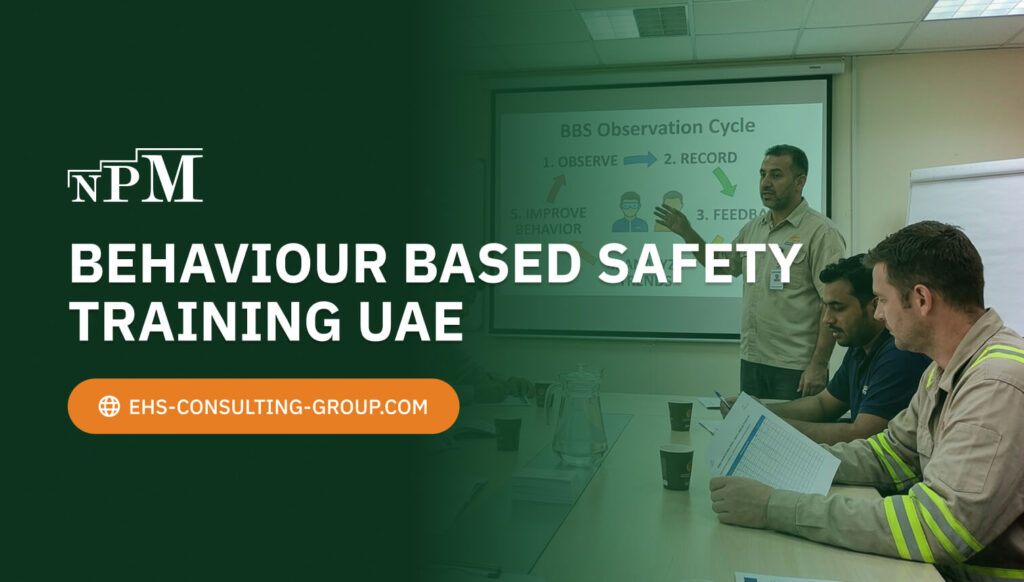
Behaviour Based Safety Training for Manufacturing delivered by NPM equips production, maintenance, and logistics teams with practical tools to observe, coach, and reinforce safe actions in real time on the shop floor. This industry-specific program is built for UAE factories and industrial estates where high-throughput operations, contractor interfaces, and shift work can cause risk normalization. This offering forms part of our broader Behaviour Based Safety Training UAE portfolio, ensuring consistency of approach across single-site and multi-site organizations while tailoring content to the realities of manufacturing processes.
Who Needs Behaviour Based Safety Training for Manufacturing?

Manufacturing plants across the UAE—ranging from discrete assembly lines to continuous-process operations—benefit directly from Behaviour Based Safety Training for Manufacturing because it focuses on the specific behavioral precursors to injuries around machinery, material handling, energy isolation, and line changeovers. Operations directors, HSE managers, production supervisors, maintenance planners, quality leaders, and contractor coordinators typically sponsor and attend this training alongside shop-floor operators, riggers, forklift drivers, electricians, fitters, and line leaders. In facilities such as metal fabrication, cement, glass, chemicals, food and beverage, pharmaceuticals, packaging, and automotive components, the high cadence of tasks makes it easy for unsafe shortcuts to become accepted norms. Behaviour Based Safety Training for Manufacturing helps organizations identify those at-risk routines through structured observation, peer-to-peer feedback, and positive reinforcement. It aligns with ISO 45001 management systems, integrates with existing near-miss and hazard reporting, and builds a common language of “critical behaviors” for machine guarding, LOTO, hot work, confined spaces, manual handling, forklift driving, and housekeeping/5S. For multi-lingual workforces common in UAE factories, NPM designs accessible checklists and coaching scripts to ensure comprehension across English, Arabic, Hindi, and Urdu. Whether you are onboarding new hires ahead of peak season, preparing for increased production, or stabilizing performance after a near-miss spike, Behaviour Based Safety Training for Manufacturing turns behavioral science into practical routines that fit shift patterns and takt-time realities.
Objectives of Our Behaviour Based Safety Training for Manufacturing

The primary objective of Behaviour Based Safety Training for Manufacturing is to hardwire safe habits at the point of operation by teaching participants how to recognize, measure, and reinforce critical behaviors that prevent injuries and downtime. Delegates learn the ABC model (Antecedents–Behavior–Consequences) and apply it to typical manufacturing tasks: clearing jams, line start-ups/shutdowns, tool changes, lifting and slinging, lockout/tagout, and warehouse traffic management. Behaviour Based Safety Training for Manufacturing enables supervisors and peer observers to conduct short, respectful observations using simple cards, turning findings into timely feedback and action. Participants also learn how to define observable, measurable behaviors; differentiate between conditions and behaviors; set behavior-based KPIs; and link BBS metrics to leading indicators within ISO 45001 dashboards. The program builds skills in coaching and feedback, bias reduction during observations, trend analysis of behavioral data, and the use of micro-interventions (e.g., pre-task briefs, point-of-work risk assessments) to prevent routine deviations. Because manufacturing must sustain throughput, Behaviour Based Safety Training for Manufacturing emphasizes low-disruption observation cycles (5–10 minutes), shift handover behaviors, contractor onboarding to house rules, and alignment with control of hazardous energy and machine safety standards. By the end, teams can run their own observation rounds, close out at-risk behaviors, and celebrate positive trends through visible leadership commitment.
Training Program and Manufacturing-Specific Modules

Our training program translates behavioral science into practical manufacturing routines without slowing production. We develop site-specific observation checklists for machine guarding, interlocks, LOTO, manual handling, forklift/pedestrian interactions, hot work, confined space entry, and chemical handling. In this section of the course, participants learn how to tailor observation scopes to different work areas (press shops vs. filling lines vs. packaging) and how to integrate BBS with existing hazard identification and permit-to-work processes. We also address human factors such as fatigue, risk normalization in repetitive tasks, shift-handover communication, and leadership behaviors during gemba walks. The curriculum is modular, allowing HSE teams to select foundational theory, supervisor-focused coaching labs, and on-the-floor practicum sessions. To make Behaviour Based Safety Training for Manufacturing stick, we incorporate blended learning (classroom, simulation, and live shop-floor observations), multilingual coaching tools, and simple analytics for behavior data trending. The result is a program your supervisors can sustain: short observation bursts, standard coaching scripts, clear positive reinforcement methods, and alignment with existing KPIs like OEE and downtime to demonstrate safety-productivity synergy.
Module A: Behavioral Foundations for Factory Teams
This module introduces the ABC model, defines observable behaviors vs. conditions, and shows how consequences shape habits during high-paced production. We contextualize Behaviour Based Safety Training for Manufacturing around common factory risks such as nip points, line start-up checks, forklift interactions, and repetitive strain, and we build a shared vocabulary for “critical behaviors” that prevent incidents.
Module B: Observation, Feedback, and Coaching
Participants practice short, respectful observations using scenario cards drawn from your equipment, SOPs, and work permits. We teach how to give constructive feedback in multilingual teams, how to reinforce safe actions positively, and how to neutralize defensiveness. This is where Behaviour Based Safety Training for Manufacturing becomes operational—delegates learn to fit observation cycles into shift rhythms without disrupting takt time.
Module C: Data, KPIs, and Continuous Improvement
Supervisors and HSE practitioners learn how to define behavioral KPIs, trend observation data, and connect leading indicators to lagging results. We show how to integrate observation findings into ISO 45001 dashboards and daily tier meetings so Behaviour Based Safety Training for Manufacturing stays visible, actionable, and linked to maintenance, quality, and operations KPIs.
Module D: Shop-Floor Practicum
With NPM facilitators, delegates run live observations in designated areas, capture data, and provide real feedback to peers. We debrief coaching outcomes and identify quick wins, removing barriers that get in the way of safe behaviors. This hands-on component ensures Behaviour Based Safety Training for Manufacturing translates to immediate, sustainable changes on the floor.
| Module | Typical Duration | Audience | Delivery Method |
|---|---|---|---|
| Module A: Behavioral Foundations | 2–3 hours | All staff | Classroom / Virtual |
| Module B: Observation & Coaching | 3–4 hours | Supervisors, HSE | Workshop with role play |
| Module C: Data & KPIs | 2 hours | HSE, Line Managers | Classroom / Virtual |
| Module D: Shop-Floor Practicum | 2–3 hours | Mixed teams | On-site walkthroughs |
Common shop-floor focus areas we embed into the observation checklists include:
- Machine guarding and interlocks around presses, cutters, and rotating equipment
- Control of hazardous energy (LOTO) during maintenance, cleaning, and changeovers
- Forklift and pedestrian segregation, battery charging, and loading dock behaviors
- Manual handling, ergonomics, and body positioning on repetitive tasks
- Hot work, confined space entry, and chemical handling protocols
Duration and Format of Behaviour Based Safety Training for Manufacturing

We design the duration and format of Behaviour Based Safety Training for Manufacturing to fit your plant’s operational tempo and shift structure. Typical delivery spans 1 to 2 days for core teams, with options for half-day segments or 2–3 hour modules to accommodate 12-hour shifts, peak production windows, and planned maintenance. For large sites, we often run multiple waves to reach all crews without impacting throughput, and we can deliver train-the-trainer pathways so your supervisors sustain observations post-training. Delivery modes include on-site classroom plus shop-floor practicums, fully virtual for theory components, and hybrid schedules for multi-site organizations. To support multilingual workforces, we provide bilingual materials and interpreters when needed. NPM calibrates group sizes based on learning objectives: 12–18 participants per cohort for strong interaction in coaching labs and safe practicums; larger groups are split to preserve hands-on quality. We collaborate on calendar planning (pre-shift starts, mid-shift touchpoints, and post-shift reflections) and align with permit-to-work availability for live observation practice. Whether you operate in KEZAD/ICAD, JAFZA, or Sharjah industrial zones, Behaviour Based Safety Training for Manufacturing is built to run safely, efficiently, and with minimal disruption to your production commitments.
- Option 1: 1-day core program (Modules A–B) + 0.5-day practicum
- Option 2: 2-day comprehensive program (Modules A–D) with coaching labs
- Option 3: Hybrid delivery (Virtual A–C over two mornings + on-site D)
Operational Benefits and Use Cases for UAE Manufacturers

By focusing on observable behaviors instead of only conditions, Behaviour Based Safety Training for Manufacturing drives measurable reductions in common factory incidents while boosting engagement and quality. Manufacturers that implement BBS correctly see fewer finger/hand injuries around nip points, safer LOTO during cleaning and changeovers, improved forklift driving behaviors at docks, and stronger 5S/housekeeping discipline that shortens changeover times and reduces tripping hazards. Because behavioral observation cycles are short and respectful, they integrate naturally into tier meetings, gemba walks, and daily management systems. UAE factories facing mixed contractor and employee workforces gain a standardized, multilingual approach to coaching that aligns to plant rules and permits. The program helps HSE managers convert near-miss narratives into behavior statements, trend and prioritize at-risk routines, and communicate wins to leadership—tying leading indicators to OEE, downtime, and rework metrics. Behaviour Based Safety Training for Manufacturing is also a pragmatic bridge between ISO 45001 objectives and line-level actions, ensuring safety is not seen as a bolt-on but as a way of working that removes variability and error traps at the source.
- Shorter time-to-competence for new hires and contractors via behavior checklists
- Fewer stoppages from unsafe shortcuts; more stable line performance
- Improved audit readiness for ISO 45001 and client audits with BBS evidence
- Higher supervisor confidence and consistency in coaching conversations
- Visible leadership through recognition of safe behaviors and positive trends
Why Partner with NPM for Manufacturing BBS Training

NPM brings deep experience across discrete and process manufacturing in the GCC, with facilitators who have run plants, led maintenance turnarounds, and implemented ISO 45001 systems. We build Behaviour Based Safety Training for Manufacturing to the realities of shift work, takt-time pressures, multilingual crews, and contractor-heavy environments. Our trainers use authentic scenarios from presses, kilns, filling lines, utilities, and warehouses—so delegates see their world reflected in the course. We integrate BBS with your existing HSE processes, from permit-to-work to near-miss reporting and tier meetings, and we leave you with simple, robust tools to sustain observations and trend data. As part of the wider group represented by CABINET NPM, NPM leverages global best practice while keeping delivery local, pragmatic, and culturally attuned. Our approach is evidence-led: we establish a baseline, co-create behavior targets, and help leadership communicate and reinforce positive change. With NPM, Behaviour Based Safety Training for Manufacturing becomes an operational enabler—reducing risk, protecting people, and unlocking reliable throughput.
Detailed Training Variants for Your Portfolio
Organizations with mixed operations often extend their program to adjacent environments. Explore the following related training variants to standardize expectations across projects and assets while keeping manufacturing at the core.
Behaviour Based Safety Training for Construction
Ideal for manufacturers managing site expansions, shutdown projects, or brownfield works, this variant addresses high-risk activities like working at height, lifting operations, excavation, and temporary works. While your factory teams apply Behaviour Based Safety Training for Manufacturing on the shop floor, construction crews need tailored observation cards for permits, subcontractor coordination, and dynamic risk assessment to keep capital projects injury-free and on schedule.
Click on the following link for more details: Behaviour Based Safety Training for Construction.
Behaviour Based Safety Training for Oil & Gas
Manufacturers supplying components to the energy sector or operating on integrated industrial sites benefit from oil and gas–specific content covering process safety behaviors, control of ignition sources, SIMOPS, and confined space protocols. Complementing Behaviour Based Safety Training for Manufacturing, this offer focuses on behaviors that prevent loss of containment and major accident events in environments governed by stringent standards and permit regimes.
Click on the following link for more details: Behaviour Based Safety Training for Oil & Gas.
Regulatory Landscape and Operating Realities in UAE Manufacturing
Manufacturing facilities in the UAE operate under a blend of federal, emirate, and free zone requirements alongside international standards. Abu Dhabi entities align to the OSHAD framework (now part of the Emirate’s integrated system), while Dubai-based factories interface with Dubai Municipality and Civil Defence codes for fire, hot work, and life safety. Free zones such as JAFZA and KEZAD enforce their own EHS requirements and permitting systems. ISO 45001 provides the occupational health and safety management backbone, while machine safety draws on ISO 12100 (risk assessment), ISO 13849 (safety-related parts of control systems), and IEC 60204-1 (electrical equipment of machines). Electrical arc flash controls reference NFPA 70E, and LOTO programs reflect best practice adapted to local regulations. Within this context, Behaviour Based Safety Training for Manufacturing serves as the practical frontline mechanism to make these standards visible in everyday behaviors around presses, kilns, mixers, conveyors, and warehouse traffic. It also addresses human factors challenges common to local plants: multi-lingual crews, contractor rotations, heat stress seasons, and 24/7 shift patterns. By embedding behavior observation and feedback into routines like gemba walks and tier meetings, manufacturers generate leading indicators that satisfy regulatory expectations and client audits while preventing incidents at their source.
Our Behaviour-Based Safety Training Across Industries
NPM delivers behavior-based programs tailored to multiple high-risk sectors across the UAE. While this page focuses on manufacturing, our methodology adapts to other environments with different work controls, equipment, and regulatory drivers—helping groups with mixed portfolios maintain a consistent safety culture.
Assessment and Certification Process
Assessment in Behaviour Based Safety Training for Manufacturing is designed to verify practical competence, not just recall. Participants complete short knowledge checks on core BBS concepts, practice live observations using site-specific checklists, and demonstrate coaching skills through structured role plays. During the shop-floor practicum, NPM facilitators evaluate how delegates plan observation routes, interact respectfully with peers, distinguish behaviors from conditions, capture data accurately, and provide timely positive reinforcement and constructive feedback. We conclude with an action planning session in which teams define critical behaviors, observation frequencies, and feedback routines suitable for their areas. Successful delegates receive an NPM certificate of completion that includes participant name, course title (Behaviour Based Safety Training for Manufacturing), training hours, date, and a unique certificate ID. Where statutory or client-specific competency sign-off is required, the client organization remains responsible for formal sign-off under its HSE management system. Recommended cohort size is 12–18 participants to maximize practice and feedback, with larger groups delivered in multiple waves. Before delivery, we run a short scoping process—reviewing SOPs, risk assessments, LOTO procedures, permit-to-work templates, and any existing BBS cards—to craft site-relevant scenarios and observation checklists that embed seamlessly into your daily routines.
Frequently Asked Questions
How often should our teams renew this training in a manufacturing setting?
Most manufacturers schedule Behaviour Based Safety Training for Manufacturing refreshers every 12–24 months, with earlier refreshers triggered by incident trends, significant process changes, new equipment, or shifts in contractor workforce composition. Short booster sessions can be used quarterly to keep observation and feedback skills sharp.
What is the difference between the initial course and a refresher?
The initial Behaviour Based Safety Training for Manufacturing builds foundational knowledge, develops coaching skills, and launches observation routines with a practicum. Refresher sessions focus on reinforcing strengths, correcting drift, analyzing behavior trend data collected on-site, and fine-tuning checklists to new risks or production realities.
Who issues the certificate for this program?
NPM issues the certificate of completion for Behaviour Based Safety Training for Manufacturing, documenting participant identity, course details, hours, and a unique ID. Any statutory or client-mandated competency sign-off remains the responsibility of the employer under its HSE management system.
Is in-house delivery better than public/open sessions for factory teams?
In-house delivery is usually preferred for Behaviour Based Safety Training for Manufacturing because it allows scenario customization, live shop-floor practicums, and alignment with your permits, SOPs, and languages. Open sessions may suit smaller teams needing foundational theory, but they cannot replicate plant-specific observation practice.
What group size works best for effective skills practice?
We recommend 12–18 participants per cohort for Behaviour Based Safety Training for Manufacturing, ensuring everyone participates in observations and receives feedback. Larger groups can dilute practice time; we split them into waves to preserve quality and coaching depth.
Are there prerequisites for enrolling?
No formal prerequisites are required for Behaviour Based Safety Training for Manufacturing. However, participants benefit from basic familiarity with site rules, permits, LOTO procedures, and job safety analysis to contextualize observation and coaching activities.
Explore Our Track Record
NPM has delivered behavior-based programs and HSE capability building for manufacturers and industrial operators worldwide, from high-volume assembly plants to heavy process industries. Our references demonstrate tangible results—incident reductions, stronger leading indicators, and sustained observation cultures that integrate with ISO 45001 systems and daily operations. We invite you to explore how NPM translates BBS principles into reliable shop-floor performance.
For more information about our references, visit Our References.
Speak with NPM About Your Manufacturing BBS Rollout
If you are ready to operationalize a practical, respectful, and data-driven approach to safe behaviors on the shop floor, NPM can help. We tailor Behaviour Based Safety Training for Manufacturing to your processes, languages, and shift patterns, and we equip supervisors to sustain observations and coaching long after the course. Let’s align the program with your ISO 45001 goals and production realities.