
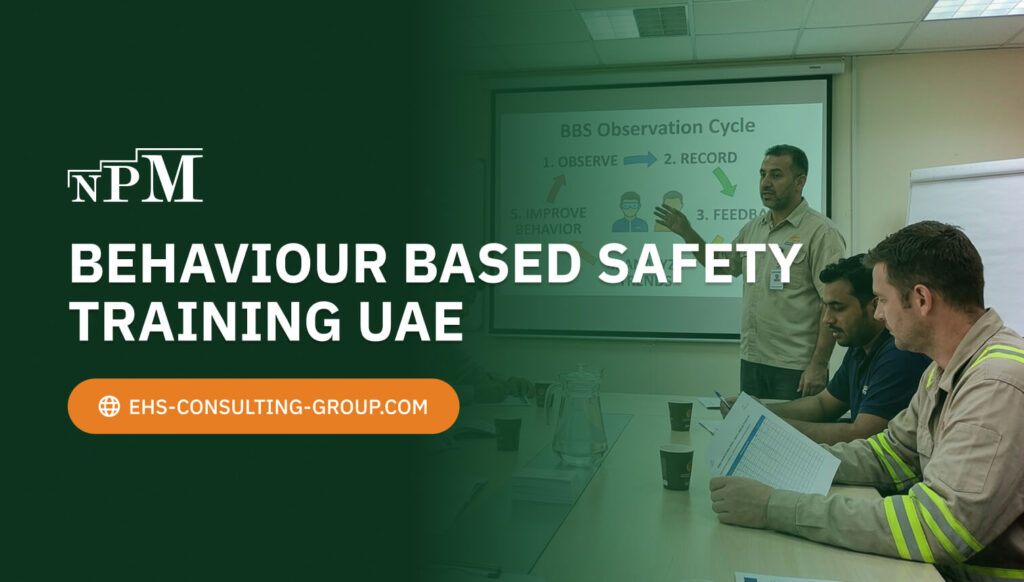
Common Behaviour Based Safety Failures are not just anecdotes swapped between supervisors — they represent patterned breakdowns in how organisations design, communicate, and sustain human-performance defences on the shop floor and at the jobsite. In high-risk UAE sectors such as upstream and downstream Oil & Gas, petrochemicals, power generation, logistics, and complex construction, these breakdowns consistently undermine otherwise robust HSE frameworks built around ISO 45001, ADNOC HSE requirements, OSHAD SF (Abu Dhabi), Dubai Municipality regulations, Civil Defence approvals, and MOHRE obligations. This article unpacks why these failures occur, how to recognise them early, and what practical steps leaders can take to fix the system rather than blame individuals.
Who Does This Affect?

Because behaviour-based safety (BBS) touches daily work execution, the impact extends across functions and contract tiers. Roles most affected include:
- HSE Directors and Managers responsible for integrating BBS with corporate risk management and ISO 45001 systems.
- Operations and Plant Managers accountable for production targets where unsafe shortcuts can be incentivised unintentionally.
- Frontline Supervisors and Permit-to-Work (PTW) Authorities who set daily expectations for energy isolation, hot work, working at height, and confined space controls.
- Project Managers and Construction Leads coordinating high-risk activities (lifting, formwork, tunnelling, tower crane operations) under schedule pressure.
- Maintenance, Turnaround, and Shutdown Coordinators managing concurrent tasks on live assets (refineries, terminals, power plants).
- Contractor HSE teams and Site Safety Officers who conduct observations and coach mixed workforces across languages and shifts.
- Logistics and Warehouse Supervisors overseeing rigging, forklift traffic, and line-of-fire risks in yards and terminals.
In short, anyone influencing how work is planned, authorised, and executed is implicated by behavioural safety strengths and weaknesses. That includes process safety specialists, because behaviour around isolation, interlocks, alarms, overrides, and operational envelopes sits on the human–technology boundary where major accident hazards propagate.
Why This Matters

After the “what” (incidents) and the “where” (task location), the “why” of unwanted outcomes often traces back to behavioural precursors: at-risk shortcuts, normalised deviations, poor hazard anticipation, or a culture that treats safety conversations as paperwork rather than learning. These patterns echo across industries and correlate with increased TRIR, serious injuries, and, critically, low-frequency/high-consequence process safety events.
Regulatory drivers in the UAE further elevate the stakes. OSHAD SF requires structured hazard control and worker participation; ADNOC HSE codes of practice demand competency, permit rigor, and management of change; Dubai Municipality and Civil Defence emphasise work-at-height, fire, and life safety obligations; and MOHRE expects demonstrable prevention of occupational injuries. Weaknesses in behavioural expectations and reinforcement make it harder to evidence compliance, survive audits, and sustain safe, efficient operations.
Beyond compliance, behaviour sits inside broader risk frameworks. HAZOP, LOPA, and Bowtie analyses identify safeguards and human responses to deviations; QRA quantifies loss of containment impacts. If workers routinely defeat interlocks, bypass alarms, or skip verifications under time pressure, the effective risk reduction credited in those studies erodes. That is why understanding behaviour-based failure modes is not a “soft” topic — it is central to keeping the assumptions behind engineered barriers valid.
Key Points to Understand

If the previous section frames the stakes, the next step is to examine the anatomy of common failure modes. While each site is unique, several patterns recur across refineries, offshore platforms, chemical plants, high-rise construction, and power stations:
- Observation quality drift: BBS cards fill up with superficial checks (“PPE OK”) rather than probing critical controls (energy isolation, line-of-fire, dropped-object prevention, gas testing calibration).
- Metric tunnel-vision: Teams chase observation counts rather than meaningful learning, leading to gaming (copy–paste comments, staged observations).
- Blame-prone messaging: Workers perceive observations as policing, not coaching. This shuts down honest reporting and hides weak signals.
- Misalignment with process safety: BBS targets focus on housekeeping and PPE but neglect behaviours tied to major accident hazard barriers (override discipline, alarm response, permit boundary management).
- Leader inconsistency: Supervisors ask for safe behaviour but reward schedule-keeping delivered via risky shortcuts. Mixed messages kill credibility.
- Normalisation of deviance: Repetition of small violations becomes “the way we work,” especially during shutdowns and heavy lifts.
- Learning loop failures: Observations do not feed into hazard registers, MOC actions, or toolbox talk content. A closed loop that never closes.
- Cultural and language gaps: Multinational workforces struggle with abstract, text-heavy tools. Coaching needs to be visual, situational, and multilingual.
Understanding these patterns allows leaders to redesign both observation systems and the surrounding management environment. The table below summarises typical failure signals and system-level countermeasures often effective in UAE industrial facilities:
| Failure Mode | Typical Symptom on Site | Likely Root Causes | Practical Corrective Actions |
|---|---|---|---|
| Superficial observations | “PPE OK” repeated; no mention of PTW, LOTO, gas tests | Unclear focus; observers untrained on critical controls | Reframe checklist to barrier-critical behaviours; calibrate observers with case studies from HAZOP/Bowtie |
| Metric tunnel-vision | High counts, low learning value; copy–paste comments | Targets emphasise quantity over insight | Replace quotas with leading indicators of learning quality (action closure, themed coaching, near-miss richness) |
| Blame-prone culture | Workers avoid reporting; scripted answers | Observers correct rather than inquire; fear of sanctions | Adopt just culture principles; coach “curious questioning;” track recognition-to-correction ratio |
| Process-safety blind spot | Focus on housekeeping; no mention of overrides/interlocks | BBS isolated from process safety team | Embed barrier health prompts (alarms, trips, isolation verifications) into observation cards |
| Leader inconsistency | Safe talk, unsafe walk | Production pressure; misaligned KPIs | Align KPIs; include “safe schedule adherence” and refusal-rights in planning reviews |
| Normalised deviations | “We always do it this way” despite rules | Chronic resource or time pressure; missing tools | Spotlight rule–work gaps in after-action reviews; fix constraints; reinforce golden rules |
| Learning loop gaps | Same issues recur across shifts | No mechanism to escalate themes into action | Integrate observation themes into risk registers, MOC, toolbox talks; verify closure |
| Cultural/language mismatch | Confusion during toolbox talks; nodding without uptake | Abstract language; lack of visuals | Use pictograms, scenario photos, bilingual prompts; peer champions from each language group |
Technically, BBS works when three layers align: the task (clear hazards and controls), the performer (competency and confidence), and the environment (signals and incentives). Standards like ISO 45001 emphasise worker participation; methodologies such as Bowtie mapping help identify the behaviours that defend critical barriers; and audits under ADNOC or OSHAD reveal whether those behaviours are consistently reinforced. Treating observations as part of barrier health monitoring, rather than a standalone count, is a critical mindset shift.
How This Works in Practice

Translating concepts into practice requires attention to work planning and job execution. Consider several UAE-relevant contexts:
At a refinery during a turnaround, dozens of contractors work within tight PTW boundaries. BBS should illuminate the behaviours that keep permit lines intact: verifying isolation tags before breaking containment, controlling simultaneous operations (SIMOPS), confirming gas tests and hot work fire watches, and managing line-of-fire risks during rigging. If observation cards do not call out these controls explicitly, the signal-to-noise ratio drops and dangerous improvisations surface unnoticed.
On an offshore platform, alarms and overrides are daily realities. Behavioural focus should include alarm response discipline, override justification and restoration, confirmation of emergency stop functionality, and maintaining situational awareness during night shifts with reduced staffing. Supervisors who narrate “why” in real time (e.g., “we’ll stop to restore that override before resuming”) set cultural anchors.
In high-rise construction, working at height dominates the risk profile. Behavioural themes include anchorage choice, edge protection inspection, housekeeping on scaffolds to prevent dropped objects, and exclusion zones below lifts. Supervisors can replace generic “wear your harness” reminders with observation prompts that ask, “Was the anchor point 21 kN-rated and above the D-ring?”
In logistics and warehousing, line-of-fire exposures and traffic management drive incidents. Behavioural checks can prioritise pedestrian–forklift separation, spotter communication protocols, load stability confirmation, and “eyes on path” practices at pinch-points and blind corners.
At power plants, lockout–tagout (LOTO), confined spaces in condensers, and live electrical work raise systemic risks. Observation prompts should probe LOTO verification (try–test–try), arc-flash boundaries, and the discipline to stop when permits drift.
Across all sites, close the loop. Themes from observations feed toolbox talks, which in turn set the next week’s observation priorities. Safety committees review recurring patterns alongside incident data, near misses, and maintenance backlog signals. Crucially, action trackers ensure fixes (tools, training, procedures, supervision) actually reach the field. This is how BBS fuses with management of change and barrier health, not merely wall charts.
Benefits and Practical Use Cases

When organisations focus BBS on barrier-relevant behaviours and sustain a just culture, practical benefits follow. Several concrete outcomes observed across heavy industry include:
- Better hazard anticipation at the job planning stage — pre-job briefs move from generic to scenario-specific, reducing improvisation.
- Sharper PTW discipline — fewer boundary breaches, better coexistence of hot work and cold work, and stronger gas monitoring practices.
- Declines in serious injuries linked to line-of-fire and dropped objects, particularly where exclusion zones and tool tethering become normalised habits.
- Improved process safety performance — fewer unauthorised overrides, more deliberate alarm response, and stronger escalation when parameters drift.
- More effective audits — OSHAD, Dubai Municipality, Civil Defence, and client audits find living systems rather than staged compliance.
- Higher morale and participation — workers perceive observations as coaching, not fault-finding, increasing the richness of near-miss reporting.
Examples of use cases that illustrate these benefits in the UAE industrial context:
- Turnaround lifting operations: Integrating BBS prompts with lifting plans and rigging checklists reduced near misses by emphasising line-of-fire discipline, tag-line use, and exclusion zone integrity.
- Terminal hose connection tasks: Behavioural focus on breakaway couplings, verification of double-block-and-bleed, and body positioning during pressurisation cut minor injuries and improved process containment events.
- Electrical isolations at power plants: Embedding “try–test–try” checks within BBS cards elevated LOTO quality, evidenced by audit findings and faster issue closure cycles.
- Confined space entries on construction sites: Pairing BBS with gas detection calibration checks and attendant vigilance prompts resulted in fewer permit holds and safer entries.
These benefits are not abstract. They come from re-weighting observation attention toward critical behaviours that defend barriers identified by HAZOP, LOPA, Bowtie, and engineering studies. As the content of conversations improves, so do outcomes.
Best Practices and Points of Caution

Bringing the above together, leaders can apply the following practices to address the most common pitfalls while avoiding new ones:
- Anchor BBS to barrier health: Derive observation prompts from critical controls — LOTO verification steps, override discipline, interlock respect, dropped-object prevention, gas test credibility, hot work boundaries.
- Calibrate observers: Use real incident case studies and Bowtie threat–control–consequence maps to align what “good” looks like. Periodically score real observation cards for depth and learning value.
- Balance recognition and correction: Track the ratio explicitly. Recognition builds trust; targeted correction builds skill. Both are necessary.
- Replace quotas with quality indicators: Focus on thematic insights, action closures, and near-miss richness, not raw counts.
- Make language and visuals work: Use simple bilingual prompts, icons, and photos of correct vs. incorrect setup — especially for multinational crews.
- Integrate with PTW and MOC: Observations are a feed into permit reviews and change processes, not a separate universe.
- Prepare leaders to model trade-offs: Supervisors should narrate safe decisions under time pressure. Credibility grows when teams see safety protected in real moments.
- Monitor for drift: Conduct periodic “fresh eyes” reviews that test whether normalisation of deviance is creeping back into routine tasks.
- Safeguard privacy and just culture: Keep individual data confidential, focus on system learning, and protect reporters from reprisal.
Documentation control matters as these practices mature. Organisations often strengthen behavioural governance and lesson-sharing by using structured repositories and controlled document workflows. For reference on governance tooling often paired with HSE programs, see CABINET NPM — not as a substitute for leadership, but as a way to maintain living procedures, observation templates, and action logs.
Finally, one practical caution: avoid letting BBS become a proxy for process safety. Personal safety observations (PPE, housekeeping) are necessary but insufficient. Unless behavioural prompts explicitly cover barrier-critical acts and decision points, the program will struggle to influence low-frequency/high-consequence risks that matter most in Oil & Gas, petrochemicals, and power generation.
Frequently Asked Questions About Common Behaviour Based Safety Failures
How do we know if our observation program is measuring what matters?
Sample observation cards and code the comments for depth: Do they mention critical controls (e.g., isolation verification, alarm response, dropped-object prevention), or are they dominated by generic PPE checks? Compare themes with your HAZOP and Bowtie controls. If barrier-relevant behaviours are under-represented, your program is not measuring what matters.
Is Behaviour-Based Safety at odds with process safety?
No. The perceived conflict arises when BBS focuses solely on personal safety. When redesigned to include behaviours that defend process safety barriers (override management, interlock respect, PTW discipline, control room alarm handling), BBS becomes a frontline feedback loop for barrier health rather than a distraction from it.
How many observations should we target per week?
Quantity is less important than quality. A smaller number of high-quality observations that surface real work-as-done insights will outperform high counts of superficial checks. Track indicators such as action closure, quality of near-miss narratives, and leader coaching time to confirm impact.
How can we prevent a blame culture from creeping into observations?
Adopt just culture principles publicly, recognise safe choices more frequently than you correct, and train observers to ask curious, open-ended questions. Protect confidentiality, separate learning conversations from disciplinary processes, and require leaders to model reporting by sharing their own near misses.
Are digital apps better than paper cards for BBS?
Digital tools can help with data quality, language translation, photos, and analytics, but the medium is not the solution. The real differentiator is the content of conversations, the integration with PTW and MOC, and timely action on themes. Choose a tool that supports these behaviours rather than driving checkbox compliance.
How do we align BBS with ISO 45001 and ADNOC/OSHAD requirements?
Map observation prompts to hazard controls referenced in your risk assessments and procedures; ensure worker participation by involving crews in defining “good looks like;” integrate observation outcomes with corrective action systems; and demonstrate management review of trends. This satisfies both standard requirements and local regulator expectations for living systems.
What’s the difference between BBS and Human and Organizational Performance (HOP)?
BBS traditionally focuses on reinforcing safe behaviours, while HOP emphasises learning from normal work and designing systems that anticipate human variability. They are complementary. Many organisations modernise BBS by incorporating HOP principles: assume error is normal, focus on system design, and treat observations as learning opportunities rather than compliance checks.
How do we show ROI for leadership?
Link behavioural themes to leading indicators (permit holds prevented, override restorations, near-miss richness) and lagging trends (reduction in line-of-fire injuries, fewer dropped-object incidents, fewer boundary breaches). Show how observation insights drove practical fixes (tools, barriers, schedule changes) and quantify avoided downtime or rework.
Conclusion
Behaviour-based safety succeeds when it becomes the conversational fabric that protects critical controls every day — not a parallel paperwork exercise. The failures seen most often in UAE heavy industry — superficial observations, metric tunnel-vision, blame-prone messaging, and neglect of process-safety-relevant behaviours — share a root: the system around people has not been designed to make the safest action the easiest, most reinforced choice. By anchoring observations to barrier health, calibrating observers with real scenarios, integrating learning with PTW and MOC, and enabling leaders to model safe trade-offs under pressure, organisations can convert BBS from compliance ritual into a genuine risk-control asset. Whether you manage turnarounds at a refinery, high lifts on a construction project, or isolations at a power station, the path forward is the same: make critical behaviours visible, learn from normal work, and close the loop with timely fixes that crews can feel.
To go further on this topic, NPM’s broader Behaviour Based Safety Training UAE page covers this in more depth.
Our References
NPM’s track record spans complex, high-risk environments where the realities of production, maintenance, and construction collide with the expectations of flawless safety performance. Our teams have supported operators, EPCs, and specialist contractors across Oil & Gas processing, petrochemical complexes, large-scale power generation, logistics hubs, and iconic building projects. In these contexts, behaviour-based safety is never a standalone initiative — it is embedded within barrier management, permit-to-work, contractor governance, and management of change. What sets effective programs apart is not slogans but the disciplined practice of observing real work, asking curious questions, and fixing the system so that the right behaviour is the path of least resistance. NPM’s references illustrate how this approach plays out under real constraints: diverse, multilingual workforces; tight turnarounds on live assets; simultaneous operations; and non-negotiable quality and schedule demands.
In our portfolio, you will find examples of supervisors shifting from checklist policing to coaching, observation content pivoting from generic PPE to barrier-critical checks, and learning loops that connect field insights to engineering and planning decisions. You will also see how integration with recognised frameworks — ISO 45001, Bowtie analysis, HAZOP/LOPA, and regulator expectations under OSHAD, ADNOC HSE, Dubai Municipality, and Civil Defence — helps organisations translate insight into lasting change. These references are diverse in geography and facility type, underscoring NPM’s worldwide perspective and the adaptability of the principles discussed in this article. If you are exploring how to modernise behaviour-based safety without losing sight of process safety and operational realities, NPM’s past work offers concrete, relevant patterns to learn from and adapt to your site.
For more information about our references, visit Our References.
Speak with NPM
If you would like to discuss how behavioural insights can be better aligned with your critical controls, or you have questions about integrating observations with PTW, MOC, and barrier health, our team is happy to share perspectives. A brief conversation can help translate the ideas in this article into practical next steps tailored to your site and workforce.
For any further questions or to speak with our team, Contact Us.