
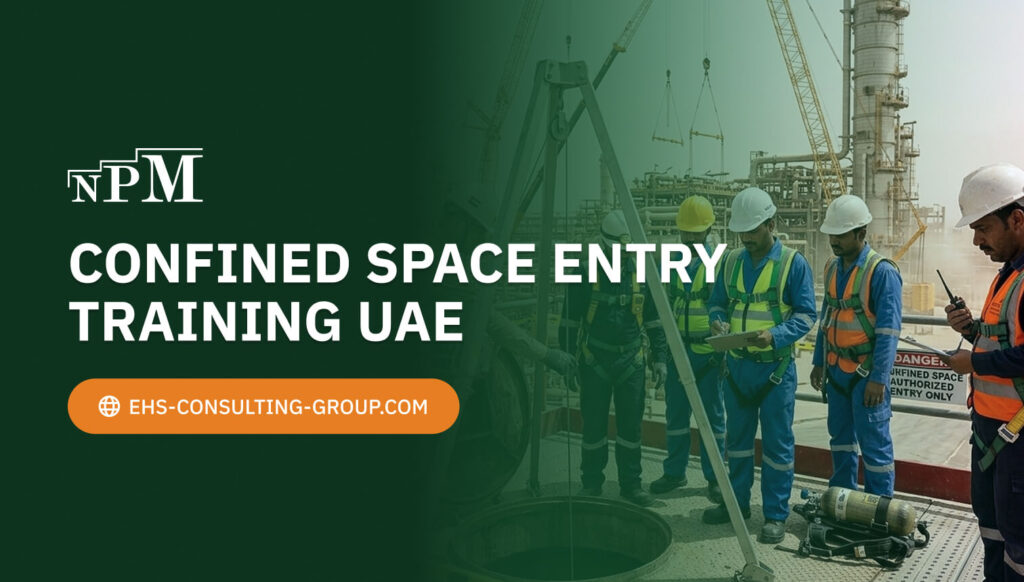
Confined Space Entry Training UAE is delivered by NPM to equip your workforce with the knowledge, practical skills, and confidence to plan and execute safe entries in tanks, vessels, manholes, culverts, and other permit-required confined spaces. This training program aligns with UAE regulatory expectations and international best practice, integrating your permit-to-work, gas testing, ventilation, isolation/LOTO, communications, and rescue arrangements into a single, coherent approach that reduces risk and supports uninterrupted operations.
This localized offering is part of our broader Safety Training Services UAE delivered across the UAE, ensuring consistent standards, traceable competency records, and measurable outcomes that stand up to client, auditor, and regulator scrutiny.
Who should attend Confined Space Entry Training UAE?

Confined Space Entry Training UAE is for industrial teams that routinely or periodically conduct entries into tanks, silos, digesters, sumps, tunnels, valve pits, and similar spaces. Typical participants include entrants, attendants, entry supervisors, gas testers, authorizing engineers, rescue team members, HSE coordinators, and permit-to-work authorities across oil and gas, petrochemicals, construction, manufacturing, logistics, utilities, and power generation. Organizations preparing for shutdowns/turnarounds, integrity inspections, cleaning campaigns, or brownfield modifications will benefit from a focused, scenario-driven delivery tailored to their actual confined spaces and equipment.
This training is equally relevant to EPC contractors, O&M providers, and facility owners that must demonstrate due diligence to clients, ADNOC group companies, Dubai Municipality inspectors, OSHAD auditors, Civil Defence, or international partners. Confined Space Entry Training UAE gives your supervisors and craft teams a common language for hazard identification, atmospheric testing, ventilation, control of energy, and rescue planning—closing the gap between procedures and field execution.
Objectives of Our Confined Space Entry Training UAE

By the end of Confined Space Entry Training UAE, participants will be able to recognize, plan, authorize, and perform entries safely and efficiently while meeting UAE regulatory expectations and internal standards. Core objectives include:
- Correctly define a confined space and a permit-required confined space, and classify typical spaces at your facility.
- Identify atmospheric, mechanical, engulfment, and configuration hazards and select layered controls.
- Conduct pre-entry atmospheric testing with calibrated instruments and interpret results for safe entry and continuous monitoring.
- Apply isolation/LOTO, inerting/ventilation strategies, and purge/flush methods suitable for local conditions.
- Roles and responsibilities of entrant, attendant, supervisor, gas tester, and rescue team; effective communications.
- Authorizing and managing permits to work, including hot work, line breaks, and simultaneous operations (SIMOPS).
- Design and practice non-entry and entry rescue approaches, equipment selection, and interface with Civil Defence.
- Document, brief, and debrief entries to capture learning and strengthen your HSE management system.
Training Program and Modules Overview

Confined Space Entry Training UAE is delivered as a modular program that maps to your workforce roles. NPM blends classroom learning with hands-on practicals using your gas detectors, ventilation units, tripod/winch systems, harnesses, retrieval devices, and communications gear. Where appropriate, we integrate your site-specific permit, JSA, and rescue plan templates so delegates leave prepared to work within your system the very next day.
Typical modules include hazard recognition and classification; gas testing and instrument care; ventilation, purging, and inert entry considerations; isolation and energy control; entrant/attendant/supervisor responsibilities; permit-to-work authorization; emergency response planning and drills; and practical rescue evolutions. Confined Space Entry Training UAE can be customized to cover sector-specific spaces such as refinery columns, desalination chambers, power plant condensers, large utility vaults, and wastewater tanks, with realistic scenarios built from your last turnaround or maintenance campaign.
Duration and Format of Confined Space Entry Training UAE

NPM offers flexible delivery to match your operational windows, workforce size, and competency baseline. Confined Space Entry Training UAE is available as awareness, operator/entrant, supervisor, and rescue-focused tracks, each calibrated to the complexity of your spaces and the equipment available on site. Programs can be delivered in English, Arabic, or bilingual formats, on-site at your facility, at NPM partner venues, or as blended sessions with pre-work eLearning and on-ground practical assessments.
| Track | Typical Audience | Duration | Delivery Mode | Assessment Components |
|---|---|---|---|---|
| Awareness | Managers, planners, supervisors new to CSE | 0.5–1 day | Classroom or virtual | Knowledge check quiz |
| Entrant & Attendant | Operators, technicians, craft teams | 1–2 days | On-site with practicals | Written test instrument/role practical |
| Entry Supervisor | Supervisors, PTW authorities, gas testers | 1–2 days | On-site/blended | Permit simulation scenario evaluation |
| Rescue | In-house rescue teams, ERT | 1–2 days | On-site with drills | Rescue drill equipment proficiency |
Confined Space Entry Training UAE can be sequenced around shutdowns and SIMOPS constraints. Practical stations are configured to reflect your assets—such as vertical entries with tripods, horizontal entries through manways, and complex entries in large tanks—so teams rehearse what they will actually face during work execution.
Operational Benefits and Use Cases

Organizations that invest in Confined Space Entry Training UAE reduce the likelihood of atmospheric incidents, unauthorized entries, and botched rescues, all of which carry severe safety, legal, and commercial consequences. Training drives consistent application of your procedures across contractors and shifts, improving first-time-right execution during cleaning, inspection, coating, or repair jobs in high-risk spaces.
- Stronger permit quality and fewer last-minute reworks due to missing controls or unclear roles.
- Improved gas detection accuracy and alarm response, preventing exposures and evacuations.
- Faster, safer rescue decision-making, with clear non-entry rescue preferences and practiced drills.
- Better coordination during shutdowns and turnarounds when multiple trades work near each other.
- Documented competency to satisfy client prequalification, audits, and regulator visits.
Confined Space Entry Training UAE translates directly into on-the-ground reliability. Whether you operate refinery tanks, LNG spheres, desalination chambers, power station condensers, or municipal sewer networks, your teams will know how to stage equipment, monitor the atmosphere, maintain communications, and close the job without incident or unnecessary downtime.
Why Choose NPM for This Program

NPM delivers Confined Space Entry Training UAE using senior practitioners who have managed complex entries on refineries, offshore platforms, large infrastructure builds, and wastewater networks across the region. Our instructors are experienced in integrating permit-to-work systems, gas testing programs, and emergency response plans so your delegates practice with the exact tools, forms, and equipment they will use. We build realistic scenarios from your risk register and last incident learnings to create memorable, habit-forming training.
Confined Space Entry Training UAE from NPM emphasizes measurable results: documented competency matrices; practical assessment records; and consolidated improvement actions for your HSE team. We adapt class size, language, and schedule to minimize production impact while ensuring adequate time on instruments and rescue devices. With pragmatic, engineering-grounded instruction, we help you move beyond theory to field-ready execution.
Detailed Training Levels and Industry-Focused Options
Confined Space Training for Oil & Gas
Confined Space Training for Oil & Gas is designed for upstream and downstream operations where entries occur in separators, columns, reactors, and storage tanks under strict SIMOPS conditions. This option within Confined Space Entry Training UAE addresses hydrocarbons, pyrophoric scale, inerting with nitrogen, and hot work in complex atmospheres. We focus on interfacing with control-of-work systems, isolation/LOTO standards, and gas testing protocols used by oil and gas operators. Delegates practice permit authorization, multi-gas detection, ventilation planning around LEL/O2/TOX exposure limits, and rescue strategies that align with site emergency response. This training is typically required before turnarounds, internal inspections, catalyst handling, and repair campaigns, as well as for contractors seeking prequalification with ADNOC group entities or major IOCs. Practical outcomes include improved permit quality, faster mobilization to work fronts, and confident role execution by entrants, attendants, supervisors, and rescue teams during high-hazard entries. By tailoring to platform, refinery, or terminal conditions, Confined Space Training for Oil & Gas makes Confined Space Entry Training UAE directly relevant to your assets without burdening delegates with generic content.
Click on the following link for more details: Confined Space Training for Oil & Gas.
Confined Space Training for Petrochemical Plants
Confined Space Training for Petrochemical Plants targets process environments with toxic and corrosive hazards, polymerization risks, and complex vessel internals. Within the broader Confined Space Entry Training UAE, this specialization addresses monomer/polymer exposure, oxygen displacement, inert entry criteria, and cleaning residues that off-gas during maintenance. Participants learn to evaluate MSDS/SDS implications for atmospheric testing, select compatible PPE and ventilation methods, and coordinate with utilities and maintenance teams to sequence isolation, depressurization, and purging. This training is commonly required ahead of planned outages in crackers, reformers, and polymer units, and for maintenance teams executing internal inspections or coating works. Practical outcomes include correctly classifying spaces, selecting appropriate detectors and bump test frequency, verifying atmospheric stability over time, and demonstrating permit diligence that aligns with client and regulator expectations. Confined Space Training for Petrochemical Plants ensures Confined Space Entry Training UAE translates into precise, plant-ready competencies that stand up to internal audits and external verification.
Click on the following link for more details: Confined Space Training for Petrochemical Plants.
Confined Space Training for Manufacturing
Confined Space Training for Manufacturing supports factories and industrial workshops where entries are needed in mixers, pits, ovens, silos, and ventilation ducts. As part of Confined Space Entry Training UAE, it emphasizes practical risk controls in busy production environments, including coordination with maintenance and production planners, controlling stored energy in conveyors and mixers, and managing dust, solvent vapors, and heat. Typical triggers include annual cleaning, breakdown repairs, and expansion projects involving ducting reroutes or tank modifications. The training equips entrants, attendants, and supervisors to apply the permit system consistently across shifts and contractors, conduct reliable gas monitoring, and prepare reasonable rescue options without overcomplicating production. Delegates leave with immediate, pragmatic skills—clear role understanding, better permit documentation, and practiced drills that reflect the equipment and layout on the shop floor. Confined Space Training for Manufacturing ensures Confined Space Entry Training UAE is lean, targeted, and effective within the time windows manufacturing facilities can allocate.
Click on the following link for more details: Confined Space Training for Manufacturing.
Confined Space Training for Utilities
Confined Space Training for Utilities addresses electrical and water utility environments where vaults, valve chambers, culverts, and tunnels impose configuration and atmospheric risks. Integrated into Confined Space Entry Training UAE, this option builds competency around gas testing for H2S and CH4, ventilation planning in long or complex spaces, and coordination with outage planning to ensure safe isolation without compromising service reliability. It is typically required for field crews, O&M technicians, and supervisors who enter chambers and manholes across distributed networks, often under time pressure after alarms or during planned maintenance. Practical outcomes include safer entry sequencing, improved use of retrieval systems for vertical entries, and credible rescue plans that balance rapid response with responder safety. Confined Space Training for Utilities brings the structure and rigor of Confined Space Entry Training UAE to civil and electrical assets, giving teams the confidence to execute entries in challenging conditions while maintaining service continuity.
Click on the following link for more details: Confined Space Training for Utilities.
Confined Space Training for Water Treatment Facilities
Confined Space Training for Water Treatment Facilities supports municipal and private operators managing wastewater treatment plants, pumping stations, digesters, and clarifiers. This specialization within Confined Space Entry Training UAE focuses on biological hazards, H2S exposure, oxygen deficiency, and the intricacies of sludge handling equipment. Delegates practice atmospheric testing specific to wastewater environments, proper ventilation for odorous/toxic gases, decontamination considerations, and rescue planning where atmospheric risk can escalate quickly. It is typically required for O&M teams, contractors performing maintenance on aeration tanks or channels, and supervisors authorizing entries near live process streams. Practical outcomes include stronger pre-entry hazard identification, improved gas detector use and calibration discipline, and realistic, drill-tested rescue plans. Confined Space Training for Water Treatment Facilities ensures that Confined Space Entry Training UAE speaks directly to the realities of pump rooms, wet wells, and digesters, helping teams keep people safe while keeping essential services running.
Click on the following link for more details: Confined Space Training for Water Treatment Facilities.
Regulatory Landscape & Industry Context in the UAE
The UAE’s regulatory framework for confined spaces is anchored in federal labor and OSH expectations, with Emirate-level authorities such as OSHAD (Abu Dhabi), Dubai Municipality, and Civil Defence enforcing detailed requirements for permits, gas testing, ventilation, isolation, and rescue readiness. Confined Space Entry Training UAE aligns with ISO 45001 principles for hazard identification and control, and draws on NFPA 350 for safe entry and cleaning of confined spaces. In Abu Dhabi, OSHAD System Framework Codes of Practice define roles, documentation, and competency; in Dubai, EHS requirements and Civil Defence codes shape how hot work, rescue, and emergency response are planned. Across free zones and industrial hubs, client standards frequently mirror international oil and gas and petrochemical benchmarks, raising expectations for competency evidence and practical assessment.
NPM leverages extensive project experience across refineries, petrochemical complexes, power and water utilities, logistics hubs, and construction megaprojects to ensure Confined Space Entry Training UAE is compliant, operationally grounded, and audit-ready. As part of a broader professional network, we maintain visibility on evolving best practices and international benchmarks through CABINET NPM, ensuring your teams receive current, field-tested guidance that stands up to scrutiny from clients and regulators alike.
Our UAE-Wide Delivery Options
Confined Space Entry Training Dubai
Confined Space Entry Training Dubai is tailored for operators in the Jebel Ali Industrial Area and within JAFZA, where logistics, manufacturing, and petrochemical storage drive frequent tank and pit entries under strict client and Dubai Municipality oversight. With proximity to Jebel Ali Port and heavy SIMOPS across adjacent facilities, entries often coincide with hot work, line-break activities, and contractor mobilizations. NPM adapts the program to address Dubai Civil Defence interface requirements, local EHS documentation expectations, and the realities of executing entries in fast-paced free zone environments. We incorporate scenarios relevant to tank farms, blending units, and warehouse sumps, and emphasize robust gas testing and communications protocols. Confined Space Entry Training Dubai helps teams plan entries that minimize disruption to import/export workflows and demonstrate due diligence during inspections, with clear role definitions and rescue preparedness that reflect local emergency response arrangements.
Click on the following link for more details: Confined Space Entry Training Dubai.
Confined Space Entry Training Abu Dhabi
Confined Space Entry Training Abu Dhabi supports OSHAD-regulated organizations operating across Mussafah, ICAD, and KIZAD, as well as ADNOC assets and contractors working near Ruwais and Khalifa Port. With refinery, petrochemical, power generation, and heavy manufacturing activities concentrated in these hubs, entries occur routinely in columns, exchangers, sumps, and large tanks during turnarounds and maintenance windows. NPM maps the program to OSHAD SF documentation, ADNOC control-of-work expectations, and the specific realities of coordinating with multiple contractors and specialized services during shutdowns. Practical modules reflect entries in vertical and horizontal configurations commonly found in these facilities, including tripod/winch retrieval and complex ventilation strategies. Confined Space Entry Training Abu Dhabi equips your entrants, attendants, and supervisors to meet auditor expectations, keep pace with aggressive turnaround schedules, and maintain consistent permit quality across day/night shifts and contractor crews.
Click on the following link for more details: Confined Space Entry Training Abu Dhabi.
Assessment & Certification
Assessment in Confined Space Entry Training UAE combines written knowledge checks with practical evaluations. Delegates demonstrate instrument setup and bump tests, perform atmospheric sampling and interpretation, complete permit sections correctly, and role-play entrant, attendant, and supervisor responsibilities in realistic scenarios. Rescue-focused participants execute non-entry and basic entry rescue evolutions with retrieval systems and communication protocols, reinforcing decision-making and team coordination.
Upon successful completion, participants receive an NPM Certificate of Completion noting the course title, learning outcomes, delivery hours, assessment summary, and the individual’s role focus (e.g., Entrant/Attendant, Supervisor, Rescue). Where legislation or client standards require statutory competency sign-off, the client organization retains responsibility for final authorization of employees; NPM provides the documented evidence needed to support that decision. Recommended group size for balanced theory and hands-on practice is 8–14 delegates per instructor, depending on the role mix and equipment available.
Before delivery, NPM conducts a short needs analysis and collects relevant documents—permit templates, rescue plans, risk assessments, and recent incident learnings—to tailor scenarios. If feasible, a pre-training site walkdown helps align practical stations with your actual confined spaces and rescue equipment, maximizing transfer of learning to the job.
FAQ
How often should this training be renewed?
For most organizations, Confined Space Entry Training UAE should be refreshed every two years, or sooner following changes in equipment, procedures, or after an incident/near miss. High-risk roles such as entry supervisors and rescue team members often benefit from annual refreshers and periodic drills.
What’s the difference between initial and refresher training?
Initial Confined Space Entry Training UAE builds foundational knowledge and practical competency across roles, typically with more time allocated to hands-on assessment. Refresher sessions focus on updates, recent learnings, targeted skill gaps, and short practical validations aligned to your current equipment and procedures.
Who issues the certificate?
NPM issues the Certificate of Completion for Confined Space Entry Training UAE. Where statutory or client rules require formal authorization to work, the employer remains responsible for final competency sign-off, using NPM’s assessment records as supporting evidence.
Is in-house delivery better than public/open sessions?
In-house Confined Space Entry Training UAE enables scenario customization to your spaces, permits, and rescue gear, which is ideal for teams executing entries on your site. Open/public sessions suit individual employees or small teams needing foundational knowledge when a custom class is not practical.
What group size works best?
Groups of 8–14 per instructor strike the right balance for Confined Space Entry Training UAE, ensuring every delegate gets instrument time, role rotation, and feedback during practicals. Larger groups can be accommodated with additional instructors and duplicated practical stations.
Are there prerequisites?
There are no formal prerequisites for entrant/attendant tracks of Confined Space Entry Training UAE, though basic HSE awareness is helpful. Supervisor and rescue-focused participants benefit from prior experience with permits, gas testing, and emergency response, and should be medically fit for the physical aspects of training.
Know More About Our Work
NPM has delivered complex HSE and process-safety training and competency programs worldwide, from refineries and petrochemical plants to power and water utilities, construction megaprojects, and logistics hubs. Our approach emphasizes credible, auditable outcomes—real skills built on realistic scenarios, with documentation that withstands client and regulator reviews. Explore how we translate standards into field-ready practice and help organizations reduce risk while maintaining productivity.
For more information about our references, visit Our References.
Book Your Confined Space Entry Training UAE Today
Equip your teams with the confidence and competence to plan and execute safe entries the first time, every time. With Confined Space Entry Training UAE, NPM brings pragmatic, scenario-driven instruction to your site, aligned with your permits, rescue plans, gas detection instruments, and actual confined spaces. Whether you’re preparing for a turnaround, standardizing contractor practices, or responding to audit findings, we will tailor the program to your operations, language needs, and schedule. Our instructors are seasoned practitioners who focus on measurable outcomes—clear role execution, stronger permits, practiced rescue options, and documented competency that stands up to audits. Let’s align the training scope, group sizes, and delivery format to minimize production impact while maximizing hands-on learning. Share your current procedures, risk assessments, and recent learnings, and we’ll design a focused course that closes the gap between paper and practice. Start the conversation with NPM’s training coordinators and request a tailored proposal today: Contact Us