
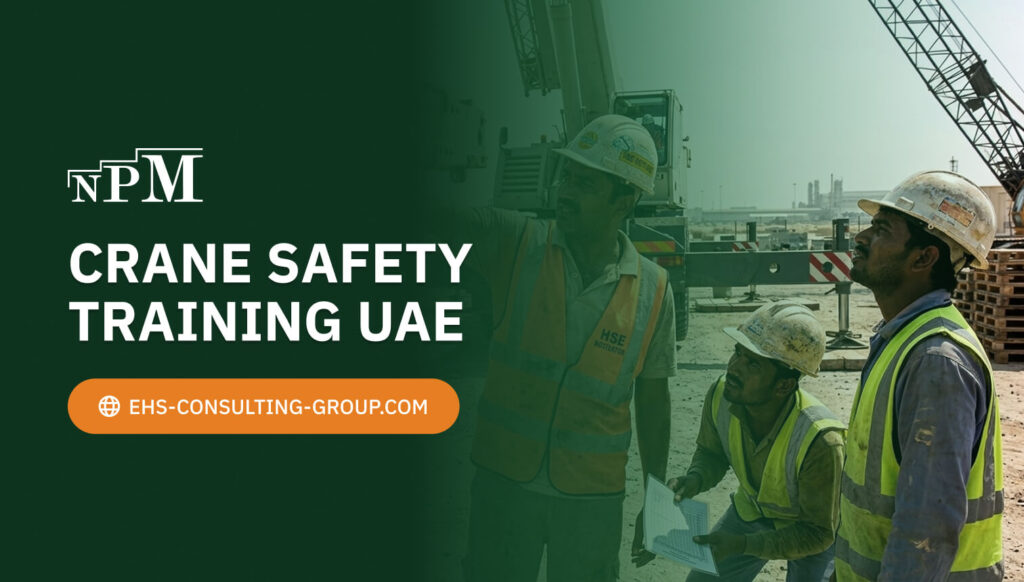
Crane Safety Training for Construction is a focused, site-ready program from NPM designed to reduce lifting incidents, improve supervisor and operator decision-making, and align your projects with UAE regulatory expectations. This industry-specific offering is part of our broader Crane Safety Training UAE portfolio delivered by NPM across the Emirates, ensuring your teams receive consistent, auditable competency development that stands up to client, consultant, and regulator scrutiny on active construction sites.
Who Needs Crane Safety Training for Construction?

Construction projects in the UAE rely on fast-paced lifting operations where multiple contractors, tight programs, and changing site geometry can create elevated risk. Crane Safety Training for Construction is built for site managers, lifting supervisors, appointed persons, tower crane operators, mobile crane operators, riggers, signalers/banksmen, site engineers, and HSE officers who plan, execute, and control lifts amid constrained laydown areas, public interfaces, and other trades. On typical building, infrastructure, and utility projects, the integration of temporary works, tandem lifts, precast/steel erection, façade installation, and congested MEP zones demands consistent application of lifting plans, communications, and exclusion zones. With Crane Safety Training for Construction, NPM equips front-line and supervisory roles with practical methods for hazard identification, load path control, wind/weather thresholds, ground bearing checks, and emergency response tailored to high-rise, deep excavation, bridge/viaduct, and brownfield refurbishment works. The training addresses realities such as shifting crane radii due to sequencing changes, night shifts to meet road corridor permits, and near public traffic or live utilities. It is equally relevant for main contractors, specialist lifting subcontractors, and developer/client HSE teams who need to verify contractor competency against method statements and risk assessments on active works. By standardizing how crews interpret lifting plans and coordinate roles, Crane Safety Training for Construction supports safer execution and reduces rework and delays linked to lifting incidents.
Objectives of Our Crane Safety Training for Construction

Crane Safety Training for Construction targets the specific decisions and controls that prevent dropped loads, tip-overs, and line-of-fire strikes on dynamic, multi-employer sites. NPM’s objective is to move beyond generic theory and give participants the tools to interpret crane charts correctly, validate outrigger and matting requirements, confirm slew and radius limitations, select appropriate rigging, and maintain clear communications even under program pressure. The program helps supervisors translate method statements into field-ready controls, ensures signalers and riggers maintain reliable hand and radio protocols, and guides operators to apply wind limits, derating factors, and safe shutdown conditions when weather, lighting, or simultaneous operations complicate lifts. For construction teams that manage steel erection, precast installation, modular unit placement, HVAC plant lifts, and formwork cycles, Crane Safety Training for Construction helps codify safe lifting stages from pre-lift checks through post-lift demobilization and close-out.
- Strengthen role clarity among appointed person, supervisor, operator, rigger, and signaler/banksman.
- Improve planning quality: load calculations, rigging selection, radius and configuration confirmation, ground assessments.
- Standardize communications, exclusion zones, and taglines for tight or public-facing works.
- Apply weather/wind thresholds and derating factors consistently for tower and mobile cranes.
- Embed stop-work authority and change control when site conditions or sequencing shift.
By the end of Crane Safety Training for Construction, delegates will have the skills and confidence to implement lifting plans pragmatically, verify readiness at the face of work, and coordinate with other trades to maintain safe clearances and stable ground conditions.
Program Outline and Curriculum

Crane Safety Training for Construction uses construction-specific scenarios drawn from high-rise residential/commercial towers, infrastructure corridors, metro/rail projects, industrial builds, and complex refurbishments. The curriculum blends technical rigging and load-handling knowledge with practical site controls: ground bearing pressure checks on backfill or slab-on-grade; exclusion zone design around scaffolds and formwork; communication methods under noise and line-of-sight restrictions; and environmental constraints such as wind gusting between towers or dust reducing visibility. NPM integrates client method statements and lifting plans where available, so participants practice identifying gaps and validating critical calculations before a lift. The program differentiates responsibilities by role, while reinforcing cross-role coordination that construction sites need for tandem lifts, night works, or public interface activities. Hands-on demonstrations, crane chart interpretation drills, and pre-lift briefings are embedded to simulate the real decision windows crews face. For organizations running multiple contractors, Crane Safety Training for Construction can be delivered as a shared session to build common language on site rules and controls.
- Core principles: lifting terminology, roles and legal duties on UAE construction sites, critical risk controls.
- Planning essentials: load weights/centers, rigging selection, crane configuration, ground conditions, change management.
- Execution controls: communications, exclusion zones, taglines, signaling, line-of-fire management, public interface.
- Environmental factors: wind thresholds, lightning/dust, temperature effects, night work lighting and visibility.
- Emergency response: suspended-load failures, loss of power, evacuation routes, incident reporting and learning.
Front-Line Construction Crews
Focused on riggers, signalers, and slingers/banksmen, this stream within Crane Safety Training for Construction builds consistent hand/radio signaling, rigging inspections, pre-use checks, and in-field risk recognition when works are congested by scaffolds, rebar cages, or temporary props. Practical demonstrations address correct use of taglines, managing blind lifts, and maintaining exclusion zones when other trades pressure the work front.
Crane Operators (Tower and Mobile)
Operators practice interpreting crane charts and applying wind/derating rules typical on tower cranes with long jibs or mobile cranes operating near capacity. Crane Safety Training for Construction emphasizes proper outrigger setup and matting on partially compacted fill, swing control with long radii, anti-collision systems coordination, and clear shutdown criteria when conditions deviate from the lifting plan.
Lifting Supervisors and Appointed Persons
This pathway strengthens the translation of method statements into daily lift plans, including verification of ground bearing pressures, slew/radius constraints versus obstructions, crane siting relative to excavations, and coordination of tandem lifts. Crane Safety Training for Construction reinforces toolbox talks, hold points, and stop-work triggers for sequencing changes and late-stage design updates.
Site Engineers, Planners, and HSE Officers
Engineers and HSE staff learn how to review lifting plans and rigging drawings, audit pre-lift readiness, and ensure temporary works and adjacent trades remain compatible with the lift. Crane Safety Training for Construction connects risk controls to permit-to-work systems, public protection, and client/consultant inspection expectations to keep programs on track.
Duration and Format of Crane Safety Training for Construction

Construction programs need scheduling agility. Crane Safety Training for Construction is offered in formats that respect shift patterns, night works, and critical-path activities such as steel erection and modular placements. For front-line crews, a concentrated 1-day practical format accelerates competency on signaling, rigging checks, exclusion zone control, and communications. For supervisors and appointed persons, a 2-day blended format provides more time for lift planning, chart interpretation, and ground condition validation exercises. NPM can deliver Crane Safety Training for Construction onsite with field walkdowns and crane setup observations, as live webinars for multi-site teams, or as hybrid sessions combining digital pre-work and face-to-face scenario labs. Organizations with large, rotating workforces often prefer the train-the-trainer option to cascade consistent content across multiple subcontractors. Regardless of format, case studies mirror your site realities—deep excavations, constrained laydown, public interfaces, or night closures—so learning transfers immediately to your method statements and RAMS. Recommended group sizes maintain interactivity and scenario practice without compromising productivity, while Crane Safety Training for Construction aligns session timing to toolbox talks, pre-pour, and pre-erection sequencing windows to minimize disruption.
| Format | Typical Duration | Recommended Group Size | Best For |
|---|---|---|---|
| Onsite Practical (Crew Focus) | 1 day (6–8 hours) | 10–16 participants | Riggers, signalers, tower/mobile operators on active projects |
| Blended Supervisor/Planner | 2 days (with pre-work) | 8–14 participants | Lifting supervisors, appointed persons, site engineers, HSE |
| Virtual Live Workshops | 2 x 3-hour sessions | Up to 18 participants | Multi-site teams requiring common standards |
| Train-the-Trainer | 2–3 days | 6–10 participants | Internal trainers cascading to subcontractors |
Operational Benefits and Use Cases

Crane Safety Training for Construction delivers measurable operational value by reducing rework, avoiding stoppages, and minimizing exposure to severe incidents that derail schedules and budgets. On high-rise towers with multiple cranes, the program supports anti-collision coordination and disciplined radio protocols to prevent swings into façades or formwork. On infrastructure corridors and bridge launches, it improves ground condition checks and proximity control near excavations and live traffic. For modular plant or precast elements, Crane Safety Training for Construction clarifies lift sequencing, tagline strategy, and load path planning to reduce strike hazards and weather-related cancellations. Site leadership gains confidence to authorize or defer lifts based on validated criteria rather than schedule pressure alone, while clients and consultants see more consistent documentation and briefing quality during inspections. The result is fewer near misses, shorter stoppages, and better use of crane time on critical-path activities.
- Fewer dropped objects and line-of-fire exposures around congested works and scaffolds.
- Improved verification of outrigger/matting on partially compacted ground or slab edges.
- More consistent exclusion zones and communications during blind or tandem lifts.
- Clear stop-work criteria when wind gusts, visibility, or sequencing change.
- Better audit trails linking method statements, lift plans, and toolbox briefings.
By aligning crews and supervisors on the same practical methods, Crane Safety Training for Construction translates directly into safer, faster, and more predictable lifting operations across main contractor and specialist subcontractor interfaces.
Why Choose NPM for Construction Crane Competency

NPM builds Crane Safety Training for Construction on real-world construction constraints—tight footprints, shifting site geometry, multi-crane operations, and pressure from adjacent trades. Our trainers are practitioner-level lifting specialists who have worked across high-rise developments, metro packages, viaducts, industrial builds, and complex refurbishments. We align content with UAE regulatory expectations and your client/consultant requirements, and we tailor case studies to your actual method statements, lift plans, and temporary works schemes. NPM’s delivery model scales from single-site crews to multi-city programs, maintaining quality through standardized materials, calibrated assessments, and traceable records your project controls and HSE teams can audit. For organizations seeking integrated HSE capability development, NPM’s affiliation with the broader professional network at CABINET NPM underscores our governance and quality systems, helping your competency management withstand external scrutiny. Above all, Crane Safety Training for Construction is practical: it teaches people what to do at the hook, at the operator cab, and at the exclusion zone, so lifts proceed safely and efficiently.
Related Training Options for Your Portfolio
Organizations operating across multiple sectors often combine Crane Safety Training for Construction with industry-specific options to standardize lifting controls while respecting sector nuances. Explore related offerings below to support multi-industry teams or specialized project packages.
Crane Safety Training for Oil & Gas
For contractors bridging construction and brownfield shutdowns, this program addresses Oil & Gas facility constraints such as hazardous areas, simultaneous operations (SIMOPS), and permit-to-work integration. It suits teams that mobilize cranes for tie-ins, heavy equipment swaps, and skids within live processing areas. Practical outcomes include tighter control of exclusion zones, gas testing interfaces, and adherence to asset owner requirements in addition to construction norms.
Click on the following link for more details: Crane Safety Training for Oil & Gas.
Crane Safety Training for Ports
Where construction packages intersect port operations—quay upgrades, warehouse builds, or logistics yards—this offer focuses on maritime interfaces, stacked containers, and lifting near live cargo movements. It covers berth safety, traffic segregation, and coordination with terminal operations to minimize disruption while maintaining lifting integrity. Teams leave with methods to manage wind, visibility, and vessel motion risks beyond typical land-based construction constraints.
Click on the following link for more details: Crane Safety Training for Ports.
Crane Safety Training for Industrial Projects
For construction teams delivering factories, utilities, and power blocks, this training adapts lifting controls to heavy plant installs, overhead crane interfaces, and confined internal erecting works. It is typically required when placing turbines, chillers, large MEP modules, or structural modules where tolerance is tight and access is limited. The outcome is improved coordination between construction lifts and permanent lifting equipment or production constraints.
Click on the following link for more details: Crane Safety Training for Industrial Projects.
Construction Regulations, Standards, and Site Realities in the UAE
Crane Safety Training for Construction aligns with the UAE’s regulatory landscape, including Abu Dhabi’s OSHAD framework for occupational safety and health, Dubai Municipality’s Code of Construction Safety Practice, and MOHRE labor and safety obligations applicable to contractors on active sites. Depending on project location, additional expectations may apply through Trakhees (Ports, Customs & Free Zone Corporation) or local authorities, and Civil Defence requirements will influence emergency planning during lifting near public areas or structures. Internationally recognized standards that inform our approach include ISO 45001 for safety management, BS 7121 for safe use of cranes, EN 14439 for tower cranes, ISO 9927 for crane inspections, ISO 4309 for wire rope care, and the ASME B30 series for lifting equipment. For high-rise and infrastructure projects, typical risks include wind amplification between towers, soft spots or unverified compaction near excavations, interface with public traffic, and simultaneous operations with concrete pumps, hoists, and piling rigs. Crane Safety Training for Construction teaches crews to connect method statements and lift plans to field-ready controls such as ground bearing verification, exclusion zone design, anti-collision system configuration, and stop-work criteria under gusting winds or low visibility. By embedding regulator expectations and client/consultant inspection patterns into the curriculum, NPM helps your teams demonstrate compliance while keeping the program moving.
Our Crane Training Reach Across Industries
NPM supports organizations that operate beyond traditional building and infrastructure works, extending lifting competence across Oil & Gas, ports/logistics, and industrial environments. While this page focuses on Crane Safety Training for Construction, we can consolidate curricula across your portfolio to maintain a single standard with industry-specific modules for each operating context.
Assessment and Certification
Assessment in Crane Safety Training for Construction balances knowledge checks with observed practical behaviors. Delegates complete pre- and post-training quizzes to validate technical understanding of crane charts, rigging selection, exclusion zones, and communications. More importantly, instructors evaluate real or simulated pre-lift briefings, signaling under line-of-sight constraints, rigging setup and inspection steps, and decision-making when conditions deviate from the plan (e.g., unexpected wind gusts or ground settlement). NPM issues a certificate of completion upon successful assessment; the certificate records participant name, role focus (e.g., operator, rigger/signalman, supervisor), training date, duration, and key competency areas covered. The client organization remains responsible for any statutory or site-specific authorization, appointment, or sign-off to work independently, as required by your internal procedures and local regulations. For strong interaction and coached practice, we recommend 10–16 participants for crew-focused sessions and 8–14 for supervisor/planner cohorts. Before delivery, NPM conducts a short needs analysis to align scenarios with your method statements and lift plans, and we can incorporate site photographs, crane siting drawings, or typical RAMS to make exercises truly relevant. This ensures Crane Safety Training for Construction translates into consistent field performance that your HSE and project controls teams can audit.
Frequently Asked Questions
How often should construction teams renew this training?
For most construction projects, we recommend renewing Crane Safety Training for Construction every 2 years, or sooner when key triggers occur: introduction of new crane types or configurations, significant incidents/near misses, major changes in site conditions (e.g., deep excavation phases, high-rise jump stages), or when supervisory roles change.
What is the difference between initial and refresher courses?
Initial Crane Safety Training for Construction establishes full competency across planning, execution, and emergency protocols with more hands-on drills and foundation theory. Refresher training focuses on updates, lessons learned from recent incidents, and scenario-based practice to close gaps identified in audits and inspections.
Who issues the training certificate?
NPM issues the certificate of completion for Crane Safety Training for Construction after participants successfully meet theory and practical assessment criteria. Your organization remains responsible for any internal authorization or appointment to supervise or operate, in line with your procedures and client/regulatory expectations.
Is in-house delivery better than open/public sessions?
In-house delivery is ideal when you want Crane Safety Training for Construction tailored to your method statements, lift plans, and temporary works, or when multiple subcontractors on the same project need a common standard. Open/public sessions suit smaller teams or individual upskilling needs where site-specific customization is not required.
What group size works best?
For crew-focused practical sessions in Crane Safety Training for Construction, 10–16 participants allow rich demonstration and coaching without overcrowding. For supervisors, appointed persons, and planners, 8–14 participants support deeper planning and assessment discussions.
Are there prerequisites?
No formal prerequisites are required, but Crane Safety Training for Construction is most effective when participants bring recent lift plans, typical rigging setups, or photos of crane siting to contextualize learning. Operators should already be familiar with the basic controls of their equipment; this training builds safe-use and coordination competencies.
Can we combine onsite and virtual modules?
Yes. Many clients blend virtual theory modules with onsite practical Crane Safety Training for Construction to fit shift schedules and minimize crane downtime, while still achieving practical assessment under real site conditions.
Explore Our Track Record
NPM has designed and delivered crane and lifting competency programs on complex builds and infrastructure packages worldwide, from high-rise clusters to heavy industrial installations. Our references demonstrate how we integrate site realities, client requirements, and regulator expectations into practical, auditable training. Review selected case studies to see how NPM has improved lifting performance and reduced incident exposure on projects similar to yours.
For more information about our references, visit Our References.
Discuss Your Construction Crane Training Needs
If you are planning high-risk lifts, mobilizing new cranes, or standardizing competency across multiple subcontractors, NPM can tailor Crane Safety Training for Construction to your methods, schedules, and regulatory obligations. Share your lift plans and typical scenarios, and we will scope the right format and depth for your workforce. Our team is ready to help you reduce risk and keep your program moving safely.