
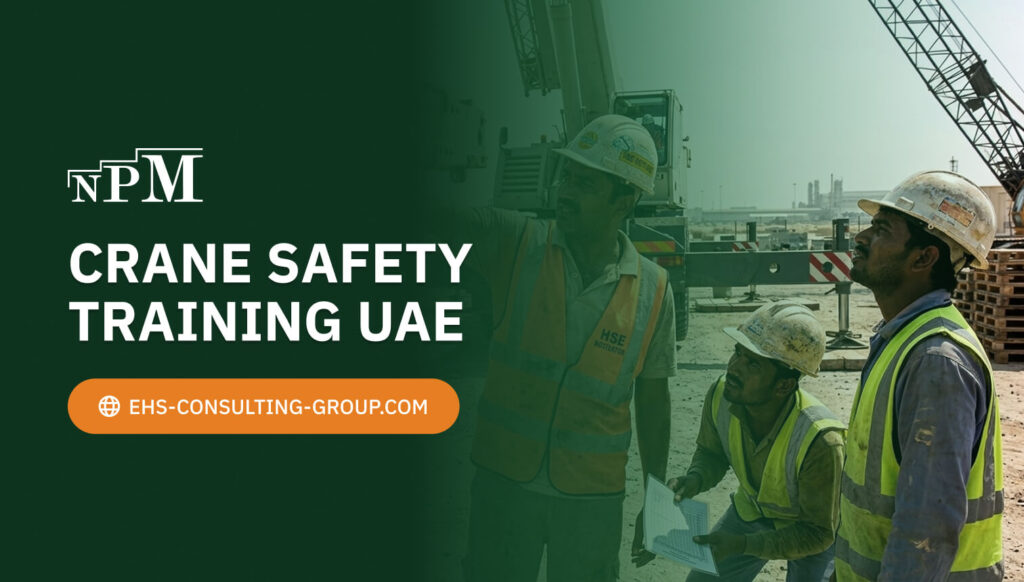
Crane Safety Training for Major Construction Project is not just a compliance checkbox; it is a structured approach to managing high-consequence risk across complex worksites where multiple trades, tight schedules, and heavy lifts converge. In the UAE’s major projects—high-rise towers, stadiums, refineries, metro extensions, power plants, and logistics hubs—lifting operations interact with temporary works, congested laydown areas, and fast-changing site conditions. This article looks at how robust, competency-based training for crane teams supports safe, efficient, and compliant lifting throughout the project lifecycle, from early enabling works to demobilisation.
Rather than reading like a course outline, the discussion here focuses on what effective lifting-focused capability building entails: aligning roles and competencies, integrating with permit-to-work systems, hardwiring risk assessment and lift planning into daily routines, and reinforcing decision-making under situational pressure. The goal is to help HSE leaders, construction managers, and plant owners understand the moving parts that make crane-related learning truly operational—not classroom-only knowledge that fails under field realities.
Across the Emirates, core expectations are shaped by ISO 45001-aligned management systems, local requirements from Abu Dhabi’s OSHAD, Dubai Municipality’s construction safety codes, Civil Defence, and MOHRE, as well as client-driven frameworks such as ADNOC’s HSE requirements and Life-Saving Rules. Overlay international guidance such as BS 7121 (safe use of cranes), EN 13000 (mobile crane safety), and recognized good practices from lifting equipment inspection standards, and you have a multi-layered baseline. Training that speaks to those standards, the specific crane fleet on site, and the project’s construction sequencing is what consistently reduces exposure.
With that context in mind, the rest of this article connects the dots: who needs to engage in this topic, why it matters at executive and field levels, the essential components of technically credible training, and how it plays out in practice on a major project with multiple subcontractors and dynamic site constraints.
Who Does This Affect?

Lifting is a team activity, and capability gaps in any role can unravel even a well-planned operation. On major works, the following groups are directly concerned:
- Appointed Persons (APs), Lift Engineers, and Temporary Works Coordinators who define method statements, select cranes/rigging, and validate ground bearing pressure (GBP) and outrigger/track support.
- Lift Supervisors, Banksmen/Signalers, and Riggers who execute and control the lift on the ground, translate plans into action, and make time-critical decisions when conditions change.
- Crane Operators across mobile telescopic cranes, crawler cranes, tower cranes, gantries, and overhead traveling cranes used in fabrication yards, precast facilities, and MEP/steel erection zones.
- Site Engineers, Construction Managers, and Package Leads who schedule lifts, manage interfaces (excavation, formwork, façade installs, utilities), and coordinate simultaneous operations (SIMOPS).
- HSE Managers/Officers and Client Reps who assure compliance with OSHAD, Dubai Municipality, Civil Defence, and client standards; they also audit, trend, and elevate learning from near misses.
- Logistics and Yard Teams handling laydown, marshalling, traffic control, and exclusion zones in constrained spaces.
On EPC mega-projects and complex urban builds, third-party inspection bodies, independent engineers, and vendor technicians (e.g., for tower crane erection, MBC/radio installation, load monitoring systems, and anti-collision) also influence the training conversation by setting inspection and acceptance criteria. Given this network of actors, training must be role-specific and coordinated so that the entire lifting system performs as designed—not just individual parts.
Why This Topic Matters

Cranes concentrate energy in a way few site activities do. A single error in rigging geometry, load estimation, signaling, or environmental monitoring (wind, visibility, ground conditions) can result in catastrophic events: dropped loads, structural collapse, tip-over, or electrical contact. In a major project environment, the consequences are magnified by scale—multi-ton prefabricated modules, complex façade panels, and tandem lifts near live plant or public interfaces.
From a compliance standpoint, the UAE’s regulatory expectations are clear. Authorities and clients expect documented competence aligned to roles, current certifications for operators and riggers, third-party inspection of lifting appliances and accessories, and lift categorization (routine/non-routine/critical) with approved plans. ISO 45001 and client HSEMS frameworks demand evidence that training is effective—i.e., that it changes behavior, not just populates a training matrix. ADNOC-aligned Life-Saving Rules add further emphasis on lifting authorization, exclusion zones, and line-of-fire controls.
Operationally, the stakes include schedule risk and cost. Major lifts often sit on the critical path. Delays or stoppages triggered by poor planning or competence gaps cascade across dependent trades. Conversely, a well-trained team reduces rework, accelerates installation, and minimizes plant downtime in brownfield tie-ins. Good training also strengthens frontline decision-making when conditions deviate from plan, which is often when things go wrong. Bowtie-style thinking—linking threats, barriers, and escalation factors—is especially relevant to lifting operations where real-time trade-offs matter.
Finally, reputational risk is material. Contractors, developers, and asset owners are evaluated not only on output but on how safely that output is achieved. A mature training approach reflects leadership commitment to workforce safety and environmental stewardship, especially in high-visibility segments like high-rise construction, petrochemical turnarounds, and large public infrastructure.
Key Points to Understand

The training that underpins safe lifting on a major project is neither generic nor one-size-fits-all. It is a competency system that connects risk assessment, equipment knowledge, human factors, and site controls into a living framework.
1) Role-based competency framework
Each role has distinct responsibilities and knowledge requirements. The matrix below illustrates how core competencies trend across key roles. This is illustrative; actual matrices should be tailored to your project, fleet, and regulatory commitments.
| Role | Technical Competence | Risk/Planning Competence | Operational Control | Standards/Regulatory Knowledge |
|---|---|---|---|---|
| Appointed Person / Lift Engineer | Crane selection, load charts, rigging design, GBP calculations, tandem lifts | HAZID, Bowtie, critical lift criteria, SIMOPS integration | Authorizes lift, approves method statements, change control | BS 7121, EN 13000, client specs, OSHAD/Dubai Municipality/Civil Defence |
| Lift Supervisor | Rigging verification, exclusion zone set-up, pre-lift checks | Dynamic risk assessment, permit-to-work interfaces | Controls execution, stop-work decisions, toolbox talks | Project lift procedures, Life-Saving Rules |
| Crane Operator | Load charts, crane setup, anti-two-block/limiters, wind alarms | On-the-spot risk adjustments, communication protocols | Operates safely, follows signals, monitors stability | Manufacturer manuals, site-specific rules |
| Banksman/Signaler | Signaling, radio protocols, line-of-sight strategies | Exclusion zone integrity, spotting overhead hazards | Directs lifts, ensures clear communication | Site traffic management, electrical proximity rules |
| Rigger | Sling angles, D/d ratio, CoG identification, hardware inspection | Field-level hazard recognition, tag line use | Prepares load, attaches/detaches safely | Lifting accessory color-coding/inspection regimes |
| HSE Officer | Inspection protocols, observation programs | Audit/assurance, incident learning, KPI trending | Verifies controls, facilitates improvement | ISO 45001, regulatory codes, client HSEMS |
2) Risk-based content and lift categorization
Training must reflect how your project defines and manages lift categories: routine vs. critical lifts (e.g., tandem lifts, lifts near live plant or public roads, lifts over occupied areas, or above energized systems). Instruction should not only explain what a critical lift is, but teach the rationale and the additional barriers involved—peer review, engineering calculations, simulation, enhanced supervision, and contingency planning.
3) Integration with management systems
Competence is sustained when it is tied to the site’s permit-to-work, method statement/Job Safety Analysis (JSA), and change control. A well-trained team knows how to embed lifting plans within PTW boundaries, how to flag and document deviations, and how to escalate when lift parameters shift (wind, ground conditions, access constraints, load verification). The ability to think in Bowtie terms—what barriers are in place, what can degrade them, and what escalation factors to monitor—is a learned skill that good training cultivates.
4) Equipment-specific knowledge
Even experienced operators encounter new combinations of cranes, luffing jibs, fly extensions, anti-collision systems, and lifting accessories on mega-projects. Good programs address manufacturer-specific controls, rated capacities across configurations, limits and alarms, how to interpret load-moment indicators, and when to stop and consult the manual. For tower cranes, anti-collision and zoning systems must be understood by both operators and lift supervisors; for mobile cranes, outriggers, cribbing, and ground bearing pressure calculations often determine whether a lift proceeds safely.
5) Environmental and site context
UAE sites contend with high winds, gusting, dust, and heat. Training should focus on interpreting wind curves, measuring gusts at height, understanding sail area effects for panelized loads, and recognizing the additional drift risk in dusty conditions. Site congestion and public interfaces require strong exclusion zone discipline, traffic coordination, and clear signaling when line-of-sight is obstructed.
6) Human factors and communication
Many crane incidents involve communication breakdowns. Practical drills on standardized hand signals, radio call structures, closed-loop communication, and cross-language confirmation (where multilingual crews operate) are not optional. Scenarios should include loss of radio, partial visibility, and emergency stops to reinforce automatic safe responses.
7) Documentation and continuous learning
Training content should prompt robust documentation: lift plans with CoG and sling angle drawings, calculations for GBP, inspection checklists for cranes and accessories, and toolbox talk records. Maintaining a current, accessible knowledge base of approved templates, case studies, and lessons learned supports the program’s memory over long projects. Many teams use a centralized repository to manage this; resources like CABINET NPM can help standardize and curate technical materials so the most up-to-date guidance is in the hands of supervisors and crews.
How This Works in Practice

On a major project, training effectiveness shows up in day-to-day routines rather than certificates pinned to noticeboards. The following practices illustrate how capability translates into safer operations:
First, planning. Appointed Persons collaborate with construction engineers during lookahead planning to map critical lifts against milestones and interfaces. They choose crane configurations, calculate GBP with geotechnical input, and develop lift drawings that communicate sling angles, taglines, and pinch points. HSE validates that planned controls align with project procedures and regulatory expectations. When training is on point, these tasks are efficient and consistent across packages and subcontractors.
Second, pre-lift verification. Supervisors use structured checklists that are consistently understood by operators and riggers. This includes confirming weather parameters, verifying the load’s weight and CoG, inspecting slings and shackles (size, SWL, certification, color code), validating exclusion zones and barriers, and establishing primary/secondary communication channels. A trained crew conducts a “dry run” for complex picks to confirm swing paths and clearance.
Third, execution discipline. Banksmen control line-of-fire exposure, maintain radio etiquette, and ensure that load travel paths remain sterile. Operators trim movements to reduce dynamic load effects and stop when signals or conditions become uncertain. Supervisors track deviations and initiate stop-work without hesitation when barriers degrade (e.g., wind spikes over manufacturer limits or ground settlement is observed).
Fourth, change control and escalation. When a load arrives heavier than expected, when a façade panel geometry is different from the drawing, or when a nearby excavation alters GBP assumptions, trained teams know how to pause and step through change protocols. They consult calculations, revalidate outrigger support, and, if necessary, recategorize the lift as critical. This is where competency shows: it is the habit of asking the right questions.
Fifth, post-lift learning. Near misses and good catches are captured in brief, blame-free after-action reviews. Photos of sling configurations, rigging hardware selection, or interference encountered are saved to the project’s knowledge base. Supervisors use these to refresh toolbox talks and update method statements if systemic lessons emerge.
Finally, subcontractor alignment. On mega-projects, multiple lifting subcontractors and suppliers cycle through the site. Trained oversight teams verify credentials, spot-check operator/rigger skills, and audit compliance with inspection regimes. They insist on compatible radio protocols and common hand signal charts posted at lifting zones. Harmonizing these elements prevents mixed-signal incidents.
- Daily reinforcement: toolbox talks that refresh one lifting principle each day (e.g., sling angle effects, tag line positioning, wind thresholds).
- Scenario-based refreshers: short, focused sessions triggered by an observed trend (e.g., increasing near misses involving blind lifts).
- Targeted coaching: HSE and senior supervisors shadow new crews to validate competence before authorizing autonomous operations.
Benefits and Practical Use Cases

When crane-related training is designed around roles, risk, and real operations, several tangible benefits emerge:
- Fewer high-potential incidents: Improved hazard recognition and stop-work authority reduce exposure during complex picks and tandem lifts.
- Schedule reliability: Reduced rework and fewer aborted lifts protect the critical path, especially when heavy modules or façade panels drive milestones.
- Assurance and audit readiness: Documentation and traceability satisfy OSHAD, Dubai Municipality, Civil Defence, and client verification needs without scramble.
- Consistency across subcontractors: Shared protocols, signals, and acceptance criteria lower integration friction on busy sites.
- Better decisions under pressure: Familiarity with wind curves, load charts, and change control enables quicker, safer responses to deviations.
Consider common use cases on major UAE projects:
In steel erection, multiple mobile cranes operate simultaneously to position trusses within tight urban constraints. A trained team enforces overlapping exclusion zones, coordinates via predefined radio channels, and uses pre-lift coordination meetings to avoid boom conflicts. Anti-collision settings are validated before operations begin, and a single banksman directs each lift with clear cross-checks when cranes enter each other’s envelopes.
For high-rise façade installation, tower cranes manage large, wind-sensitive panels. Crews trained on sail area effects and gusting at height use a conservative wind threshold, pre-rig panels with balanced pickup points, and assign tag line handlers experienced in drift control. A standby line with a secondary handler is prepared for sudden gusts.
On brownfield petrochemical tie-ins, critical lifts over live equipment require advanced planning. The AP models swing paths, defines emergency set-down areas, verifies non-sparking tag lines, and integrates with the site’s permit-to-work. Operators are drilled on emergency stop practices; riggers know how to retreat to safe zones if the load oscillates.
In precast yards feeding mega-projects, overhead traveling cranes move heavy segments. Training focuses on load stability during acceleration/deceleration, avoiding side pull, ensuring maintenance inspections are current, and coordinating ground guides in noisy environments. Documented competence and routine refresher briefings keep pace with high throughput.
Best Practices and Points of Caution

To make crane-related capability stick across the project duration, several best practices are recommended:
- Build a living competency matrix: Map roles to learning outcomes and keep it current as the project evolves (e.g., introducing tandem lifts or new crane models).
- Link training to critical lift reviews: Require evidence of recent, relevant learning before authorizing critical lifts, especially for new crews or complex configurations.
- Integrate environmental awareness: Teach crews to interpret site-specific wind data and to escalate early in gusting or sandstorm conditions.
- Standardize communication: Post common hand signal charts at lifting zones, enforce closed-loop radio protocol, and include multilingual confirmation steps where needed.
- Audit field application, not just certificates: Observe pre-lift checks, signal discipline, and change control in the field; coach on the spot.
- Harmonize subcontractor standards: Use common acceptance criteria for rigging hardware, inspection tags, and documentation packages to avoid mismatches.
- Control interfaces: Coordinate with temporary works and excavation teams to verify GBP assumptions remain valid as site conditions change.
- Treat proximity to power as exceptional: Reinforce safe approach distances, isolation, and dedicated spotters for any work near energized lines.
Caution is warranted particularly around ground conditions (underrated in many incidents), evolving wind profiles with height, complex load geometries where the center of gravity is difficult to establish, and communication in visually cluttered areas. Training must emphasize that stopping to reassess is a positive control action, not a delay to be punished.
Frequently Asked Questions About Crane Safety Training for Major Construction Project
How often should crane teams refresh their lifting competencies on a mega-project?
Frequency depends on role criticality, turnover, and observed trends. Operators, riggers, and supervisors benefit from periodic refreshers keyed to incident learning, equipment changes, or introduction of new lift categories. Many projects use a mix of annual formal refreshers and short, scenario-driven updates triggered by leading indicators.
What distinguishes a critical lift from a routine lift in practice?
Critical lifts typically involve elevated risk factors: heavy or near-capacity loads, tandem lifts, lifts near live plant or public areas, blind lifts, lifts over occupied spaces, or unusual configurations. The distinction is not just a label; it triggers enhanced planning, peer review, approvals, and controls, all of which teams need to learn and practice.
How do wind limits apply to different crane types and loads?
Manufacturers specify wind limits for crane configurations, and loads with large sail areas may require stricter thresholds than the crane’s base limit. Training reinforces reading wind curves, measuring gusts at height, and applying the more conservative limit between crane and load. When in doubt, stop and reassess; wind is a dynamic hazard that deserves real-time monitoring.
Can multinational, multilingual crews maintain clear signaling and radio communication?
Yes—if protocols are standardized and reinforced. Common hand signal charts posted in lifting zones, closed-loop radio communication with confirmation, and pre-lift checks that validate comprehension help overcome language barriers. Drills that simulate partial visibility, dead spots, or radio failure build confidence in backup tactics.
How should ground bearing pressure be handled during planning and in the field?
APs calculate GBP with the crane’s configuration, load, and outrigger/track support, often in consultation with geotechnical and temporary works teams. In the field, supervisors verify that site conditions match assumptions: no undermining by nearby excavations, adequate cribbing, no soft spots or voids, and that matting is placed as designed. If conditions differ, stop and revalidate.
What documentation should a lift plan include to be audit-ready?
At minimum, include the method statement, lift categorization and approvals, crane configuration, load charts, GBP calculations, sling angle drawings, accessory certifications and inspection status, communication plan, exclusion zones, environmental limits, and emergency procedures. Audit readiness is about clarity and traceability; training should teach crews what “good” looks like.
How do we verify third-party operators’ and riggers’ competence?
Check valid certifications aligned to local requirements and client standards, conduct practical assessments on site (signals, load chart reading, rigging inspection), and shadow initial operations before granting full authorization. Align subcontractors with your communication protocols and inspection/color-coding regime from day one.
What role do HAZID, Bowtie, or similar methodologies play in lifting safety?
They help teams visualize threats, preventive barriers, and potential escalation, turning abstract risks into concrete controls. Bowtie thinking, for example, clarifies what to monitor as conditions change and which safeguards can degrade. Training that introduces these techniques equips supervisors and operators to make more reliable decisions in the field.
Conclusion
On a major project, lifting is a litmus test of a site’s safety maturity. When people understand their roles, share a common language of risk, and practice decisive control actions, cranes become productive assets rather than sources of anxiety. Everything discussed above—from role-based competencies and lift categorization to communication discipline, documentation, and environmental awareness—points to the same objective: a trained, cohesive lifting team capable of consistent, safe execution.
Crane Safety Training for Major Construction Project, approached as a competency system embedded in planning and field practice, gives HSE leaders and construction managers a way to turn standards into daily behaviors. With UAE regulatory expectations, international codes like BS 7121 and EN 13000, and client-driven HSEMS frameworks setting the baseline, the differentiator is how well your teams internalize and apply the controls when the lift is live.
To go further on this topic, NPM’s broader Crane Safety Training UAE page covers this in more depth.
Our References
NPM’s references reflect complex, real-world lifting challenges across multiple industries and geographies, not just a narrow set of sites. Over the years, NPM has supported construction megaprojects, oil and gas facilities, petrochemical expansions, power generation assets, logistics terminals, and manufacturing plants where cranes are everyday tools and also potential high-consequence hazards. This breadth matters for crane-related capability building: when teams draw on lessons from high-rise tower works, refinery turnarounds, prefabrication yards, and metro extensions, they gain a richer perspective on how lift planning and execution succeed under different constraints. Our past work demonstrates how role-based competence, rigorous lift categorization, environmental triggers (wind, dust, heat), and robust communication protocols can be codified into training that genuinely improves field performance.
Across large EPC contracts and multi-contractor builds, NPM’s project experience shows the value of harmonizing subcontractor practices, aligning radio and hand-signal protocols, and managing inspection regimes for cranes and accessories so that audit readiness is a by-product of good operations. Where tower cranes, mobile fleets, or overhead systems form critical-path dependencies, our references highlight how pre-lift verification, ground bearing engineering, and change control preserve both safety and schedule. Whether the lifts involved façade panels with complex sail areas or tandem picks near live process equipment, the priority remained the same: practical competence that translates under pressure. We invite you to explore how these insights can inform your own approach to lifting capability on major projects.
For more information about our references, visit Our References.
Speak with NPM
If you have questions about how these concepts apply to your site, NPM is available to discuss practical approaches tailored to your project’s crane fleet, risk profile, and regulatory commitments. Whether you are aligning multiple subcontractors, managing critical lifts, or seeking to strengthen field execution, we are happy to share perspectives. For any further questions or to speak with our team, Contact Us.