
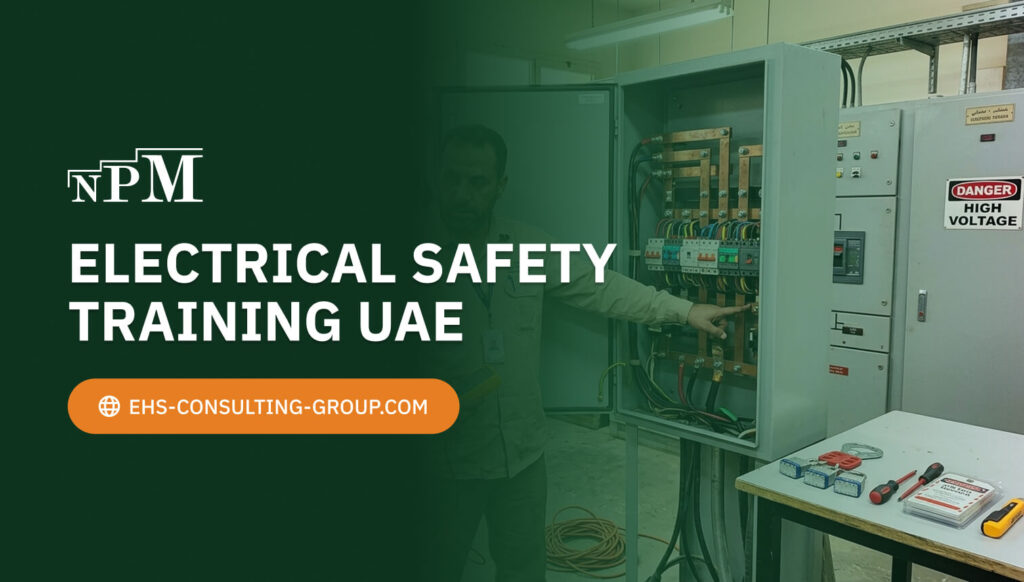
Electrical Safety Training UAE delivered by NPM equips technicians, engineers, supervisors, and non-electrical staff with practical skills to identify, control, and work safely around electrical hazards in high-risk industrial environments. Tailored for oil and gas, petrochemical, manufacturing, utilities, logistics, construction, and power generation operations, this training aligns with UAE regulatory expectations and international best practice (NFPA 70E, IEC/BS standards, and ISO 45001). This localized offering is part of our broader Safety Training Services UAE delivered across the country, ensuring your workforce gains role-appropriate competencies for lockout/tagout (LOTO), permit-to-work (PTW), energized work controls, arc-flash risk management, and equipment isolation in both LV and HV contexts.
Electrical Safety Training UAE is customized to your assets, job roles, and risk profile. NPM’s instructors bring deep field experience from refineries, terminals, offshore platforms, manufacturing lines, utilities substations, warehouses, and construction sites across the UAE. We integrate site-specific procedures, single-line diagrams, and real permits and job plans into case-based exercises so participants leave with skills they can apply immediately on your equipment and within your management systems.
Who should attend Electrical Safety Training UAE?

Electrical Safety Training UAE is designed for organizations operating complex or energy-intensive facilities, and for teams that install, operate, maintain, or supervise electrical systems. Typical attendees include electrical engineers, maintenance technicians, instrument and control (I&C) personnel, facility managers, safety officers, authorized persons (AP), competent persons (CP), supervisors, contractors, commissioning teams, and operations staff who interact with electrically powered equipment or work near energized parts.
For industrial operations where shutdown windows are tight and downtime is costly, Electrical Safety Training UAE helps your people plan isolations correctly, verify zero energy, understand arc-flash boundaries, apply selection and inspection criteria for PPE, and coordinate safely with PTW issuers, LV/HV switching teams, and construction contractors. HSE managers and training coordinators rely on this program to standardize safe work practices across mixed-nationality workforces and multi-site portfolios, improving compliance while reducing undesired electrical events and near misses.
Objectives of Our Electrical Safety Training UAE

Our Electrical Safety Training UAE builds practical competence and confidence so delegates can perform electrical tasks safely, comply with local requirements, and make sound risk-based decisions. By the end of the program, participants understand hazard identification, risk evaluation, and the control measures necessary for both routine and non-routine electrical work, including isolation, testing, maintenance, and energization.
- Recognize common electrical hazards (shock, arc flash, arc blast, burns) and applicable safe approach boundaries.
- Apply LOTO and PTW requirements correctly, including testing for dead and establishing zero-energy state.
- Select and inspect appropriate PPE for LV/HV tasks, considering arc-rating, gloves, face shields, and tools.
- Interpret single-line diagrams, labels, and nameplates to plan safe isolations and switching sequences.
- Implement safe work practices for confined spaces, wet areas, temporary supplies, and portable tools.
- Coordinate with supervisors/authorized persons on switching, isolation, testing, and re-energization controls.
- Respond effectively to electrical incidents: first aid for electric shock and safe emergency shutdown steps.
- Align site practice with UAE regulations and international guidance (e.g., NFPA 70E, ISO 45001).
Training Program / Modules

Electrical Safety Training UAE is modular and scalable. NPM maps the curriculum to your workforce roles, from awareness for non-electrical staff to practitioner and authorized person levels for technicians, supervisors, and engineers. We blend short toolbox sessions with deep-dive modules covering hazard controls, LOTO, PTW integration, arc-flash risk, and EX equipment considerations where relevant. Delivery can be on-site, virtual, or hybrid, with case studies built from your procedures, diagrams, and permits.
| Module | Key Topics | Typical Audience | Indicative Duration |
|---|---|---|---|
| Electrical Safety Fundamentals | Shock/arc hazards, safe approach, signage, equipment labeling | All staff, non-electrical workers | 0.5–1 day |
| LOTO and PTW Integration | Isolation planning, test-for-dead, tags/locks, PTW interface | Technicians, supervisors, PTW issuers/receivers | 1 day |
| Arc-Flash Risk and PPE | Incident energy basics, boundaries, arc-rated PPE/tool selection | Electrical crew, authorized persons | 0.5–1 day |
| LV/HV Switching & Isolation | Single-line diagrams, switching orders, testing, re-energization | AP/CP, supervisors, engineers | 1–2 days |
| EX (Hazardous Areas) Awareness | Equipment protection concepts, gas groups, ignition controls | Oil & gas, petrochemical, terminals | 0.5 day |
| Portable Tools & Temporary Power | Inspection, RCD/GFCI, cords, site set-up, housekeeping | Construction, maintenance, fabrication | 0.5 day |
| Electrical Incident Response | Shock first aid, burns, rescue considerations, reporting | Supervisors, HSE, first responders | 0.5 day |
For organizations seeking competency development at scale, Electrical Safety Training UAE can be staged as a pathway: awareness for all, practitioner skills for electrical teams, and authorized person-level modules for those who plan and supervise isolations, switching, and energization. NPM ensures scenario realism with examples drawn from your equipment and operating conditions.
Duration and Format of Electrical Safety Training UAE

Electrical Safety Training UAE is available in multiple durations to match your risk profile and operational windows. Awareness-level training typically runs 4–8 hours. Practitioner pathways range from 1–2 days depending on scope (LOTO/PTW, arc-flash, LV/HV isolation). Authorized person and supervisor-level courses often span 2–3 days with competency checks on planning isolations, issuing switching orders, and verifying controls before re-energization. Refresher or toolbox sessions can be delivered in focused 2–4 hour blocks, ideal for contractor mobilizations or shutdown readiness.
Delivery is on-site at your facility anywhere in the UAE, at an NPM-hosted venue, or through live virtual/hybrid sessions when multi-site teams must align at once. Electrical Safety Training UAE is conducted in English or Arabic as required, with bilingual materials available. Class sizes are balanced for interactivity and hands-on exercises, typically 10–16 delegates per cohort for practitioner/AP levels, and up to 20–24 for awareness, ensuring adequate coaching time without disrupting production schedules.
Benefits and Practical / Operational Use Cases

Electrical Safety Training UAE helps organizations reduce incidents, avoid costly downtime, and demonstrate due diligence to regulators and clients. Delegates return to the job capable of applying site-specific procedures, selecting the right PPE and tools, and coordinating effectively under your PTW system. The program also supports contractor management by standardizing expectations across mixed workforces during turnarounds, shutdowns, and brownfield expansion projects.
- Fewer electrical near-misses and first-aid cases through correct approach boundaries and PPE use.
- Improved LOTO/PTW discipline, reducing inadvertent energization and maintenance delays.
- Better planned isolations and faster safe re-energization following maintenance and testing.
- Reduced arc-flash exposure via reinforced risk assessment and task-based PPE selection.
- Consistent standards across sites, contractors, and shifts for dependable compliance outcomes.
- Demonstrable commitment to UAE rules and recognized international standards during audits.
Why Choose Us

NPM brings real-world electrical safety leadership experience from refineries, petrochemical complexes, power and water utilities, manufacturing plants, and major construction programs. Our instructors are seasoned practitioners who have authored switching procedures, implemented LOTO programs, led incident investigations, and harmonized PTW systems across multi-site portfolios. Electrical Safety Training UAE is not a generic classroom lecture; it is an interactive, scenario-driven program anchored in your drawings, permits, and equipment, so participants leave with immediately usable competence.
Beyond technical excellence, NPM aligns with international best practice and maintains access to a global network of standards and management expertise through CABINET NPM. We invest in high-quality learning materials, bilingual delivery, and rigorous assessments so your organization can evidence competence during audits and client pre-qualifications. Electrical Safety Training UAE with NPM scales across the UAE, integrating seamlessly with your HSE management system and contractor onboarding workflows.
Detailed Training Levels and Role-Focused Offerings
Electrical Safety Training for Manufacturing
Electrical Safety Training for Manufacturing focuses on hazards common to assembly lines, machine cells, conveyors, packaging equipment, compressed air systems with electrical interlocks, and automated controls. This training is for production supervisors, maintenance technicians, electricians, and safety coordinators who must keep throughput high while controlling exposure to shock, arc flash, and unexpected energization. The program addresses machine-specific lockout plans, interlock bypass controls, RCD/GFCI use, portable tool inspection, and maintenance handover under PTW. It also reinforces risk assessment at changeovers and during troubleshooting of VFDs, MCCs, and control cabinets. Because many manufacturing plants run continuous shifts, we tailor Electrical Safety Training for Manufacturing into staggered cohorts and toolbox refreshers so skills are applied without disrupting takt time. As part of NPM’s Electrical Safety Training UAE portfolio, the curriculum references IEC/BS standards and NFPA 70E concepts to guide PPE selection and boundary setting, all while using your SOPs, single-line diagrams, and actual isolation points to make practice sessions real. Participants leave with a repeatable routine for safe isolation/verification, better coordination with production planning, and the confidence to manage electrical risks amidst lean operations and just-in-time pressures.
Click on the following link for more details: Electrical Safety Training for Manufacturing.
Electrical Safety Training for Oil & Gas
Electrical Safety Training for Oil & Gas addresses upstream, midstream, and downstream contexts including offshore platforms, terminals, gas processing plants, refineries, and tank farms. It is designed for electrical engineers, I&E technicians, operations supervisors, and PTW issuers who work in hazardous areas and must integrate electrical isolation with process safety controls. The curriculum dives into EX equipment concepts, gas group classifications, and ignition source control, linking electrical risk decisions with simultaneous operations (SIMOPS), hot work, confined space entry, and line break activities. Delegates practice planning LV/HV switching, coordinating isolation with mechanical lockouts, verifying test-for-dead in classified zones, and sequencing re-energization to avoid surge risks. Electrical Safety Training for Oil & Gas also covers interface risks during shutdowns and brownfield tie-ins, where multiple contractors share power sources and temporary supplies. Embedded within Electrical Safety Training UAE, the program we deliver by NPM incorporates NFPA 70E, IEC, and ADNOC-aligned expectations for competence, documentation, and PTW integration. Outcomes include fewer LOTO deviations, improved energization planning, stronger coordination among discipline leads, and traceable compliance ready for client and regulator audits in high-hazard energy operations.
Click on the following link for more details: Electrical Safety Training for Oil & Gas.
Electrical Safety Training for Construction
Electrical Safety Training for Construction targets general contractors, EPCs, and specialist subcontractors involved in greenfield builds, brownfield expansions, and fit-outs. Construction presents dynamic conditions: temporary power, variable earthing/grounding, wet areas, congested workfronts, and frequent equipment moves. This training equips site engineers, supervisors, electricians, and safety officers to manage electrical risks during erection, testing, and commissioning. Content includes planning temporary supplies and distribution boards, correct use of RCDs/GFCIs, cable routing and protection, inspection of portable tools and extension leads, and control of energization during progressive commissioning. In addition, the course connects electrical controls to broader construction risk coordination under PTW: segregation, signage, barricading, and simultaneous high-risk tasks like lifting, hot work, and work at height. Electrical Safety Training for Construction is embedded within NPM’s Electrical Safety Training UAE offer and is customized with your site layout, sequence plans, and permit conditions so crews can practice safe isolation and verification in staged workfronts. Benefits include fewer rework items from electrical damage, safer energization milestones, improved coordination between MEP and civil trades, and stronger evidence of competence for client HSE teams and consultants conducting site audits.
Click on the following link for more details: Electrical Safety Training for Construction.
Electrical Safety Training for Utilities
Electrical Safety Training for Utilities is designed for power generation, transmission, and distribution operators, as well as district cooling and water/wastewater utilities. Utilities face unique risks in HV switching, substation operations, live-line work boundaries, and control room coordination. This program builds competence for authorized persons, controllers, and field crews to plan and execute switching orders, perform isolation and earthing, verify test-for-dead, and manage re-energization safely. It includes interpretation of single-line diagrams, relay protection awareness, coordination with system operations, and clarity on roles and responsibilities between the control center and field personnel. Electrical Safety Training for Utilities, as part of Electrical Safety Training UAE, maps to IEC and utility best practices while reinforcing PTW/LOTO integration in complex network topologies. The course leverages your procedures, network diagrams, and event histories to build realistic exercises, culminating in scenario walk-throughs on outage planning and incident response. Outcomes include improved discipline in switching and tagging, fewer operational errors leading to equipment stress, stronger situational awareness across crews, and a clear, auditable trail of competency development for regulators and stakeholders.
Click on the following link for more details: Electrical Safety Training for Utilities.
Regulatory Landscape & Industry Context in the UAE
Electrical Safety Training UAE is aligned with the UAE’s regulatory environment and common client expectations. While federal labor law requirements (e.g., Federal Decree‑Law No. 33 of 2021 and implementing regulations under MOHRE) set high-level duties of care, practical electrical safety expectations are enforced through Emirate-level systems, client specifications, and international standards. In Abu Dhabi, the OSHAD system (now administered through Abu Dhabi Public Health Centre) prescribes structured risk management and training for high-risk activities, including electrical work, PTW, and contractor oversight. In Dubai, Dubai Municipality codes and Dubai Civil Defence (UAE Fire and Life Safety Code of Practice) shape site controls, labeling, emergency planning, and safe energization during construction and fit-out. Across the UAE, many operators adopt ISO 45001 for OHSMS governance and NFPA 70E as the go-to guidance for shock and arc-flash risk controls.
Free zones and industrial hubs such as JAFZA, Dubai Industrial City (DIC), KIZAD, ICAD, Mussafah, and RAKEZ often stipulate training and competence evidence for workers exposed to electrical hazards. Electrical Safety Training UAE by NPM ensures your training records, assessment outcomes, and competence matrices are audit-ready and traceable, supporting client pre-qualification, insurance requirements, and regulatory inspections.
Coverage Across UAE Locations
NPM delivers this program across major industrial hubs and free zones. Whether your crews operate at ports, industrial cities, or remote assets, we schedule Electrical Safety Training UAE to align with shift patterns, shutdowns, and contractor mobilizations, ensuring consistent competency across your portfolio.
Electrical Safety Training Dubai
Electrical Safety Training Dubai supports operators across Jebel Ali Industrial Area, JAFZA, Dubai South, and Dubai Industrial City, where logistics hubs, manufacturing plants, and large construction programs demand robust electrical controls for temporary power, LV/MV substations, and commissioning activities. With Dubai Municipality requirements and Dubai Civil Defence oversight shaping site practices, Electrical Safety Training Dubai helps teams integrate LOTO/PTW with hot work, lifting, and energized testing under tight schedules. NPM customizes content using your permits, distribution layouts, and switching procedures, reflecting realities at Jebel Ali Port interfaces, free zone gate controls, and mixed-contractor workfronts typical of large EPC projects. The training also addresses fit-out stages in commercial towers and data centers, where coordination between MEP trades and base-build services is critical. By embedding case studies from your Dubai assets and clarifying responsibilities between supervisors, authorized persons, and contractors, Electrical Safety Training Dubai builds consistent, auditable competence that withstands client and authority inspections without compromising program timelines.
Click on the following link for more details: Electrical Safety Training Dubai.
Electrical Safety Training Abu Dhabi
Electrical Safety Training Abu Dhabi is structured around OSHAD expectations and the operational realities of Mussafah, ICAD, KIZAD, Ruwais, and Khalifa Port. ADNOC and utility stakeholders typically require rigorous isolation, switching, and re-energization discipline backed by documented competence. Electrical Safety Training Abu Dhabi equips authorized persons, technicians, and supervisors to plan isolation using single-line diagrams, execute HV/LV switching orders, coordinate with control rooms, and integrate electrical controls with process safety, especially in petrochemical and power/water assets. The program references Abu Dhabi Civil Defence requirements and aligns with ISO 45001 and NFPA 70E guidance so that site practices are consistent with both Emirate and international expectations. Participants work through exercises using site permits, equipment labels, and past incident learnings from Abu Dhabi facilities, ensuring relevance to real challenges like brownfield tie-ins, shutdown SIMOPS, and contractor interfaces across ICAD and KIZAD. Electrical Safety Training Abu Dhabi ultimately improves field discipline, reduces rework and delays during energization milestones, and provides competence records that stand up to regulator and client audits.
Click on the following link for more details: Electrical Safety Training Abu Dhabi.
Assessment & Certification
Electrical Safety Training UAE includes formal and practical assessments appropriate to the level delivered. Delegates complete written knowledge checks, participate in case-based problem solving, and undertake practical demonstrations such as isolation planning, correct sequence for LOTO, test-for-dead verification, arc-flash boundary determination, and appropriate PPE/tool selection. For AP/CP pathways, competency is evaluated against role responsibilities, including reviewing a mock switching order or isolation certificate.
Upon successful completion, participants receive a certificate of completion that states the course title, learning objectives, duration, assessment type, and the participant’s name and unique ID. The certificate also records the delivery format (on-site/virtual) and trainer credentials. The client organization remains responsible for statutory competency sign-off, authorization to work, and any role appointments under internal or regulatory frameworks.
For impactful delivery, NPM recommends group sizes of 10–16 for practitioner/AP levels and up to 20–24 for awareness cohorts. Before training, we conduct a scoping phase (needs analysis, review of PTW/LOTO procedures and single-line diagrams, and agreement on site-specific scenarios) to ensure Electrical Safety Training UAE maps precisely to your operations, risk profile, and job roles.
FAQ
How often should this electrical training be renewed?
Most organizations repeat Electrical Safety Training UAE every 24 months for practitioners and annually for high-risk roles or contractor workforces. Triggers for earlier refreshers include procedure changes, new equipment, incident learnings, or upcoming shutdowns and commissioning phases.
What is the difference between initial and refresher training?
Initial Electrical Safety Training UAE establishes baseline competence, covering fundamentals, procedures, and practical exercises. Refresher training is shorter and focuses on critical updates, observed gaps, and scenario practice aligned to current tasks, assets, and lessons learned.
Who issues the certificate of completion?
NPM issues the certificate of completion upon successful assessment. Your organization retains responsibility for any formal authorizations, role appointments, or statutory competency declarations as required by your management system or authorities.
Is in-house delivery better than public sessions?
In-house delivery allows Electrical Safety Training UAE to incorporate your procedures, drawings, and permits, maximizing relevance and impact. Open/public sessions suit smaller teams needing rapid upskilling without scheduling a dedicated cohort.
What are the recommended group sizes?
For hands-on practice and interaction, we recommend 10–16 participants for practitioner/AP cohorts and up to 20–24 for awareness. These sizes ensure coaching time while minimizing operational disruption.
Are there prerequisites for this course?
Awareness-level courses have no prerequisites. Practitioner and authorized person pathways benefit from basic electrical knowledge, familiarity with your PTW/LOTO procedures, and access to relevant drawings or equipment information during the course.
Can multi-site teams attend remotely?
Yes. Electrical Safety Training UAE supports live virtual and hybrid formats for geographically distributed teams. We combine remote instruction with on-site practicals where needed to ensure competence is demonstrated on actual equipment.
Explore Our Track Record
NPM has delivered complex, high-impact electrical safety and process safety training programs worldwide, integrating client procedures, asset configurations, and regulatory expectations into practical, scenario-driven learning. Our track record spans oil and gas, petrochemicals, utilities, manufacturing, logistics, and construction, with proven outcomes in risk reduction, audit-readiness, and workforce competence.
For more information about our references, visit Our References.
Upskill Your Team in UAE — Get in Touch
Electrical Safety Training UAE is most effective when it directly reflects your assets, procedures, and operational tempo. NPM partners with your HSE leaders, electrical supervisors, and training coordinators to scope a program that fits your shutdown calendars, contractor onboarding cycles, and authorization pathways. Whether you need awareness training across multiple sites, deep-dive practitioner modules for LV/HV crews, or authorized person development aligned with your PTW and switching standards, we will configure role-specific learning, bilingual delivery, and robust assessment that stands up to client and regulator scrutiny. Our instructors bring field-tested experience, from isolations and test-for-dead routines to arc-flash boundary setting and EX equipment considerations, ensuring each delegate leaves with the confidence to act safely and the competence you can evidence. If you are planning a major turnaround, onboarding new contractors, or seeking to harmonize electrical safety practices across a national portfolio, let’s shape a manageable rollout with measurable results. Start the conversation with NPM today and we will map the right curriculum, schedule, and delivery format to your needs: Contact Us