

HAZID Team Composition is one of the most underestimated drivers of quality in early-stage hazard identification, yet it often determines whether a study uncovers credible major accident scenarios or simply ticks a procedural box. In high-risk UAE industries—oil and gas, petrochemicals, power generation, construction, manufacturing, and logistics—the makeup of the team around the table shapes the creativity, realism, and defensibility of what goes into the risk register. This article explains how to build the right blend of disciplines and experience, how to tailor it to project phase and facility type, and how to maintain rigor while respecting local regulatory and operational realities.
When organizations treat team makeup as a deliberate design rather than a casual invite list, HAZID outputs improve measurably: scenarios become more specific to local conditions, safeguards are grounded in standards like IEC 61511 and NFPA codes, and the action tracker advances issues that genuinely reduce risk to ALARP. Conversely, gaps in representation—such as missing operations, construction, or local authority insight—can surface later as costly rework in HAZOP, LOPA, or QRA, or worse, as unanticipated incidents during SIMOPS or commissioning.
This piece draws on practical experience across the UAE’s regulatory context, where ADNOC requirements, Dubai Municipality rules, Civil Defence approvals, MOHRE labor obligations, and Abu Dhabi’s OSHAD (now the Abu Dhabi EHS Center framework) interact with international practices such as API RP 14C/750, ISO 45001, and ISO 14001. The goal is to explain, in concrete terms, how a well-constructed HAZID team supports safe design, operational reliability, and clean regulatory pathways without turning the exercise into an overstaffed workshop or a narrow engineering-only conversation.
Who Does This Concern?

Because hazard identification intersects design, construction, and operation, the question of who belongs in the room concerns a broad set of stakeholders. In practice, the following roles are most affected:
- HSE and Process Safety leadership: HSE Managers, Process Safety Engineers, and Risk Engineers accountable for risk registers, barrier health, and compliance with company standards and local regulations.
- Plant, Asset, and Operations leaders: Plant Managers, OIMs (offshore), Operations Superintendents, Control Room Supervisors—people who turn design choices into daily operating realities.
- Engineering disciplines: Process, Mechanical, Pipelines, Electrical, Instrumentation/Controls, Rotating, Civil/Structural, and Fire Protection—those who understand design intent and constraints.
- Construction and Commissioning teams: EPC Contractors, PMC oversight, Construction Managers, and Commissioning Leads who recognize buildability, temporary states, and SIMOPS interfaces.
- Maintenance and Integrity: Reliability Engineers, Maintenance Superintendents, and Inspection/Integrity specialists with insights on maintainability, access, and degradation mechanisms.
- Emergency response and security: Site fire teams, mutual aid coordinators, security supervisors—critical for credible emergency scenarios and response assumptions.
- Supply chain and logistics: Warehouse managers, terminal operators, and fleet coordinators—particularly where bulk chemicals, fuels, or dangerous goods are received, stored, or transferred.
- Project and commercial: Project Managers, Contract Managers, and where relevant, key vendors or package suppliers whose equipment or guarantees constrain design options.
- Regulatory liaisons and permitting coordinators: Interface with Civil Defence, municipality authorities, ADNOC, free-zone authorities, and port/maritime bodies where applicable.
If a facility spans multiple risk environments—e.g., an onshore gas processing plant feeding a marine terminal, or a high-rise construction project adjacent to live power infrastructure—the team must widen to include marine operations, third-party utility owners, and SIMOPS coordinators. The working rule: include those who can credibly challenge assumptions, describe realistic failure modes, and articulate how barriers will work in the real world.
Why Team Makeup Matters in HAZID
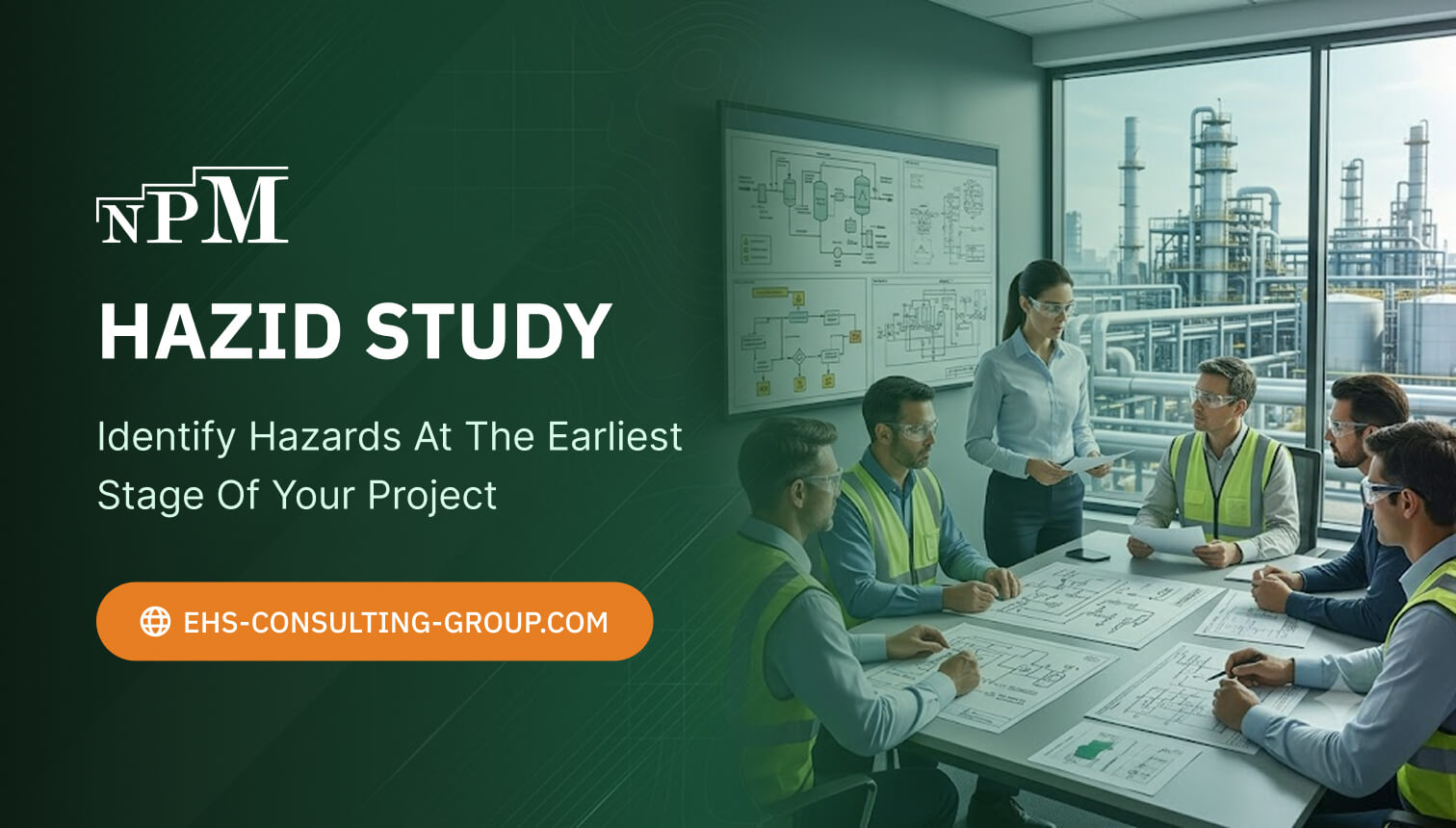
A HAZID study’s purpose is to anticipate credible hazards early—during concept selection, FEED, or change definition—so that design can eliminate, reduce, or control risk before costly commitments lock in. The team’s composition directly influences:
- Scenario completeness: Multi-disciplinary dialogue uncovers coupled hazards (e.g., process upset leading to overpressure and simultaneous ignition sources from temporary power during construction).
- Barrier realism: Operators and maintainers translate paper safeguards into workable procedures, access constraints, and impairment risks (e.g., relief valve accessibility during scaffolding).
- Regulatory readiness: Awareness of Civil Defence fire water demand expectations, ADNOC codes of practice, or OSHAD risk rating methods allows early alignment rather than late-stage rework.
- Integration with later studies: HAZID seeds HAZOP nodes, informs LOPA target SILs, sharpens QRA inputs (inventory, occupancy, ignition probability), and frames Bowtie diagrams around major accident hazards.
- ALARP defense: A defensible trail of alternatives considered and rejected—with operational voices in the record—supports ALARP demonstrations and management of change when inspectors or internal assurance ask “why this option.”
By contrast, narrow teams risk blind spots: missing lifting hazards during modular construction, underestimating drain system interactions with storm events, or assuming emergency response capabilities that site fire teams do not actually have. Even a well-facilitated session cannot compensate for absent perspectives.
Key Points to Understand

What HAZID Is—and Is Not

HAZID is a structured, early-phase hazard identification technique that prioritizes breadth over depth. It differs from HAZOP, which interrogates deviations against design intent once P&IDs and cause/effect are mature. A robust early hazard review identifies major accident hazards (loss of containment, fire/explosion, toxic releases, structural collapse, dropped objects, confined space incidents, energized contact), points to inherently safer design options, and captures actions for follow-up analysis (HAZOP, LOPA, SIL verification to IEC 61511, fire protection to NFPA standards, QRA where required by local policy or company criteria). Because the scope is wide, team selection is the control knob for relevance and efficiency.
Principles of HAZID Team Composition

Successful teams apply a few repeatable principles:
- Representation across the lifecycle: design, construction, commissioning, operations, and maintenance—so temporary states and long-term realities are both visible.
- Authority and independence: a competent chair/facilitator who can challenge senior voices respectfully and keep the group in an evidence-based mode.
- Local and regulatory knowledge: someone who understands UAE permitting, Civil Defence expectations, ADNOC-specific practices, and free-zone or port requirements.
- Interface coverage: where the scope borders live facilities, third-party utilities, marine operations, public roads, or shared corridors, ensure interface owners are present.
- Data literacy: participants who can interpret PFDs, preliminary plot plans, layouts, hazardous area classification, cause/effect sketches, and vendor packages even if they are not yet final.
Right-Sizing the Team for Phase and Scope

The right size is “as small as possible, as large as necessary.” Concept and FEED phases typically need senior cross-discipline voices capable of abstract reasoning and trade-off thinking. As definition tightens, representation can rotate in specialists pertinent to the hazards under review (e.g., marine for SPM buoys, geotechnical for trenching near live pipelines, or heavy lift for preassembled rack installs). For brownfield work, operations and maintenance presence is non-negotiable; they know impairment windows, isolation realities, and SIMOPS schedules.
Typical Roles and Responsibilities

| Role | Core Perspective | Responsibilities in HAZID | Mandatory by Phase | UAE/Regulatory Notes |
|---|---|---|---|---|
| Chair/Facilitator | Process safety/risk | Guide prompts, manage bias, ensure coverage, synthesize actions | All phases | Align with company PSM and ADNOC/OSHAD expectations |
| Scribe | Technical documentation | Record scenarios, barriers, actions with clear ownership | All phases | Ensure traceability for ALARP and authority queries |
| Process Engineer | Design intent | Explain PFDs, inventories, relief philosophy | Concept/FEED/Detailed | Inputs to QRA and HAZOP continuity |
| Operations Representative | Operational realism | Describe normal/abnormal states, isolation and access | FEED/Detailed/Operations | Vital for brownfield and SIMOPS with live ADNOC assets |
| Maintenance/Integrity | Reliability and access | Identify maintainability, inspection, impairment risks | FEED/Detailed/Operations | Supports ISO 45001 safe work integration |
| E&I/Controls | SIS, power, I/O | Outline trip functions, power reliability, spurious trip risk | FEED/Detailed | IEC 61511 alignment for SIFs; NFPA for electrical fire risk |
| Fire Protection | Active/passive defense | Evaluate detection, suppression, spacing, drainage | FEED/Detailed | Match Civil Defence expectations and NFPA design |
| Construction/Commissioning | Temporary states | SIMOPS, lifting, temporary power, energization plan | Detailed/Construction | MOHRE labor safety and site logistics in urban areas |
| Vendor/Package Rep | Equipment specifics | Provide limits, utilities, safeguards of packages | As needed | Clarify guarantees vs site conditions |
| Regulatory/Permitting Liaison | Authority interface | Flag permit-critical design choices and documentation | As needed | Civil Defence, Municipality, port/maritime coordination |
Competence and Behavioral Factors

Beyond titles, competence and behavior determine whether the team thinks expansively and debates constructively. Chairs need facilitation skill, not just technical fluency, to prevent anchoring, groupthink, or dominance by seniority. Operations voices should be empowered to correct optimistic design assumptions. Scribes must capture actions with clarity—what, why, and how success will be verified—so follow-up analysis (HAZOP, LOPA, SIL verification) can proceed without relitigation.
Documentation and Integration
The HAZID record is not a meeting minute; it is the seed of the risk register and barrier model. Where organizations use Bowtie for major accident hazards, HAZID outputs should map directly to threats, preventive barriers, escalation factors, and recovery measures. When SIL is later assigned, HAZID notes help justify why a function is protective versus informative, supporting IEC 61511 traceability. Fire and explosion hazard outcomes from HAZID can be cross-referenced to NFPA-driven fire protection philosophies and to QRA consequence modeling inputs.
For more on how governance and role clarity reinforce risk decisions across complex programs, curated resources at CABINET NPM can help frame the organizational side of the conversation.
How This Works in Practice
Translating principles into daily reality starts with a disciplined approach to scoping and preparation. The chair and project lead agree the boundaries (geographical, system, or activity-based), the main prompts to be used, and the pre-read materials. Even at concept stage, a plot plan, PFDs, hazardous area classification sketches, and outline emergency response assumptions allow participants to challenge layout decisions, inventories, and egress. As the study unfolds, the chair steers from generic hazards to concrete scenarios.
Consider a few illustrative UAE contexts:
Onshore gas compression FEED: Including pipeline and rotating equipment specialists brings clarity to surge risks, blowdown sizing logic, and temporary flare capacity during tie-ins. An operations representative describes realistic impairments during sandstorm conditions—visibility and access impacts on manual isolation—prompting design to prioritize remote-operated isolation valves and consider barrier spacing against wind-driven flame paths.
Brownfield refinery exchanger replacement: Construction voices highlight the need for heavy lifts over live pipe racks and the interaction of temporary power with classified areas. Maintenance explains historical fouling that necessitates frequent cleaning, pushing design toward improved access and isolation. Fire protection specialists test assumptions about water supply and drainage to avoid overtaxing existing deluge systems, aligning with Civil Defence expectations for hydraulic performance.
High-rise construction near live power lines: The project team includes the utility owner and lifting supervisor. The HAZID exposes combined risks of crane radius, wind conditions common on the Gulf coast, and night shifts during fast-track schedules. Controls such as no-go envelopes, anemometer alarms, and independent spotters become specific, auditable safeguards rather than generic “use competent rigger.”
Logistics terminal expansion at a port: Marine operations and port authority liaisons join to discuss berthing, jetty manifolds, and spill response. The team identifies SIMOPS with bunkering operations and considers how vapor control and ignition source controls are maintained when multiple vessels operate adjacent berths, a frequent real-world challenge in busy terminals.
Power generation turbine upgrade: E&I and fire teams examine energized work boundaries during testing, balancing protection of critical equipment with maintainability. The HAZID links to IEC 61511 through a discussion on trip setpoints and spurious trip rates affecting grid stability, and to NFPA by clarifying gaseous suppression coverage in enclosures where access must be controlled.
Across these scenarios, the mechanics look similar: the chair keeps the conversation systemic, the scribe documents scenarios and actions with owner and due intent, and the team checks that outcomes link forward—into design deliverables, permit packages, and downstream studies—so nothing is stranded.
Benefits and Practical Use Cases
When the team is shaped intentionally, benefits show up quickly:
- Earlier elimination of hazards: Better layout choices (spacing, segregation, drainage fall) remove ignition or escalation paths before concrete is poured.
- Reduced churn later: Fewer late HAZOP surprises and cleaner Civil Defence or municipality approvals due to coherent fire protection and egress concepts from the start.
- Sharper major hazard control: Bowtie models seeded with reality-based threats and barriers that can be monitored through barrier health indicators.
- Clearer ALARP arguments: Action logs that document alternatives considered, enabling reasoned cost-benefit discussions for inherently safer design features.
- Improved SIMOPS planning: When construction and operations both participate, controls become workable during live tie-ins, shutdowns, and phased commissioning.
Concrete examples include:
Pipeline reroute in congested corridors: Bringing utility owners and excavation contractors into HAZID reveals undocumented services and typical permit delays. Results include adopting vacuum excavation in identified zones, adding temporary cathodic protection bonding, and sequencing works to minimize exposure time near pressurized lines.
Offshore topside brownfield tie-in: An OIM and marine rep highlight simultaneous vessel operations and crane slewing constraints, prompting stronger dropped-object controls and timed exclusion zones during lifts made within the 500-meter safety zone, reducing risk during busy turnarounds.
Petrochemical storage expansion: Fire protection and operations agree on foam system selection and test strategy that satisfies NFPA and local authority oversight without overloading water supplies or creating maintainability traps.
Manufacturing line upgrade: Maintenance points out frequent jam-clear interventions; guarding redesign and lockout placements are improved before procurement, improving ISO 45001 alignment.
Best Practices and Points of Caution
Effective teams don’t happen by accident. A few evidence-based practices help:
- Nominate an independent, experienced chair: Independence helps prevent design ownership from biasing risk conclusions; experience enables efficient, respectful challenge.
- Define roles up front: Make clear who speaks for operations, who owns regulatory nuance, and who can decide on design concessions in the room.
- Balance seniority and proximity to the work: Senior engineers bring context; technicians and supervisors bring lived reality. Aim for both.
- Use structured prompts and keep a hazard ledger: Guidewords anchored in energy sources, people exposure, environment, and interfaces prevent tunnel vision.
- Test a few scenarios deeply: While HAZID is broad, pausing to walk through one or two critical scenarios end-to-end (as a Bowtie sketch) exposes hidden assumptions.
- Record rationale, not just actions: Capture “why rejected” notes for alternatives; this fortifies ALARP documentation and informs later LOPA or QRA.
- Mind language and culture: In bilingual teams, summarize decisions clearly and check for shared understanding, especially for emergency response terminology.
- Invite authorities indirectly via competence: If regulators cannot attend, ensure someone genuinely conversant with Civil Defence and municipality expectations is present.
- Calibrate representation to hazard profile: Don’t invite everyone to every session; instead rotate in marine, geotech, or vendor expertise when their hazards are on the table.
A few cautions from real projects:
- Overstaffing dilutes accountability: Massive rooms slow decisions; prefer a core with targeted specialists rotating in.
- Vendor dominance can skew safeguards: Balance supplier input with independent challenge to avoid over-reliance on package protections that may not align with site utilities or climates.
- Absence of operations in brownfield HAZIDs is a red flag: Without operators and maintainers, impairments and access issues are missed.
- Unclear action ownership leads to drift: Assign actions with names, intent, and verification method; vague “engineering to review” items frequently stall.
- Confusing HAZID for HAZOP: Diving too deep into deviations consumes time without improving early design choices. Keep HAZID wide and defer depth appropriately.
Frequently Asked Questions About HAZID Team Composition
What is the minimum team for a credible HAZID?
At minimum, you need a competent independent chair, a scribe, a process engineer who can explain design intent, and an operations or maintenance representative who grounds scenarios in reality. From there, add disciplines based on the dominant hazards—fire protection, E&I/controls, construction, or vendor specialists when their equipment is central to risk.
How does team selection differ between greenfield and brownfield projects?
Greenfield HAZIDs emphasize design disciplines and regulatory alignment; brownfield HAZIDs must include operations, maintenance, and construction logistics because live-plant interfaces, impairments, and access dominate risk. Brownfield sessions also benefit from people who know the site’s incident history, work control norms, and common deviations from procedure.
Where do standards like IEC 61511 and NFPA fit into team discussions?
These standards inform what “good” looks like for safeguards. IEC 61511 provides a framework for defining and verifying safety instrumented functions later in the process; NFPA codes guide detection and suppression philosophies. In HAZID, team members reference these to ensure early design decisions won’t later conflict with SIL capability, firewater demand, or detection coverage expectations.
Should contractors and vendors always be present?
Invite them when their scope materially affects hazard scenarios or when their guarantees constrain viable safeguards. However, balance supplier input with independent challenge to avoid bias. If proprietary detail is needed only briefly, consider having them join for targeted segments rather than the entire session.
How do we handle SIMOPS in HAZID without overwhelming the study?
Define SIMOPS interfaces explicitly—what operations are concurrent, where, and with whom—and bring in the right interface owners. Use a focused prompt set for simultaneous activities (lifting near live equipment, hot work near fuel systems, marine alongside operations). Map a few high-risk SIMOPS as Bowtie sketches to expose barrier conflicts, then assign follow-up analysis to specialized teams.
What competencies should the chair/facilitator have?
Beyond technical literacy in process safety and risk, the chair needs facilitation skill: managing pace, resolving conflict, detecting bias, and keeping the group at the right level of detail. Familiarity with UAE regulatory pathways and common pitfalls in ADNOC, Civil Defence, and municipality approvals helps anchor discussions in what is actually required.
How does HAZID interact with HAZOP, LOPA, and QRA downstream?
HAZID seeds the risk register and provides the initial list of scenarios, barriers, and open questions. HAZOP deepens analysis at the node level once the design is mature; LOPA quantifies risk reduction and sets SIL targets for instrumented functions; QRA models consequences and frequencies for land-use planning and emergency response. A coherent team in HAZID ensures the handover into these later studies is clean and efficient.
Do we need different team members for construction-phase HAZIDs?
Yes. When the focus is construction or commissioning, include lifting supervisors, temporary works coordinators, electrical supervisors for temporary power, and SIMOPS planners. Their presence makes temporary-state hazards visible and helps design workable controls for confined areas, night shifts, and staged energization.
Conclusion
Good HAZID outcomes start with good HAZID teams. As the examples and principles above show, breadth of perspective, independence of facilitation, and targeted inclusion of operations, construction, and regulatory insight produce hazard registers that stand up in HAZOP, inform LOPA and QRA, and clear authority reviews. In the UAE’s complex regulatory and operational environment—where ADNOC standards, Civil Defence approvals, and local municipality requirements intersect—intentional team selection prevents late surprises, reduces rework, and strengthens ALARP defenses. Whether you are scoping a greenfield FEED, planning a brownfield tie-in, or coordinating SIMOPS across a live plant, investing attention in who is at the HAZID table pays off in safer, more buildable, and more operable projects.
To go further on this topic, NPM’s broader HAZID Study Services UAE page covers this in more depth.
Our References
NPM’s references illustrate how disciplined team design changes the quality of hazard identification across industries and geographies. In upstream oil and gas, cross-functional HAZID teams combining process, drilling, marine, and operations expertise helped uncover coupled well control and marine collision scenarios during complex SIMOPS—scenarios that might have remained hidden had the room been limited to design disciplines only. In petrochemicals, bringing vendor package specialists into carefully timed segments yielded practical safeguards that aligned with site utilities and local firefighting capabilities, reducing later redesign during HAZOP and Civil Defence approvals. Power generation projects benefited from the presence of E&I and fire teams alongside operations, clarifying how trip philosophies and suppression coverage interact with grid stability and maintainability constraints. Construction projects, from high-rise towers to industrial facilities, gained from including lifting supervisors, temporary works coordinators, and emergency responders who realistically mapped nighttime operations and restricted-access conditions. Logistics and manufacturing sites saw hazard lists that reflected the true mix of dangerous goods, traffic patterns, and human-machine interfaces, thanks to the inclusion of warehousing and maintenance supervisors who understood daily operations. Across these diverse contexts, a consistent lesson emerges: representation, independence, and clarity of roles lead to credible scenarios, workable controls, and efficient regulatory pathways. If you are evaluating how to staff your next HAZID, NPM’s portfolio offers concrete examples of team structures tuned to project phase, hazard profile, and authority expectations, with traceable outcomes into HAZOP, LOPA, QRA, and emergency planning. The breadth of our experience worldwide provides a library of practical patterns that organizations can adapt to their own governance and culture without sacrificing rigor or efficiency.
For more information about our references, visit Our References.
Talk With NPM
If you are shaping the team for an upcoming HAZID and want a second opinion on roles, balance, or scope, NPM is glad to share perspectives grounded in real projects. Whether your facility is at concept, FEED, or preparing for brownfield SIMOPS, a short discussion can help you avoid common pitfalls and set up the work for success. For any further questions or to speak with our team, Contact Us.