
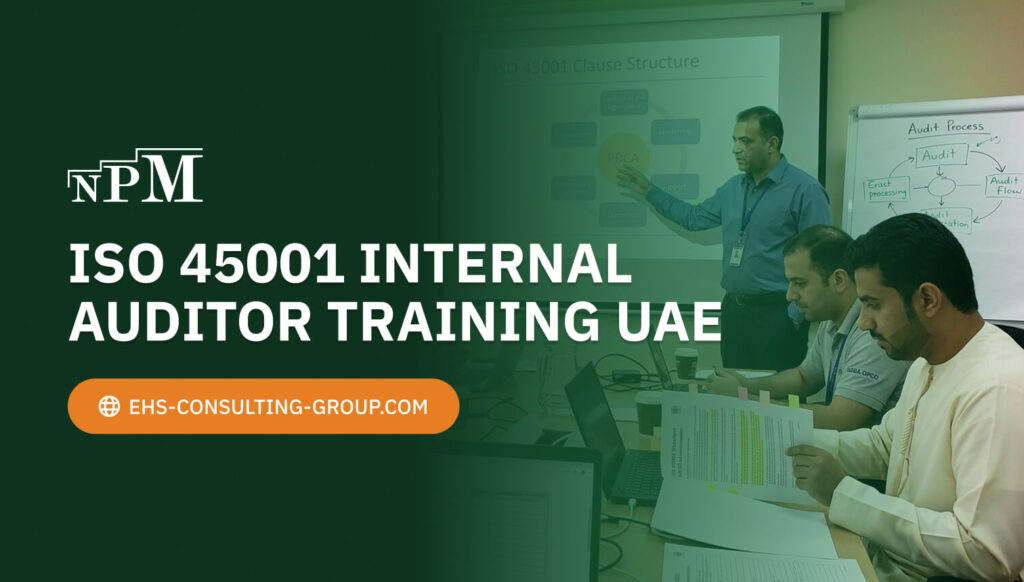
Internal Audit Process Explained is a request NPM hears frequently from HSE and operations leaders who want a clear, practical walkthrough of how audits actually create value under ISO 45001 and related standards within UAE industrial settings. Beyond certification, internal audits are one of the few management tools that simultaneously test compliance, verify the effectiveness of risk controls, and expose improvement opportunities that keep people safe and critical assets running. When done well, they connect the board’s risk appetite to field-level reality, bridging management system clauses with day-to-day work on refineries, construction sites, logistics hubs, and power plants.
This article unpacks the internal audit lifecycle as it is truly practiced in high-hazard industries. We will reference familiar frameworks like ISO 45001 and ISO 14001; point to process safety methodologies such as HAZOP, LOPA, Bowtie, and QRA; and consider expectations from UAE regulators and authorities including the Abu Dhabi EHS regulatory framework, Dubai Municipality, Civil Defence, MOHRE, and industry operators with their own HSE codes of practice (e.g., ADNOC). The goal is to help you use internal auditing to target what matters most: preventing harm, reducing major accident risk, and supporting resilient operations.
Who Does This Affect?

The internal audit process touches multiple functions, not only the HSE team. Roles typically involved include:
- HSE managers, OHSMS coordinators, and compliance officers responsible for ISO 45001 Clause 9.2 and integrated management systems (9001/14001/45001).
- Plant managers, maintenance superintendents, and operations leaders accountable for controlling major risks and ensuring permit-to-work, isolation/LOTO, and contractor management work as intended.
- Process safety engineers and technical authorities overseeing IEC 61511 Safety Instrumented System lifecycle evidence, MOC records, HAZOP actions, and proof test intervals.
- Construction project directors and site HSE leads managing high-rise builds, tunneling, lifting operations, temporary works, and SIMOPS.
- Logistics and warehousing leaders concerned with traffic management, dangerous goods, cold chain integrity, and fire protection reliability.
- Utility and power generation teams ensuring emergency response readiness, confined space entry controls, and contractor oversight during outages and turnarounds.
It also affects corporate functions—Internal Audit/Assurance, Legal and Compliance, Procurement (supplier/contractor audits), and HR (competency/induction evidence). Because audit results drive management review inputs, the C-suite and board risk committees are indirect but critical stakeholders in how this work is planned, executed, and acted upon.
Why It Matters

Internal audits matter because they verify whether the organization is actually doing what it says in its policies, procedures, and risk assessments—and whether those controls are effective enough for the real risks on site. For ISO 45001 and ISO 14001, Clause 9.2 demands a planned program of audits that considers risk, importance of processes, changes, and past results. Under UAE oversight, this assurance function supports readiness for interactions with regulators and authorities such as Abu Dhabi’s EHS regulatory framework administrators, Dubai Municipality inspections, Civil Defence fire system reviews, and MOHRE labor inspections.
From a process safety viewpoint, internal audits close the loop between studies like HAZOP and LOPA and the realities of shift work, contractor interfaces, and maintenance backlogs. They test whether safeguards defined on paper—alarms, trips, fire and gas systems, relief devices—are maintained, proof-tested at the right intervals, and supported by trained, competent people with the right permits and spare parts. This is about more than “finding nonconformities.” It is about anticipating failure and building the operational discipline to prevent it.
Finally, internal audits are uniquely positioned at the intersection of compliance, culture, and performance. They can reveal why deviations occur—over-complex procedures, unclear accountabilities, incentive conflicts, or inadequate training—so corrective actions resolve root causes instead of papering over symptoms. When integrated with management review, KPIs (e.g., API RP 754 Tier 2/3 indicators), and continual improvement, audits help leaders steer toward fewer incidents, lower lifecycle cost, and higher reliability.
Key Points to Understand

Although each organization tailors its approach, strong internal audit programs share recognizable building blocks. The flow below connects ISO guidance (including the principles in ISO 19011) with practical realities on industrial sites.
| Step | Focus | Typical Outputs | UAE/Industry Considerations |
|---|---|---|---|
| Program Planning | Risk-based coverage across the year | Audit program, calendar, competence matrix | Align with outage windows, SIMOPS, seasonal heat stress; consider ADNOC or client HSE codes |
| Scoping & Criteria | Define what to test and against which standards | Scope note; criteria list (ISO 45001/14001/9001, local laws, procedures) | Include Civil Defence fire codes, Abu Dhabi EHS framework, Dubai Municipality requirements |
| Preparation | Document review and sampling plan | Checklist/lines of inquiry; evidence sampling strategy | Target high-consequence tasks (confined space, hot work, lifting); integrate SIS proof-test records (IEC 61511) |
| Fieldwork | Interviews, observation, and record testing | Field notes; deviations; good practices | Cover day/night shifts; contractor interfaces; multilingual teams; respect photography policies |
| Reporting | Clear, risk-ranked findings | Report with major/minor NCs, OFIs, root causes | Link to hazard scenarios (Bowtie) and critical controls; note regulatory implications if any |
| Corrective Actions | Containment, cause removal, effectiveness checks | CAPA plan with owners, due dates, verification method | Prioritize safeguards affecting major accident risk; verify by observation/test rather than paper only |
| Management Review | Learn and adjust the program | Trends, systemic issues, resource decisions | Integrate with KPI dashboards, training plans, and budget cycles |
Three principles underpin the flow. First, independence and objectivity: auditors should not audit their own work and must be free from pressure to “green-light” results. Second, competence: auditors require training in ISO auditing techniques and sufficient domain knowledge to understand, for example, the practicalities of isolating energy sources, managing simultaneous operations, and proof-testing protective systems. Third, evidence-based conclusions: triangulate documents, interviews, and direct observation to avoid over-reliance on paperwork.
Sampling is a cornerstone. On a refinery, you might sample permit-to-work packages across tasks (hot work, confined space, electrical isolation), shifts, and contractors, then walk the field to verify controls—gas testing, ventilation, standby attendants, LOTO tags—are present and effective. In logistics, sampling could include forklift pre-use checks, racking inspections, and dangerous goods segregation. In construction, lifting plans, competency cards, and temporary works approvals are common high-risk samples. Attribute sampling (e.g., pass/fail criteria) helps keep findings consistent and defensible.
Risk-based criteria selection prevents “box-ticking.” Blend ISO clauses with process safety expectations (IEC 61511 lifecycle evidence, API RP 14C for offshore production safety systems, API RP 754 indicators), local codes (Civil Defence approvals, Abu Dhabi’s EHS regulatory framework elements), and your own procedure set. Where governance meets practice—policy to plant—audits become the connective tissue of assurance. For readers exploring the wider governance context of assurance and risk oversight, see CABINET NPM for additional perspective; then return to the practicalities of applying those ideas through disciplined internal audits that test controls where risk is highest.
How This Works in Practice

Translating the framework into day-to-day work starts with planning around operational rhythms. For example, plant leaders may time audits before major turnarounds to test contractor onboarding, lifting plans, hazardous energy isolation, and confined space regimes. On offshore platforms or remote sites, scheduling around helideck operations and bed-space constraints may dictate shorter, more focused audits that still sample critical controls—fire and gas coverage, deluge system readiness, escape routes—across both day and night shifts.
Scoping is always risk-led. If a recent HAZOP highlighted reliance on a high-integrity pressure protection system (HIPPS), the internal audit should include sampling of proof-test records, bypass controls, and trip setpoints, as well as interviews with technicians to verify competence and understanding of impairment management. If LOPA studies used conditional modifiers (e.g., human response to alarm), audits can observe alarm rate management, standing alarms, operator training, and adherence to alarm response procedures.
In construction, the practical focus often moves toward work authorization, temporary works design sign-offs, edge protection, lifting operations, mobile plant segregation, and site traffic. Interviews in multiple languages may be needed, with interpreters or bilingual auditors ensuring worker participation. The approach should reflect the cultural reality on site: many workers are comfortable showing how they do the job; the auditor’s task is to respectfully verify whether that practice matches risk controls described in the method statement and toolbox briefs.
In logistics and manufacturing, auditors may sample fire pump maintenance records, sprinkler valve supervision, racking load signage, and lithium battery storage arrangements. They can also trace the chain from induction training to observed behavior—seatbelt use, line-of-fire awareness, or adherence to pedestrian routes—triangulating what is taught, what is documented, and what is actually done. In power generation, emergency drills and black-start readiness can be tested through scenario-based interviews and spot checks, while contractor controls during outages are sampled for supervision ratios, permit quality, and isolation verification.
Fieldwork is where the truth appears. Effective auditors avoid spending the day in a meeting room; they go to where risk lives—the job sites, workshops, control rooms, and laydown yards. To keep evidence robust, they take contemporaneous notes with time and location, capture unique identifiers for sampled records, and where permitted, take photographs that anonymize individuals. When policy forbids photography, sketches and detailed descriptions can provide equivalent documentation. The golden rule: record enough to support a finding without overwhelming the recipient with noise.
Reporting relies on transparent, calibrated grading. A “major” nonconformity typically indicates a systemic failure or a lapse that could foreseeably result in serious harm or noncompliance with legal requirements (e.g., a disabled critical trip without approved impairment management). “Minor” issues are contained lapses that do not present immediate elevated risk. Observations or opportunities for improvement (OFIs) highlight better ways of working even if criteria are technically met. Each finding should cite the criterion breached (e.g., ISO 45001 8.1.2 Management of Change), describe objective evidence, and state the risk impact in language operations understand.
Benefits and Practical Use Cases

When internal audits move beyond formality, they deliver tangible results that operations leaders value. These include:
- Sharper risk control: testing the controls that prevent high-consequence events, not just easy-to-audit paperwork.
- Faster learning loops: feeding management reviews with clear, trendable insights that drive resource decisions.
- Regulatory confidence: demonstrating due diligence to authorities through risk-based, evidence-led assurance.
- Operational reliability: fewer surprises during shutdowns, startups, and SIMOPS thanks to verified discipline in permits and isolations.
- Culture and competence: targeted training plans based on audit evidence of skill and knowledge gaps.
- Supply chain resilience: structured audits of contractors and key vendors to reduce interface risks.
Consider a few concrete scenarios. A petrochemical plant links audit sampling to its Bowtie analysis of a loss-of-containment scenario: auditors test personal gas detector bump tests, hot work controls near flammables, and proof-test intervals for relevant interlocks. A logistics hub observes repetitive near misses involving pedestrians and forklifts; an audit of traffic management checks route demarcation, speed controls, blue-light/spotlights on forklifts, and supervision during peak loading. A construction project about to lift pre-cast panels uses an audit to verify lifting plans, crane certifications, exclusion zones, and signaller competence; the findings inform a pre-lift briefing that removes ambiguity.
On the environmental side, integrated audits under ISO 14001 can test spill response preparedness, segregation of hazardous waste, and evidence of emissions monitoring. Because many industrial organizations operate integrated management systems, unified audits can reduce duplication and highlight systemic issues—such as document control weaknesses or inconsistent competency assurance—that affect quality, safety, and environment together.
Best Practices and Points of Caution

Internal audits are only as strong as the rigor behind them. NPM’s recommendations reflect what works on complex sites:
- Base the audit program on risk and change. Adjust frequency for high-hazard tasks, major projects, or after incidents and MOC events.
- Ensure auditor competence. Blend formal auditing skills with domain knowledge (e.g., isolations, confined space, lifting, process safety).
- Preserve independence. Avoid auditing your own procedures or areas where you have direct accountability.
- Triangulate evidence. Corroborate documents with interviews and field observation; avoid “paper-only” conclusions.
- Calibrate grading. Define major/minor/OFI with examples; use risk language operations understand.
- Write actionable findings. State criterion, evidence, risk impact, and a clear expectation for correction—not a vague “close the gap.”
- Drive root cause, not blame. Apply 5-Why or cause-mapping; test for systemic factors (competence, supervision, workload, design).
- Verify effectiveness. Confirm that CAPAs remove causes and that controls work in the field, not just on paper.
- Close the loop. Feed recurring issues to management review; change procedures, training, or resourcing as needed.
- Respect people. Engage workers; invite them to demonstrate tasks; avoid a “gotcha” tone.
- Be mindful of data protection and site rules. Follow local photography, confidentiality, and security protocols.
- Integrate with process safety. Sample protective functions, bypass management, proof tests, and impairment controls aligned to IEC 61511.
Common pitfalls are equally instructive: overloading checklists with low-consequence items, treating audits as a certification tick-box activity, letting findings age without verification, and failing to connect audits to hazard analysis and emergency planning. Another risk is losing credibility by grading inconsistently across sites or auditors. A disciplined program management approach—with a shared methodology, calibration sessions, and peer reviews—keeps the system fair and trusted.
Frequently Asked Questions About the Internal Audit Process
How is an internal audit different from an inspection?
Inspections are typically routine checks for specific conditions (e.g., housekeeping, PPE, fire extinguishers), while internal audits are systematic, evidence-based assessments of whether a management system and its controls meet defined criteria and are effective. Audits test processes end-to-end—documents, competence, field practice—and evaluate adequacy against risk and standards like ISO 45001.
How often should we audit each process under ISO 45001?
Frequency should be risk-based. High-hazard processes (e.g., confined space entry, lifting near live plant, SIS maintenance) warrant more frequent and deeper audits, especially after change or incidents. Lower-risk areas can be sampled less often, but the overall program should ensure coverage across the full cycle before management review.
What qualifies someone to be an internal auditor?
Auditors need formal training in auditing techniques and knowledge of the relevant standards and legal requirements. In high-risk industries, they also require sufficient operational understanding to ask the right questions and recognize ineffective controls—for example, identifying a weak lockout sequence or an inadequate gas testing regime.
What kind of evidence should auditors collect?
Good audits triangulate documents (procedures, permits, training records), interviews (operators, supervisors, contractors), and direct observation in the field. Evidence must be objective, traceable (e.g., record IDs, dates, locations), and sufficient to support the conclusion without disclosing sensitive personal data or breaching site rules.
How are nonconformities graded?
Organizations typically define major nonconformities as systemic or high-risk failures that could lead to serious harm or legal noncompliance, while minor nonconformities are contained deviations with limited risk. Observations or opportunities for improvement highlight better practices even when criteria are met. Clear definitions and calibration sessions help maintain consistency across auditors and sites.
Can we integrate audits for ISO 45001, ISO 14001, and ISO 9001?
Yes. Many organizations operate integrated management systems and benefit from unified audits that test cross-cutting processes like document control, competence, and change management. The key is to maintain risk focus and avoid diluting attention away from high-consequence safety and environmental controls.
How do internal audits connect to HAZOP, LOPA, or Bowtie analysis?
Audit criteria can be derived from safeguards and critical controls identified in these studies. For example, if a Bowtie highlights ignition control as critical, auditors might sample hot work permits, gas detector calibration, and area classification adherence. This linkage ensures audits validate the controls that actually prevent major events.
What is the role of management review after audits?
Management review synthesizes audit trends, systemic issues, and resource needs, then decides on priorities—procedure redesign, additional training, staffing, or capital improvements. It ensures that audits are not an end in themselves but a driver of strategic and operational decisions.
How should we audit contractors and third parties?
Contractor audits should test prequalification, onboarding, supervision, permits, and interface controls, with sampling that includes field verification. In high-risk settings, it’s essential to test competence cards, lifting plans, and isolation procedures in practice—not rely solely on corporate documentation provided during tendering.
What does good corrective action look like?
Effective corrective action addresses root causes, assigns clear ownership and deadlines, and includes a plan to verify that controls work in the field. Avoid superficial fixes (e.g., retraining alone) when the real issue is workload, unclear roles, or impractical procedures; effectiveness checks should confirm sustained results.
Conclusion
Stepping back across the journey—risk-based planning, evidence-led fieldwork, calibrated reporting, and verified corrective action—the picture that emerges is a management discipline that protects people and assets. With the Internal Audit Process Explained in practical terms, it becomes clear why independence and competence matter, why sampling must follow risk, and how linking audits to HAZOP/LOPA safeguards and UAE regulatory expectations strengthens both compliance and performance. When leaders close the loop through management review, audits evolve from a certificate-driven exercise into one of the most potent levers for preventing serious harm and improving operational reliability.
To go further on this topic, NPM’s broader ISO 45001 Internal Auditor Training UAE page covers this in more depth.
Explore NPM’s References
NPM’s body of work demonstrates how disciplined internal auditing translates into safer, more reliable operations across sectors and regions. Our teams have supported complex energy production environments, petrochemical plants, high-rise and infrastructure construction, integrated logistics hubs, and power and utilities operations. In each context, we focus on risk-based scoping and evidence-led conclusions that operations leaders trust. For example, in process facilities we have connected Bowtie and LOPA controls to sampling plans that test protective layers and impairment management. In construction, we have combined audits of lifting operations and temporary works with interviews at the workface to gauge whether briefings and method statements are truly understood by multilingual crews. In logistics and manufacturing, our audits have traced the chain from induction training to field behavior, reviewing forklift operations, racking integrity, dangerous goods handling, and emergency preparedness. Across these engagements, the emphasis remains on practical improvements: clear findings, targeted corrective actions, and verification that risk controls work under real conditions. The result is a proven approach where internal auditing reinforces management system intent, regulatory expectations, and the everyday discipline that keeps people and assets safe worldwide.
For more information about our references, visit Our References.
Connect with NPM
If you would like to discuss how to tailor risk-based internal audits to your facility’s hazards, systems, and regulatory context, NPM is available to share practical perspectives. We welcome questions from HSE managers, plant leaders, and compliance teams who want to strengthen assurance without adding unnecessary bureaucracy. A short conversation can help clarify where to focus and how to build auditor capability that operations will respect.
For any further questions or to speak with our team, Contact Us.