
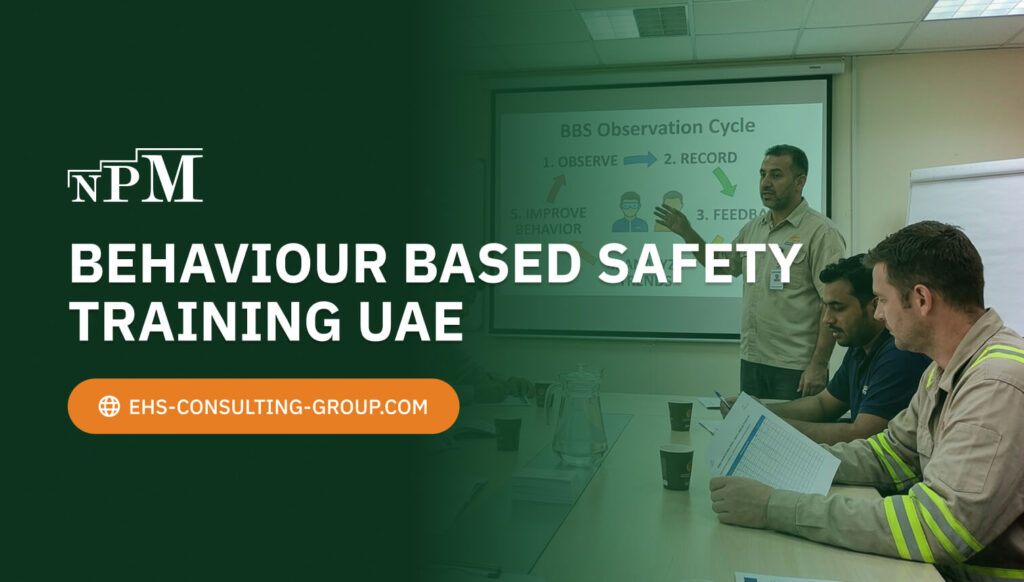
Positive Reinforcement In Safety is a practical discipline for shaping safer behaviors in high-risk industries without relying solely on rules, penalties, or after-the-fact investigations. It draws on applied behavior science to encourage the specific, repeatable actions that prevent incidents in oil and gas facilities, petrochemical plants, construction sites, heavy manufacturing lines, logistics hubs, and power generation assets across the UAE. Rather than adding more procedures, the focus is on reinforcing what people do right — at the exact moment they do it — so desired behaviors become the path of least resistance under real operating pressures.
Who Does This Affect?

While the approach is relevant to every employee, the responsibility for setting up and maintaining effective reinforcement systems usually spans several roles and functions:
- HSE managers and advisors who design cultural and behavioral programs aligned to ISO 45001, OSHAD SF, and ADNOC HSE requirements.
- Plant managers, operations leaders, and control room supervisors who integrate positive reinforcement into shift routines, permit-to-work oversight, and frontline decision-making.
- Construction project directors and site engineers who manage high-risk activities such as lifting operations, work at height, and confined space entries.
- Maintenance managers and planners who coordinate isolations (LOTO), scaffolding works, and turnaround/shutdown tasks where safe behaviors are critical amid intense schedules.
- Logistics, warehousing, and transport supervisors who need consistent behaviors for vehicle movement, pedestrian segregation, and loading/unloading controls.
- Power plant O&M teams who emphasize procedural adherence for start-up, switching, and energy isolation steps where human performance is pivotal.
- Contractor management, procurement, and HR/training functions who influence onboarding, reward and recognition policies, and just culture frameworks.
Importantly, contractors and temporary workforces — common on major engineering projects and during outages — must be included from day one. Reinforcement must reach them in clear, culturally aware, and language-appropriate ways if it is to affect daily behaviors where risk resides.
Why This Topic Matters

Controls such as HAZOP recommendations, SIL-rated instrumented functions under IEC 61511, and procedural safeguards are necessary — but people implement them. The gap between “work-as-imagined” and “work-as-done” is where near misses, process upsets, and serious injuries can emerge. Lagging indicators (TRIR, LWDC, environmental non-conformances) tell you what already happened. Positive reinforcement influences leading indicators: how consistently operators verify gas tests before hot work, how rigorously riggers manage exclusion zones, or how often mechanics pause to verify isolations before breaking containment.
For UAE operators subject to OSHAD Authority requirements, Dubai Municipality approvals, Civil Defence expectations, MOHRE labor directives, and ADNOC HSE compliance frameworks, it is not enough to have documented systems; organizations must demonstrate effective implementation. A reinforcement-based approach makes compliance visible in everyday acts that can be observed, measured, and encouraged. When done well, it supports barrier integrity in bowtie analyses, reduces SIF (serious injury and fatality) exposure, and improves the reliability of human responses in abnormal situations.
Key Points to Understand

Before applying this approach broadly, it helps to align on the core mechanics of behavior reinforcement and how they translate to industrial operations:
- Reinforcement is not bribery. It is the systematic, timely acknowledgment of a specific, desired behavior to increase its future likelihood. The behavior comes first, then the reinforcement.
- Make it immediate, specific, and contingent. The closer in time the recognition follows the behavior, and the clearer the “what” and “why,” the stronger the learning signal.
- Reinforce actions, not outcomes. Celebrate “the valve line-up verification” or “the last-minute risk assessment” rather than “no incidents this week,” which can unintentionally suppress reporting.
- Aim for consistency and fairness. Supervisors must apply the same standards across shifts, crews, and contractors to avoid perceptions of favoritism.
- Start with critical behaviors. Align reinforcement with the life-saving rules, procedural steps that prevent loss of containment, and the high-energy/line-of-fire hazards identified in risk assessments and LOPAs.
In practice, most organizations combine several forms of reinforcement. Social reinforcement (verbal thanks, peer recognition), symbolic reinforcement (tokens, commendation notes), and opportunities (leading a toolbox talk, representing the crew in a safety committee) often outperform cash incentives. This matters because incentive schemes built around injury-free hours can backfire by discouraging reporting. A reinforcement lens keeps attention on the behaviors that prevent harm, not on the absence of recorded harm.
The table below illustrates how different operating contexts map to targeted reinforcements and related governance touchpoints:
| Priority Behavior | Setting | Reinforcement Example | Timing | Metric | Reference |
|---|---|---|---|---|---|
| Verify gas test before hot work | Refinery unit turnaround | Immediate peer acknowledgment + supervisor note in shift log | Right after test and permit sign-off | % of hot work permits with valid pre-tests observed | ADNOC CoP on Hot Work; ISO 45001 |
| Spot and stop line-of-fire exposure | Construction high-rise lift | Recognition card and shout-out at daily stand-up | Within the same shift | Number of interventions leading to hazard removal | Dubai Municipality EHS Guidelines |
| Two-person verification of LOTO | Power plant maintenance | Team commendation on PTW board | Immediately after verification | Compliance rate from PTW audits | IEC 61511 interface; Company PTW |
| Use of banksman signals for reversing | Warehouse logistics area | On-the-spot acknowledgement + monthly peer-nominated mention | Real time; monthly roll-up | Observed compliance during traffic audits | OSHAD SF; Internal Traffic Plan |
| Final valve position check before start-up | Petrochemical unit start-up | Supervisor recognition + learning note shared in shift handover | At checklist completion | Checklist adherence score | API RP 750; Operations Procedures |
Measurement deserves emphasis. If you cannot observe a behavior, you cannot reinforce it consistently. Many organizations adopt a short list of critical safe behaviors drawn from HAZOP, bowtie analyses, and incident learnings, then embed them in observation cards or digital checklists. This allows teams to provide real-time, high-quality feedback while also generating data to spot patterns, coach supervisors, and refine the reinforcement strategy.
As you build literacy in this area, it can help to review broader performance and culture materials. Resources such as CABINET NPM discuss leadership practices and organizational behaviors that complement a reinforcement mindset, including how recognition norms cascade from the top and how psychological safety fosters open reporting.
Finally, align with your governance framework: ISO 45001 requires worker participation and continual improvement; OSHAD SF emphasizes risk-based controls and competence; ADNOC HSE frameworks expect visible safety leadership and contractor alignment. Positive reinforcement strengthens each of these pillars by making the “human performance” element observable, coachable, and auditable.
How Does This Work in Practice?

Translating the ideas into day-to-day routines is where the value compounds. Building on the principles above, organizations typically progress through practical steps:
- Select 5–8 critical behaviors tied to your highest hazards (e.g., gas testing before hot work, barricading dropped object zones, energy isolation verifications, spotter use in vehicle movement, housekeeping to prevent slips/trips/falls).
- Define what “good” looks like in unambiguous, observable terms. Use photos or brief video clips if helpful during toolbox talks and inductions.
- Equip supervisors and experienced operators with quick reinforcement language: what they saw, why it matters, how it prevents specific failure modes identified in HAZOP/bowtie models.
- Build reinforcement into existing rhythms: pre-job briefs, SIMOPS coordination, last-minute risk assessments, shift handovers, and permit sign-offs.
- Record observations with short, high-quality notes, then review trends in weekly operations and HSE meetings. Emphasize coaching over counting.
- Close the loop by sharing crew-level successes at toolbox talks and highlighting learning that came from positive observations, not just from incidents.
Consider a refinery turnaround. Thousands of permits move daily, contractors rotate on and off shifts, and schedules compress. Reinforcement needs to be fast and unbureaucratic: a supervisor thanks a welder for refusing to strike an arc until the gas test is in spec; a permit issuer highlights a team who re-routed hoses to eliminate trip hazards; a planner calls out a rigger who halted a lift due to wind gusts. These micro-moments shape what crews perceive as “the way we work here.”
In construction, foremen can standardize positive callbacks during pre-task briefings: “Yesterday we saw great use of chocks on mobile equipment; let’s keep that up.” On logistics sites, traffic marshals can be empowered to issue immediate recognition for textbook hand signals and maintained eye contact during reversing. In power generation, control room supervisors can reinforce strict adherence to switching orders — right down to the verbal call-and-response that prevents wrong-breaker operations.
Two implementation realities deserve attention in the UAE context. First, multi-lingual, multi-cultural crews demand simple, concrete reinforcement language. If necessary, provide phrases in the predominant languages on site, and use visual job aids. Second, contractors should be included in recognition structures from day one; otherwise, you risk a split culture where staff receive appreciation while contractors feel peripheral, even though they often carry out the riskiest work.
Benefits and Practical Use Cases

When reinforcement is embedded into operations rather than added as an “extra,” several benefits typically appear:
- Higher procedural reliability: Critical steps (e.g., valve line-up checks, isolations, gas tests) are executed more consistently even under schedule pressure.
- Stronger leading indicators: Observation quality improves, near-miss reporting increases, and coaching conversations become more substantive.
- Fewer normalization-of-deviance patterns: Crews are rewarded for doing things right, not just for getting away with shortcuts.
- Improved contractor alignment: Shared reinforcement norms create cohesion across mixed teams.
- More resilient barrier management: Human barriers in bowtie models are actively sustained rather than assumed.
- Better start-up and shutdown performance: Teams stay focused on critical behaviors when energy states and risk levels change rapidly.
Across typical UAE industrial scenarios, positive reinforcement can be targeted where it matters most:
- Offshore platforms and onshore terminals: Reinforce permit rigor, gas testing, and simultaneous operations coordination to prevent hydrocarbon releases.
- Petrochemical crackers and storage terminals: Recognize adherence to sampling protocols and bond/ground practices to minimize ignition risk.
- High-rise and infrastructure construction: Encourage consistent tie-off, tool tethering, lifting exclusion zones, and scaffold tag checks.
- Manufacturing and heavy industry: Reinforce machine guarding verification, LOTO holds, and line-of-fire awareness around presses and conveyors.
- Warehousing and logistics: Acknowledge correct pedestrian segregation, speed control, and dock safety practices.
- Power generation (thermal, CCGT, and renewables O&M): Recognize precision in switching orders, energy isolations, and confined space controls.
The cumulative effect is cultural. As supervisors call out what good looks like and peers normalize it, safe behavior becomes a source of professional pride, not mere compliance. This social gravity often achieves more than additional signage, memos, or punitive rules.
Best Practices and Points of Caution

To keep the approach robust and credible, consider these guidelines:
- Anchor to risk. Choose behaviors linked to major accident hazards and serious injury exposures identified in HAZID, HAZOP, LOPA, and bowtie results.
- Coach supervisors. Invest in brief, practical coaching so supervisors deliver reinforcement that is timely, specific, and sincere — and know how to redirect at-risk acts without blame.
- Watch for perverse incentives. Avoid “no incident” rewards; they can suppress reporting and distort reality.
- Protect psychological safety. Recognition must never be used to single out or embarrass; it should invite participation and speaking up.
- Calibrate fairness. Ensure balanced reinforcement across shifts, contractors, and departments; audit for consistency.
- Measure what matters. Track observation quality, not just counts. Use sample reviews in operations meetings to calibrate expectations.
- Integrate with management systems. Reference ISO 45001 clauses on worker participation and leadership; align with OSHAD SF mechanisms for competence and communication; reflect ADNOC HSE requirements in contractor interactions.
- Close the loop. Share learning from positive cases — e.g., a team that prevented a dropped object by re-securing tools — to illustrate practical, replicable actions.
- Respect data privacy. If using digital observation tools, clarify purposes, access, and boundaries to preserve trust.
Finally, remember that reinforcement does not replace enforcement. It complements it. Life-saving rules must still carry clear consequences when intentionally violated. The art is to make the desired behavior so normal — and so evidently valued — that enforcement becomes the exception, not the default.
Frequently Asked Questions About Positive Reinforcement in Safety
Is this the same as rewards programs that give prizes for zero incidents?
No. Reinforcement targets specific, observable safe behaviors — like verifying isolations or maintaining exclusion zones — to increase their frequency. “Zero incident” contests often suppress reporting and can create perverse incentives. A reinforcement approach recognizes what people do right in real time and supports learning.
How does this fit with ISO 45001 and OSHAD requirements?
ISO 45001 emphasizes leadership, worker participation, and continual improvement; OSHAD SF stresses competence, communication, and risk-based controls. Positive reinforcement operationalizes these ideas by making participation visible and measurable, improving leading indicators, and aligning daily practices with documented systems.
What should we reinforce first?
Start with a short list of high-impact behaviors tied to your top hazards — those identified through HAZID, HAZOP, and bowtie analyses. Examples include gas testing before hot work, barricading dropped object zones, strict LOTO verification, and spotter use during vehicle movement.
Will this make people complacent or overconfident?
Done well, it has the opposite effect. Reinforcement stresses procedural discipline, encourages speaking up, and keeps attention on critical behaviors. It rewards vigilance, not outcomes. Complacency usually declines as teams receive specific feedback on what good looks like and why it matters.
How do we avoid favoritism in recognition?
Set clear, observable behavior definitions; rotate who gives recognition; use simple logs to ensure coverage across shifts and contractor firms; and periodically review samples in operations meetings. Consistency and transparency are essential for credibility.
Can we use small tokens or points?
Yes, but keep the emphasis on social and professional recognition. Tokens can work when they are symbolic and contingent on specific behaviors — not on the absence of incidents. Avoid high-stakes prizes that distort reporting or invite gaming.
How do we measure progress?
Track the frequency and quality of positive observations, adherence to critical behaviors during audits, and the strength of leading indicators such as near-miss reporting and quality of last-minute risk assessments. Over time, you should see fewer at-risk observations in the same contexts and improvements in barrier integrity during verifications.
Does this replace enforcement for life-saving rules?
No. Enforcement remains essential for intentional or reckless violations. Positive reinforcement reduces the need for enforcement by making desired behaviors habitual, but consequences for serious rule-breaking must be unambiguous and consistently applied.
Conclusion
Positive reinforcement, when grounded in real operational hazards, is one of the most reliable ways to convert safety from a paper system into day-to-day practice. By focusing on observable actions — from gas tests and barricades to isolation verifications and spotter protocols — leaders create a strong behavioral current that aligns with ISO 45001, OSHAD SF, ADNOC HSE expectations, and the practical realities of UAE industrial operations. The sections above outlined who is involved, why it matters, the mechanics of effective reinforcement, and how to embed it in shift rhythms, permit-to-work processes, and contractor interactions. Taken together, these steps build a more resilient barrier system and a culture where doing the right thing is both recognized and expected.
To go further on this topic, NPM’s broader Behaviour Based Safety Training UAE page covers this in more depth.
Our References
NPM’s experience with reinforcement-driven safety spans complex, high-hazard environments, where consistent human performance is a decisive factor in preventing major incidents. Over the years, NPM has supported operators, EPCs, and asset owners on projects that range from refinery turnarounds and brownfield modifications to offshore SIMOPS, large-scale construction, logistics network expansions, and power generation maintenance campaigns. In each context, the emphasis is the same: translate risk assessments and management system requirements into observable, coachable behaviors that hold under operational pressure. Our references illustrate how targeted reinforcement helped teams improve leading indicators, strengthen life-saving rule adherence, and sustain barrier integrity during dynamic, shifting work. They also show how contractor ecosystems can be aligned through shared recognition practices, even where multiple languages, nationalities, and organizational cultures intersect.
Beyond individual success stories, the portfolio reflects NPM’s commitment to practical integration: reinforcement woven into permit-to-work oversight, embedded in toolbox talks and shift handovers, and supported by concise coaching for supervisors. Case materials demonstrate how frontline recognition improves the quality of observations, how positive learnings spread across crews, and how leaders sustain momentum without bureaucratic overhead. Whether the project involved process safety governance on a petrochemical unit or logistics traffic management at a distribution hub, the through-line is consistent: practical, fair, and timely reinforcement that makes safe work the natural way work gets done. These references provide a clear window into how NPM partners with clients to build durable safety habits and measurable performance gains grounded in recognized standards and local regulatory expectations while maintaining scalability across diverse operations worldwide.
For more information about our references, visit Our References.
Talk With NPM
If you would like to explore how these ideas might align with your site’s risk profile, we are glad to discuss practical options and lessons learned. Whether you oversee a single facility or a multi-site portfolio, a brief conversation can clarify where reinforcement can make the quickest difference. For any further questions or to speak with our team, Contact Us.