
“What Is ISO 45001?” is a question that comes up frequently among HSE leaders and operations executives across the UAE’s high-risk industries, especially when aligning corporate risk governance with the realities of refineries, petrochemical complexes, construction megaprojects, logistics hubs, and power generation assets. In straightforward terms, ISO 45001 is the global standard for occupational health and safety (OH&S) management systems. It provides a structured, risk-based framework to prevent work-related injury and ill health, drive continual improvement, and involve workers meaningfully in safety decision-making. Yet this short definition hides a richer, highly practical set of requirements that can materially reduce incidents when applied with discipline in the field.
Framed around Plan-Do-Check-Act (PDCA), the standard connects leadership, hazard identification, operational control, monitoring, and improvement into a single, auditable system. For organizations operating under ADNOC HSE expectations, Abu Dhabi’s OSHAD framework, Dubai Municipality safety codes, MOHRE labor requirements, and Civil Defence emergency mandates, it also forms a common language to demonstrate due diligence and assure clients, regulators, and insurers that OH&S risks are being managed systematically. This article explains the structure of the standard, unpacks its practical implications for UAE industrial settings, and explores where it strengthens—and is strengthened by—process safety methods such as HAZOP, LOPA, and Bowtie analysis.
Who Does This Affect?

Although ISO 45001 is read most visibly by HSE managers, its effectiveness depends on how well it is understood across the organization. If your operations involve heavy equipment, hazardous substances, work at height, lifting operations, confined spaces, or high-energy processes, the standard’s principles touch your daily work. Typical roles and settings include:
- HSE managers, plant managers, operations superintendents, and offshore installation managers (OIMs) responsible for safe execution at refineries, gas processing plants, power stations, construction sites, storage terminals, and offshore platforms.
- Project directors, construction managers, lifting supervisors, and site engineers coordinating crane lifts, temporary works, SIMOPS, and high-risk construction phases on high-rise, tunneling, or marine infrastructure projects.
- Maintenance planners, turnaround coordinators, and PTW authorities implementing isolations, lockout/tagout, and simultaneous operations during shutdowns and brownfield tie-ins.
- Logistics and warehouse leaders managing forklift traffic, rack stability, flammable storage, and driver fatigue across regional distribution centers and port facilities.
- Quality/IMS leaders seeking to integrate OH&S with ISO 9001 and ISO 14001 into a single, process-based management system.
- Procurement, HR, and training coordinators charged with contractor control, worker competence, and multilingual communication.
Because the standard elevates leadership responsibility and worker participation, it also concerns executive teams and safety committees who must align governance, resources, and company culture with operational reality. In short: if you touch operations, you touch ISO 45001, whether you are the one setting policy or the person using a harness on a scaffold.
Why Does This Question Matter?

Understanding what ISO 45001 entails matters for reasons that go beyond a certificate on the wall. First, the standard embodies modern risk thinking: it requires organizations to identify hazards proactively, evaluate associated OH&S risks and opportunities, and embed controls into the way work is planned and executed. For UAE operations where ambient heat, crane-intensive logistics, hydrogen sulfide risk, flammable atmospheres, and heavy vehicle traffic converge, this discipline can be the difference between routine work and a recordable incident—or worse.
Second, regulators and clients expect structured assurance. Whether it is ADNOC’s contractor prequalification, OSHAD system requirements in Abu Dhabi, Dubai Municipality site inspections, or Civil Defence emergency readiness, the standard’s clauses align with expectations for leadership accountability, competent control of high-risk activities, and traceable performance monitoring. Even when certification is not strictly mandated, an OH&S management system that reflects ISO 45001 principles streamlines audits and eases stakeholder scrutiny.
Third, the standard supports operational continuity. Lost-time injuries impair production, stress supply chains, and drive corrective rework. For complex facilities—petrochemical plants with compressors and cracking units, combined-cycle power plants, or material-handling terminals—stability and safe productivity move in lockstep. By tying incident learning into formal improvement cycles, ISO 45001 helps plants sustain performance gains instead of repeatedly addressing the same failure modes.
Finally, safety expectations are now woven into ESG narratives and capital markets’ views of organizational resilience. Investors, partners, and insurers look for evidence that operational risks are not only identified but are governed and reduced in a verifiable, worker-centered way. ISO 45001 offers that evidence in a structure recognized worldwide.
Key Points to Understand

With the stakes in view, it helps to break down the standard into its core elements and translate them into everyday practice. While the clauses follow Annex SL (a common structure used across ISO standards), the heart of ISO 45001 is operational: it is about how work is organized, supervised, and improved.
A PDCA framework driven by leadership and participation
ISO 45001’s PDCA cycle starts with leadership setting direction. Top management must establish the OH&S policy, define responsibilities, integrate OH&S into business processes, and ensure worker participation. This is not symbolic—leaders must allocate resources, remove barriers to reporting (e.g., fear of blame), and actively consult the workforce when changing processes. Worker participation goes beyond toolbox talks; it means involving operators, riggers, scaffolders, and technicians in hazard identification, risk assessment, and control design.
Core clauses, translated into field reality
Each clause sets expectations that connect directly to site-level controls:
- Context and interested parties: Understand internal and external issues that affect OH&S—such as extreme summer heat, simultaneous operations during shutdowns, or client HSE requirements at a JV site—and the needs of regulators, employees, contractors, and the public.
- Planning: Identify hazards, assess risks and opportunities, determine legal and other requirements, and plan actions. This is where systematic HAZID workshops, task-level risk assessments, and Bowtie diagrams clarify threat-barrier relationships for common hazards like dropped objects, heavy lifts, or hot work in hydrocarbon areas.
- Support: Provide competence, awareness, communications, and documented information. In practice, that means task-specific training (e.g., rigging, confined space entry), multilingual procedures, and controlled documents accessible where work is performed.
- Operation: Plan and control processes, including management of change (MOC), contractor control, procurement, and emergency preparedness. Here, ISO 45001 comes alive in permit-to-work systems, pre-lift plans, H2S contingency measures, and emergency drills coordinated with Civil Defence and site security.
- Performance evaluation: Monitor leading and lagging indicators, conduct internal audits, and perform management reviews. Incident trends, near-miss density, behavioral safety observations, and action closure rates provide an early view of risk drift before it becomes an event.
- Improvement: React to incidents and nonconformities, investigate root causes, and implement corrective actions that actually change how work is planned and performed.
Where ISO 45001 meets process safety
In oil, gas, and petrochemicals, OH&S interlocks with process safety. ISO 45001 does not replace IEC 61511 functional safety for SIS lifecycle, nor does it substitute for QRA, LOPA, or API guidance. Instead, it integrates the human and organizational dimensions—competence, shift handovers, maintenance controls, contractor interfaces—into the barrier model that process safety depends on. Many organizations map personal safety controls (PPE, working at height) and process safety controls (SIS, relief systems) within a single Bowtie framework so leadership can see where organizational controls (e.g., training, supervision, MOC) underpin both.
Integration with other management systems
Because ISO 45001 shares a common structure with ISO 9001 and ISO 14001, most companies can unify policy, risk, documentation, and audit processes in an Integrated Management System (IMS). This reduces duplication and helps operations teams understand that quality, environment, and safety controls are interdependent along the same process. For broader corporate governance perspectives that often sit above an IMS, some practitioners consult resources such as CABINET NPM to align strategic oversight with management system performance—helpful when translating board-level risk appetite into field-level permit rules and competence matrices.
From clause language to controls on the ground
To make the clauses more tangible, the following table maps selected requirements to typical UAE industrial applications and recognized methods:
| ISO 45001 Clause | What It Requires | Typical UAE Industrial Application |
|---|---|---|
| 6.1 Hazard identification | Proactively identify hazards considering routine/non-routine, emergency, and human factors | HAZID workshops for shutdown SIMOPS; task-level risk assessments for hot work near hydrocarbon systems; heat-stress exposure assessment in summer months |
| 6.1.2 Assessment of OH&S risks | Evaluate risk magnitude and prioritize controls | Bowtie visualizations for crane operations in congested laydown areas; LOPA informing procedural safeguards where instrumented layers are limited |
| 8.1 Operational planning and control | Define and implement necessary controls, including documented procedures | Permit-to-work integration with gas testing, LOTO, and confined space protocols; contractor bridging documents in joint-venture sites |
| 8.1.3 Management of change | Control OH&S risks during changes | MOC for tie-ins, temporary bypasses, or revised lift paths; review of competence and supervision for new contractors |
| 8.2 Emergency preparedness & response | Plan, test, and review emergency arrangements | H2S shelter-in-place drills; Civil Defence-coordinated evacuation drills; mutual-aid arrangements at industrial zones |
| 9.1 Monitoring, measurement, analysis | Track performance with suitable indicators | Leading indicators like permit quality scores, pre-job briefing effectiveness, and action close-out time; lagging indicators like TRIR |
| 10.2 Incident and nonconformity | Investigate, correct, and prevent recurrence | Root-cause analysis following API/ICAM approaches; dissemination of lessons learned across projects and shift teams |
Documentation is a means, not the objective
The standard expects documented information where it adds control—procedures, risk assessments, MOC forms, training records—but documentation alone does not satisfy the intent. Auditors and, more importantly, your own leadership should look for evidence that people understand hazards, controls are in place at the point of work, and behaviors reflect competence and supervision. In short: the paper must match the plant, and the plant must match the paper.
How Does This Work in Practice?

Turning the standard’s clauses into everyday practice depends on planning cycles that connect corporate intent to field execution. Many organizations adopt an annual rhythm aligned with budget and turnaround schedules, while retaining flexibility to respond to incident learning and operational changes. A practical flow might look like this:
- Establish direction: Leadership sets policy, OH&S objectives, and resources; safety committees shape priorities based on incident data and operational plans (e.g., upcoming shutdowns, major lifts, or new projects).
- Identify and assess: Multidisciplinary teams update hazard registers, review task-risk assessments, and refresh Bowtie diagrams for high-impact scenarios (dropped objects, vehicle-pedestrian interface, hot work near flammables).
- Plan and brief: Controls are embedded into PTW, isolation plans, pre-lift studies, and emergency arrangements; supervisors and contractors receive clear, language-appropriate briefings supported by visual aids.
- Execute and supervise: Work proceeds under PTW and method statements; supervisors verify controls at the point of work; field leadership performs behavior-based safety observations and immediate coaching.
- Monitor and learn: Leading indicators (e.g., right-first-time permit reviews, toolbox effectiveness, closure of near-miss corrective actions) are tracked; incident investigations feed system improvements.
- Review and improve: Management reviews check that objectives remain relevant, resources are adequate, and systemic issues (competence, design, procurement) are addressed—not just symptoms.
In the UAE, certain contextual realities shape how these steps land. Heat stress programs must be designed around ambient conditions, work-rest cycles, hydration, and medical readiness. Multilingual workforces require layered communications—icons and color codes on PTW, bilingual toolbox talks, and peer interpreters. Contractor ecosystems are dynamic; robust prequalification, onboarding, and ongoing assurance (including verification of third-party certifications and equipment inspection records) keep standards from drifting on busy sites. And because many facilities operate under client or JV safety regimes, bridging arrangements align procedures without diluting control quality or accountability.
For asset-heavy sectors, integrating ISO 45001 with process safety governance helps avoid silos. For example, ensuring that maintenance task-planning under the OH&S system also respects functional safety proof-test intervals under IEC 61511 prevents latent impairment of critical protection layers. Similarly, emergency drills should be built on realistic process hazards (e.g., loss of containment scenarios) as identified by HAZOP and QRA, not only on generic evacuation scripts.
Benefits and Practical Use Cases

When these practices cohere into a management system, tangible improvements follow. While each site’s context differs, common benefits and use cases include:
- Reduced incident rates and severity: Targeted controls on critical tasks (lifting, work at height, confined space, energization) reduce recordables and costly downtime during turnarounds.
- Stronger contractor performance: Clear onboarding, competence checks, and supervision criteria lead to more consistent quality across multi-tier subcontracting, improving outcomes on construction megaprojects and shutdowns.
- Audit-ready compliance: ISO 45001-aligned documentation and monitoring ease client audits and regulatory inspections, reducing administrative time and unplanned rework.
- Better decision-making: Leading indicators tied to barrier health (e.g., % of permits verified with spot-checks, MOC cycle times, behavioral observation trends) enable proactive interventions rather than reactive fixes.
- Faster learning cycles: Structured incident investigation and corrective action follow-through reduce repeat events and institutionalize practical lessons across sites and shifts.
- Integrated performance with ISO 9001/14001: Aligned procedures simplify change management, training, and communication; operators experience fewer conflicting instructions.
- Enhanced workforce engagement: Worker participation clauses drive genuine dialogue—crews surface hazards early and take ownership of improvements, reinforcing a just culture.
Consider a few concrete scenarios. On a petrochemical site, a pre-lift plan aligned with hazard analysis reduces site congestion and the risk of line-of-fire injuries during a complex tandem lift. In logistics, standardized pedestrian-vehicle interface controls and visual floor marking lower near misses in forklift aisles. At a power station, coupling permit-to-work standards with robust LOTO verification and shift-handover protocols shrinks the risk window during turbine maintenance. And in construction, an integrated approach to temporary works, working at height, and scaffold tagging practices improves clarity for multi-trade crews operating under tight schedules.
Best Practices and Points of Caution

Organizations often ask where to focus first and what pitfalls to avoid. Based on field experience in high-hazard operations, the following considerations help sustain an effective OH&S system:
- Anchor leadership behaviors: Visible, predictable involvement by top management—site walks, responsive action on workforce feedback, and resourcing that matches risk—sets the tone more than any policy statement.
- Prioritize high-consequence tasks: Focus audits, observations, and coaching where a single miss can be catastrophic (lifting, energy isolation, confined space, hot work). Spread attention proportionally—not evenly.
- Make MOC non-negotiable: Temporary changes, schedule pressures, or “minor” deviations around turnarounds are prime sources of risk drift. Treat MOC triggers as hard gates, not soft guidelines.
- Build competence where it matters most: Go beyond general training. Validate practical skill on the job—rigging plans, gas testing, atmospheric monitoring, scaffold inspections—through observed task demonstrations.
- Design communication for a multilingual workforce: Use pictograms, color coding, dual-language materials, and peer explainers. Test comprehension, don’t assume it.
- Use data that operators can influence: Leading indicators should track controls within crews’ sphere of action (e.g., quality of pre-job briefings), not just distant metrics. Close the loop by showing how their data changes decisions.
- Integrate OH&S with process safety: Map administrative and human performance controls into Bowties alongside engineering safeguards. Ensure audits test both sides of the barrier model.
- Guard against “paper compliance”: Dense procedures and immaculate binders mean little if not put to work. Calibrate document depth to user need and access—especially in the field.
- Strengthen contractor interfaces: Use clear bridging documents, define supervision expectations, and conduct early joint risk reviews. Verify certificates and inspection records rather than assuming compliance.
- Plan realistically for heat stress: Incorporate work-rest cycles, hydration, shaded rest areas, and acclimatization. Train supervisors to recognize early symptoms and intervene decisively.
- Exercise emergency plans—not just evacuations: Drill H2S events, man-down in confined spaces, and fire scenarios with Civil Defence coordination and post-drill debriefs that convert to corrective actions.
- Close the loop at management review: Elevate systemic issues—design flaws, resourcing gaps, or cultural barriers—so actions modify the system, not just patch symptoms.
Finally, remember that governance context matters. Aligning board-level risk appetite and oversight with management system performance helps keep safety objectives connected to real operational constraints and opportunities. Many leaders find it useful to cross-check management system thinking with corporate governance perspectives available through resources like CABINET NPM, especially when translating enterprise risk into field-level controls and metrics.
Frequently Asked Questions About ISO 45001
Is certification mandatory in the UAE?
No. Certification itself is generally not a statutory requirement in the UAE. However, many regulators and clients expect organizations to operate to a standard equivalent to ISO 45001, and some clients require certification for prequalification or contract award. Even without certification, aligning with the standard’s requirements can ease regulatory inspections and client audits.
How is ISO 45001 different from OHSAS 18001?
ISO 45001 replaces OHSAS 18001 and strengthens several areas: leadership accountability, worker participation, integration with organizational context, and risk-based thinking. It also follows the Annex SL structure, simplifying integration with ISO 9001 and ISO 14001. Organizations transitioning should pay close attention to participation mechanisms, procurement and contractor controls, and management of change.
Does ISO 45001 cover process safety risks?
It covers organizational and operational controls that influence process safety (competence, supervision, MOC, contractor management), but it does not replace standards like IEC 61511 for safety instrumented systems or methodologies such as HAZOP, LOPA, Bowtie, and QRA. The best practice is to integrate these into a coherent framework so human and engineering barriers reinforce each other.
What kind of documentation do we need?
Provide documentation that supports control and clarity: policy, roles and responsibilities, risk assessments, procedures for critical tasks, training and competence records, PTW templates, MOC logs, emergency plans, monitoring results, audit reports, incident investigations, and management review minutes. Document only what adds control and understanding, then ensure those documents are available and used where work happens.
How often should we audit our OH&S system?
Audit frequency should reflect risk and change: complex operations, intense project phases, or frequent contractor turnover warrant more frequent internal audits and targeted inspections. At minimum, an annual cycle that includes internal audits and a management review is common, but high-hazard sites often layer monthly assurance activities for critical controls.
What are typical leading indicators for ISO 45001 performance?
Useful leading indicators include the percentage of permits with field-verified controls, action closure time for near-miss findings, quality scores for pre-job briefings, frequency of management site walks, MOC cycle time and effectiveness checks, and behavioral safety observation trends. Indicators should encourage proactive behavior, be within the control of frontline teams, and connect visibly to leadership decisions.
How should we manage multilingual crews under ISO 45001?
Design communications and procedures with language diversity in mind: dual-language documents, pictograms, visual standards for PPE and tagging, and peer interpreters during toolbox talks. Validate understanding through spot checks and job observations. Training and competence assessment should account for literacy and cultural factors, not just attendance.
Does integrating ISO 45001 with ISO 9001/14001 create added complexity?
When done well, integration reduces complexity. Shared processes—document control, internal audits, management review, risk assessment—become unified. The key is to maintain clarity on risk-specific controls (e.g., permit-to-work, environmental aspect controls) while using common governance and improvement mechanisms across the IMS.
Conclusion
Returning to the original question, understanding ISO 45001 is less about memorizing clause numbers and more about recognizing how a risk-based, worker-centered system enables safe, reliable operations. The standard’s PDCA engine aligns leadership intent, hazard identification, operational control, monitoring, and improvement—exactly the disciplines that matter for UAE facilities managing heat stress, high-energy tasks, complex logistics, and process hazards. When integrated with process safety techniques like HAZOP, LOPA, and Bowtie, and when calibrated to local regulatory expectations under ADNOC, OSHAD, Dubai Municipality, MOHRE, and Civil Defence oversight, it becomes a practical framework that crews can see and feel at the point of work.
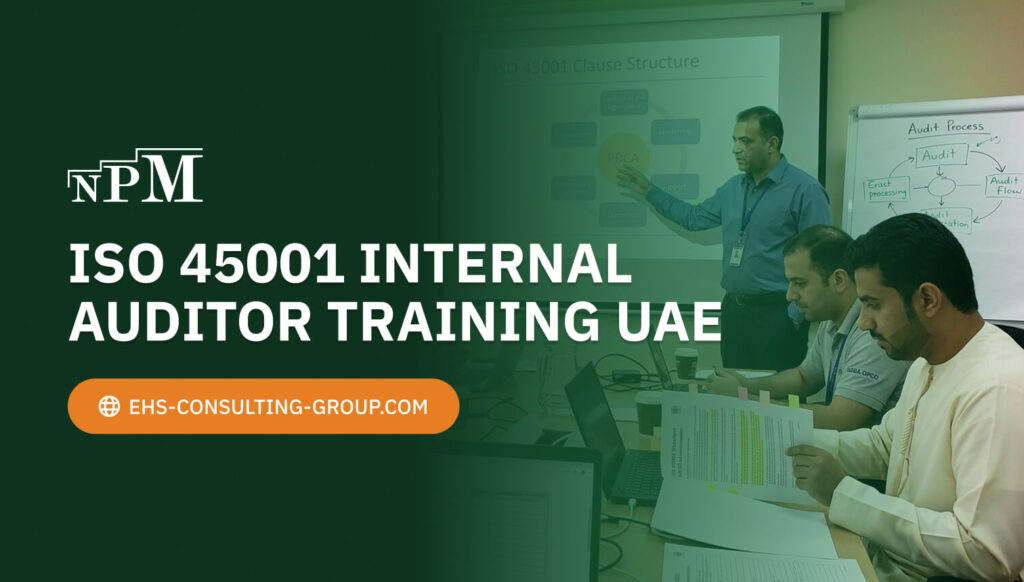
To go further on this topic, NPM’s broader ISO 45001 Internal Auditor Training UAE page covers this in more depth.
Explore NPM’s References
NPM’s references showcase how a disciplined OH&S management system translates into safer, more reliable operations in complex, high-risk environments. Across refineries, offshore facilities, petrochemical complexes, large civil and marine construction projects, heavy manufacturing plants, power generation assets, and logistics platforms, NPM has supported leadership teams and site crews in building practical control of risk. Our worldwide experience includes aligning ISO 45001 with process safety governance, integrating OH&S with ISO 9001 and ISO 14001 in unified IMS frameworks, and strengthening contractor ecosystems through clear onboarding, supervision criteria, and targeted assurance. We have seen the difference that focused attention on high-consequence tasks—lifting operations, energy isolation, confined space entry, hot work—can make when competence is verified and supervision is active. We have also helped organizations convert incident learning into systemic change so that improvements persist across shifts and project phases, not just immediately after an event.
These references are not just certificates or checklists; they are evidence that leadership behaviors, worker participation, and robust operational controls can be aligned without overburdening teams with paperwork. Whether addressing multilingual communications on fast-paced construction sites, calibrating heat-stress programs for extreme ambient conditions, or integrating emergency preparedness with Civil Defence coordination, the objective remains the same: controls that work at the point of risk. If you would like to see how such approaches have been applied in contexts similar to yours, our reference portfolio provides detailed, practical illustrations of the outcomes achieved and the lessons learned along the way.
For more information about our references, visit Our References.
Talk With NPM
If you are exploring how ISO 45001 principles can be grounded in your organization’s real operating conditions, we are happy to discuss practical options. Whether your focus is a brownfield turnaround, a multi-contractor construction site, or integrating OH&S with process safety, a short conversation can clarify next steps. For any further questions or to speak with our team, Contact Us.