
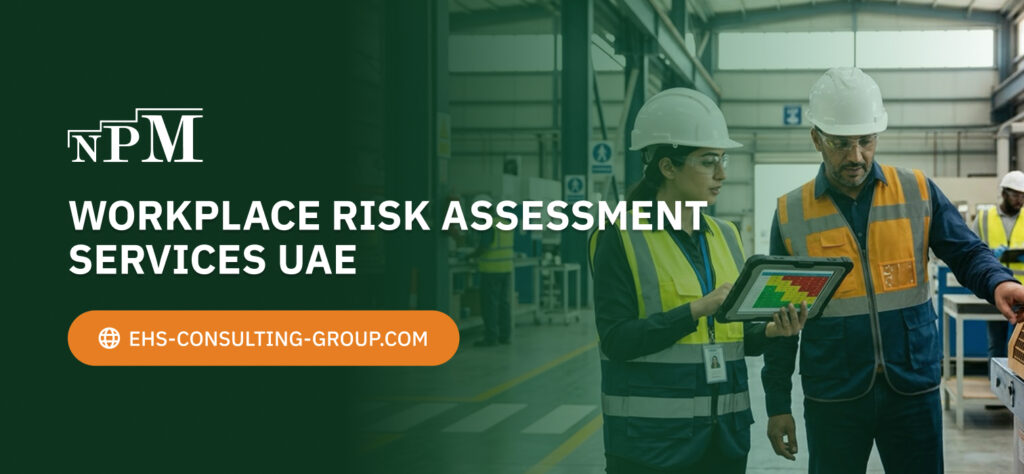
Workplace Risk Assessment for Utilities is a focused consulting engagement delivered by NPM to help UAE utility operators reduce occupational and operational risk across generation, transmission, water, wastewater, and district cooling assets. This industry-specific offering is part of our broader Workplace Risk Assessment Services UAE program, providing standardized methodology with utility-sector depth. We combine on-site walkdowns, task-based risk analysis, and system-level reviews to align your facility’s HSE controls with UAE regulatory expectations and international best practice while minimizing disruption to live operations and planned outages.
Who Needs Workplace Risk Assessment for Utilities?

Utility organizations in the UAE run complex, continuously operated systems where a single failure can compromise people, reliability, and service continuity. Workplace Risk Assessment for Utilities is essential for power generation stations (open-cycle/CCGT, solar PV with battery storage), transmission and distribution substations, desalination and RO plants, district cooling chiller and ETS networks, central boiler/steam plants, water distribution pumping stations, and municipal/industrial wastewater treatment works. Typical stakeholders include HSE managers responsible for OSH compliance and safe systems of work; plant managers and O&M supervisors accountable for uptime, maintenance, and contractor interfaces; asset integrity and electrical safety engineers managing arc-flash, switching, and isolation risk; and compliance officers preparing for authority or client audits. In the UAE, many utilities operate in multi-emirate footprints or inside industrial zones where site access is controlled, work is shift-based, and outage windows are tight. A structured Workplace Risk Assessment for Utilities gives your organization a defensible risk register, practical task-level controls, and a prioritized action plan that targets real exposures such as energized work, LOTO discipline, confined spaces in tanks and culverts, chemical dosing and storage (chlorine, acids, polymers), legionella in cooling systems, heat stress during summer operations, traffic and lifting at yards, and proximity risks at substations. NPM’s specialists tailor this engagement to the realities of 24/7 operations, contractor-heavy maintenance, and coordination with dispatch and control centers.
Objectives of Our Workplace Risk Assessment for Utilities

Our primary objective is to help you prevent incidents that threaten people, reliability, and compliance by building a clear, evidence-based picture of where and how work is performed—and whether existing controls are sufficient. The Workplace Risk Assessment for Utilities delivered by NPM pursues several outcomes: identify foreseeable hazards in routine and non-routine tasks across generation trains, switchyards, chemical dosing rooms, water treatment basins, and district cooling plants; quantify risk using your corporate or authority-aligned matrix; and define practicable controls that fit site constraints. We align risk assessment processes and outputs with recognized frameworks such as ISO 45001 to strengthen integration with your HSE management system. Objectives also include validating the effectiveness of key life-saving rules and permits (LOTO, confined space, hot work), verifying contractor safety management at high-risk interfaces (crane lifts, excavations near buried services, energization), and reviewing emergency preparedness for electrical incidents, chemical spills, and process upsets. For utilities with distributed assets, the Workplace Risk Assessment for Utilities further aims to harmonize risk language and critical control standards across sites so leaders can compare risk exposure and track closure consistently. Finally, we ensure traceability—from hazard identification to action completion—so each recommendation can be owned, resourced, and verified without ambiguity.
Scope of Work & Methodology

NPM’s methodology for a Workplace Risk Assessment for Utilities combines document review, stakeholder interviews, task-level studies, and physical verification. We begin with a scoping session to confirm system boundaries—generation units, substations, process buildings, workshops, yards, and adjacent third-party interfaces—and to align on your corporate risk matrix, critical controls, and permit-to-work architecture. Our consultants then perform targeted reviews of existing procedures (LOTO, switching, confined space, chemical handling), drawings (single line diagrams, P&IDs), OEM manuals, and recent incident/near-miss records to focus fieldwork. On site, we conduct representative walkdowns across shifts, observing live work and verifying safeguards such as isolation points, arc-flash labeling, interlocks, rescue equipment, eyewash/showers, spill containment, and emergency egress. We facilitate task risk assessments (TRA/JSA) with supervisors and technicians, capturing hazards and practicable controls that reflect how the job is actually done. Where appropriate, we apply bow-tie or layers-of-protection thinking to critical scenarios (e.g., inadvertent energization, chemical exposure, engulfment in wet wells). We conclude by consolidating a ranked actions register with responsible owners and closure criteria, ready for integration into your HSE system.
- Pre-engagement scoping: objectives, site list, risk matrix, documentation set, and logistics
- Desktop review: procedures, permits, drawings, incidents, maintenance plans, competency records
- Fieldwork: multi-shift walkdowns, photos, sampling of tasks, verifications, and worker interviews
- Analysis: risk evaluation, critical control validation, and gap assessment to standards/codes
- Reporting: risk register, action plan, executive summary, and implementation roadmap
| Utilities System/Area | Typical Workplace Hazards | Assessment Techniques Applied |
|---|---|---|
| Gas/Steam Turbine-Generator Sets (CCGT/OCGT) | Energized equipment, rotating machinery, high-pressure steam, confined spaces | Task Risk Assessment, LOTO verification audit, critical control checks, bow-tie for inadvertent energization |
| Substations & Switchyards | Arc-flash, step/touch potential, switching errors, working at height | Procedural review of switching, arc-flash labeling verification, TRA with electrical team |
| Desalination/RO Plants | Chemical dosing (chlorine, acids), slips/trips, confined spaces, pressure systems | JSA with O&M crew, chemical handling assessment, eyewash/shower adequacy checks |
| District Cooling Plants & ETS | Legionella risk, chemical treatment, lifting operations, noise | Task-based risk studies, contractor interface review, emergency response adequacy |
| Wastewater Treatment Works | H2S exposure, engulfment in tanks/wet wells, biological hazards, confined spaces | Confined space permit review, gas monitoring competency checks, TRA with maintenance team |
| Central Boiler/Steam Plants | Burns/scalds, pressure vessel hazards, combustion gas exposure | LOTO verification, hot work controls, operator competency sampling |
| Workshops, Stores & Yards | Material handling, forklifts, racking stability, contractor works | Traffic risk review, lifting plan sampling, housekeeping and segregation assessment |
Duration and Format of Workplace Risk Assessment for Utilities

The duration of a Workplace Risk Assessment for Utilities depends on the number and type of assets, geographic dispersion, and the breadth of tasks to be sampled. For a single plant (e.g., district cooling or mid-size RO plant), typical on-site work spans 2–4 days across at least two shifts to observe real work conditions, with 1–2 weeks for analysis and reporting. For larger or multi-unit power stations and combined water and power plants, on-site work may extend 5–10 days to cover generation islands, balance-of-plant, workshops, and switchyards—planned to avoid peak generation periods and to align with outage or maintenance windows. Distributed networks (e.g., multiple substations, pumping stations, ETS sites) are best scheduled as a phased program, combining remote pre-reviews (procedures, drawings, incidents) with clustered site visits to minimize travel and access coordination. NPM delivers this engagement in a hybrid format: remote kickoff and document review, then on-site walkdowns and workshops, followed by remote validation meetings for findings sign-off. We consider Ramadan schedules, midday heat breaks, and permit/access restrictions typical to high-security utilities. The Workplace Risk Assessment for Utilities culminates with an executive debrief and a practical action plan tailored to your resourcing and shutdown calendars, ensuring improvements are implementable without jeopardizing service continuity.
Benefits and Practical / Operational Use Cases

When performed rigorously, a Workplace Risk Assessment for Utilities delivers measurable operational and compliance value. Your organization gains a clearer view of critical tasks and residual risks across generation, electrical, water, and cooling systems—backed by evidence collected on the floor and in the field. Practical use cases include: reducing arc-flash exposure through verified labeling and switching improvements; minimizing inadvertent energization via tighter LOTO discipline and isolation point standardization; preventing confined space incidents in tanks and culverts with better entry planning and rescue readiness; controlling chemical hazards at dosing skids with improved storage, PPE, and eyewash/shower placement; and lowering heat-stress risk by re-timing and re-engineering outdoor tasks. The results improve audit readiness and align day-to-day work with UAE regulatory expectations from authorities such as the UAE Ministry of Human Resources and Emiratisation (MOHRE), while also fitting your asset management and outage planning practices. NPM prioritizes actionable controls—clear ownership, defined closure criteria, and verification methods—so improvements make a difference in the field, not just on paper.
- Fewer incidents and near-misses through strengthened critical controls and safer task execution
- Improved reliability and uptime by addressing human-factor and procedural contributors to failures
- Demonstrable compliance posture for client, insurer, and regulator audits with traceable actions
- Harmonized risk language and standards across multi-site or multi-utility portfolios
- Optimized training and competency focus based on real gaps observed during work
Why Choose Us

NPM brings deep utilities-sector experience across power generation, electrical networks, water/wastewater, and district cooling assets in the GCC, pairing process safety and OHS expertise with pragmatic operations insight. Our consultants have spent years inside turbine halls, switchrooms, chemical dosing areas, and ETS stations; we know how work actually gets done under time pressure, with contractors, and inside permit regimes. A Workplace Risk Assessment for Utilities with NPM emphasizes realism and traceability: we verify controls in the field, test assumptions with technicians and supervisors, and propose actions that are achievable within your outage windows, procurement cycles, and budget constraints. We are conversant with UAE authority expectations, corporate client audit criteria, and leading international practices, and we document findings in a format that integrates smoothly into your HSE management system and CMMS. Our digital workflows support photographic evidence, geo-tagging for distributed assets, and dashboards for closure tracking. Above all, we are independent and focused on reducing risk where it matters most—protecting people and ensuring continuity of essential services.
Detailed Service Offerings for Risk Programs
Beyond utilities, NPM provides industry-tailored workplace risk assessments across adjacent sectors. Explore these related offerings to support contractors, clients, or sister business units operating in other high-risk environments.
Workplace Risk Assessment for Manufacturing
This service suits OEM partners, captive workshops, and production lines that interact with utilities or supply components to your plants. It addresses machine guarding, LOTO for presses and CNCs, manual handling, and line changeovers, typically required before capacity expansion or new line commissioning. The practical outcome is a risk register and controls that reduce downtime and injuries in production environments interfacing with your utility operations.
Click on the following link for more details: Workplace Risk Assessment for Manufacturing.
Workplace Risk Assessment for Construction
Designed for EPCs and contractors executing brownfield tie-ins, excavations near buried services, and lifting operations on utility sites, this engagement covers temporary works, crane/lifting plans, excavations, working at height, and traffic management. It is commonly required prior to shutdowns or network expansions to ensure contractor risks are well controlled. The outcome is a contractor-ready action plan aligned to your permit-to-work system.
Click on the following link for more details: Workplace Risk Assessment for Construction.
Workplace Risk Assessment for Oil & Gas
For operators and service companies performing works inside refineries, gas processing plants, pipelines, and terminals that connect to utility infrastructure, this assessment covers process-related hazards, hot work interfaces, H2S exposure, and SIMOPS. It is typically required before maintenance campaigns and capital projects. The result is a prioritized set of controls integrated with PTW, MOC, and asset integrity programs.
Click on the following link for more details: Workplace Risk Assessment for Oil & Gas.
Workplace Risk Assessment for Logistics And Warehousing
Applicable to spare parts hubs, chemical stores, and distribution centers serving utility networks, this service examines racking stability, MHE operations, hazardous materials segregation, and traffic flows. It is often undertaken ahead of warehouse expansions or DG storage upgrades. The outcome is safer warehousing and logistics operations that support uninterrupted utility services.
Click on the following link for more details: Workplace Risk Assessment for Logistics And Warehousing.
Regulatory Landscape & Operational Risks in Utilities
UAE utilities operate within a robust regulatory environment that expects systematic hazard identification, risk control, and demonstrable competence. Federal Decree-Law No. 33 of 2021 and its implementing regulations set overarching worker health and safety obligations, complemented by emirate-level schemes such as the OSHAD framework in Abu Dhabi and approvals by Dubai Municipality and Dubai Civil Defence for relevant safety systems. Internationally, utilities often align with management standards (e.g., ISO 45001) and sector guidance from the Energy Institute (EI) for safe operations and asset integrity across power and energy systems. Operationally, common risk themes in the UAE include arc-flash at substations, switching/synchronization errors, confined space entries in tanks and wet wells, chemical dosing and bulk storage of chlorination media and acids, legionella control in district cooling towers, heat stress during summer, and heavy lifting or excavation near live buried services. Many facilities are distributed across industrial zones and residential areas, creating access controls and public interface considerations. A rigorous Workplace Risk Assessment for Utilities must therefore translate regulatory expectations into field-verified controls, ensure permits and isolation practices are robust, and document a defensible risk register that shows clear ownership and timelines. NPM structures the engagement so findings feed into your HSE system and are auditable by clients, insurers, and authorities.
Related Workplace Risk Assessments Across Industries
NPM supports organizations across multiple UAE industries with sector-specific approaches. Explore how our methods adapt to the unique hazards, standards, and operational realities of each sector below.
Workplace Risk Assessment for Manufacturing
Workplace Risk Assessment for Manufacturing is geared to factories with presses, CNC machining, assembly lines, and finishing operations where hazards include machine guarding, entanglement, LOTO, solvent use, and MHE traffic. It references standards like ISO 45001 and regulator expectations from MOHRE, addressing risks unique to fast-paced production with changeovers and maintenance. This offer is relevant to operators of machining cells, paint booths, and packaging lines that must control exposure to pinch points and hazardous energy while meeting client audits and OEM requirements.
Click on the following link for more details: Workplace Risk Assessment for Manufacturing.
Workplace Risk Assessment for Construction
Workplace Risk Assessment for Construction targets high-rise builds, infrastructure works, and brownfield tie-ins where hazards are dominated by working at height, scaffold integrity, crane operations, excavations, and temporary electrical setups. It considers UAE authorities like Dubai Municipality and MOHRE and integrates controls aligned to fall protection programs and lifting plans. This is particularly relevant to contractors managing tower cranes, deep excavations near utilities, and hot-weather working regimes on large construction sites.
Click on the following link for more details: Workplace Risk Assessment for Construction.
Workplace Risk Assessment for Oil & Gas
Workplace Risk Assessment for Oil & Gas addresses upstream and downstream operations including refineries, gas processing, pipelines, and offshore/onshore terminals with hazards such as H2S, flammables, hot work in hazardous areas, and SIMOPS. It references API and IOGP practices, and ties into permit-to-work, MOC, and isolation standards expected by operators. This is particularly relevant to turnaround teams, pipeline maintenance crews, and terminal operators coordinating high-risk work near live process equipment.
Click on the following link for more details: Workplace Risk Assessment for Oil & Gas.
Workplace Risk Assessment for Logistics And Warehousing
Workplace Risk Assessment for Logistics And Warehousing focuses on racking configurations, forklift/MHE operations, traffic segregation, and dangerous goods handling in warehouses and port-associated yards. It aligns with NFPA guidance for flammable liquids storage and considers MOHRE and local authority requirements for safe warehouse operations. This is especially relevant to DCs handling spare parts, oils, chemicals, and heavy crates supporting utility maintenance and projects.
Click on the following link for more details: Workplace Risk Assessment for Logistics And Warehousing.
Deliverables and Validation
NPM structures the Workplace Risk Assessment for Utilities to ensure transparent validation and traceability from field observation to final action closure. We begin with a pre-engagement scoping phase—kickoff meeting, targeted document review (procedures, permits, drawings, incident learnings), and, where feasible, a preliminary site visit to confirm access needs, PPE, and photography protocols. During execution, our consultants conduct multi-shift walkdowns, focused interviews with supervisors, technicians, control room operators, and contractor leads, and facilitated TRA/JSA workshops. We recommend a workshop/interview team of 6–10 people per session to include O&M, HSE, electrical/MEP, and contractor supervision—balanced for shift patterns and workload, and scheduled around outage windows and dispatch constraints.
Draft findings are validated through review meetings and optional joint site rechecks to confirm practicality of proposed controls. The final report includes: an executive summary for leadership; a detailed narrative of methodology and scope; a hazards and controls register traceable to tasks/locations with risk ratings; a prioritized action plan with owners, resources, and due dates; evidence logs (photos, forms, excerpts from permits/procedures) where permitted; and a mapping to your HSE management system elements. We supply the actions register in a structured format compatible with your tracking tools (Excel/CSV or API-ready export), preserving traceability for audits. The client organization owns implementation and sign-off of actions; NPM can provide post-engagement advisory or verification upon request. This validation flow ensures the Workplace Risk Assessment for Utilities is both technically defensible and operationally achievable, and that findings withstand internal reviews, client audits, and authority scrutiny.
FAQ
How often should a utilities facility repeat this assessment, and what triggers a re-assessment?
For most utilities, a Workplace Risk Assessment for Utilities should be refreshed every 12–24 months, with interim updates when significant changes occur. Triggers include new equipment or lines entering service, major maintenance turnarounds, procedure or permit-to-work changes, incidents or near-misses, contractor mobilizations for capital projects, or regulatory updates that affect risk criteria or controls.
What is the difference between an initial assessment and a periodic review in the utilities context?
An initial Workplace Risk Assessment for Utilities establishes the baseline: scope definition, complete task inventory sampling, and a comprehensive actions register. A periodic review focuses on verifying closure effectiveness, re-sampling higher-risk tasks, checking for drift in critical controls (e.g., LOTO, arc-flash labeling), and integrating new learnings or modifications. The periodic review is faster and more targeted, leveraging the original baseline.
Who implements the recommendations—the consultant or our organization?
NPM delivers the analysis, risk register, and action plan, while your organization owns implementation and sign-off. We can support with clarification, training, or verification checks upon request, but execution remains with your O&M, HSE, and contractor teams to align with site governance and procurement processes.
Can this engagement be delivered remotely for multi-site utilities, or must it be on-site?
We use a hybrid approach. Scoping meetings, document reviews, and some validation can occur remotely to accelerate timelines for multi-site portfolios. However, the Workplace Risk Assessment for Utilities requires on-site walkdowns and task observations to validate real-world controls. For distributed networks, we cluster site visits to optimize travel and access.
What team size and stakeholders are recommended for interviews and workshops in utilities operations?
We recommend 6–10 participants per session, including O&M supervisors, technicians, electrical/MEP engineers, HSE representatives, and a contractor supervisor where relevant. This mix reflects typical utilities staffing and ensures balanced insights from those planning, authorizing, and performing the work across shifts.
What information or access do you need before starting?
Before commencing a Workplace Risk Assessment for Utilities, we request HSE procedures (LOTO, confined space, hot work), recent incident and near-miss summaries, risk matrix, representative permits/JSAs, electrical single line diagrams, relevant P&IDs for process areas, site layouts, chemical inventories, and access protocols. We also need clarity on photo permissions and escort requirements to plan efficient fieldwork.
Can NPM align the assessment with our corporate standards instead of a generic framework?
Yes. We map the Workplace Risk Assessment for Utilities to your corporate HSE system, risk matrix, and critical control standards, ensuring outputs integrate with your internal governance and tracking tools while remaining auditable to external expectations.
How do you handle sites with strict security and limited photo permissions?
We adapt evidence collection using redacted notes, diagram annotations, and where permitted, controlled imagery. Validation workshops then confirm observations with site stakeholders to ensure accuracy without breaching security protocols.
Explore Our Track Record
NPM has delivered workplace risk assessments and operational safety engagements for critical infrastructure operators worldwide, spanning generation fleets, water/wastewater utilities, and district energy networks. Our references demonstrate how we translate global best practice into site-ready actions under real operating constraints, with measurable improvements in risk and reliability. We invite you to explore our experience and outcomes.
For more information about our references, visit Our References.
Speak to Our Specialists
Discuss how a tailored Workplace Risk Assessment for Utilities can strengthen critical controls, reduce incident risk, and improve audit readiness across your plants, substations, and distributed assets. NPM will scope an engagement that fits your outage windows, shift patterns, and multi-site realities. Reach out to outline your priorities and request a proposal.