
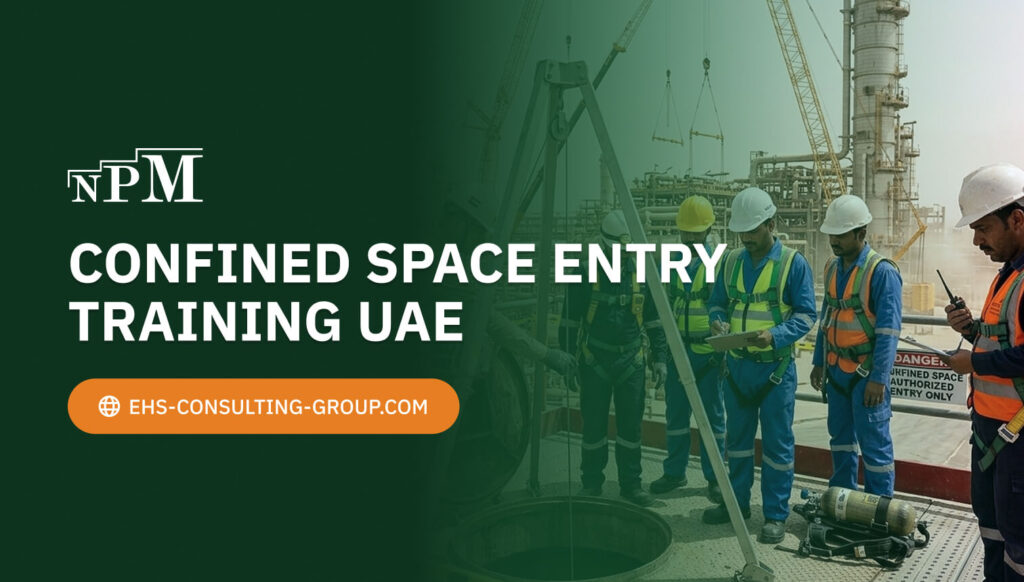
Confined Space Training for Water Treatment Facilities delivered by NPM equips O&M teams at desalination plants, wastewater treatment plants, pumping stations, and network maintenance crews with the competencies to plan, permit, monitor, and rescue safely during entries into tanks, wet wells, valve chambers, culverts, and manholes. This industry-specific program is aligned with UAE regulatory expectations and international best practice, and is part of our broader Confined Space Entry Training UAE portfolio for multi-site utilities and municipal operators.
Who Needs Confined Space Training for Water Treatment Facilities?

Water and wastewater operations present a unique mix of toxic, oxygen-deficient, and physical hazards that demand targeted capability building. Confined Space Training for Water Treatment Facilities is designed for process operators, maintenance technicians, electrical & instrumentation teams, network rehabilitation crews, and supervisors who routinely interact with assets such as aeration basins, primary and secondary clarifiers, sludge thickeners, anaerobic digesters, effluent channels, contact tanks, odor control vessels, and buried valve chambers. Typical high-risk tasks include entry to wet wells for pump change-outs, manhole interventions on pressurized or surcharged sewers, inspection of RO concentrate tanks at desalination plants, and clean-in-place (CIP) tank maintenance. Elevated H2S and CH4, low O2 due to biological activity, potential chlorine gas releases from disinfection systems, limited access/egress, and engulfment in sludges are everyday realities in this sector. Confined Space Training for Water Treatment Facilities here focuses on the entrant, attendant, and supervisor roles, including emergency response team members and contractors who may be called to support shutdowns, turnarounds, or network emergencies. In the UAE context, we account for OSHAD requirements in Abu Dhabi, Dubai Municipality expectations, Civil Defence emergency coordination, and client-specific permit-to-work programs used by utilities and municipal authorities. NPM helps training coordinators schedule crews around shifts and live-plant constraints, ensuring permit rigour and rescue readiness without disrupting water supply and wastewater treatment continuity.
Objectives of Our Confined Space Training for Water Treatment Facilities

Our Confined Space Training for Water Treatment Facilities builds practical competence to identify, control, and continuously monitor atmospheric and process hazards in spaces typical of water treatment and wastewater operations. By the end of this program, delegates can map confined-space inventories across plants and networks; classify spaces based on known and reasonably foreseeable hazards; conduct instrumented pre-entry and continuous atmospheric testing for O2, H2S, CO, and combustible gases; and implement ventilation strategies suitable for deep wet wells, long culverts, and large tanks where stratification can occur. Participants learn how to integrate confined space permits into utility permit-to-work regimes, verify LOTO for pumps, blowers, and mixers, and coordinate with chlorine systems to avoid inadvertent releases during entries near gas rooms or vacuum regulators. Confined Space Training for Water Treatment Facilities also clarifies role-specific duties: the entrant’s self-awareness and communication protocols; the attendant’s continuous monitoring and non-entry rescue readiness; and the supervisor’s responsibility for hazard re-evaluation, permit revalidation, contractor oversight, and interface with emergency services. We emphasise selection, inspection, and use of retrieval systems (tripods, davits, winches), harnesses, fall protection, intrinsically safe lighting, and confined-space-rated gas detectors. Drawing on NFPA 350 guidance, ISO 45001-aligned OHS management practices, and UAE authority requirements, the training culminates in simulated rescue drills that are realistic for digesters, manholes, and valve chambers—so crews can respond decisively to evolving risks without exposing rescuers to secondary harm.
Training Program and Curriculum Tailored to Water Sector Operations

NPM structures the curriculum so that crews from desalination and wastewater plants, pumping stations, and network teams receive scenario-driven learning that matches their daily reality. Confined Space Training for Water Treatment Facilities begins with a focused risk profile of the water sector—biological decomposition producing H2S and CO2, oxygen displacement in deep wet wells, methane in digesters and sewers, chlorine exposure near disinfection systems, and mechanical entrapment from mixers and scrapers. We then build capability in hazard identification and control selection, atmospheric testing strategy (sensor limitations, cross-sensitivities, calibration/bump testing, placement in stratified atmospheres), and ventilation design for vertical and horizontal spaces. Permit-to-work integration is trained using water-utility templates so that entrants, attendants, and supervisors can execute their role-specific checklists confidently. Practical modules familiarise participants with retrieval systems, communication protocols, rescue considerations, and when to stand down due to unacceptable conditions. Confined Space Training for Water Treatment Facilities concludes with realistic field drills that mirror the facility’s layout and constraints, always planned to avoid service disruption and protect water quality and environmental compliance.
| Module | Key Topics | Method | Typical Equipment | Indicative Duration |
|---|---|---|---|---|
| Regulatory & Standards Landscape | OSHAD, Dubai Municipality expectations, Civil Defence interface, ISO 45001, NFPA 350 fundamentals | Instructor-led | Policy templates, sample permits | 1–1.5 hours |
| Hazard Identification in Water Assets | H2S/CH4, low O2, chlorine, engulfment, mechanical and electrical isolation (LOTO) | Case studies workshop | P&IDs, site layouts, LOTO devices | 2 hours |
| Atmospheric Testing & Ventilation | Pre-entry and continuous monitoring, sampling in stratified spaces, forced-air ventilation planning | Hands-on | Confined-space gas detectors, blowers, ducting | 2–3 hours |
| Permit-to-Work & Supervision | Permit completion, verification, shift handover, contractor oversight | Role-play templates | Utility PTW forms, checklists | 1.5 hours |
| Rescue Planning & Non-Entry Retrieval | Tripods/davits, winch operation, non-entry first strategies, emergency escalation | Hands-on drill | Tripod, davit, winch, harness | 2–3 hours |
| Live-Scenario Drill (Offline Space) | Full entry cycle from hazard assessment to closeout, communications, debrief | Practical drill | All above radios, lighting | 2 hours |
- Hands-on tasks include bump testing multi-gas detectors, setting up ventilation for a deep wet well, and configuring a davit system over a valve chamber.
- Participants practice completing utility permit-to-work documents and role-play entrant–attendant–supervisor communications.
- Rescue scenarios simulate a suspended entrant in a manhole, prioritising non-entry retrieval and safe handover to emergency responders.
Because Confined Space Training for Water Treatment Facilities must reflect each site’s geometry and constraints, NPM can integrate site-specific scenarios (e.g., clarifier scum box entry, siphon chamber inspections, RO feed tank cleaning) into the practical components while respecting process integrity and water quality commitments.
Duration and Format of Confined Space Training for Water Treatment Facilities

NPM offers delivery formats that accommodate shift patterns, turnaround windows, and live-plant constraints common to desalination and wastewater plants. Confined Space Training for Water Treatment Facilities is typically available in three tiers. A 1-day Awareness course covers hazard recognition, atmospheric monitoring fundamentals, and basic permit concepts for personnel who support but do not enter confined spaces. A 2-day Entrant & Attendant course adds extensive hands-on practice with gas detection, ventilation set-up, retrieval systems, and role execution under a full permit cycle. A 3-day Supervisor & Rescue option extends to advanced permit oversight, contractor control, rescue planning, and multiple scenario-based drills to validate leadership decisions under pressure. For multi-site utilities, we can schedule rolling cohorts to keep essential operations manned, and we can deliver theory modules in a live online format followed by on-site practicals at one or more facilities. Confined Space Training for Water Treatment Facilities is conducted in English or Arabic, with bilingual materials as required, and we tailor examples to the specific assets—tanks, manholes, culverts, valve chambers—present at your sites.
- On-site delivery at a water or wastewater facility with offline spaces prepared for drills.
- Hybrid format: online theory modules followed by concentrated on-site practical sessions.
- Dedicated in-house cohorts for utilities and municipal operators to align with internal PTW systems.
Operational Benefits and High-Value Use Cases

When implemented across field and plant teams, Confined Space Training for Water Treatment Facilities reduces incident likelihood and improves permit discipline, directly supporting continuity of water supply and wastewater treatment services. The program drives more reliable atmospheric testing in deep structures and large tanks, better ventilation planning that accounts for stratification and dead zones, and stronger supervision that resists production pressure and contractor shortcuts. Typical high-value applications include pump replacement in a 15 m wet well, clarifier maintenance during a seasonal shutdown, emergency sewer blockage removal in a high-H2S district, desludging of digesters, and inspections of culverts at desalination intake structures—all under rigorous permit and rescue readiness. Outcomes include faster, safer entries; fewer permit rejections due to documentation errors; reduced exposure to toxic atmospheres; and smoother coordination with Civil Defence where necessary. Confined Space Training for Water Treatment Facilities also enhances cross-functional collaboration between process, maintenance, and HSE teams, enabling data-driven decisions on whether to attempt non-entry solutions or proceed to entry under defined controls.
- Improved hazard anticipation for H2S spikes and oxygen depletion in biologically active spaces.
- Consistent use of calibrated gas detectors and evidence-based decisions on ventilation rates.
- Stronger contractor oversight and integration with utility permit-to-work and isolation standards.
- Rescue strategies that prioritise non-entry retrieval and minimise secondary victim risk.
- Documentation quality that withstands internal audits and regulator inspections.
Why Choose NPM for Water-Sector Confined Space Capability

NPM combines deep water and wastewater domain experience with practical rescue and permit implementation skills. Our instructors have supported major desalination facilities (RO and hybrid plants), municipal wastewater treatment plants, and large pump station networks across the region—translating process-specific hazards into training that sticks. Confined Space Training for Water Treatment Facilities is delivered with your permit-to-work templates, isolation standards, and local emergency procedures, so participants practice exactly how they will work the next day. We come equipped with training-grade retrieval systems, intrinsically safe lighting, and multi-gas detectors to provide realistic drills without impacting service continuity. For authorities and large utilities, we help baseline current competencies and plan sustainable refresher cycles tied to risk and incident learnings. NPM is part of a broader technical ecosystem that values rigorous professional standards; our affiliation with CABINET NPM underscores our commitment to quality, ethics, and continuous improvement in high-stakes industrial training.
Detailed Training Pathways Related to the Water Sector
Many water utilities, EPCs, and O&M contractors operate across multiple sectors. In addition to Confined Space Training for Water Treatment Facilities, NPM delivers industry-calibrated programs that address the realities of working in mixed portfolios and shared services.
Confined Space Training for Oil & Gas
Ideal for water sector operators and contractors who also maintain assets within oil terminals, upstream gathering stations, or shared corridors that cross hydrocarbon facilities. This training covers hydrocarbon vapor hazards, H2S at higher concentrations, hot work interfaces, and ADNOC/ARAMCO-style permit regimes—preparing mixed crews to transition safely between municipal and oil & gas sites. Practical outcome: crews can adapt permit, testing, and rescue protocols for hydrocarbon-classified environments without losing the discipline built in Confined Space Training for Water Treatment Facilities.
Click on the following link for more details: Confined Space Training for Oil & Gas.
Confined Space Training for Petrochemical Plants
For utilities teams supporting industrial zones with chemical storage, polymer units, or shared effluent treatment plants adjacent to petrochemical sites. The course emphasises toxic and flammable vapors, inerting hazards, and complex isolations associated with reactors and process vessels—complementing the sanitation-focused risks addressed in Confined Space Training for Water Treatment Facilities. Practical outcome: your supervisors can navigate multi-operator permits and controls in chemical plants without compromising safety.
Click on the following link for more details: Confined Space Training for Petrochemical Plants.
Confined Space Training for Manufacturing
Useful for municipal and private water operators who also maintain manufacturing utility systems—boiler rooms, cooling towers, CIP tanks, and silos in food and beverage plants. The curriculum bridges biological/toxic risks with dust explosion potential and mechanical isolation standards found in factories, building on the foundations from Confined Space Training for Water Treatment Facilities. Outcome: technicians can switch confidently between plant utility spaces and treatment assets while maintaining robust permit and monitoring practices.
Click on the following link for more details: Confined Space Training for Manufacturing.
Confined Space Training for Utilities
Designed for integrated utilities spanning power generation, transmission, and water services. It harmonises confined space procedures across substations, culverts, intake tunnels, and valve chambers, enabling consistent role execution and rescue planning across the network. This complements Confined Space Training for Water Treatment Facilities by aligning terminology, permits, and response expectations at enterprise scale.
Click on the following link for more details: Confined Space Training for Utilities.
Regulatory Landscape and Operating Realities in UAE Water and Wastewater
In the UAE, utility operators and their contractors must align confined space work with emirate-level and federal safety expectations. Abu Dhabi’s OSHAD framework sets out Codes of Practice for permit-to-work, confined spaces, and emergency preparedness that many operators adopt as baseline requirements. In Dubai, utilities and O&M firms are expected to meet Dubai Municipality occupational safety expectations and coordinate rescue and emergency response with Civil Defence, especially where public infrastructure is involved. ISO 45001-certified management systems are common among leading utilities and EPCs, and many adopt NFPA 350 as a practical guide for hazard evaluation, testing, ventilation, and rescue strategy. Confined Space Training for Water Treatment Facilities therefore emphasises PTW integration, verifiable LOTO for pumps, mixers, and blowers, atmospheric testing to detect oxygen deficiency and toxic/flammable gases in sewers and tanks, and non-entry rescue planning suitable for vertical entries into manholes and wet wells. Typical facility types include RO desalination plants with intake culverts and concentrate tanks; municipal and industrial wastewater treatment plants with digesters, clarifiers, sludge thickeners, and odor control vessels; and extensive sewer and stormwater networks with buried valve chambers and culverts. Practical implementation in the UAE must factor extreme ambient temperatures, high humidity in underground structures, and multilingual crews—each addressed in how we structure Confined Space Training for Water Treatment Facilities, from equipment selection (intrinsically safe lighting and ATEX-rated blowers where required) to bilingual instruction and role cards.
Our Training Across UAE Industries
NPM delivers confined space capability across sectors with distinct risk profiles and permit cultures. The following industry programs ensure your mixed-portfolio teams remain compliant and competent when working beyond water and wastewater assets.
Confined Space Training for Oil & Gas
Confined Space Training for Oil & Gas prepares teams for entries in refineries, offshore platforms, onshore gathering stations, and tank farms where hydrocarbons, pyrophoric scale, and H2S exposures are prevalent. We address ADNOC Codes of Practice alignment, API-referenced practices, gas testing for LEL in hydrocarbon vapors, and control of ignition sources under hot work permits. This is particularly relevant to operators whose infrastructure interfaces with pipelines or terminal corridors, requiring coordination with OSHAD and facility-specific permit authorities, and mitigation of hazards unique to hydrocarbon processing.
Click on the following link for more details: Confined Space Training for Oil & Gas.
Confined Space Training for Petrochemical Plants
Confined Space Training for Petrochemical Plants focuses on reactors, distillation columns, utility plants, and storage spheres typical of polymer and chemical complexes. Delegates learn to manage flammable/toxic atmospheres per NFPA 30 considerations, isolation of interlinked process systems, and simultaneous operations (SIMOPS) that impact entry conditions. With regulators such as Civil Defence overseeing emergency readiness and operators adopting IEC 61511-driven controls, the offer is especially relevant for industrial zone stakeholders managing shared effluent and utility interfaces with their water treatment units.
Click on the following link for more details: Confined Space Training for Petrochemical Plants.
Confined Space Training for Manufacturing
Confined Space Training for Manufacturing addresses entries into CIP tanks, mixers, boiler rooms, and powder silos in food and beverage or general manufacturing plants. We tackle oxygen displacement from CO2/N2, solvent vapors, and combustible dust risks (referencing NFPA 652 principles where relevant) alongside UAE Fire and Life Safety Code expectations for safe access and egress. This training is vital for manufacturers operating on shared utility corridors with water and wastewater facilities, where cross-permit compatibility and consistent atmospheric testing practices are essential.
Click on the following link for more details: Confined Space Training for Manufacturing.
Confined Space Training for Utilities
Confined Space Training for Utilities spans power generation units, substations, culverts, cooling water intakes, and valve chambers under integrated utility operators. It aligns with enterprise-wide permit systems (e.g., DEWA, SEWA, or TRANSCO-style regimes), OSHAD principles for Abu Dhabi operations, and Civil Defence emergency interfaces. This is highly relevant for operators seeking a single standard across water, power, and district energy assets—covering LOTO of rotating equipment, atmospheric testing in long culverts, and non-entry retrieval as a first resort.
Click on the following link for more details: Confined Space Training for Utilities.
Assessment and Certification Process
Competency is verified through both knowledge and performance components. Confined Space Training for Water Treatment Facilities uses a written assessment to test understanding of hazard recognition, permit requirements, role responsibilities, and gas detection principles. More importantly, delegates complete practical evaluations that simulate real-world entries in offline spaces—performing bump tests and calibrations on multi-gas detectors, planning and installing forced-air ventilation in vertical shafts, setting up a tripod/davit with a retrieval winch, demonstrating entrant–attendant communications, and executing a safe, non-entry retrieval. Instructors use scored checklists to assess critical steps such as verifying isolations, confirming acceptable atmospheric conditions, documenting permit fields accurately, and halting work when readings or conditions change. Certificates of completion are issued by NPM and include participant name, employer, course title, hours, learning outcomes, assessment results, and a unique certificate ID. The client organisation remains responsible for any statutory competency assignment and internal authorisations per their PTW system. Recommended cohort size is 8–12 participants to ensure sufficient hands-on time with equipment and individual feedback. Before delivery, we conduct a short needs analysis and, where possible, a site walkdown to select appropriate training spaces and confirm language needs so Confined Space Training for Water Treatment Facilities fully reflects your assets and procedures.
- Assessment components: closed-book knowledge test, practical skills demonstration, and instructor observation during scenario drills.
- Pre-training scoping: document review (permits, LOTO standards), site access planning, and alignment on rescue interfaces with Civil Defence.
Frequently Asked Questions
How often should we renew this training for water and wastewater crews?
For most utilities, renewal every two years is appropriate, with annual practical refreshers for high-exposure teams. Trigger a sooner refresher after incidents, major permit deviations, role changes, or introduction of new equipment or chemicals impacting Confined Space Training for Water Treatment Facilities application.
What is the difference between initial and refresher sessions?
Initial training develops full knowledge and practical skills, while refresher sessions emphasise updates to your PTW, focused drills, and performance gaps observed in the field. In water operations, refreshers often centre on atmospheric testing discipline and rescue readiness related to Confined Space Training for Water Treatment Facilities scenarios.
Who issues the certificate, and is it recognised?
NPM issues the certificate of completion with course details and assessment outcomes. Recognition is based on employer acceptance and alignment with UAE regulatory expectations; your organisation remains responsible for internal authorisation to work following Confined Space Training for Water Treatment Facilities.
Should we choose in-house or open/public sessions?
In-house delivery is best for utilities and EPCs needing integration with their permit templates, isolations, and site-specific risks. Open/public sessions suit smaller contractors needing foundational skills, with the understanding that site-specific application after Confined Space Training for Water Treatment Facilities should be reinforced internally.
What group size works best for effective learning?
We recommend 8–12 participants per cohort to balance equipment access and coaching time during practicals. Larger utilities can schedule multiple cohorts to maintain coverage while ensuring the quality of Confined Space Training for Water Treatment Facilities.
Are there prerequisites?
No formal prerequisites; however, participants should be medically fit for confined space work and familiar with their employer’s PTW and LOTO expectations. Prior exposure to site P&IDs, layouts, and gas detection basics helps maximise learning during Confined Space Training for Water Treatment Facilities.
Explore Our Track Record
NPM has delivered complex HSE and process safety engagements and training worldwide, from utilities and municipal infrastructure to large industrial operators. Our references demonstrate proven outcomes, including reduced permit deviations, improved rescue readiness, and measurable competence growth in programs such as Confined Space Training for Water Treatment Facilities. We invite you to review projects that reflect the quality and consistency we bring to every engagement.
For more information about our references, visit Our References.
Speak with NPM About Your Next Cohort
If you manage water or wastewater assets and want to build reliable, audit-ready capability, NPM can tailor Confined Space Training for Water Treatment Facilities to your permit system, language mix, and operating realities. Share your facility constraints and scheduling needs, and we will structure a practical, defensible training plan that keeps operations running while elevating safety performance.