
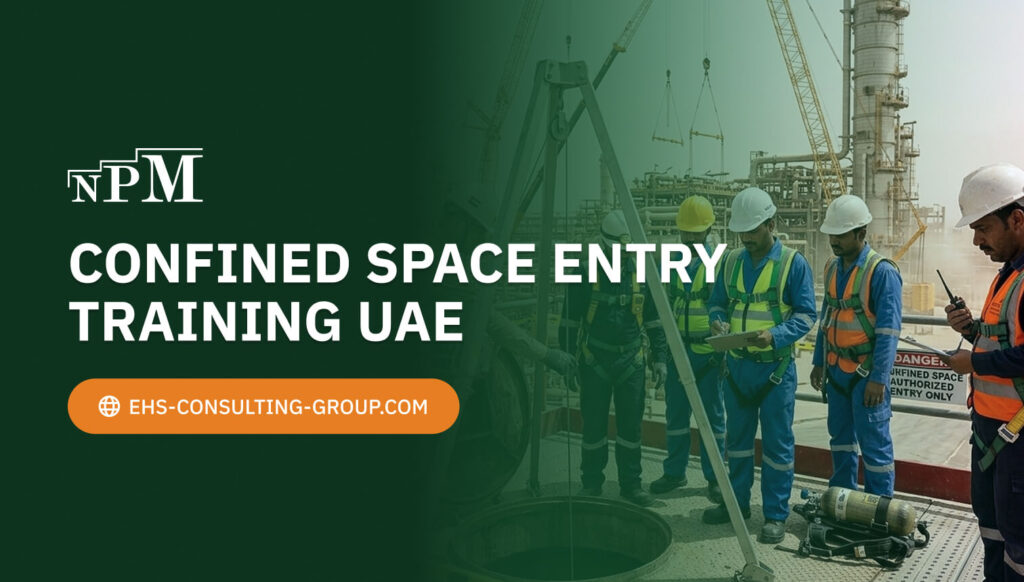
Confined Space Training During Shutdown Project planning is fundamentally different from routine entry preparation because outage conditions compress time, concentrate hazards, and bring multi-contractor teams into spaces that have not been entered for years. In refineries, petrochemical complexes, power plants, and large construction and manufacturing sites across the UAE, shutdowns and turnarounds intensify the complexity of confined space work: more simultaneous operations, more isolation points, more intrusive maintenance, and a higher probability that normal safeguards are bypassed or temporarily unavailable. This article unpacks how to configure training, competency, and on-the-day readiness so that confined space work during outages is executed safely, lawfully, and efficiently.
Rather than describing a class agenda, the discussion below focuses on what competence looks like when vessels are opened, boilers are cooled, tanks are purged, columns are inspected, and culverts or shafts become active workfronts. It weaves together recognized standards (ISO 45001, NFPA 350, and relevant UAE regulatory frameworks), turnaround realities (compressed schedules, permit queues, late design changes), and practical constraints (language diversity, heat stress, complex rescue access) to help HSE leaders and operations teams shape a plan that actually performs under pressure. Throughout, the perspective reflects lessons NPM practitioners have seen across offshore and onshore assets, pipelines, storage terminals, high-rise and infrastructure projects, and logistics depots.
While the word “training” suggests a classroom, the real test of competence during an outage happens as soon as blinds are installed, nitrogen purging starts, and scaffolds or rope access teams descend into spaces with changing conditions. The priority is aligning human performance with the process safety picture that HAZOP, HAZID, and Bowtie analyses anticipate but cannot execute on the ground without people who understand their roles.
Who Does This Affect?
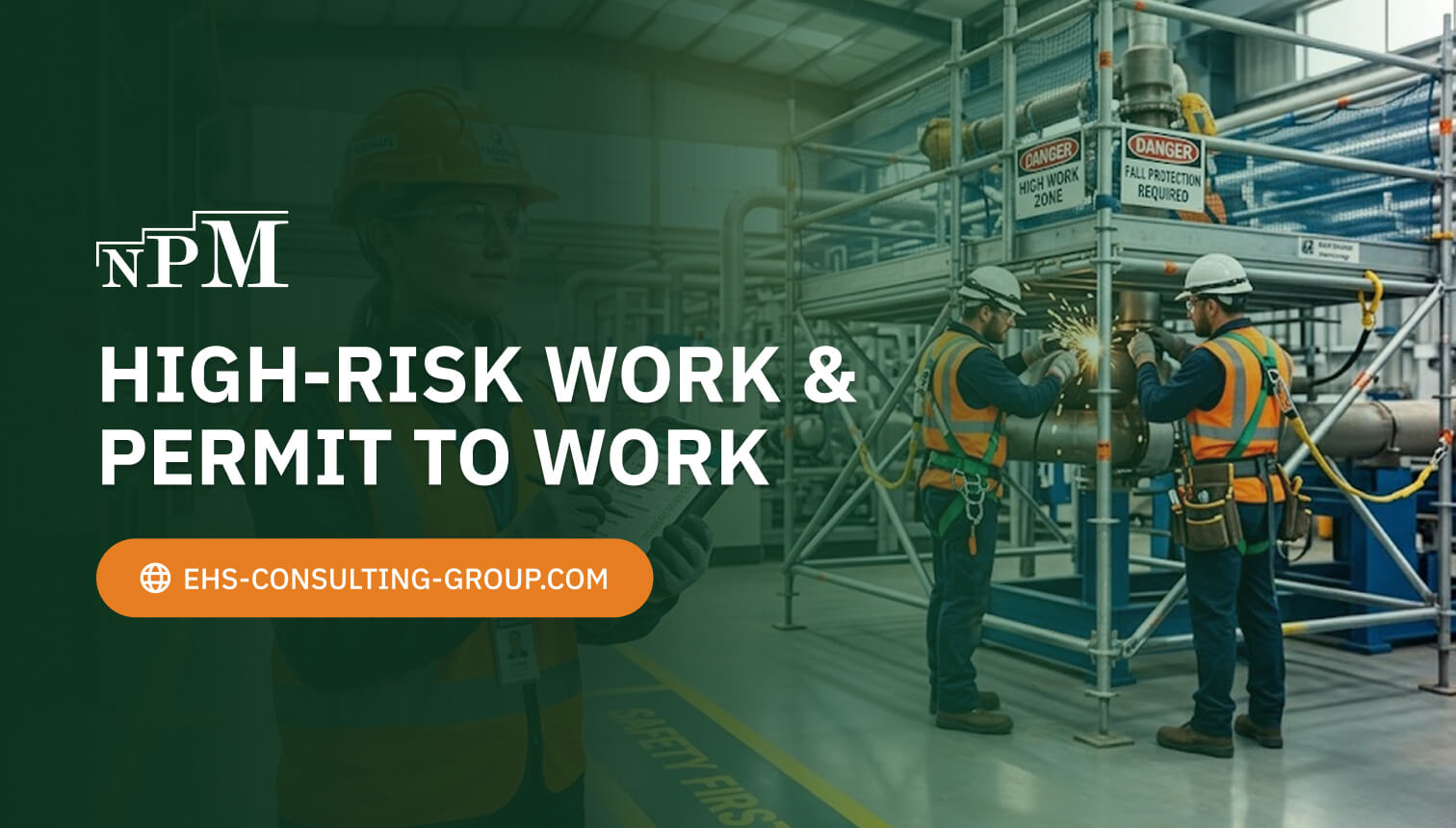
The responsibility for safe confined space work during shutdowns is spread across many roles. The immediate audience includes HSE managers and site HSE teams who steward the permit-to-work (PTW) process, turnaround (TA) and maintenance managers who schedule and sequence workfronts, and operations supervisors who approve isolations and gas testing regimes. Just as importantly, it concerns contractor management and onboarding coordinators, because most outage manpower is third-party. The craft and specialist personnel who actually enter spaces—cleaning, hydroblasting, NDT inspection, scaffolding, welding, coating, rope access—need unambiguous competency expectations and verifiable authorization to act.
Specific duty holders include:
- Entry supervisors and permit issuers who verify isolation and atmospheric testing, and authorize the work
- Attendants (standby) who maintain continuous watch, track entrants, and halt operations when triggers are reached
- Authorized entrants who understand hazard evolution, PPE limitations, and emergency actions
- Gas testers who can interpret multi-gas readings and understand ventilation dynamics
- Rescue teams capable of executing non-entry and entry rescue, with realistic route planning
- Area authority/operations representatives who own the process and the space
Across the UAE market, this includes organizations regulated under OSHAD (Abu Dhabi), Dubai Municipality, MOHRE oversight, and sector-specific requirements such as ADNOC HSE expectations for operating companies and their contractors. It also touches EPC and maintenance contractors executing works on oil and gas processing facilities, petrochemical crackers and storage terminals, power generation boilers and HRSGs, water treatment plants, large-scale manufacturing (e.g., cement kilns, steel works), logistics terminals (tank farms, shipping), and heavy civil construction (tunnels, shafts, culverts).
Why This Topic Matters

Turnarounds and shutdowns are periods of heightened risk. The same energy control and atmospheric hazards that exist in normal operations shift shape: equipment is opened, residual hydrocarbons become airborne, pyrophoric materials can ignite, and purging or inerting strategies can create severe oxygen deficiency. On the people side, there are many new faces on site, with varying language skills and safety cultures. In short, the error margin narrows just as the work tempo increases.
Confined spaces in outage mode often multiply decision points: blinds and spades must be correctly placed and positively identified; interlocks and instrument air may be isolated; temporary power and ventilation create ignition or tripping hazards; ventilation paths are changed by scaffolds or temporary bulkheads; and multiple work groups may share adjacent spaces. Missteps—such as insufficient purge time, misinterpreting “safe” gas readings, or not recognizing stratification in large vertical vessels—can escalate quickly.
From a governance perspective, competence is not optional. OSHAD-SF Codes of Practice (e.g., CoP related to confined spaces), Dubai Municipality EHS requirements, and ADNOC HSE standards all anticipate that organizations will define competencies and assure them. ISO 45001-aligned management systems sharpen the point further: competence, awareness, and control of documented information are auditable requirements. NFPA 350 and other technical references offer practical guidance on atmospheric testing, ventilation, non-entry rescue, and program elements to reduce deaths and serious injuries—falling in line with the underlying aim of MOHRE oversight to protect workers and ensure responsible employer practices.
Critically, training is only a part of the solution. The objective during a shutdown is not simply to “attend” a course but to demonstrate role-appropriate capabilities: read and act on PTW conditions; recognize, communicate, and respond to changing atmospheres; coordinate with SIMOPS; and execute rescue within a realistic time window. The stakes are life safety, environmental integrity, and the continuity of an outage schedule measured in millions of dirhams per day.
Key Points to Understand

Building on the context above, several foundational concepts shape effective competence for confined space work during outages. Understanding these concepts helps align training content, on-the-job coaching, and supervisory oversight so that people can deploy skills under pressure.
What qualifies as a confined space in outage mode
A confined space is not defined only by size; it is defined by limited entry/exit, poor natural ventilation, and the potential for serious hazards. During shutdowns, many spaces that are “normally safe” become confined because ventilation paths are altered, or because cleaning and inspection open up cavities that were never accessed when in service. Examples include: vertical columns, reactor vessels, boilers and economizers, HRSG drums, storage tanks, culverts and utility galleries, wet wells, lift shafts, ship holds, and road tankers. Each has a distinctive geometry that affects access, atmosphere, and rescue.
Hazard categories that intensify during turnarounds
- Atmospheric hazards: oxygen deficiency from nitrogen purge; flammable vapors from residual hydrocarbons; toxic gases (H2S, CO, SO2); welding fumes; stratification effects
- Engulfment and entrapment: product sludges, catalyst beds, scaling, improperly secured temporary bulkheads
- Energy sources and process hazards: misidentified or incomplete isolations; stored energy in lines; hot work ignition sources; incompatible chemicals used for cleaning
- Ergonomics and access: vertical rescue challenges, line-of-sight issues for attendants, restricted headroom and awkward egress
- SIMOPS conflicts: blasting or hydrojetting adjacent to welding; crane lifts over open manways; simultaneous entries in connected spaces
Competency framework aligned to roles
Competency needs to be mapped to specific duties. Not everyone requires the same depth of knowledge. A practical approach distinguishes between entrants, attendants, supervisors, gas testers, and rescue personnel, ensuring each is proficient for their tasks and can interface effectively with others. The table below provides a concise view of outage-specific expectations by role.
| Role | Shutdown-Specific Risk Focus | Critical Competencies | Reference Touchpoints |
|---|---|---|---|
| Authorized Entrant | Changing atmospheres; vertical access; tool/line management | Reading gas trends; PPE limitations; emergency signals; communication | NFPA 350; site PTW; ADNOC HSE; ISO 45001 competence |
| Attendant (Standby) | Multiple entries; language barriers; SIMOPS interference | Accurate tallying; stop-work triggers; radio protocol; escalation | OSHAD-SF CoPs; PTW; emergency plan |
| Entry Supervisor | Isolation verification; permit clarity; rescue availability | Cross-checking blinds/spades; ventilation design; handover between shifts | ADNOC bridging docs; PTW; ISO 45001 documented info |
| Gas Tester | Stratification; instrument calibration; inerting transitions | Multi-level sampling; bump test/zeroing; interpreting LEL vs %vol O2 | NFPA 350 testing guidance; manufacturer manuals |
| Rescue Team | Vertical recovery; narrow egress; patient packaging under heat stress | Non-entry rescue; tripod/haul systems; airway management; casualty care | NFPA 350 rescue; local Civil Defence coordination |
Atmospheric testing strategies
Testing is not a one-time act but a strategy. Vertical vessels can stratify, leading to safe readings at mid-level while oxygen deficiency or flammable vapors persist at the top or bottom. Purging and ventilation patterns evolve as work progresses. Competent gas testers understand sampling order (oxygen, flammables, toxics), probe placement at multiple elevations, and what instrument readings mean for the work in progress. Bump tests, calibration, and battery checks are mandatory; so is understanding the difference between %LEL and volume concentrations for oxygen and flammables.
Interaction with process safety and PTW
Confined space competence plugs into the larger process safety framework. Outcomes of HAZOP, SIL, and LOPA studies shape isolation philosophies and define safeguards that may be unavailable during shutdown. Entry supervisors and permit issuers therefore need to understand how compensating controls (temporary blinds, double block-and-bleed, positive isolation) are being implemented and verified. Documentation control matters as well; in large outages, permit draughting, updated P&IDs with marked isolations, and rescue plans proliferate, and the latest approved version must always be at the point of use. For disciplined document management and standards referencing, many teams rely on curated repositories; for example, NPM maintains resource hubs like CABINET NPM to help practitioners navigate current guidance and controlled documentation.
Rescue planning realities
Rescue is a system, not a number of minutes on a plan. Vertical entries into columns or boilers require haul/lowering systems pre-rigged and tested, with clear path control. Non-entry rescue should be the default where feasible (e.g., lifeline retrieval), but realistic assessment often shows entry rescue will be required—demanding more equipment, more people, and stronger coordination with site emergency response and local Civil Defence. Heat stress and patient packaging are acute considerations in the UAE climate, even during night shifts.
How This Works in Practice

Translating the framework into day-to-day outage performance requires orchestration and repetition. Training efforts pay off when they are embedded into the work planning and control cycles that govern shutdown execution. That starts before the outage with competence matrices and verification of qualifications, and continues through daily PTW briefings and toolbox talks aligned to actual job steps and hazards.
During contractor mobilization, role clarity prevents assumption gaps—who is the entry supervisor, which company provides attendants, who owns gas testing rounds, and which rescue capability is on standby for which spaces. For instance, in a refinery column entry with internal scaffolding and inspection works, the operating company may own the gas testing regime while a specialist contractor provides the attendant; the rescue team may be a dedicated, trained unit staged near the column, not distributed across the site. Clarity on these interfaces is crucial.
On the tools, several practical measures help:
- Use space-specific hazard registers that travel with the permit, capturing geometry, known residues (e.g., H2S potential, pyrophoric iron sulfide), expected cleaning chemicals, and ingress/egress constraints
- Stage ventilation and atmospheric testing equipment before opening manways, including spare batteries and calibration gases for multi-gas detectors
- Rig rescue systems early and test reach and haul before first entry, including communication checks in dead spots
- Brief key phrases and stop-work triggers in common languages on site to overcome noise and language barriers
- Plan attendant rotations to prevent fatigue; continuous observation is a performance function, not a formality
Turnover between shifts is another stress point. Handover must include the latest readings, any anomalies (e.g., recurring low O2 at the bottom cone of a vessel), changes to ventilation ducting, and open actions from the previous shift. Many incidents occur at handovers when assumptions are carried forward without checking.
Benefits and Practical Use Cases

When competence is tuned to outage realities, organizations see concrete improvements in both safety and efficiency. While the primary outcome is risk reduction, the secondary benefits—fewer permit rejections, less rework, faster rescue response, cleaner interfaces between contractors—can directly protect the outage critical path.
- Refineries and petrochemical plants: Entrants and gas testers trained to recognize stratification in tall columns reduce false starts and dangerous entries; supervisors fluent in positive isolation checks avoid rework due to misidentified blinds
- Power generation: Boiler and HRSG entries benefit from teams trained on heat stress, vertical rescue haul systems, and coordination with electrical isolation procedures; fewer “go backs” for calibration oversights
- Construction and infrastructure: Shaft and tunnel entries supported by attendants trained in SIMOPS conflicts (e.g., lifting over openings) and communication with crane operations reduce dropped object risks
- Logistics and storage terminals: Road tanker and tank farm entries managed by attendants who can distinguish between %LEL and ppm toxic readings prevent premature entries and misinterpreted “all clear” signals
- Manufacturing heavy industry: Cement kilns and steel vessels with complex internal geometries demand rescue teams practiced in patient packaging and non-standard egress routes
Across these settings, competence aligned to standards like NFPA 350 and management systems under ISO 45001 helps demonstrate due diligence to regulators (OSHAD, Dubai Municipality), clients (e.g., ADNOC affiliates), insurers, and internal audit. It also improves confidence among supervisors issuing permits; a well-briefed and properly equipped entry team receives authorization faster, shortening queues without compromising rigor.
Best Practices and Points of Caution

Several practices consistently distinguish strong shutdown performance in confined space work from programs that look good on paper but struggle on the ground. The list below is not exhaustive but offers actionable focus areas drawn from high-hazard industries.
- Define role-based competencies, not generic “confined space” attendance. Map skills to Entrant, Attendant, Supervisor, Gas Tester, and Rescue Team, and verify with practical demonstrations.
- Integrate atmospheric testing into the job plan. Specify sampling heights, frequencies, and stoppage triggers in the PTW and JSA, and have gas testing logs at the point of work.
- Engineer for ventilation first. Position intake and extraction to prevent short-circuiting; re-check flows after scaffold erection or material staging changes the internal geometry.
- Plan rescue routes with equipment in-place. Pre-rig haul systems, test clearance at obstructions, and document who leads the rescue decision tree; do not rely on a generic response time assumption.
- Control documents tightly. Keep marked-up P&IDs, isolation certificates, gas testing logs, and rescue plans synchronized and current at the job site; old versions are a recurring root cause in audit findings.
- Reinforce handovers and shift-change discipline. Capture current readings, ventilation changes, and outstanding hazards; confirm understanding verbally across language lines.
- Respect instrument limitations. Conduct bump tests, track sensor poisons (e.g., effect of silicones on catalytic bead sensors), and train crews to interpret readings without complacency.
- Address human factors. Rotate attendants, hydrate and cool entrants, and plan communication in noisy environments (visual signals, hardline coms where radios fail).
- Anticipate SIMOPS. Coordinate lifting plans, adjacent hot work, and vehicle movements around open manways; use simple, visible barriers and route markings.
- Engage early with Civil Defence and site emergency response. Share layouts, access points, and contact protocols before first entry, not after an alarm.
Common pitfalls include over-reliance on checklists without understanding, assuming ventilation guarantees safety everywhere in the space, misinterpreting gas readings from a single sampling point, and neglecting the rescue implications of new scaffolds or temporary equipment installed mid-task. Treat every change in geometry, crew, or tooling as a trigger to pause and reassess.
Frequently Asked Questions About Confined Space Training During Shutdown Project
How is outage-focused competence different from routine confined space training?
Outage-focused competence adds depth in atmospheric dynamics (e.g., stratification in tall vessels), positive isolation verification, SIMOPS coordination, and rescue logistics for vertical or complex entries. It also emphasizes shift-to-shift continuity, documentation control, and the ability to respond to evolving conditions as maintenance tasks progress.
Which standards should guide our approach in the UAE?
Organizations typically align with ISO 45001 for the management system aspects of competence and documented information, leverage NFPA 350 for technical guidance on testing, ventilation, and rescue, and comply with local frameworks such as OSHAD-SF in Abu Dhabi, Dubai Municipality EHS requirements, and sector expectations (including ADNOC HSE standards). These collectively form a practical, auditable baseline.
What are the most common atmospheric testing mistakes during shutdowns?
Sampling only at one height in tall spaces, failing to re-test after ventilation changes, neglecting instrument bump tests or calibration status, and misunderstanding what %LEL versus ppm toxic readings imply for work in progress are frequent errors. Another is relying on a single instrument for a large space with changing conditions.
Do we always need an entry-capable rescue team on standby?
Not always, but the decision must be evidence-based. Where non-entry rescue is genuinely feasible (e.g., entrants connected to retrieval lines in simple geometries), dedicated entry-capable rescue may not be necessary. In many outage scenarios—vertical vessels, boilers with obstructions, or complex internals—entry rescue capability with pre-rigged systems is typically required. This should be documented in the permit and emergency plan.
How should we manage multi-contractor interfaces for confined space work?
Define and document roles: who issues the permit, who supervises the entry, who provides the attendant, who performs gas testing, and who owns rescue readiness. Use bridging documents and pre-job meetings to confirm interfaces, and audit during the outage to ensure practice matches the plan.
What proof of competence do auditors typically expect?
Auditors look for more than certificates. They expect role-based competence matrices, training records tied to specific duties, documented practical assessments (e.g., rescue drill outcomes), current PTW documents at the job site, gas testing logs, instrument calibration records, and evidence of effective handovers between shifts.
How do we handle language diversity at large shutdowns?
Translate key permit conditions and emergency signals into common site languages, use pictograms on point-of-work briefings, confirm understanding through teach-back, and assign bilingual leads where possible. Radio protocols should be simple, standardized, and tested with each crew.
What should trigger a stop-work during entry?
Triggers include any alarm from gas monitoring, loss of ventilation, change in work that could introduce new hazards (e.g., hot work starting above an entry), inability to maintain effective communication, fatigue or heat stress symptoms among entrants, and any deviation from PTW conditions. Attendants and supervisors must be empowered to act immediately.
Bringing It Together for Turnaround Safety
Across refineries, petrochemical units, power stations, construction sites, and logistics terminals, the pattern is consistent: what keeps entrants safe during a shutdown is not generic awareness but role-focused competence integrated with process safety, PTW, and rescue planning. The earlier sections outlined why outage conditions magnify hazards (compressed schedules, SIMOPS, complex geometries) and what specific knowledge and behaviors counter those risks (multi-height gas testing, ventilation design, rigorous handovers, pre-rigged rescue). When teams internalize these points, incidents fall, permit cycles accelerate without compromise, and outage momentum is preserved.
To go further on this topic, NPM’s broader Confined Space Entry Training UAE page covers this in more depth.
Our References
NPM’s portfolio includes complex turnarounds, shutdowns, and brownfield modifications where confined space work was central to the critical path. Over the years, NPM has supported operators, EPCs, and maintenance contractors on refineries with tall fractionation columns, petrochemical plants containing reactors and storage terminals, and offshore platforms with cargo tanks and ballast spaces. The team has also engaged with power generation facilities conducting boiler and HRSG outages, and with large infrastructure and construction projects navigating shafts, culverts, and deep excavations. In each case, the outcomes that matter to clients are similar: a demonstrable reduction in confined space risk, faster and more reliable permit cycles, and rescue readiness that stands up to drills and—when required—real events.
What distinguishes NPM’s track record is the insistence on role-based competence woven into the site’s permit-to-work and process safety systems. Rather than treating “confined space training” as a one-time event, NPM works with clients to define responsibilities for entrants, attendants, supervisors, gas testers, and rescue teams; map those to practical assessments; and ensure documentation, handovers, and SIMOPS controls are robust. This approach is scalable across industries and geographies, which is why NPM’s references span multiple sectors worldwide. Whether the context is an ADNOC-operated asset, a major petrochemical complex, or a power station boiler outage, the underlying methodology remains consistent: align human performance with hazard realities, validate competence in real conditions, and keep control of documents and decisions at the point of work.
For more information about our references, visit Our References.
Speak with NPM
If you would like to discuss how these principles apply to your next turnaround, or you have questions about aligning role-based competence with your PTW system and rescue planning, we are happy to share perspectives. A brief conversation can help you test your current assumptions, spot common pitfalls, and decide where to strengthen your approach ahead of outage mobilization.
For any further questions or to speak with our team, Contact Us.