
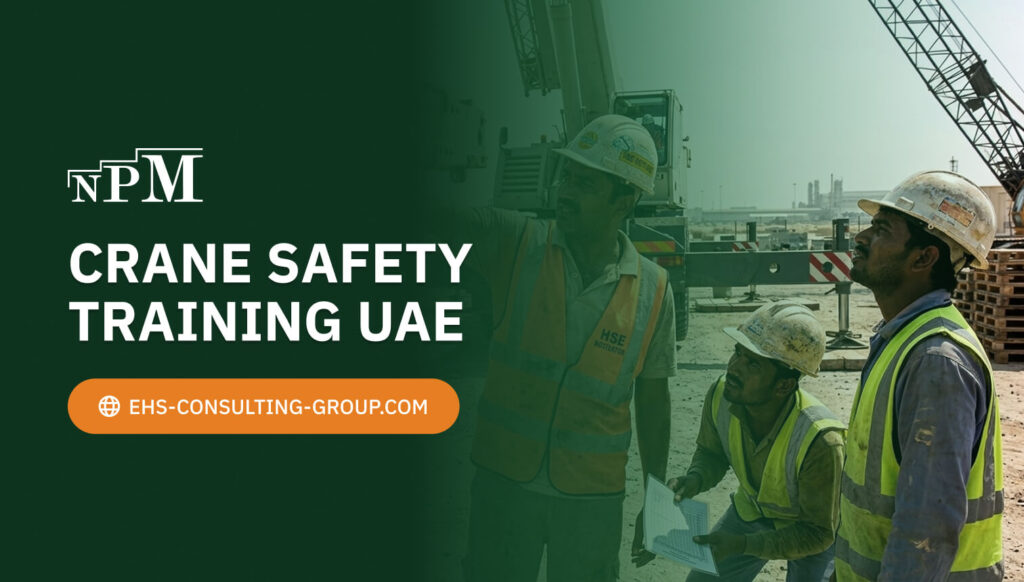
Crane Safety Training for Industrial Projects delivered by NPM equips project teams to plan, supervise, and execute lifting operations safely during fast-paced greenfield builds, brownfield tie-ins, and shutdown/turnaround windows. Designed for multi-contractor, multi-lingual sites typical of the UAE’s industrial expansion, this program aligns practical field controls with company procedures and the requirements of local authorities and client specifications. This industry-focused offering is part of our broader Crane Safety Training UAE capability, ensuring consistent competence across your portfolio of projects and geographies.
Who Needs Crane Safety Training for Industrial Projects?

Crane Safety Training for Industrial Projects is essential for EPC/construction managers, lifting supervisors, crane operators, rigging teams, site HSE officers, method statement authors, QA/QC inspectors, and client representatives overseeing industrial builds and modifications. On greenfield sites, complex tandem lifts, heavy module installations, and tower crane operations demand precise load-path control and interface management with civil and mechanical works. On brownfield jobs, SIMOPS, live utilities, and restricted laydown areas intensify risk; Crane Safety Training for Industrial Projects ensures participants can create defensible lift plans that work around energized equipment, overhead obstructions, and occupied units. In the UAE context, project delivery often involves joint-ventures and subcontractors under tight milestone pressure, where drift from procedures is a persistent risk; this program gives supervisors and crews the confidence to challenge unsafe setups and optimize rigging choices without slipping schedule. Crane Safety Training for Industrial Projects also benefits client-side personnel who review contractor lift plans, verify ground bearing pressure calculations, assess exclusion zones, and confirm that lifting equipment is certified and appropriate for the load and radius. The training addresses multi-lingual communication challenges, signaler/operator protocols, and escalation pathways common to industrial projects so that critical lifting decisions are made quickly and correctly, even during night shifts or compressed shutdown windows.
Objectives of Our Crane Safety Training for Industrial Projects

Crane Safety Training for Industrial Projects focuses on the specific knowledge and behaviors that prevent dropped loads, tip-overs, structural failures, and line-of-fire injuries on industrial work sites. Participants learn how to translate method statements and RAMS into field-executable lift plans, including selection of crane type (crawler, rough-terrain, all-terrain, tower), reading and applying manufacturer load charts, calculating ground bearing pressure and sizing mats, and determining realistic swing, hoist, and radius envelopes with obstructions mapped. A core objective of Crane Safety Training for Industrial Projects is to improve risk anticipation: delegates practice assessing wind, visibility, and dynamic load effects (snatch loads, side loading, shock) and learn when to stand down and when to reconfigure the rig. The program builds fluency in rigging fundamentals—sling angles, D/d ratios, center of gravity, hardware selection, and deration—so the supervisor can spot an overstressed shackle or an under-protected edge before the lift begins. We emphasize safe system-of-work controls for industrial projects: interface with Permit-to-Work and isolation plans, SIMOPS coordination, controlled access and exclusion zones, and communications discipline with hand signals and radios. Participants also become adept at validating third-party certificates, understanding SLI/LMI indicators and overrides, and conducting toolbox talks that surface latent conditions. Above all, Crane Safety Training for Industrial Projects develops practical judgment—how to pause, reassess, and adjust when ground conditions vary from the drawings or when crane setup diverges from the plan.
Structured Program and Technical Modules

Crane Safety Training for Industrial Projects is built as a modular program so training coordinators can match depth and duration to project risk. The curriculum progresses from core principles to advanced planning and supervision skills used on industrial facilities, refits, and shutdowns. Early modules anchor participants in equipment capabilities and limitations (crane classes, duty cycles, load charts), while mid-program blocks focus on rigging calculations, matting and GBP verification, and exclusion-zone design in congested work fronts. Later modules immerse delegates in the realities of industrial projects: multiple contractors sharing craneage, tandem lifts for skid/module placement, lifting near live pipe racks, and precision placement within structures. Each module includes worked examples, peer review of lift plans, and site-specific scenarios drawn from your facility’s P&IDs, GA drawings, and site layouts. To ensure transfer to the field, Crane Safety Training for Industrial Projects integrates dry-runs for toolbox briefs, radio check protocols, and emergency stop drills, so teams can reliably execute under time pressure without compromising safety or productivity.
| Module | Focus Topics | Typical Audience | Practical Exercise | Indicative Duration |
|---|---|---|---|---|
| 1. Crane Fundamentals | Crane types, load charts, stability, radius/boom angles | Operators, riggers, supervisors | Load chart selection for given lift scenario | 3 hours |
| 2. Rigging Science | Sling angles, CoG, hardware deration, edge protection | Riggers, lifting foremen, QA/QC | Rigging plan calculation workshop | 3 hours |
| 3. Ground & Mats | Ground bearing pressure, outrigger mats, soil verification | Supervisors, civil interface leads | GBP calculation and mat sizing | 2 hours |
| 4. Lift Planning | RAMS, method statements, exclusion zones, SIMOPS | Lift planners, HSE, client reps | Authoring and peer-review of a lift plan | 4 hours |
| 5. Advanced Lifts | Tandem lifts, tight laydown, lifts near live plant | Senior supervisors, construction managers | Tandem lift sequencing table-top | 3 hours |
- Specialized contexts covered include shutdown/turnaround lifts inside operating units, modular skids placement onto foundations, and tower crane erection/dismantling within industrial footprints.
- Additional scenarios focus on lifting over pipe racks, near HV lines and substations, and at night under permit constraints to simulate real industrial project conditions.
Duration and Format of Crane Safety Training for Industrial Projects

Crane Safety Training for Industrial Projects is available in multiple formats to fit project schedules and shift patterns. A 1-day awareness option builds baseline competence for general site crews, while a 2-day supervisory track develops lift plan authors and front-line leaders who sign permits and coordinate SIMOPS. For high-consequence workfronts—heavy modules, tandem lifts, or lifts adjacent to live units—a 3-day advanced program provides deeper practical work-ups and assessment. Delivery can be fully on-site at your industrial project with field walkdowns (where permitted), or hybrid with virtual pre-work and in-person practicals. To reduce disruption during shutdowns, sessions can be scheduled as split shifts (e.g., 4-hour evening blocks) and run in both English and Arabic to match workforce composition. Crane Safety Training for Industrial Projects is instructor-led, with hands-on rigging demonstrations and applied calculations using your crane data sheets, soil reports, and GA drawings. Class sizes are optimized for interaction, and we incorporate client-specific templates for RAMS and lift plan sign-offs so participants practice exactly how they will perform on site. All formats maintain the rigor expected by industrial clients: competency checks, scenario-based problem solving, and coaching that reinforces each site’s life-saving rules and lifting and hoisting codes.
Operational Benefits and Use Cases

By aligning lifting competence with real project constraints, Crane Safety Training for Industrial Projects delivers measurable improvements in safety performance and schedule reliability. Teams that understand how to validate ground bearing pressure against actual soil conditions and mat availability avoid last-minute stand-downs and rework. Supervisors who can read manufacturer charts correctly, choose the right rigging configuration, and size exclusion zones precisely reduce near misses and protect adjacent work streams, even in the most congested industrial areas. For shutdowns and brownfield tie-ins, Crane Safety Training for Industrial Projects strengthens SIMOPS coordination so lifting activities mesh with hot work, scaffolding, and energization plans without conflict. The training also equips client representatives to review contractor submittals efficiently, identifying missing certifications, weak rigging plans, or infeasible crane placements before equipment mobilization. On modular builds, where on-time placement is critical to protect downstream commissioning, teams trained through Crane Safety Training for Industrial Projects make better go/no-go decisions on wind thresholds and visibility, and maintain clear communication protocols during night lifts. Ultimately, the program reduces cost of poor quality—fewer damage incidents, fewer delays from inadequate planning—and builds a culture in which crews raise concerns early and resolve them professionally.
- Lower incident rates from improved lift planning, rigging, and ground stability checks.
- Faster review/approval cycles for lift plans due to higher-quality submittals.
- Improved SIMOPS outcomes via tighter PTW integration and exclusion-zone discipline.
- Increased workforce confidence during high-risk lifts, including tandem operations.
- Reduced crane and crew idle time by preventing setup errors and rework.
Why NPM for Project-Based Crane Competence

NPM delivers Crane Safety Training for Industrial Projects with the practical perspective of consultants and trainers who have supported heavy lifts on complex industrial builds, shutdowns, and brownfield modifications across the region. Our specialists translate standards (BS 7121, ASME B30 series, and client lifting codes) into workable site routines and checklists your team can apply immediately. Every session is tailored: we embed your lift plan template, permit-to-work interface, and life-saving rules into case studies so the training reflects your governance, not generic theory. NPM trainers are bilingual and experienced with multi-national crews, ensuring hand signals, radio protocols, and escalation pathways are drilled consistently. We bring scenario libraries covering tower crane erection/dismantling within industrial footprints, mobile crane placement over underground services, and precision lifts within steel structures. Crane Safety Training for Industrial Projects from NPM is also accompanied by competency checks and coaching notes that help supervisors close individual skill gaps. Our approach reinforces schedule protection—teaching how to prevent late-stage plan changes—and quality outcomes, with rigging inspections and hardware control integrated into day-to-day routines. With NPM, your lifting program is not only compliant but also deeply aligned with project delivery realities.
Related Industry-Focused Crane Training
Explore adjacent offerings that address sector-specific lifting risks and operating conditions, each designed to complement Crane Safety Training for Industrial Projects when your teams work across multiple environments.
Crane Safety Training for Construction
This option targets main contractors and subcontractors on high-rise builds, infrastructure works, and industrial civil packages, focusing on tower cranes, mobile crane slewing near public interfaces, and sequencing lifts alongside formwork and rebar installation. It is typically required ahead of major structural lifts or before commissioning tower crane operations on constrained sites. Participants leave ready to plan and supervise lifts in compliance with municipal codes, while integrating learning from Crane Safety Training for Industrial Projects when construction and plant workfronts intersect.
Click on the following link for more details: Crane Safety Training for Construction.
Crane Safety Training for Oil & Gas
Developed for upstream, midstream, and downstream operators and contractors, this course addresses ADNOC and client-specific lifting codes, simultaneous operations near process units, and lifting on offshore platforms and in refineries. It is commonly scheduled prior to turnarounds, plant modifications, and module placement. The curriculum complements Crane Safety Training for Industrial Projects by deepening exposure to process-safety interfaces, permit-to-work controls, and lifting over live pipe racks typical of hydrocarbon facilities.
Click on the following link for more details: Crane Safety Training for Oil & Gas.
Crane Safety Training for Ports
Built for terminal operators, stevedores, and logistics providers, this program zeroes in on quay cranes, RTGs/RMGs, mobile harbor cranes, and heavy-lift logistics within free-zones. It is often required before introducing new crane types, handling project cargo, or executing tandem lifts on the quay. While distinct from Crane Safety Training for Industrial Projects, it enables teams that move between terminals and industrial sites to carry over best practices in rigging, exclusion zones, and communications discipline.
Click on the following link for more details: Crane Safety Training for Ports.
Regulatory Landscape and Project Realities in UAE Industrial Works
Industrial projects in the UAE operate within a layered regulatory environment and strict client standards for lifting and hoisting. In Abu Dhabi, the OSHAD System Framework and relevant Codes of Practice guide lifting planning, equipment certification, and competency; Dubai sites follow the Dubai Municipality Code of Construction Safety Practice, and free-zone projects may be under Trakhees-EHS or JAFZA requirements. Many industrial builds are governed by client-specific codes (e.g., ADNOC Lifting and Hoisting requirements or internal owner specifications), which often reference international standards like ISO 45001 for OHS management, BS 7121 for the safe use of cranes, and ASME B30 series for rigging and crane operations. Crane Safety Training for Industrial Projects translates these frameworks into operational behaviors: documented RAMS, lift plan sign-offs, proof of third-party certification, and clear competence matrices for operators, riggers, and signalers. Practical examples include matting and GBP verification for crawler cranes over engineered backfill, tower crane anchor checks against structural drawings, and exclusion-zone control in congested laydowns. On brownfield sites, integration with Permit-to-Work, electrical isolation, and Civil Defence access is non-negotiable; training emphasizes how to resolve conflicts between lifting windows and live process constraints. For governance resources that align policy and execution, see CABINET NPM. Across all Emirates, the expectation is clear: competent people, certified equipment, and lift plans that reflect actual ground conditions and structural limits—exactly what Crane Safety Training for Industrial Projects reinforces on the ground.
Our Crane Training Coverage Across Industries
NPM supports organizations that operate across multiple sectors and project types, ensuring Crane Safety Training for Industrial Projects dovetails with industry-specific requirements. Whether your teams rotate between industrial builds, construction packages, oil and gas shutdowns, or terminal logistics, we maintain consistent competence standards and documentation practices to simplify oversight and audits.
Assessment & Certification
Assessment within Crane Safety Training for Industrial Projects blends knowledge checks and practical demonstration to confirm that participants can plan and execute lifts safely under industrial project constraints. Delegates complete progressive quizzes aligned to modules (load chart interpretation, rigging calculations, ground bearing pressure), participate in scenario-based planning where they author or critique a lift plan using actual project drawings, and undergo observed practice for communications, exclusion-zone setup, and rigging inspection. Practical evaluations emphasize decision quality—knowing when to change crane configuration, stand down due to wind or poor visibility, or escalate SIMOPS conflicts. Upon successful completion, NPM issues a certificate of completion stating participant name, course title (Crane Safety Training for Industrial Projects), training hours, module coverage, assessment outcome, and a unique certificate ID for traceability. The certificate confirms completion of training; statutory sign-off or licensing obligations (where applicable) remain the responsibility of the client organization and relevant authorities. Recommended group size for effective facilitation is 10–16 participants, allowing instructors to coach individual rigging methods and supervise plan reviews without diluting feedback quality. Before training, NPM conducts a needs analysis to align modules to project risk, gathers site-specific inputs (method statement templates, lift plan formats, sample soil/GBP data, and relevant structural drawings), and designs scenarios that mirror your workfronts—tower crane erection within a plant, crawler cranes over backfilled trenches, or tandem lifts during a shutdown. This structured approach ensures assessment is meaningful and that certification represents real, applied competence for industrial projects.
FAQ
How often should this training be renewed for teams working on industrial projects?
For most organizations, Crane Safety Training for Industrial Projects is refreshed every two to three years, with earlier refreshers triggered by incident/near-miss trends, introduction of new crane types or lifting attachments, significant changes to client lifting codes, or prior to major shutdowns and critical lifts.
What is the difference between initial training and a refresher for industrial project teams?
Initial Crane Safety Training for Industrial Projects builds foundation knowledge in load charts, rigging, and lift planning, while refreshers target updates to standards, lessons learned from recent projects, and focused practice on scenarios you expect in the next phase—such as tandem lifts or lifting near live units—so experienced crews sharpen decision-making where risk is highest.
Who issues the certificate of completion?
NPM issues the certificate of completion for Crane Safety Training for Industrial Projects, documenting hours, modules covered, and assessment results; any statutory licensing or legal sign-off required by authorities or clients remains the responsibility of your organization.
Should we book in-house sessions or attend open/public courses?
In-house delivery is preferred for Crane Safety Training for Industrial Projects because scenarios can be tailored to your drawings, ground conditions, and lifting codes; open/public sessions suit individuals or small teams needing baseline competence when in-house groups cannot be consolidated.
What group size is recommended for best results?
For interactive learning and quality coaching, 10–16 participants per cohort is optimal in Crane Safety Training for Industrial Projects, enabling thorough observation during practicals and detailed feedback on lift plan exercises.
Are there prerequisites for this program?
There are no formal prerequisites, but participants benefit from basic familiarity with site safety rules and lifting terminology; for advanced Crane Safety Training for Industrial Projects modules, prior experience with lift plans, rigging calculations, or supervision enhances learning outcomes.
Can we integrate our permit-to-work and lift plan templates into the training?
Yes. NPM can incorporate your PTW interface, RAMS, and lift plan templates into Crane Safety Training for Industrial Projects so participants practice exactly how they will plan, brief, and execute lifts on your site.
Explore Our Track Record
NPM has supported complex lifting programs worldwide, from module setting on large industrial builds to high-risk tandem lifts during shutdowns, always aligning training with real project constraints. Our references demonstrate measurable improvements in lift plan quality, reduced rework, and stronger SIMOPS outcomes under tight schedules. Explore how we translate standards into field-ready practices that protect people and milestones.
For more information about our references, visit Our References.
Discuss Your Project Requirements
Strengthen the competence of your lifting teams and protect critical milestones with Crane Safety Training for Industrial Projects delivered by NPM. We will tailor modules to your risk profile, drawings, and governance framework to ensure immediate field impact. Speak with us to align schedules, languages, and assessment depth with your project phases and shutdown windows.