
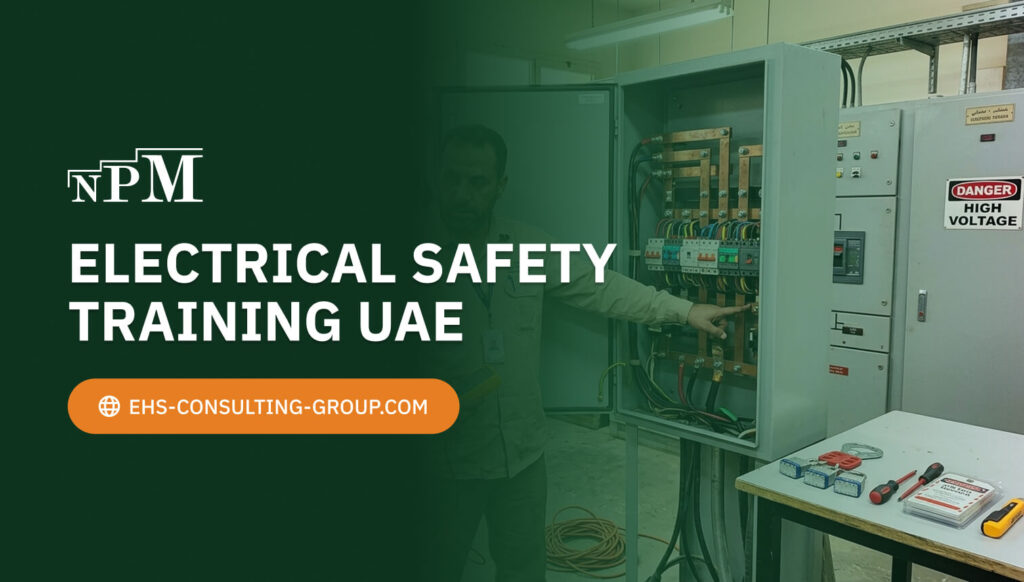
Electrical PPE Requirements are often misunderstood as a simple checklist of gloves, helmets, and face shields—yet in high-risk industries across the UAE, the real picture is a structured, risk-based system grounded in electrical hazard analysis, applicable standards, and disciplined field practice. For HSE and operations leaders, getting this right is not only about compliance; it is about controlling shock and arc-flash exposures, sustaining uptime, and ensuring that technicians return home safe after every intervention on energized or potentially energized equipment.
Who Does This Affect?

Because electrical energy touches almost every production and construction environment, the obligations around personal protective equipment for electrical tasks cut across functions and facility types. The following groups typically carry day-to-day responsibility:
- Electrical and instrumentation technicians working on LV and MV switchgear, MCCs, control panels, and distribution boards
- Maintenance supervisors and planners scheduling isolations, lockout/tagout (LOTO), and energized work permits
- HSE managers and compliance officers accountable for implementing ISO 45001-aligned risk controls and meeting OSHAD, Dubai Municipality, Civil Defence, and MOHRE expectations
- Project managers and site engineers coordinating temporary power on construction sites, including tower cranes, hoists, and dewatering pumps
- Operations leadership in oil and gas, petrochemicals, and power generation—especially where ADNOC HSE requirements and internal company specifications set minimum electrical safety rules
- Contractors and service providers working under client permits to work (PTW) and needing alignment with facility-specific PPE matrices
Across refineries, offshore platforms, storage terminals, manufacturing plants, logistics warehouses, and power stations, the same foundation applies: identify the hazard (shock and/or arc flash), evaluate the exposure, then select and maintain PPE compatible with the task and environment. The complexity varies—an 11 kV substation on a power plant presents different risks from a 400 V distribution board in a packing hall—but the underlying logic remains consistent.
Why This Matters

If these requirements are implemented superficially, the organization carries both human and business risk. Serious arc-flash injuries can occur even at low voltages with high available fault current; shock events can be fatal at surprisingly low energy if contact and path-to-ground conditions align. Beyond personal harm, uncontrolled events lead to equipment damage, fire, and prolonged outage—compromising production and potentially breaching regulatory obligations.
Regulatory and standards context sits behind this. Within the UAE, organizations look to OSHAD (now under the Abu Dhabi Department of Health/SF framework) for structured approaches to occupational risk control; Dubai Municipality and Civil Defence add construction and fire-life safety expectations; MOHRE sets overarching labor protections. Industry operators (e.g., ADNOC) routinely stipulate electrical safety protocols that align with international benchmarks. Globally recognized standards—such as NFPA 70E for electrical safety in the workplace, IEEE 1584 for arc-flash hazard analysis, IEC 60903 for insulating gloves, and IEC 61482-2 for arc-rated clothing—provide detailed criteria for assessments and PPE selection. The goal is integrated risk management: engineering and administrative controls first, then PPE as the last line of defense.
Correctly defining and applying PPE narrows residual risk to tolerable levels when de-energization is not feasible, when diagnostic testing requires exposure, or when field conditions complicate full isolation. It also gives supervisors defensible clarity when authorizing permits, and it helps frontline teams trust that their kit matches the real hazard—not a guess.
Key Points to Understand

With the stakes in mind, it helps to unpack the elements that make an electrical PPE system effective and defensible.
1) The two fundamental hazards: shock and arc flash
Shock protection addresses contact with energized conductors or circuit parts. Controls include insulating gloves and sleeves (IEC 60903), dielectric footwear, insulated mats, and insulated tools. Arc flash protection addresses radiant heat, pressure waves, and molten metal produced by an arcing fault. Controls include arc-rated garments (IEC 61482-2), hoods/face shields, gloves rated for arc exposure, and hearing protection. Tasks often involve both hazards simultaneously, so PPE selection must be integrated—not piecemeal.
2) Risk assessment as the driver of PPE
Modern practice is risk-based. Many facilities apply NFPA 70E methods and IEEE 1584 calculations to determine incident energy at working distances and to set approach boundaries (limited and restricted approach for shock; arc-flash boundary for thermal exposure). Where detailed studies are not available, task-based tables (e.g., for operating a circuit breaker on 400 V switchgear with the enclosure closed and properly maintained) can guide minimum PPE—provided the preconditions are verified.
3) Arc ratings, categories, and what they actually mean
Arc-rated garments carry an ATPV or Ebt value in cal/cm² determined through standardized testing. Historic “HRC” terms are now replaced by PPE categories in NFPA 70E, but the essence remains: ensure the garment system’s arc rating meets or exceeds the calculated incident energy. Layering (e.g., FR base layer plus arc-rated coverall) must be understood as a system; non-melting undergarments are essential to avoid secondary injury. Always check that face shields/hoods and gloves are rated to the same exposure level as the garments.
4) Insulating gloves and leather protectors
For shock protection, glove classes (00 to 4) indicate the maximum working voltage. Gloves require regular dielectric testing per standard and daily field air tests. Leather protectors are typically worn over rubber insulating gloves to prevent mechanical damage, except when arc-flash-rated gloves are used as part of a validated system. Glove selection must match both the nominal system voltage and the actual task, including clearances and conductor geometry.
5) Face and eye protection for arc flash
Arc-rated face shields with chin protection and balaclavas are selected for moderate exposures; full arc flash hoods are used for higher incident energies. Clear visibility is critical in dusty or humid environments common across the Gulf; anti-fog coatings and disciplined cleaning/storage routines reduce error potential from poor sightlines.
6) Boundaries, labeling, and permits
In practice, approach boundaries and the arc-flash boundary are set by labels on equipment, populated from an arc-flash study or verified task tables. The PTW and LOTO procedures incorporate these boundaries. A pre-job briefing confirms who will cross which boundary, wearing what PPE, for how long, and with what standby conditions. This ensures that PPE is not a generic uniform but a task-specific control anchored to clearly communicated limits.
7) Environmental realities in the UAE
Heat stress is a serious overlay on electrical PPE use. Arc-rated clothing must remain worn and closed even in high ambient temperatures; therefore, fabric breathability, garment fit, ventilation breaks, shaded rest, and hydration planning are operational necessities. Sand and salt air can degrade visors and conductive dust may increase risk in open MCC rooms; cleaning routines and enclosure integrity checks matter as much as the PPE itself.
8) Documentation and controlled accessibility
Electrical PPE rules live or die by document control. Technicians need the latest PPE matrix, voltage class charts, and inspection intervals at the point of use. Many organizations maintain digital procedure libraries to ensure a single source of truth accessible in the field. Resources such as CABINET NPM are often used to centralize controlled documentation, ensuring that the PPE decision aids and inspection checklists technicians rely on are the current, approved versions.
Illustrative PPE selection matrix
The following table illustrates typical combinations for selected tasks. It is intentionally conservative and must be refined by each facility’s risk study, labeling, and PTW rules.
| Task | System/Equipment | Primary Hazard | Minimum PPE (indicative) | Standards/Notes | Inspection/Use Notes |
|---|---|---|---|---|---|
| Operate breaker with doors closed | LV switchgear ≤ 600 V | Arc flash (low), shock (enclosed) | Safety glasses; arc-rated face shield if label indicates; hearing protection as labeled | Follow equipment label from study; verify enclosure integrity | Check for abnormal sounds/odors; no signs of racking misalignment |
| Open panel door for infrared scan | LV MCC/DB, energized | Arc flash (moderate), shock | Arc-rated clothing ≥ label (e.g., 8–12 cal/cm²); arc-rated face shield + balaclava; class 00–0 gloves as needed | NFPA 70E task tables if study not available; maintain approach boundaries | IR window preferred; eliminate loose jewelry; spotter present |
| Test/verify absence of voltage | LV control panel | Shock, arc flash (task-dependent) | Insulating gloves (class per voltage) with leather protectors; arc-rated face shield; hearing protection | Use verified tester; test-before, test-after sequence | Daily glove air test; verify CAT rating of meter/leads |
| Racking a breaker in/out | LV/MV switchgear | Arc flash (higher), mechanical | Arc-rated suit per label (often ≥ 25–40 cal/cm²); hood; gloves compatible with arc rating and voltage | Prefer remote racking where available | Confirm maintenance condition; clear non-essential personnel from boundary |
| Substation switching | MV (11 kV) switchgear | Shock, arc flash | Arc-rated suit per label; insulating gloves (class 2–3); dielectric footwear | Adhere to utility procedures; two-person rule as applicable | Functional test of interlocks; assess environmental dust/humidity |
How This Works in Practice

Translating principles into consistent field practice ties the analysis, the kit, and the permit system together. After aligning on standards and completing (or validating) an arc-flash study, most sites converge on a practical rhythm focused on planning, communication, and verification.
- Establish your single-line baseline. Ensure electrical one-lines are current and accessible. You cannot protect what you cannot see on paper.
- Quantify the hazard. Use IEEE 1584 for arc-flash modeling where justified; otherwise, apply validated task tables conservatively with explicit conditions.
- Label and communicate. Apply equipment labels with incident energy, arc-flash boundary, and PPE guidance. Train supervisors to reference labels in every pre-job brief.
- Build the PPE matrix. Map typical tasks to PPE ensembles, aligned to your labels and PTW system. Integrate glove classes by voltage and arc ratings by task.
- Kit and control. Issue tagged, serialized PPE kits. Define inspection intervals (e.g., monthly glove visual checks, annual lab dielectric tests) and field checks (daily air tests).
- Permit and brief. Every energized task or exposure within a boundary runs through PTW/LOTO, with a focused pre-job discussion on hazards, boundaries, and exact PPE.
- Verify and adapt. Audit field use. In hot months, plan shorter exposure windows and rest breaks so technicians keep arc suits fully fastened and visors down.
- Close the loop. Capture lessons learned and update the matrix, labels, and training materials promptly, maintaining document control and versioning.
In oil and gas and petrochemical facilities, additional complexities arise around classified areas, conductive contamination, and concurrent operations. For construction, rapid changes to temporary power demand frequent reassessment of fault levels and protective device settings; the PPE matrix must move with the site. In logistics and manufacturing, high-throughput schedules can pressure teams to skip face shields “just for a quick reset”—this is where supervisory discipline and easy access to correctly sized PPE matter most. Power generation and utilities add a further dimension with MV systems, where shock hazards and approach boundaries become more pronounced.
Benefits and Practical Use Cases

Organizations that treat electrical PPE as a living, risk-driven system report tangible improvements. Below are common, concrete advantages observed across UAE industrial sites and analogous global operations:
- Fewer high-potential events: When boundary decisions are enforced and PPE matches labeled incident energy, near misses drop and equipment damage is minimized.
- Clearer permits: Supervisors reference a shared PPE matrix and equipment labels during PTW issuance, reducing ambiguity and rework.
- Faster, safer switching: Standardized kits (e.g., arc suit, hood, Class 2 gloves) staged near substations save time without sacrificing protection.
- Improved contractor alignment: Guest crews follow the host’s documented PPE rules and inspection criteria, supported by visible labels and pre-job briefs.
- Regulatory confidence: Auditors from OSHAD, Dubai Municipality, Civil Defence, and MOHRE see that risk assessments, labels, and field behavior align with international standards.
- Resilience in harsh climates: Heat-stress planning tied to PPE enables sustained compliance during peak temperatures—no shortcuts required.
Consider a refinery switchgear room where an arc-flash study indicated incident energies up to 21 cal/cm² at specific cubicles. Labels drove a shift from ad-hoc face shields to standardized 25 cal/cm² ensembles with hoods; an uptick in procedural discipline and visibility resulted. On a high-rise project, temporary power changed weekly; the site team instituted a rolling review of fault levels and tightened the PPE matrix for racking operations until protective settings stabilized. In a logistics cold store, visor fogging caused recurrent noncompliance; anti-fog face shields and warm-room task sequencing reduced the temptation to lift protection mid-task. In a power plant outage, remote racking and staged PPE kits enabled safe, efficient breaker handling even when schedules were tight.
Best Practices and Points of Caution

Electrical PPE is the last barrier between a worker and severe injury. It must be specified, used, and maintained deliberately. The following practices reflect what experienced sites embed into their routines:
- Lead with engineering controls: Prioritize de-energization, remote racking, arc-resistant switchgear, maintenance that trims incident energy, and correct protective device coordination. PPE does not fix poor design or maintenance.
- Use defensible standards: Anchor decisions to NFPA 70E, IEEE 1584, IEC 60903, and IEC 61482-2, and align with ISO 45001 management system structures. Reference ADNOC HSE, OSHAD, Dubai Municipality, Civil Defence, and MOHRE obligations where applicable.
- Size and comfort matter: Ill-fitting arc suits and gloves cause human-factor errors. Ensure a range of sizes, lightweight arc-rated fabrics, and breathable designs appropriate for desert heat.
- Glove discipline: Perform daily air tests, schedule dielectric testing, and never use insulating gloves without leather protectors unless part of a validated arc-rated glove system.
- Face/eye clarity: Select arc-rated face shields with chin protection and anti-fog performance; keep spare visors where sand abrasion is common.
- Non-melting base layers: Mandate non-melting undergarments beneath arc-rated clothing. Ban synthetic layers that can melt and exacerbate burns.
- Integrate LOTO and boundaries: PPE use must be part of a coherent PTW/LOTO program with defined approach boundaries and clear roles.
- Keep it clean: Contamination with oils and conductive dust undermines protection. Establish laundry and storage protocols that preserve arc ratings and visor clarity.
- Watch for counterfeit products: Source from reputable manufacturers and verify certifications. Counterfeit “FR” fabric and mislabeled gloves exist and will fail under stress.
- Account for DC systems: Battery energy storage and PV inverters bring DC arc behavior; confirm PPE and task rules reflect DC hazards, not just AC.
- Audit behavior, not just stock: Having PPE on shelves is not compliance. Observe work, interview technicians, and act on lessons learned to close gaps.
Frequently Asked Questions About Electrical PPE Requirements
Do we always need arc-rated clothing for operating a breaker with the door closed?
Not always. Compliance depends on the equipment’s condition, label guidance, and applicable task tables. If an arc-flash study label indicates negligible incident energy for a closed, properly maintained enclosure, basic eye protection and normal workwear may be acceptable. Where labels or conditions are uncertain, apply conservative arc-rated protection and verify the preconditions before relaxing PPE.
How are glove classes chosen for shock protection?
Match glove class to the maximum nominal system voltage and task specifics. For example, Class 00 or 0 gloves may be used on 230–400 V circuits under defined conditions, while Class 2 or 3 are typically used for 11 kV operations. Gloves must be tested at prescribed intervals, air-tested before each use, and typically worn with leather protectors to prevent mechanical damage.
What arc rating should our face shield or hood have?
The face protection must be at least equal to the calculated or labeled incident energy at the worker’s position. For moderate exposures (e.g., around 8–12 cal/cm²), a shield with balaclava may suffice. For higher exposures (e.g., 25 cal/cm² and above), a full arc flash hood is typically required. Always consider the garment system as a whole—torso, face, hands, and legs must be consistently protected.
How do UAE regulations influence our electrical PPE program?
While UAE regulators may not prescribe a single method, they expect employers to manage risks to an acceptable level under frameworks like OSHAD, Dubai Municipality, Civil Defence, and MOHRE requirements. Many organizations demonstrate compliance by aligning their programs with recognized international standards (NFPA 70E, IEEE 1584, IEC 60903/61482-2) and, where applicable, meeting ADNOC HSE specifications. Documentation, training, and verifiable field practice are key to regulatory confidence.
Does heat stress allow us to relax arc-flash PPE in summer?
No. Heat stress must be mitigated without compromising protection. Solutions include task planning to reduce exposure time, shaded rest breaks, hydration protocols, lighter arc-rated fabrics, and improved ventilation. Supervisors should monitor conditions and adjust work-rest cycles rather than allowing partial PPE.
Are task-based tables a substitute for an arc-flash study?
Task tables provide a conservative path when their preconditions are met (e.g., equipment maintenance status, fault current limits). However, they cannot replace the specificity of a site arc-flash study for complex or high-energy systems. Where critical equipment or MV systems are involved, a study under IEEE 1584 typically yields more reliable labeling and PPE selection.
How often should insulated gloves be tested?
Follow the relevant standard and manufacturer guidance. Common practice is visual inspection before each use, daily air tests in the field, and periodic laboratory dielectric testing (e.g., every 6 months or as otherwise specified). Always remove gloves from service if inspection reveals damage or if test intervals have lapsed.
Can we use standard safety glasses instead of an arc-rated face shield?
Safety glasses protect against projectiles and some debris but do not provide thermal protection against arc flash. When labels or task analysis indicate arc-flash exposure above negligible levels, an arc-rated face shield or hood is required to protect the face and neck. Use safety glasses in combination with arc-rated face protection as appropriate.
What about contractors—whose rules apply?
The host facility’s PTW and PPE rules take precedence, but contractors should also apply their own company standards where they are more stringent. A site induction that reviews labels, boundaries, and the facility’s PPE matrix is essential to align expectations and avoid conflicting practices.
Conclusion
Electrical PPE Requirements, when treated as a disciplined risk-control system rather than a shopping list, help organizations manage shock and arc-flash hazards with precision. The approach starts with an honest view of the electrical system (current one-lines), proceeds through defensible assessment (labels, boundaries), and culminates in field-ready ensembles that technicians will actually use—because they fit, they are available, and supervisors reinforce their purpose. For UAE operators aligning to OSHAD, Dubai Municipality, Civil Defence, MOHRE, and ADNOC expectations, the thread tying it all together is documentation and practice: from glove testing discipline to visor clarity in dust, from heat stress planning to contractor alignment. With these fundamentals in place, PPE fulfills its true role: the last reliable barrier after engineering and administrative controls have done their part.
To go further on this topic, NPM’s broader Electrical Safety Training UAE page covers this in more depth.
Explore NPM’s References
NPM’s work in electrical safety and broader process safety spans complex facilities and diverse operating contexts worldwide. Our references reflect environments where electrical PPE decisions must dovetail with arc-flash studies, LOTO programs, and management systems aligned to ISO 45001. In oil and gas and petrochemical projects, we have supported clients in translating arc-flash labels into practical, climate-aware PPE matrices that technicians trust—because garments fit, visibility is preserved, and inspection routines are realistic under actual site conditions. On major construction programs, experience has centered on temporary power that evolves weekly, requiring disciplined reassessment of fault currents and careful communication so that PPE rules keep pace with the project. For manufacturing and logistics, we have encountered the human-factors side of compliance: visor fogging in cold storage, time pressure on shifts, and the need to stage PPE at points of use instead of distant stores. Across power generation and utilities, references include MV-focused controls where approach boundaries and glove class selection are fundamental—and where remote racking and arc-resistant gear can be the difference between routine switching and a critical incident. Taken together, these references demonstrate that effective electrical PPE management is never copy-paste; it is tailored, conservative where uncertainty persists, and always anchored to verifiable field behavior rather than policy alone. We invite you to explore how NPM has helped organizations integrate standards, labeling, and PPE into coherent systems that stand up to regulatory scrutiny and, more importantly, protect people on their most demanding days.
For more information about our references, visit Our References.
Speak with NPM
If you are reviewing your site’s electrical PPE rules or considering how heat, maintenance intervals, and contractor practices affect real-world compliance, we are happy to discuss practical options. Our team can share insights on aligning labels, permits, and ensembles so technicians get clear, consistent guidance. For any further questions or to speak with our team, Contact Us.