
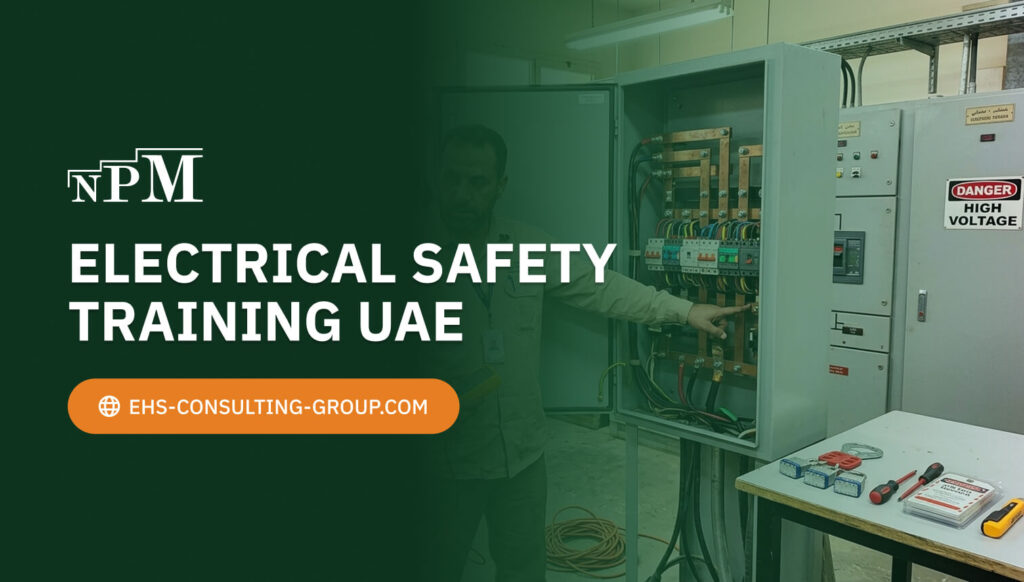
Common Electrical Safety Violations appear across every industrial sector, and understanding why they occur — and how to prevent them — is essential for HSE managers and plant leaders responsible for safe, continuous operations. In high-risk environments like refineries, petrochemical plants, power stations, construction sites, and logistics hubs, electrical hazards do not politely announce themselves; they hide in overworked panels, misapplied protection settings, missing labels, makeshift cabling, and assumptions about isolation that turn out to be wrong when it matters most. This article takes a practical, standards-informed look at the violations most frequently observed in the UAE industrial context, what drives them, and how to tighten control so the next audit or incident investigation does not find the same issues again.
Who Does This Affect?

Electrical risk does not live only with the electrical team. It touches any person, department, or contractor that plans, operates, or modifies equipment capable of producing, distributing, or using electrical energy. Within oil and gas production, this means maintenance planners, instrument and controls teams, operations supervisors, and construction managers working around MCCs, switchgear, UPS systems, hazardous-area lighting, and temporary power. In petrochemicals, it includes reliability engineers overseeing drives and heat-tracing, and turnaround coordinators who manage multiple isolation points during shutdowns. In manufacturing and logistics, it affects facility engineers, third-party contractors installing conveyor drives or dock levellers, and IT/OT teams provisioning server rooms and battery systems. In power generation, it extends to protection engineers and technicians configuring relays and breakers, and renewal teams integrating solar, storage, or backup generation.
From a governance standpoint, corporate HSE leaders, audit/compliance professionals, and departmental heads are responsible for ensuring that local regulatory obligations — such as requirements from the Abu Dhabi AD EHS Center (formerly OSHAD), Dubai Municipality, Civil Defence, MOHRE, and utility authorities (DEWA/ADDC/SEWA/FEWA) — translate into clear procedures, competency, and records. In facilities operated to ADNOC’s HSE directives or to ISO 45001 and ISO 14001 management systems, electrical safety is not a niche procedure; it is integral to PTW, isolation, maintenance, contractor control, and emergency preparedness.
Why This Topic Matters

The stakes are high: arc flash, electric shock, and ignition of flammable atmospheres can cause life-altering injury and multi-million-dirham losses. Shock hazards can be present at surprisingly low voltages when wet conditions or defective insulation exist. Arc flash energy can exceed PPE protection boundaries in a fraction of a second if incident energy has not been calculated or if labels and distances are outdated. In hazardous areas, a single non-compliant luminaire or incorrectly terminated cable gland can defeat the protection concept and ignite a flammable mixture. For mobile and temporary installations found on construction sites and shutdowns, defects proliferate with speed: undersized cables, missing RCDs/GFCIs, and daisy-chained extension leads create a backdrop for incidents that are too often labelled “preventable” in hindsight.
Compliance is an operational necessity, not a paperwork exercise. NFPA 70 (NEC), NFPA 70E for electrical safety in the workplace, IEC 60364 for low-voltage installations, IEC 61439 for switchgear assemblies, and local authority requirements provide a coherent set of controls. But they only work when embedded into how work is planned and executed — through accurate single-line diagrams, verified isolation points, tested protection devices, labelled panels, competent workers, and disciplined supervision. When audits reference ADNOC HSE requirements or inspections by Civil Defence or Dubai Municipality, findings often revolve around the same recurring gaps. Eliminating those recurring gaps is the fastest way to improve safety performance, availability, and audit outcomes.
Key Points to Understand

Electrical violations tend to cluster around a few underlying failure modes: inadequate planning and design control, weak isolation and verification practices, missing or incorrect documentation, improper equipment selection for the environment, and gaps in competency and supervision. Each theme shows up as multiple “symptoms” in the field. Below is a consolidated view framed for UAE industrial operations.
1) Inadequate isolation and verification
Lockout/tagout (LOTO) that exists on paper but not in practice is a common driver of incidents. Typical issues include isolating the wrong circuit due to outdated drawings, using a single point of isolation for multi-feed equipment, or failing to test for absence of voltage with a properly rated tester. NFPA 70E emphasizes the sequence: identify all energy sources, isolate, lock and tag, verify absence of voltage, and apply grounding where required. In process plants, isolation should also align with PTW and control of work — including a second-person verification for complex isolation points. ADNOC and AD EHSMS requirements reflect these multi-layer controls.
2) Equipment not suitable for the location
Another frequent violation is the installation or maintenance of equipment not rated for the environment. In hazardous areas, Ex equipment must be selected and installed according to the zone, gas group, and temperature class, following IEC 60079 series requirements. Typical violations include ordinary junction boxes used in Zone 2, incompatible cable glands, damaged Ex enclosures, or using portable tools without EX certification. In wet or corrosive environments found in utilities or marine settings, ingress protection (IP) ratings, corrosion resistance, and protective coatings matter. Substitutions during maintenance often create non-compliance without anyone noticing.
3) Protective devices and settings out of sync
Breakers and relays cannot do their job if incorrect trip settings create coordination failures. Nuisance trips push teams toward unsafe bypasses; miscoordination allows faults to escalate. Arc flash studies, short-circuit analyses, and selective coordination assessments ensure protection operates as intended. Industrial facilities need periodic review of protection settings when loads or upstream fault levels change — for example, after adding large motors, VFDs, or alternative supplies. Without this, incident energy labels, PPE categories, and approach boundaries can become misleading.
4) Deficient earthing and bonding
Improper or deteriorated earthing/grounding leads to touch voltages and unreliable fault clearing. Common findings: corroded connections, missing bonding jumpers across flanges or flexible joints, and high earth resistance not aligned with design. For sensitive controls and instrument loops, poor equipotential bonding produces spurious trips and intermittent faults that invite unsafe “trial-and-error” fixes.
5) Panels, distribution boards, and enclosures out of compliance
Open knockouts, missing blanks, overcrowded wiring, unlabelled or poorly labelled circuits, and blocked clearance in front of panels are textbook violations. IEC 61439 imposes requirements on assembly design and verification that informal modifications easily compromise. Electrical rooms must maintain minimum clearances and remain free of storage; this is as much a facilities discipline issue as it is an electrical one.
6) Temporary power and portable tools
Temporary power is rife with shortcuts: damaged extension cords, improper cable protection across traffic areas, missing RCDs/GFCIs, makeshift connections, and under-rated generators. On construction sites and during shutdowns, these issues multiply. Routine inspection and tagging, load balancing, and proper weather protection are essential. Dubai Municipality and Civil Defence inspections frequently cite temporary setups for recurring non-conformities.
7) Incomplete documentation and change control
Accurate single-line diagrams, panel schedules, cable lists, hazardous area drawings, and equipment datasheets are not optional. Without them, maintenance teams improvise, which turns an electrical job into a guessing game. Document control should be integrated with management of change (MOC) so that any modification triggers drawing updates, label revisions, and protection setting recalculations. If your isolation plan relies on an outdated drawing, your LOTO is only fictionally safe. For structured document governance, some organizations centralize their procedures and records in purpose-built repositories such as CABINET NPM, ensuring that authorized personnel access the latest approved versions.
8) PPE, training, and supervision gaps
Even the best hardware controls fail without competent people. NFPA 70E and company procedures require arc-rated clothing, rubber insulating gloves, face shields, and properly rated tools for energized work that cannot be de-energized. Supervisors must verify that workers understand boundaries and labels and that they plan work to eliminate exposure where feasible. Contractors must meet the same standard — a common oversight when relying on third parties for urgent repairs.
| Frequent Violation | Primary Hazard | Indicative Standard/Requirement | Quick Diagnostic Question | Priority Corrective Action |
|---|---|---|---|---|
| LOTO not verified; wrong circuit isolated | Shock, arc flash | NFPA 70E; PTW/AD EHSMS; ADNOC CoW | Was absence of voltage verified at the point of work? | Establish test-before-touch, two-person verification, update SLDs |
| Non-Ex equipment in Zone 2 | Ignition of flammable atmosphere | IEC 60079 series; Civil Defence approvals | Is the equipment Ex rated for zone/gas group/temperature class? | Replace with certified equipment; correct glands; record in MOC |
| Outdated arc flash labels | Under-protection during energized work | NFPA 70E; IEEE 1584 practices | When were labels last calculated and verified? | Recalculate incident energy; update labels; train affected staff |
| Damaged cords/no RCD on temporary power | Shock, electrocution | IEC 60364; DM site safety; MOHRE | Are RCDs/GFCIs installed and tested; cords protected and tagged? | Install RCDs, replace cords, implement daily/weekly checks |
| Panels blocked or overcrowded | Delayed egress, overheating, arc flash risk | IEC 61439; NFPA 70; facility rules | Is clearance maintained and wiring within design limits? | Restore clearance, re-terminate to spec, update load schedules |
| Weak earthing/bonding | Touch voltages; unreliable fault clearing | IEC 60364; utility authority rules | When were earth resistances last measured and logged? | Repair bonds; reduce resistance; document test results |
How This Works in Practice

Understanding typical failure modes helps, but translating that understanding into daily practice is where risk reductions are won. In a refinery electrical room, for example, the day-to-day battle is about control of access, good housekeeping, and discipline around temporary modifications. A well-run facility posts and enforces access rules; maintains up-to-date one-line drawings at the door; ensures arc flash labels match the equipment; and keeps the floor free of materials that would obstruct egress or work clearance. Small acts add up: returning blanks to knocked-out panel openings, labelling new circuits the day they are installed, and logging all breaker setting changes.
During construction or turnaround activities, electrical safety hinges on three processes working together: PTW, LOTO, and temporary power control. The best PTW systems are not just forms; they require site walks, cross-discipline coordination (electrical, mechanical, instrumentation), and confirmation that temporary power plans include load calculations, RCD provision, and cable routing away from water and traffic. Daily toolbox talks can reinforce that extension leads are not permanent wiring and that any damaged lead is removed from service immediately. These are supervisory disciplines, not administrative ones.
For hazardous areas, the competency of inspectors and technicians is crucial. Even small items — such as missing shrouds on glands or incorrect thread engagement — determine whether an installation maintains its explosion protection concept. A robust inspection regime categorizes defects (A/B/C), prioritizes A defects for immediate action, and routes B/C to planned maintenance with traceable close-out. Integration with MOC ensures a loop back to drawings and data sheets so the next team inherits an accurate record.
Power system studies are another linchpin. When facilities add VFDs, upgrade switchgear, or connect new generation sources, the electrical system changes. Without re-running short-circuit, coordination, and arc flash studies, protection may no longer be selective; incident energy may creep into levels that exceed available PPE. Good practice triggers studies when the installed capacity or configuration changes materially — and logs the rationale, results, and the updates to labels and settings that follow.
Benefits and Practical Use Cases

Addressing recurring violations pays off across safety, reliability, and compliance. While zero incidents is a moral imperative, the operational dividends are equally compelling. Consider the following practical benefits observed when facilities tighten electrical controls:
- Fewer unplanned outages: Proper coordination and accurate settings reduce nuisance trips and prevent cascading failures.
- Faster, safer maintenance: Clear labels, updated drawings, and verified isolation points shorten job times and reduce exposure.
- Stronger audit outcomes: When Dubai Municipality, Civil Defence, or ADNOC compliance teams visit, they see evidence — not promises — of control.
- Improved contractor performance: Clear expectations for documentation and temporary power, enforced by supervision, reduce defects at their source.
- Lower lifetime cost: Correct equipment selection (e.g., Ex-rated fixtures, corrosion-resistant enclosures) reduces rework and failure rates.
Concrete use cases include: a storage terminal replacing ordinary luminaires in Zone 2 with certified alternatives and reducing hot work permits; a logistics warehouse eliminating repeated GFCI trips by addressing moisture ingress and cable routing; a power plant updating relay settings after adding a generator tie-in, restoring selectivity and lowering incident energy at critical panels; and a high-rise construction site cutting electrical findings by more than half by instituting a color-coded tagging system for leads and quarterly RCD testing with recorded results.
Best Practices and Points of Caution

Effective control of electrical risks blends standards, supervision, and culture. The following points reflect what consistently works in industrial environments:
- Make drawings trustworthy: Keep single-line diagrams, panel schedules, and hazardous area plans current. If an isolation or study depends on a drawing, that drawing must be accurate.
- Treat energized work as the exception: Plan to de-energize by default. When not possible, follow NFPA 70E rigorously — energized work permits, shock and arc flash risk assessments, and appropriate PPE.
- Institutionalize LOTO verification: “Test before touch” using a rated tester; use absence-of-voltage indicators where suitable; require second-person verification for complex or high-energy work.
- Embed temporary power discipline: RCDs/GFCIs on all suitable circuits, intact cords, mechanical protection across traffic areas, and routine inspection/tagging. Temporary means temporary — plan permanent wiring promptly.
- Respect hazardous area integrity: Select, install, and maintain Ex equipment according to zone/gas group/temp class; log inspections; fix A defects immediately.
- Revisit protection settings after change: Any material change to loads, sources, or system topology should trigger coordination and arc flash re-evaluation.
- Train and refresh: Ensure supervisors and craft personnel can read labels, understand approach boundaries, and recognize when conditions drift out of compliance.
Caution is equally important. Beware of “temporary fixes” that become permanent, any workaround that defeats a protective function, or assumptions that a breaker trip was a nuisance rather than a symptom of miscoordination or a genuine fault. Do not mix equipment from incompatible protection concepts in hazardous areas, and do not rely on vendor brochures as a substitute for certified product documentation. Finally, remember that document control is a safety control; when documentation lags reality, risk accumulates invisibly.
Frequently Asked Questions About Common Electrical Safety Violations
What are the most frequent violations found during industrial electrical audits?
Typical findings include incomplete LOTO verification, outdated or missing single-line diagrams, blocked or overcrowded panels, mislabelled circuits, absence of RCDs/GFCIs on temporary power, damaged extension leads, non-compliant Ex equipment in hazardous areas, inadequate arc flash labelling, and earthing/bonding defects. Many of these trace back to weak change control and supervision rather than a lack of technical knowledge.
How often should arc flash labels and protection settings be reviewed?
Review when your system changes and at defined intervals. Any material change — new feeders, added generation, major motor loads, or reconfiguration — should trigger fresh studies. Many facilities choose a 3–5 year review cycle for arc flash and coordination studies, with shorter cycles in rapidly changing operations. Labels must reflect the latest study outputs to remain credible for field personnel.
Are RCDs/GFCIs mandatory on construction sites and temporary power?
While specifics depend on local authority rules and installation conditions, good practice aligned with IEC 60364 and local requirements expects residual current protection for temporary and outdoor circuits where shock risk is elevated. In the UAE, site inspections by Dubai Municipality and other authorities frequently cite missing or non-functioning RCDs as a violation, and many client HSE specifications mandate them.
What distinguishes an A, B, or C defect in hazardous area inspections?
Though classification schemes vary, an “A” defect typically represents an immediate safety risk or a non-compliance that defeats the protection concept and demands prompt correction (e.g., broken Ex enclosure, wrong gland). “B” defects require timely remediation but pose lower immediate risk, and “C” defects are minor issues suitable for planned maintenance. The key is consistent criteria and documented close-out.
Is it acceptable to perform energized work if it’s faster?
Speed is not a justification under recognized standards. Energized work is allowed only when de-energizing is infeasible due to equipment design, process needs, or increased risk from de-energization — and even then, a formal risk assessment, energized work permit, and appropriate PPE and boundaries are required per NFPA 70E. In practice, most tasks can be planned to eliminate exposure by de-energizing safely.
What role do management systems like ISO 45001 play in preventing violations?
Management systems transform technical requirements into sustained practice: competence matrices, document control, MOC, internal audits, and leadership reviews. ISO 45001 helps ensure electrical safety requirements are embedded, verified, and improved over time, while integration with ISO 14001 and asset management practices drives consistency across departments and contractors.
How do utility authority requirements (e.g., DEWA, ADDC) influence facility electrical safety?
Authority requirements affect design approvals, inspection checkpoints, metering, protection coordination at points of common coupling, and specific installation details. Facilities that keep their designs, settings, and records aligned with authority approvals reduce non-conformities, delays, and technical conflicts during expansions, energization, or fault investigations.
Why do electrical rooms so often fail clearance and housekeeping checks?
Because storage pressure and time pressure are constant. Without strict access rules, signage, and routine supervision, electrical rooms become convenient storage areas. Clearing them and enforcing minimum clearances is a leadership habit — it requires attention every day, not just before audits.
Conclusion
Reducing electrical risk is not about chasing every possible hazard at once; it is about eliminating the most persistent causes of harm and disruption. The violations discussed earlier — weak isolation verification, unsuitable equipment for location, outdated protection settings and labels, temporary power shortcuts, and stale documentation — are common precisely because they emerge where technical detail meets everyday pressure. By tightening document control, rigorously applying LOTO and PTW, respecting hazardous area integrity, and treating system studies as living documents, organizations cut through recurring findings and build a resilient electrical safety culture. In doing so, they protect people, safeguard uptime, and stand ready for inspections and audits by regulators and clients alike. To go further on this topic, NPM’s broader Electrical Safety Training UAE page covers this in more depth.
Our References
NPM’s body of work spans complex, high-energy operations where electrical safety is inseparable from operational excellence. Across oil and gas upstream facilities, refineries and petrochemical complexes, power plants, manufacturing sites, logistics hubs, and large-scale construction projects, NPM has supported clients in building the systems, competency, and discipline that prevent the recurring violations described in this article. Our teams have worked alongside asset owners and EPC contractors to align designs with authority requirements, embed isolation and PTW rigor during turnarounds, rationalize temporary power on dynamic construction sites, and refresh arc flash and coordination studies following system changes. Because electrical risk often intersects with process safety, we bring an integrated view: tying HAZID and HAZOP insights to electrical design decisions, folding LOPA outcomes into protection philosophies where relevant, and linking hazardous area inspections with maintenance and MOC so field realities are always reflected in the record.
NPM’s references also demonstrate a practical approach to change. Rather than relying solely on periodic campaigns, we help clients reinforce everyday supervision — for example, checklists that keep electrical rooms clear and compliant, and document workflows that ensure single-line diagrams, labels, and settings are never left behind by modifications. This emphasis on living systems is visible in the steady improvement of audit findings and in the resilience of operations under abnormal conditions. Whether the driver is ADNOC HSE compliance, Civil Defence and municipality inspections, or corporate governance aligned to ISO 45001 and ISO 14001, our references show what consistent, field-ready control looks like in practice, worldwide.
For more information about our references, visit Our References.
Speak with NPM
If you are assessing how these points apply to your facility, we are available to discuss practical next steps or to clarify any aspect of this article. A short conversation can often help you decide where to focus first — documentation, isolation practices, temporary power, or system studies. For any further questions or to speak with our team, Contact Us.