
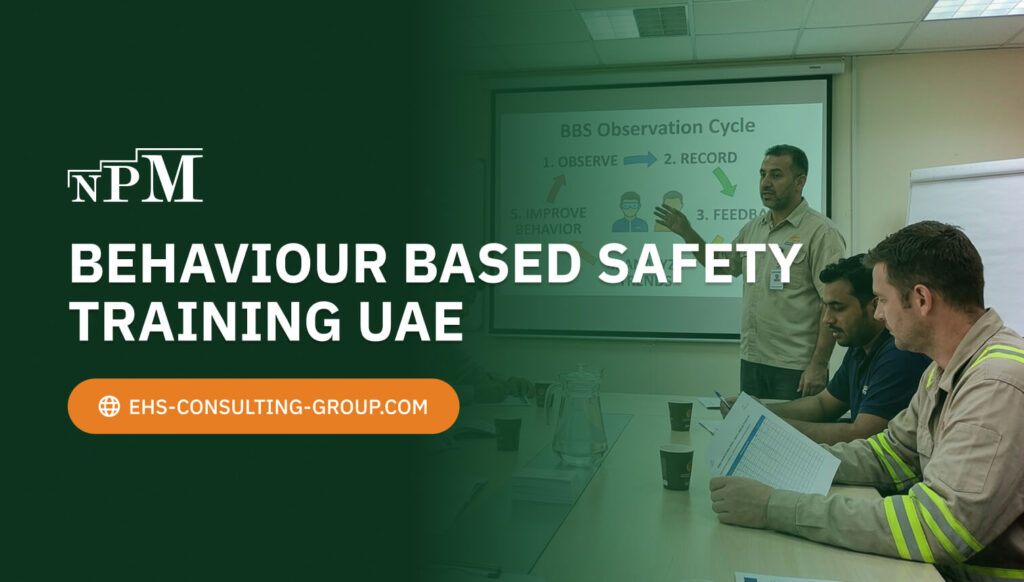
Behaviour Based Safety Training for Construction is a practical, field-focused program delivered by NPM to build observable safety leadership and consistent safe behaviours across UAE construction sites. From high-rise tower builds and industrial EPC projects to infrastructure corridors, tunnelling, and fit‑out works, this training equips supervisors, foremen, engineers, and craft workers with the skills and tools to recognise at‑risk behaviours, conduct respectful peer-to-peer interventions, and turn everyday tasks into learning opportunities that prevent incidents before they occur. This industry-specific program is part of our broader Behaviour Based Safety Training UAE delivered across the UAE.
Who Needs Behaviour Based Safety Training for Construction?

Construction projects in the UAE operate within complex, multi-contractor environments where concurrent activities, tight schedules, and dynamic site conditions create elevated exposure to at‑risk behaviours. Behaviour Based Safety Training for Construction is designed for main contractors, EPC consortia, specialist subcontractors (lifting, scaffolding, MEP, piling, façade, and fit‑out), and client representatives overseeing fast-moving works at high-rise towers, industrial plants, road and rail corridors, ports, and coastal developments. Typical participants include HSE managers, construction managers, site and section engineers, supervisors/foremen, lifting teams (riggers and banksmen), crane operators, scaffold inspectors, electrical/MEP technicians, and safety officers tasked with coaching crews drawn from multi-lingual, multi-cultural workforces. The training addresses realities such as night shifts, Ramadan hours, extreme heat, dust, confined works, and frequent contractor handovers. Behaviour Based Safety Training for Construction helps these roles develop observation discipline, use simple behaviour checklists effectively, intervene early without conflict, and escalate when stop-work is warranted. It supports project leaders in converting toolbox talks and PTP/JSA reviews into behaviour-focused learning moments, closing the loop on near-miss reporting, and aligning site teams to client HSE requirements, OSHAD in Abu Dhabi, Dubai Municipality guidelines, Civil Defence permit conditions, and MOHRE heat-stress directives. For organisations managing multiple packages and interfaces, it creates a common language of safe behaviours that travels across zones, shifts, and subcontractors.
Objectives of Our Behaviour Based Safety Training for Construction

The primary objective of Behaviour Based Safety Training for Construction is to turn safety from a compliance exercise into a daily practice of observable, coachable behaviours that prevent falls, struck‑by incidents, electrical shocks, trench collapses, dropped objects, and hot-work fires. Participants learn the ABC model (Antecedent–Behaviour–Consequence) and how it applies to high-risk tasks such as working at height, crane and MEWP operations, temporary works, excavation and shoring, concrete pouring, traffic management, confined space entries, and live testing/energisation. Behaviour Based Safety Training for Construction builds capability to: 1) conduct structured behavioural observations with respect and cultural sensitivity; 2) recognise—and immediately coach—at-risk body positions, line-of-fire exposures, PPE lapses, and shortcuts under schedule pressure; 3) use simple observation cards and digital tools to record leading indicators; 4) run brief, high-impact toolbox talks that prime safe behaviours before critical tasks; 5) facilitate stop-work and restart protocols without conflict; and 6) analyse observation and near-miss trends to prioritise corrective actions and targeted micro‑training. The training also strengthens supervisor communication skills—asking open questions, confirming understanding across language barriers, and reinforcing safe choices. By the end of Behaviour Based Safety Training for Construction, participants connect behaviour data with site KPIs (PTP quality, permit compliance, energy isolation discipline) and understand how to feed insights into ISO 45001 management reviews for sustained, measurable improvements.
Training Program Structure and Modules

Our construction-focused program combines classroom learning, scenario practice, and field application to ensure Behaviour Based Safety Training for Construction translates immediately to active worksites. A structured blend of interactive modules, case studies from tower cranes, scaffolding, and excavation tasks, and role-play of observation/intervention dialogues make the learning memorable and usable. Participants practice with construction-specific observation checklists aligned to hazards such as edge protection, lifting plan adherence, exclusion zones, hot-work precautions, lockout/tagout, and mobile plant movements. For multi-lingual crews, we incorporate simplified visual aids and coach leaders to use concise, consistent phrases that bridge language gaps. Behaviour Based Safety Training for Construction includes exercises to convert pre‑task briefings and JSAs into behaviour-focused engagements, and to close near-miss feedback loops with tangible corrective actions. Delegates leave with a field-ready behaviour observation card, an approach for sampling critical tasks during peak risk windows (first hour, shift handovers, late evenings), and a simple method for analysing leading indicators so site management can act before lagging metrics deteriorate. The methodology dovetails with existing permit-to-work systems, lifting plans, temporary works approvals, and client HSE requirements, ensuring BBS complements—not competes with—established controls on construction projects.
Module 1 — Foundations of Behavioural Safety in Construction
This module grounds Behaviour Based Safety Training for Construction in the ABC model, human performance principles, and the unique dynamics of multi-contractor construction sites. Participants connect behavioural drivers—production pressure, unclear roles, poor housekeeping, fatigue—to typical incidents like falls from height and struck‑by events, framing BBS as a practical prevention tool.
Module 2 — Effective Observation and Respectful Intervention
Delegates learn how to plan and conduct observations around critical activities (lifting, scaffolding, excavations, electrical works), identify safe/at‑risk behaviours, and engage with workers constructively. Behaviour Based Safety Training for Construction emphasises culturally respectful language, non-punitive dialogue, and de-escalation when stop-work is necessary.
Module 3 — Building High-Quality Leading Indicators
Participants practice completing behaviour observation cards correctly, coding findings consistently, and transforming data into actionable insights. Behaviour Based Safety Training for Construction shows how to prioritise high-severity exposures, identify recurring patterns across crews/shifts, and integrate trends into toolbox talks and weekly coordination meetings.
Module 4 — Field Coaching and Toolbox Integration
This module teaches supervisors to embed Behaviour Based Safety Training for Construction into daily operations—turning PTPs/JSAs and permit briefings into short behaviour-focused micro‑trainings that improve glove selection, harness use, spotter positioning, and plant-pedestrian separation at live workfronts.
Module 5 — Sustaining BBS in Project Controls
Leaders learn to align Behaviour Based Safety Training for Construction with ISO 45001, client KPIs, OSHAD/Dubai Municipality expectations, and Civil Defence permit conditions—linking observation trends to corrective actions, audits, and management reviews so behaviours improve and stay improved through handover.
- Hands-on practice with construction behaviour observation cards and short-form checklists
- Scenario libraries for working at height, crane lifts, hot works, trenching, and mobile plant movements
- Role-plays to build confident, respectful intervention skills across language barriers
- Templates for trend dashboards and toolbox talk integration
Duration and Format of Behaviour Based Safety Training for Construction

Behaviour Based Safety Training for Construction is designed to fit project realities—turnarounds, heavy pours, lifts, and inspection windows—while maintaining training effectiveness. A one‑day foundation course builds shared language and core skills for crews and frontline supervisors. A two‑day practitioner course deepens capability for HSE and site leadership, adding more field coaching, data analysis, and action planning. For large or distributed sites, we can stage half‑day blocks across shifts to keep production moving, or run evening sessions during cooler hours. Delivery is available on-site at active workfronts, at your training centre, or in hybrid format with pre‑work eLearning and on‑site coaching. Behaviour Based Safety Training for Construction can be delivered in English, Arabic, Hindi/Urdu, or bilingual formats to support comprehension and retention. Typical cohorts range from 10–18 delegates to balance interaction and attention—large organisations can cascade learning via train‑the‑trainer add‑ons. All formats include construction-specific scenarios, observation card practice, and tools to integrate leading indicators into site meetings and ISO 45001 processes, ensuring skills transfer from classroom to scaffolds, decks, and laydown areas the very next shift.
| Format | Typical Audience | Duration | Delivery Mode | Languages | Group Size | Outcome |
|---|---|---|---|---|---|---|
| Foundation | Crew leads, foremen, crane/MEWP teams | 1 day (or 2 x 0.5 day) | On-site or hybrid | EN/AR/Hindi/Urdu | 12–18 | Shared BBS language and observation basics |
| Practitioner | HSE/site engineers, supervisors, managers | 2 days | On-site or classroom | EN/AR | 10–16 | Advanced coaching, trend analysis, action planning |
| Train-the-Observer | Internal champions, safety officers | 1 day + field coaching | On-site | EN/AR | 8–12 | Capable in-house observation network |
Operational Benefits and Real-World Use Cases

Behaviour Based Safety Training for Construction delivers measurable improvements where they matter: at the workface. Crews learn to recognise and correct body positioning that precedes falls and line-of-fire injuries; riggers and signalers become more consistent in establishing and maintaining exclusion zones; supervisors sharpen their eye for temporary works deviations, poor housekeeping, and energy isolation gaps; and planners embed behaviour checks in lift plans and PTPs. On projects where Behaviour Based Safety Training for Construction has been deployed, we see near‑miss reporting volume rise (a healthy leading indicator), better quality of observation data, and specific reductions in common event types such as dropped objects from scaffolds and hand injuries during rebar, formwork, or cable pulls. Leaders apply BBS trend insights to target micro‑trainings—for example, a spike in harness misuses triggers a focused five‑minute talk before tower crane hook‑ups; a run of poor spotter positioning prompts refresher guidance and visual aids. Because construction sites evolve daily, Behaviour Based Safety Training for Construction emphasises short, frequent, behaviour‑focused engagements that travel with the work, rather than long, one‑time lectures divorced from site reality.
- Reduced permit-to-work nonconformities through behaviour-focused briefings
- Fewer dropped-object and line-of-fire incidents via improved exclusion discipline
- Higher observation quality and closure rates on corrective actions
- Improved coordination between main contractor and specialist subcontractors
- Better heat-stress self-monitoring and hydration behaviours in extreme conditions
Why Choose NPM for Construction BBS Training

NPM brings deep, site-tested expertise to Behaviour Based Safety Training for Construction, built from delivering programmes across high-rise builds, industrial EPC sites, metros and highways, and large-scale fit‑outs. Our trainers are seasoned construction HSE practitioners who understand contractor interface risks, client permit regimes, and the reality of multilingual crews working under schedule pressure. We tailor every course with your site’s risk profile—tower cranes and MEWPs, heavy lifts, excavations and dewatering, façade and glazing, temporary works, congested laydowns—and we co‑design observation cards and toolbox content that reflect your PTP/permit processes, not generic templates. NPM’s approach is collaborative: we coach respectful, non‑punitive interventions that fit your culture, we train your champions to sustain observation networks, and we set up simple dashboards so leading indicators inform weekly coordination and ISO 45001 reviews. We also draw upon best-practice resources available through CABINET NPM, ensuring consistent quality in materials and methods. From flexible scheduling that avoids critical pours and lifts, to bilingual delivery and field coaching, NPM ensures Behaviour Based Safety Training for Construction is immediately usable on your active workfronts.
Related Behaviour-Based Safety Programs for Your Teams
Beyond construction sites, NPM delivers industry-tuned BBS programs that align with the differing risks, standards, and workflows of other sectors. Explore these sibling offerings to equip your broader portfolio.
Behaviour Based Safety Training for Manufacturing
For organisations operating fabrication shops, assembly lines, and maintenance workshops adjacent to project sites, this program focuses on machine guarding, lockout/tagout, ergonomics, and material handling behaviours. It is typically scheduled before commissioning of new lines or during safety stand-downs to refresh observation discipline. The outcome is a manufacturing floor where near-miss insights and behaviour observations drive targeted fixes without disrupting takt time.
Click on the following link for more details: Behaviour Based Safety Training for Manufacturing.
Behaviour Based Safety Training for Oil & Gas
For EPC contractors and service providers supporting upstream pads, pipelines, or downstream plant tie-ins, this course adapts BBS to process safety contexts, permit-to-work, SIMOPS, and confined space/LOTO rigor. It is commonly required ahead of shutdown/turnaround windows and brownfield integrations. The practical outcome is a workforce that recognises and corrects at‑risk behaviours around process hazards while aligning with client standards.
Click on the following link for more details: Behaviour Based Safety Training for Oil & Gas.
Regulatory Landscape & Site Realities in the UAE Construction Sector
In the UAE, Behaviour Based Safety Training for Construction supports compliance with ISO 45001 management systems and Emirate-level requirements such as OSHAD (Abu Dhabi Occupational Safety and Health System Framework), Dubai Municipality and Trakhees–EHS guidelines, and Local Civil Defence permit conditions for hot works and temporary installations. Projects must also integrate MOHRE expectations for heat-stress management and labour welfare, and align with widely referenced international codes including NFPA 241 (Safeguarding Construction, Alteration, and Demolition Operations), BS EN 12811 for scaffolding, ASME B30 for lifting, and best practices for temporary works coordination (e.g., BS 5975). Construction operators in the UAE range from developers and EPC leaders to specialist subcontractors and logistics providers moving heavy components in urban corridors. Typical hazards—working at height on cores and façades, concurrent lifting and MEWP use, excavation around utilities, live electrical testing, hot works near combustibles, and heavy vehicle–pedestrian interface—depend heavily on human behaviour to control effectively. Behaviour Based Safety Training for Construction ensures observation and intervention skills are embedded within pre‑task briefings, PTP/JSAs, lifting plans, and permit-to-work, while ensuring trend data flows upward into management review. With rapid programme schedules and frequent subcontractor turnover, NPM emphasises short, frequent, behaviour‑focused engagements that maintain vigilance across shifts and contractor interfaces, aligning with client audits and authority inspections without slowing progress.
Our Training Across UAE Industries
NPM adapts behaviour-based safety to the operating realities of diverse sectors across the UAE, from heavy industry and logistics to complex process environments. While this page addresses construction, we also tailor programs to other industries with their own risk profiles and regulatory expectations. Speak to us to align content with your portfolio.
Assessment & Certification
Assessment in Behaviour Based Safety Training for Construction is built around practical competence. Delegates complete a short pre‑course diagnostic, participate in scenario-based exercises and role‑plays, and are evaluated through observed practice using construction-specific behaviour checklists (e.g., for working at height, lifting, excavation, hot works, and plant movement). A short post‑test confirms understanding of core BBS concepts and their application to site tasks. Where on‑site coaching is included, participants are observed conducting a real field observation and respectful intervention. Successful delegates receive an NPM Certificate of Completion indicating course title, duration, learning objectives, and delegate/organisation details; where statutory or client competency sign‑off is required, the client organisation remains responsible for formal authorisation in accordance with internal procedures and applicable regulations. Recommended group size is 10–18 to ensure ample practice and feedback; for multi‑site organisations, we can run parallel cohorts or rotate sessions by shift. Prior to delivery, we conduct a brief needs analysis to align Behaviour Based Safety Training for Construction with your risk profile, permits, and temporary works controls; collect relevant procedures and PTP/JSA templates; and agree language needs. Where feasible, we design site‑specific scenarios (e.g., tower crane lifting of rebar bundles, trench shoring checks, façade cradle access) so assessment mirrors real workfronts and participants transfer skills immediately.
Frequently Asked Questions
How often should we renew this training for construction crews and supervisors?
Most organisations refresh Behaviour Based Safety Training for Construction every 12–24 months, with earlier refreshers triggered by trend deterioration in leading indicators, contractor mobilisation on new packages, major incidents/near-misses, or shifts in site risk (e.g., transition to façade and fit‑out or start of heavy lifts).
What is the difference between initial and refresher sessions?
Initial Behaviour Based Safety Training for Construction builds foundational concepts, observation skills, and tools from the ground up, while refresher sessions are shorter, trend-driven tune‑ups focused on recent site scenarios, reinforcing respectful intervention and addressing specific behavioural gaps emerging from your observation data.
Who issues the certificate, and does it satisfy client competency requirements?
NPM issues the Certificate of Completion for Behaviour Based Safety Training for Construction. Client or statutory competency sign‑off (e.g., role authorisations) remains the responsibility of your organisation under internal procedures and applicable authority or client requirements.
Is in-house delivery better than open/public sessions for construction teams?
For project-based crews, in-house Behaviour Based Safety Training for Construction is generally preferred because it incorporates your permits, temporary works controls, and lift plans. Public sessions can suit individual supervisors or small firms needing foundational exposure, but site-tailored training yields greater transfer to the workface.
What group size works best for effective skills practice?
We recommend 10–18 delegates per cohort for Behaviour Based Safety Training for Construction to maximise role-play, observation practice, and coaching feedback. Larger organisations can schedule multiple cohorts or adopt a train‑the‑observer pathway to cascade skills across packages and shifts.
Are there prerequisites for delegates?
No formal prerequisites are required, but participants will benefit from familiarity with your site’s PTP/JSA templates, permit-to-work processes, and critical task procedures. For advanced Behaviour Based Safety Training for Construction practitioner sessions, prior experience in supervision or HSE roles is advantageous.
Explore Our Track Record
NPM has delivered behaviour-based safety programs and HSE capability-building for complex construction, industrial, and infrastructure projects worldwide. Our track record spans high-rise builds, industrial EPC, and multi-billion infrastructure packages, with measurable improvements in leading indicators and field coaching habits. We invite you to explore case examples and references that reflect our approach to Behaviour Based Safety Training for Construction and other industry variants.
For more information about our references, visit Our References.
Speak With Our Training Team
If you are ready to embed practical, respectful safety coaching on your sites, NPM can configure Behaviour Based Safety Training for Construction around your workfronts, languages, and schedules. Tell us about your projects, risk profile, and contractors, and we will propose a delivery plan that accelerates behavioural improvements without slowing progress.