
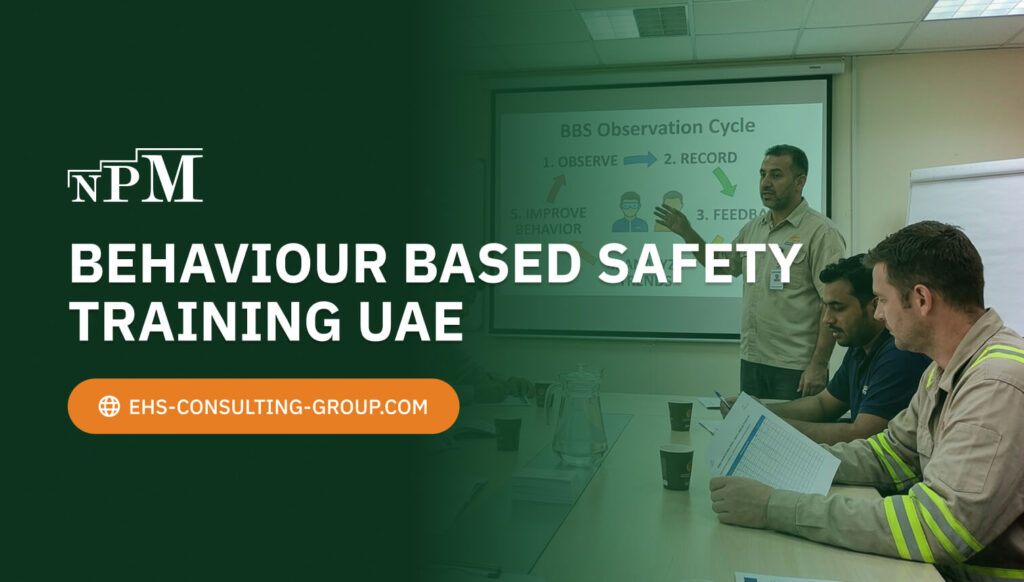
Behaviour Based Safety Training for Oil & Gas delivered by NPM aligns front-line behaviors with critical controls in high-hazard upstream, midstream, and downstream operations across the UAE. This training equips supervisors, permit issuers, and craft personnel to recognize exposure, intervene effectively, and embed safe habits during drilling, well services, plant operations, maintenance turnarounds, and pipeline activities. This industry-specific offering is part of our broader Behaviour Based Safety Training UAE delivered by NPM to reinforce culture, reduce incidents, and meet ADNOC COPs, OSHAD, and international best practice expectations.
Who Needs Behaviour Based Safety Training for Oil & Gas?

Behaviour Based Safety Training for Oil & Gas is designed for operations and maintenance teams working in environments where energy isolation, flammable atmospheres, line-of-fire exposure, and complex SIMOPS converge. Typical participants include Offshore Installation Managers, drilling supervisors, rig crews, PTW authorities, operations technicians, turnaround planners, rigging/lifting teams, scaffolders, H2S watch, hot work fire watch, and contractor HSSE leads embedded on refineries, gas plants, FPSOs, drilling rigs, and pipeline spreads. Oilfield realities—multi-lingual crews, shift rotations (12/12 offshore, 6/1 or 5/2 onshore), and contractor-heavy workforces—demand a pragmatic program that calibrates how people observe tasks, speak up, and reinforce life-saving rules without disrupting production. Behaviour Based Safety Training for Oil & Gas by NPM translates hazard recognition into consistent micro-actions at the jobsite: verifying isolations before breaking containment, confirming gas readings before hot work, maintaining exclusion zones for lifts, and controlling dropped-object risks. Whether you manage brownfield modifications within live process units, manage well interventions with simultaneous operations, or supervise multi-contractor turnarounds, Behaviour Based Safety Training for Oil & Gas provides the common language and coaching routines to improve near-miss reporting quality, tighten JSA/TRA conversations, and sustain compliance under time pressure.
Objectives of Our Behaviour Based Safety Training for Oil & Gas

Behaviour Based Safety Training for Oil & Gas focuses on embedding observable, repeatable behaviors that directly influence process and personal safety outcomes in hazardous facilities. The program equips delegates to conduct high-quality peer observations tied to critical controls (permit-to-work, LOTO, gas testing, confined space entry, working at height, hot work, lifting), use coaching techniques that de-escalate resistance, and document trends that inform your leading indicator dashboard (e.g., quality of isolations verified, frequency of last-minute risk assessments, integrity of barricades). Beyond techniques, Behaviour Based Safety Training for Oil & Gas reframes “compliance” into operational discipline by linking behaviors to barrier health and major accident prevention—aligning with IOGP Life-Saving Rules, API RP 75, and ADNOC COP expectations. Supervisors learn to close the loop through toolbox talks, tiered audits, and cross-contractor engagement so improvement sticks between shifts and across crews.
- Calibrate what “good” looks like for observations on rigs, process units, and pipeline ROWs.
- Coach in the field to address shortcuts, normalization of deviance, and risk drift.
- Strengthen JSA/TRA quality and last-minute risk assessment habits.
- Integrate BBS insights into PTW audits and leadership safety walks.
- Improve near-miss capture and learning quality, not just volume.
- Focus on DROPS, line-of-fire, energy isolation, and simultaneous operations.
- Align behavioral checks with ADNOC COPs, OSHAD SF, ISO 45001, and API guidance.
Training Program and Modules for Oil & Gas Operations

Behaviour Based Safety Training for Oil & Gas is structured as a modular progression to meet the needs of mixed-experience crews and multi-contractor environments common in drilling campaigns, brownfield projects, and refinery shutdowns. NPM blends classroom briefings with role-play, field-simulated observation drills, and analysis of your own PTW, JSA, and incident data so the content mirrors your realities—H2S potential, simultaneous hot work and line breaks, heavy lifts near pipe racks, and confined entry amid hydrocarbon residues. Participants practice observation protocols during realistic vignettes (e.g., preparing for a wellhead maintenance task, staging a crane pick near live lines, setting up hot work with changing wind direction), receive feedback on language and tone, and learn how to escalate when critical controls are missing. The program standardizes definitions (safe, at-risk, coaching needed), clarifies documentation quality thresholds, and embeds a simple cadence for toolbox reinforcement. Behaviour Based Safety Training for Oil & Gas also provides supervisors with templates for trend reviews and action planning, closing the loop between front-line observation and management oversight. By adapting case studies to offshore and onshore assets, participants finish with a shared playbook for observation, intervention, and reporting that elevates barrier effectiveness without slowing the job.
Module 1 — Foundations of Behavioral Safety in High-Hazard Operations
This module grounds delegates in human performance principles, error traps, and the link between behaviors, critical controls, and major accident prevention. Using examples from turnarounds and drilling, we map behaviors to barriers, then introduce the Observation-Coaching-Documentation cycle central to Behaviour Based Safety Training for Oil & Gas.
Module 2 — Observation Skills and Field Application
Participants learn to scan tasks for hazard-energy mismatches, verify isolations, spot line-of-fire exposures, and evaluate DROPS controls. We rehearse observation scripts for multi-cultural crews and contractor interfaces, ensuring respectful, effective interventions under production pressure.
Module 3 — Supervisor Coaching and Feedback Loops
Supervisors practice coaching micro-skills, from open questions to positive reinforcement and decisive escalation. The module shows how Behaviour Based Safety Training for Oil & Gas integrates with toolbox talks, PTW spot-checks, and tiered audits, maintaining consistency across day and night shifts.
Module 4 — Data, Trends, and Action Planning
We convert observation notes into actionable leading indicators—trend heat maps, recurring gaps in JSAs, and control failures tied to specific tasks. The module standardizes reviews so operations can prioritize fixes that move TRIR, SIF potential, and near-miss learning quality.
Duration and Format of Behaviour Based Safety Training for Oil & Gas

Behaviour Based Safety Training for Oil & Gas is scheduled to minimize operational disruption and fit the realities of offshore tours, 24/7 plant operations, and turnaround windows. Typical delivery options include a 1-day Practitioner course for front-line observers and craft leads, a 2-day Supervisor & Coach course for team leaders and PTW authorities, and a 0.5-day Executive Briefing tailored for OIMs, plant managers, and HSE leadership. For offshore assets, NPM can deliver condensed modules over two consecutive evenings to accommodate 12-hour shifts, ensuring both day and night crews gain equal access. Onshore refineries and gas plants often prefer pre-TAR delivery to embed observation and coaching habits before SIMOPS intensify; pipeline projects may select a rolling weekly cadence to keep new contractor crews aligned. Behaviour Based Safety Training for Oil & Gas is available onsite at your facilities, at a neutral training venue, or live-virtual for distributed teams. All formats include oil and gas-specific case work and can be localized with your PTW templates, Life-Saving Rules, and ADNOC COP references so learning transfers directly to field execution.
| Delivery Mode | Best For | Typical Use Cases | Notes |
|---|---|---|---|
| Onsite (Onshore/Offshore) | Large crews, multi-contractor TARs, rig teams | Pre-turnaround readiness, drilling startup, brownfield SIMOPS | Scenario design customized to asset hazards; supports day/night shifts |
| Live-Virtual | Distributed engineering/HSE teams, pre-mobilization refresh | Campaign kickoffs, contractor alignment, refresher sessions | Interactive breakout rooms; site-specific case studies included |
| Hybrid | Organizations seeking minimal downtime | Self-paced primers + targeted field coaching days | Data-driven reinforcement with scheduled coaching touchpoints |
To maximize retention, Behaviour Based Safety Training for Oil & Gas can be paired with field coaching days during the first week of a turnaround or campaign, allowing NPM facilitators to shadow crews, calibrate observation quality, and reinforce constructive intervention in live conditions.
Operational Benefits and Use Cases

When embedded within permit-to-work and contractor management, Behaviour Based Safety Training for Oil & Gas yields measurable improvements in observation quality, intervention frequency, and closure of at-risk conditions before they escalate. NPM emphasizes practical wins: fewer uncontrolled hot work conditions; better barricade discipline and spotter positioning during lifts; improved DROPS inspections on derricks and pipe racks; and more accurate gas monitoring prior to confined space entry and line breaks. Supervisors report stronger JSA conversations that target real exposure rather than box-ticking, and leadership gains early-warning signals through leading indicators that correlate with reductions in SIF potential. Behaviour Based Safety Training for Oil & Gas also strengthens contractor alignment, particularly when multiple subcontractors converge during TARs, revamps, or well service campaigns—building a shared expectation for how to observe, coach, and act. The program’s operational discipline focus complements ISO 45001 systems and ADNOC COP compliance by translating policy into repeatable, observable behaviors under production pressure.
- Pre-TAR culture tune-up to ready hundreds of contractor workers for SIMOPS intensity.
- Rig crew onboarding before a new drilling or workover campaign with H2S exposure.
- Pipeline tie-in activities near live lines, emphasizing energy isolation and line-of-fire.
- Brownfield revamps in refineries where hot work and line breaks coincide.
- Commissioning phases with frequent permit changes and shifting hazards.
- Performance turnaround initiatives following an uptick in near-misses or findings.
Why Choose NPM for Behaviour-Based Safety in Oil & Gas

NPM brings oil and gas depth, bilingual facilitation, and data-driven reinforcement to Behaviour Based Safety Training for Oil & Gas. Our facilitators have led field coaching on offshore platforms, gas processing plants, and tank terminals, balancing production targets with safety integrity. We integrate your PTW, JSA/TRA, and Life-Saving Rules into the curriculum, using real scenarios to build the exact observation and coaching behaviors you expect on the job. Our analytics approach turns observation notes into actionable dashboards that flag weak controls and recurring exposure patterns, creating a tight loop between front-line behavior and leadership action. Behaviour Based Safety Training for Oil & Gas is supported by NPM’s broader technical risk expertise and advisory ecosystem, including resources available through CABINET NPM, enabling us to align behavioral interventions with process safety and operational excellence priorities. Above all, we tailor delivery to shift realities—offshore tours, night crews, and contractor mobilizations—so your teams practice behaviors they will use on the next permit, the next lift, and the next confined entry.
Detailed Training Levels and Related Options
Complementary training variants help multi-asset operators standardize behavioral expectations across adjacent workstreams and contractor ecosystems. Explore these related options to extend the impact of Behaviour Based Safety Training for Oil & Gas.
Behaviour Based Safety Training for Construction
For oil and gas operators overseeing brownfield projects inside live facilities, this variant addresses high-risk construction activities—scaffolding, heavy lifts, excavation near underground services, and hot work—executed alongside process operations. Many clients pair Behaviour Based Safety Training for Oil & Gas with this course during revamps and turnarounds to align EPC and specialist contractors with asset operator expectations and Life-Saving Rules.
Click on the following link for more details: Behaviour Based Safety Training for Construction.
Behaviour Based Safety Training for Manufacturing
Downstream logistics, packaging, and blending operations often mirror manufacturing work patterns and equipment risks (warehousing, forklifts, maintenance activities). Organizations extend Behaviour Based Safety Training for Oil & Gas with this option to reinforce observation and coaching habits in non-process areas that still influence overall safety performance and contractor alignment.
Click on the following link for more details: Behaviour Based Safety Training for Manufacturing.
Our Training Reach Across UAE Industries
NPM delivers behavior-based safety programs across asset-intensive sectors, adapting observation and coaching tools to industry-specific hazards, regulatory expectations, and contractor dynamics. If your portfolio spans multiple industries, we can align terminology, critical control checks, and reporting so leadership sees comparable leading indicators across sites.
Regulatory Landscape and Operating Realities in the UAE Oil & Gas Sector
The UAE oil and gas context demands that behavioral safety directly supports barrier health and regulatory compliance. Abu Dhabi’s OSHAD framework and ADNOC Codes of Practice set expectations for PTW, confined space entry, working at height, energy isolation, and hot work controls; Dubai Municipality and local Civil Defence authorities enforce safe systems of work, fire prevention, and emergency preparedness. Internationally, ISO 45001 provides the management system backbone, while API RP 75 (Safety and Environmental Management), API 754 (Process Safety Performance Indicators), and the IOGP Life-Saving Rules guide risk prioritization and performance measurement. Behaviour Based Safety Training for Oil & Gas by NPM connects these frameworks to daily execution: verifying gas tests and isolations prior to line breaks, controlling ignition sources around hydrocarbon systems, enforcing DROPS inspections, and maintaining exclusion zones during lifts. For offshore and remote sites, we factor in access constraints, medevac considerations, and logistics windows; for refineries and gas plants, we address SIMOPS during TARs, integrity threats during recommissioning, and contractor bridging documentation. Behaviour Based Safety Training for Oil & Gas helps organizations transform compliance from paperwork into observable habits that protect people, assets, and production continuity in the UAE’s high-consequence operating environment.
Industry Internal Links
NPM provides a unified behavioral safety methodology that scales across mixed portfolios, enabling consistent observation quality and coaching language wherever your teams work. Contact us if you need cross-industry alignment using the same core tools and dashboards.
Assessment and Certification
Assessment in Behaviour Based Safety Training for Oil & Gas is practical and performance-focused. Delegates complete knowledge checks on observation categories, intervention triggers, and documentation standards, then apply skills in scenario-based role plays tailored to your hazards (e.g., hot work near live equipment, confined space entry into vessels, or a heavy lift alongside live pipe racks). Facilitators evaluate observation accuracy, coaching technique, and escalation judgment, providing individual feedback and a calibration benchmark for supervisors. Each participant who meets performance criteria receives an NPM Certificate of Completion indicating the course title (“Behaviour Based Safety Training for Oil & Gas”), total training hours, delivery format, date, and trainer credentials. Where statutory or company-specific authorizations apply, the client organization remains responsible for competency sign-off and internal authorization matrices. Recommended cohort size is 10–16 participants to enable realistic practice while maintaining high-quality feedback; larger crews can be split by shift or craft discipline. Before delivery, NPM conducts a scoping call and light document review—recent incidents, near-miss reports, PTW/JSA samples, Life-Saving Rules, ADNOC COP references—so exercises use your language and risk profile. For major turnarounds or drilling campaigns, we can design site-specific scenarios and coaching cards, ensuring Behaviour Based Safety Training for Oil & Gas connects seamlessly to operational reality from day one.
Frequently Asked Questions
How often should teams renew this training?
For crews in high-risk operations, we recommend refreshing Behaviour Based Safety Training for Oil & Gas every 24 months, or sooner following organizational changes, an uptick in at-risk observations, a major incident/near-miss, or prior to large turnarounds and drilling startups.
What’s the difference between initial and refresher sessions?
Initial Behaviour Based Safety Training for Oil & Gas builds foundational concepts and extensive practice in observation and coaching; refresher sessions focus on calibration using your recent observation data, address drift in PTW/JSA quality, and target recurring exposure patterns identified in your dashboards.
Who issues the certificate?
NPM issues the Certificate of Completion for Behaviour Based Safety Training for Oil & Gas, documenting course scope, hours, and trainer credentials. Your organization remains responsible for any statutory or internal competency sign-off and authorization to perform safety-critical roles.
Should we choose in-house or public courses?
Oil and gas operators typically select in-house delivery so we can tailor scenarios to asset hazards (H2S, DROPS, SIMOPS) and integrate your PTW and Life-Saving Rules. Public courses suit individual upskilling or small teams needing a quick baseline before mobilization.
What group size is most effective?
We find 10–16 delegates per cohort yields strong practice-to-feedback ratios for oilfield realities, allowing multiple role-play rotations and scenario variety. For very large workforces, staggered cohorts by shift or discipline maintain quality while achieving coverage.
Are there prerequisites?
No formal prerequisites are required, but participants benefit from prior exposure to your PTW system, JSA/TRA process, and Life-Saving Rules. For supervisors, recent involvement in toolbox talks and tiered audits enhances learning transfer.
Explore Our Track Record
NPM has delivered behavior-based safety, process safety, and operational excellence programs to complex assets worldwide, from offshore platforms and LNG terminals to refineries and pipeline networks. Our approach emphasizes measurable behavior change, practical field coaching, and integration with management systems and critical control frameworks. Explore how NPM equips teams to translate standards into safe execution in demanding environments.
For more information about our references, visit Our References.
Speak to Our Team
Strengthen field execution and critical control discipline with Behaviour Based Safety Training for Oil & Gas tailored to your rigs, plants, and pipeline operations. NPM will align scenarios with your PTW, JSA/TRA, and Life-Saving Rules and schedule delivery around shifts and TAR windows. Speak with our specialists to scope the right format and timeline for your crews.