
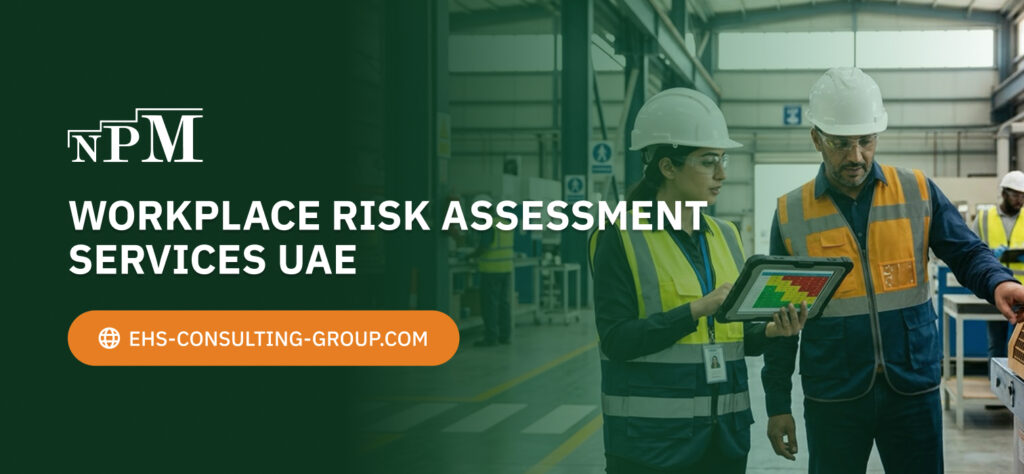
Workplace Risk Assessment for Manufacturing delivered by NPM gives HSE managers, plant managers, production leaders, and compliance officers a rigorous, audit-ready pathway to identify, evaluate, and control shop-floor hazards across discrete, batch, and continuous manufacturing operations in the UAE. From machining, fabrication, assembly, and packaging lines to paint booths, press shops, automated cells, and high-bay warehouses, we align hazard identification and risk reduction with your permits-to-work, maintenance windows, shift patterns, and statutory obligations so that your facility can operate safely, efficiently, and in compliance.
This industry-specific engagement is part of our broader Workplace Risk Assessment Services UAE portfolio. NPM’s consultants combine deep manufacturing know-how with practical risk methodologies (HIRA, JSA, task-based and area-based assessments) to prioritize control measures that are feasible in your production reality—reducing incident potential, improving OEE and uptime, and strengthening evidentiary compliance for internal and external audits.
Who Needs Workplace Risk Assessment for Manufacturing?

Workplace Risk Assessment for Manufacturing is essential for organizations operating machining centers, CNC and manual toolrooms, welding and fabrication bays, die-casting and injection molding lines, coating and curing ovens, bottling and canning lines, pharmaceutical and FMCG packaging halls, and heavy assembly/erection shops. In these environments, multiple hazard vectors converge: rotating equipment and entanglement points; hot work and ignition sources; chemical exposures from solvents, resins, coolants, and adhesives; ergonomic and manual handling risks; powered industrial trucks and pedestrian interfaces; energized panels, lockout/tagout routines, and arc-flash zones; working at height around mezzanines and racking; and compressed air and pressure systems. Workplace Risk Assessment for Manufacturing by NPM is structured to reflect the reality of UAE operations—shift handovers, multi-lingual crews, contracted service technicians, and periodic OEM interventions—so that findings are accurate, implementable, and owned by frontline teams. Typical stakeholders include HSE managers and officers embedded in production, plant managers and manufacturing engineers responsible for takt time and throughput, maintenance and reliability leads managing shutdowns and PM schedules, quality leaders overseeing GMP/FSMS integration, and warehouse/logistics supervisors coordinating material flow. Whether you run a single plant in Jebel Ali or a multi-site footprint across Abu Dhabi, Dubai, and Northern Emirates, Workplace Risk Assessment for Manufacturing ensures hazards are systematically identified, risk-ranked, and controlled without compromising your production commitments.
- Facility types: metalworking and fabrication shops, plastics and rubber processing, food and beverage plants, pharmaceuticals, electronics assembly, wood products, printing/packaging, and building materials.
- Key roles: HSE managers, plant/operations managers, production supervisors, maintenance and reliability engineers, quality managers, warehouse and logistics leads, EHS coordinators.
Objectives of Our Workplace Risk Assessment for Manufacturing

The primary aim of NPM’s Workplace Risk Assessment for Manufacturing is to embed a defensible, repeatable process for hazard identification and risk control that integrates smoothly with your safety management system and production planning. We focus on mapping job steps and line configurations, verifying the adequacy of existing controls (engineering, administrative, and PPE), and closing gaps that create residual risk for people, product, and plant. Our consultants benchmark your programs against UAE statutory expectations and recognized international frameworks while tailoring recommendations to your facility’s automation level, maintenance strategies, and workforce profile. For each assessed area, Workplace Risk Assessment for Manufacturing will provide a clear risk register with likelihood–severity ratings and ALARP considerations, practical action plans with accountable owners, and a prioritization logic aligned to criticality and downtime windows. We also aim to strengthen competence deployment on the shop floor by clarifying safe work procedures, point-of-use visuals, and line-clearance standards. A further objective is to reinforce contractor controls and interfaces—for example, how OEM technicians and forklift drivers interact with production cells—so that risk is not reintroduced during servicing, changeovers, or material moves.
- Identify task, area, and process hazards across production, maintenance, and logistics.
- Validate adequacy of engineering, administrative, and PPE controls against risk tolerability.
- Produce prioritized, time-phased action plans with clear ownership and verification steps.
- Integrate the risk register into your OSHMS, permit-to-work, and training matrices for sustained control.
Scope of Work & Methodology

NPM structures Workplace Risk Assessment for Manufacturing around the realities of your operations: takt times, shift rosters, OEM maintenance visits, and planned changeovers. After a short pre-engagement scoping, our consultants perform targeted document reviews (procedures, SWPs, JSA/JHA, PTW, incident history, OEM manuals, chemical inventories, electrical single-lines, and LOTO lists) and then move on-site for walkdowns and task observations during live production where safe, or during simulated cycles when required. We facilitate task-based and area-based HIRAs, validate process and equipment safeguards, and assess pedestrian–vehicle segregation, ergonomic handling, warehousing racking integrity, and confined/hot work interfaces. Workplace Risk Assessment for Manufacturing also examines energy isolation strength (LOTO), machine guarding (fixed, interlocked, presence-sensing), and line changeover methods that often create exposure windows. We conduct focused interviews with operators, maintainers, and supervisors (multi-lingual as needed) to capture tacit knowledge and informal workarounds. Findings are risk-ranked using a transparent, calibrated matrix and translated into actionable controls—engineering upgrades, procedural revisions, targeted toolbox talks, revised visual standards, or monitoring improvements. The engagement closes with a validation workshop to confirm practicality, build ownership, and finalize timelines compatible with your production schedule.
To enhance consistency, Workplace Risk Assessment for Manufacturing by NPM aligns with recognized professional guidance from the Institution of Occupational Safety and Health (IOSH) while being tailored to UAE regulatory expectations and your manufacturing processes. We emphasize practicable measures: retrofittable guards, standardized LOTO points and tags, resilient segregation (guardrails, bollards, line markings), point-of-use SDS and labeling, ergonomic aids (lift assists, turntables, roller conveyors), and robust supervisory checks that can be executed reliably in high-tempo environments.
| Hazard Category | Typical Manufacturing Examples | Evidence Reviewed | Typical Controls Recommended | Residual Risk Notes |
|---|---|---|---|---|
| Mechanical/Entanglement | CNC lathes, presses, conveyors, rotating shafts | Guarding diagrams, OEM manuals, incident reports | Fixed/interlocked guards, PSSR, presence sensing, line clearance | Verify integrity after maintenance/changeovers |
| Electrical/Arc Flash | MCC rooms, panels, VFD cabinets, energized troubleshooting | Single-line diagrams, LOTO lists, test records | LOTO, arc-rated PPE, boundary labeling, maintenance switches | Reassess after load changes or new feeders |
| Chemical Exposure | Solvents, paints, coolants, adhesives, cleaning agents | SDS, inventory, ventilation checks, exposure monitoring | LEVs, substitution, closed systems, spill kits, training | Track changes in formulations/SDS revisions |
| Ergonomics/Manual Handling | Palletizing, lifting, repetitive assembly, awkward reaches | Observation data, injury logs, workstation layouts | Lift assists, job rotation, fixture redesign, work height changes | Monitor trends via near-miss and discomfort reports |
| Traffic & Storage | Forklifts, tuggers, high-bay racking, dock levellers | Traffic plans, racking inspections, MHE maintenance | Segregation, speed control, impact protection, rack load signs | Seasonal peaks require frequency adjustments |
Duration and Format of Workplace Risk Assessment for Manufacturing

NPM calibrates the duration and delivery format of Workplace Risk Assessment for Manufacturing to your facility size, process complexity, and operational cadence. A single-shift, single-hall operation with limited automation may require 2–3 on-site days plus 2–4 off-site days for analysis and report finalization. Multi-shift plants with multiple lines and utilities (boilers, air compressors, ammonia refrigeration, or solvent storage) typically require 4–7 on-site days to capture activities across shifts, changeovers, and maintenance windows, plus 1–2 weeks for analysis, validation, and final deliverables. For multi-site organizations, we can implement a hybrid model: remote pre-reviews of documents and historical data, followed by targeted site visits prioritized by risk or business criticality. Workplace Risk Assessment for Manufacturing may also be phased by department (e.g., machining first, then finishing and packaging) to align with production peaks, OEM visits, or shutdowns. Engagement cadence includes a kick-off meeting, scheduled walkdowns, operator interviews, interim debriefs for quick wins, a validation workshop, and final close-out. All sessions are planned in cooperation with production planning to minimize disruption and ensure that the assessment captures real operating conditions, not just idealized procedures.
Benefits and Practical / Operational Use Cases

Workplace Risk Assessment for Manufacturing translates directly into safer tasks, fewer stoppages, and better audit outcomes. By testing the real effectiveness of guarding, lockout, ventilation, segregation, and housekeeping in live conditions, we help you prevent recordable injuries, fires, equipment damage, and product quality excursions. The risk register and action plan become your single source of truth for prioritizing capital upgrades, maintenance tasks, and procedural changes—with measurable KPIs tied to closure. Workplace Risk Assessment for Manufacturing also supports your occupational safety management system, aligning with the risk-based thinking mandated by ISO 45001, so you can present clear evidence during surveillance or certification audits. Use cases include preparing a new line for start-up (PSSR/Risk Assessment), integrating contract labor during peak seasons, qualifying redesigned fixtures or guarding after a near miss, reassessing forklift–pedestrian interfaces following layout changes, or building a corrective action program after a regulatory inspection. Many clients also use the results to refresh toolbox talks, improve visual standards at points of use, and update permit-to-work templates with sharper energy isolation steps.
- Reduce incident potential, lost-time injuries, and unplanned downtime linked to unsafe conditions.
- Improve audit readiness, corrective action closure, and management review effectiveness.
- Direct capex/opex toward the highest-value risk reductions substantiated by data.
- Enhance operator engagement through targeted, line-specific controls and visuals.
Why Choose Us

NPM brings manufacturing DNA to Workplace Risk Assessment for Manufacturing—our specialists have stood on shop floors, supported changeovers against the clock, and balanced safeguarding with throughput. We understand how to collect valid evidence without disrupting takt time, how to stage observations across shifts to capture real exposure, and how to write recommendations that maintenance can implement within realistic PM windows. Our methodology aligns with UAE regulatory expectations and international frameworks, but our controls are engineered to be practical in your exact context: your machines, your workforce mix, your suppliers, and your production goals. We are fluent in integrating risk outputs into OSHMS elements—competence and training matrices, toolbox talks, PTW improvements, KPIs, and management review inputs—so the assessment becomes a living part of your system, not a shelf-bound report. Workplace Risk Assessment for Manufacturing by NPM is backed by robust project management, clear communications, bilingual fieldwork where useful, and strong visualization of findings (heat maps, photos, annotated layouts). We prioritize building internal ownership, ensuring that supervisors and operators can see and feel the improvements in their daily work, and that leadership can track progress with unambiguous metrics.
Detailed Service Offerings for Related Sectors
While this page focuses on Workplace Risk Assessment for Manufacturing, NPM also supports adjacent industries where similar hazard profiles demand tailored risk assessment depth. Explore related options below to standardize your approach across your wider portfolio.
Workplace Risk Assessment for Construction
For contractors and developers, this engagement adapts lessons from Workplace Risk Assessment for Manufacturing to dynamic construction environments with shifting work fronts, heavy lifting, and temporary works. It supports main contractors, EPCs, and specialist trades during enabling works, superstructure phases, and handover, producing controls that hold under schedule pressure.
Click on the following link for more details: Workplace Risk Assessment for Construction.
Workplace Risk Assessment for Oil & Gas
Operators and service companies can extend the rigor of Workplace Risk Assessment for Manufacturing to upstream and midstream operations, where process safety interfaces with occupational risks on platforms, terminals, and pipelines. The scope targets simultaneous operations, hot work in hazardous areas, vehicle movements, and contractor coordination during turnarounds.
Click on the following link for more details: Workplace Risk Assessment for Oil & Gas.
Workplace Risk Assessment for Logistics And Warehousing
3PLs, distribution centers, and in-plant warehouses benefit from a variant grounded in traffic management, racking integrity, MHE interactions, and fire load controls—complementing practices refined through Workplace Risk Assessment for Manufacturing on the production side. It is typically commissioned during expansions, peak season planning, or after near-miss clusters.
Click on the following link for more details: Workplace Risk Assessment for Logistics And Warehousing.
Workplace Risk Assessment for Utilities
Utility operators can apply the structured approach proven in Workplace Risk Assessment for Manufacturing to generation plants, substations, and water/desalination assets, focusing on electrical safety, confined spaces, chemical handling, and maintenance interfaces. This engagement is well-suited ahead of major outages or control system modifications.
Click on the following link for more details: Workplace Risk Assessment for Utilities.
Regulatory Landscape & Operational Realities for UAE Manufacturing
In the UAE, manufacturers must manage risk within a federal framework led by the UAE Ministry of Human Resources and Emiratisation (MOHRE), along with Emirate-level authorities such as Abu Dhabi OSHAD through ADPHC and Dubai Municipality for public health and safety requirements. Workplace Risk Assessment for Manufacturing must demonstrate that hazards are identified and controlled to protect employees, contractors, and visitors, with evidence integrated into your occupational safety management system and presented during regulatory inspections or client audits. Internationally, many plants also align with risk-based safety management under ISO 45001 to structure leadership oversight, worker participation, and continual improvement; sector-specific codes may apply to fire protection (e.g., NFPA-based requirements enforced by local Civil Defence for flammable liquids storage or high-rack sprinklered warehousing). Practical manufacturing realities in the UAE—high ambient temperatures, multi-lingual crews, seasonal workforce peaks, and reliance on OEM service teams—require that Workplace Risk Assessment for Manufacturing evaluate heat stress programs, language-appropriate visuals, contractor controls, and realistic LOTO/permit-to-work processes. For organizations operating across free zones and multiple Emirates, NPM harmonizes a single corporate risk methodology while mapping outputs to the differing documentation styles preferred by each authority, ensuring both consistency and local compliance fit.
Our Workplace Risk Assessment Across UAE Industries
NPM applies the same disciplined methodology across sectors, adapting criteria, controls, and validation steps to the hazards that define each industry. Explore how our approach extends beyond shop floors into complex construction, energy, logistics, and utilities environments.
Workplace Risk Assessment for Construction
Workplace Risk Assessment for Construction addresses high-rise tower sites, deep excavations, crane operations, scaffolding, and temporary electrical systems where dropped objects, collapse, and live services dominate the hazard profile. We reference requirements from Dubai Municipality and MOHRE alongside ISO 45001 and typical Civil Defence expectations for hot work. As with Workplace Risk Assessment for Manufacturing, we prioritize controls that withstand schedule-driven changes, subcontractor interfaces, and shifting work fronts.
Click on the following link for more details: Workplace Risk Assessment for Construction.
Workplace Risk Assessment for Oil & Gas
Workplace Risk Assessment for Oil & Gas spans onshore terminals, pipelines, and process plants, where H2S exposure, hazardous area classification, and SIMOPS with hot work create elevated consequence. We incorporate references to IOGP/API good practice and Abu Dhabi OSHAD expectations, and we factor in control of ignition sources, permit-to-work rigor, and gas testing. Similar to Workplace Risk Assessment for Manufacturing, we validate practicality against shift rosters, turnarounds, and contractor-intensive outages.
Click on the following link for more details: Workplace Risk Assessment for Oil & Gas.
Workplace Risk Assessment for Logistics And Warehousing
Workplace Risk Assessment for Logistics And Warehousing focuses on high-bay storage, racking systems, MHE traffic, dock operations, and battery charging rooms where collision, collapse, and fire load risks prevail. We align controls with typical Dubai Civil Defence sprinkler and egress requirements and operational standards like NFPA 13 for racking layouts. Building on Workplace Risk Assessment for Manufacturing, we optimize pedestrian segregation, signage, and replenishment interfaces between production and warehouse zones.
Click on the following link for more details: Workplace Risk Assessment for Logistics And Warehousing.
Workplace Risk Assessment for Utilities
Workplace Risk Assessment for Utilities covers generation plants, substations, water treatment, and desalination assets characterized by high-energy electrical systems, rotating equipment, chemicals (e.g., chlorine, acids), and confined spaces. We incorporate references to IEC-based electrical safety expectations and typical Energy Institute good practice for process safety interfaces. As with Workplace Risk Assessment for Manufacturing, our recommendations are staged around outages and control system work to ensure safe implementation without grid or water supply disruption.
Click on the following link for more details: Workplace Risk Assessment for Utilities.
Deliverables and Validation
Workplace Risk Assessment for Manufacturing culminates in a set of deliverables designed for traceability and implementation. NPM runs a validation workshop with your cross-functional team—production, HSE, maintenance, quality, and warehouse—to test the practicality of each recommendation against your shift patterns, changeovers, and scheduled PMs. We also conduct targeted shop-floor walkdowns to verify guarding feasibility, LOTO points, segregation paths, and point-of-use visuals prior to freezing the action plan. The final report includes an executive summary for leadership, methodology and scope, a photographic log of findings, annotated layouts, a calibrated risk register with before/after ratings, and a prioritized action plan with owners and due dates. Workplace Risk Assessment for Manufacturing integrates seamlessly with your OSHMS: we provide a findings register in spreadsheet format for upload to your action tracking system, along with suggested KPIs and verification checks to confirm closure. The client organization owns implementation and ultimate sign-off; NPM can support follow-up verification on request. For interviews and workshops, we recommend 6–12 participants per session, reflecting typical manufacturing staffing and allowing representation across shifts. Access needs include escorted entry to production areas, availability of line supervisors and operators for short interviews, and safe access to utilities and storage where relevant. Pre-engagement options include a remote kick-off, document review, and a preliminary site visit to calibrate scope and schedule.
To maximize value, Workplace Risk Assessment for Manufacturing explicitly maps each action to its validation method—physical inspection, functional test, document update, or training verification—and its evidence requirement, ensuring audit-ready traceability once closed. We also identify actions best bundled into shutdowns or OEM service windows to avoid unnecessary downtime and to streamline execution by maintenance teams.
FAQ
How often should this assessment be repeated, and what triggers a re-assessment in manufacturing?
For most facilities, Workplace Risk Assessment for Manufacturing should be refreshed every 12–24 months, with immediate re-assessment triggered by line reconfiguration, introduction of new machinery or chemicals, significant incidents or near misses, layout changes affecting traffic flow, or regulatory/client audit findings.
What is the difference between an initial assessment and a periodic review for factories?
The initial Workplace Risk Assessment for Manufacturing builds the baseline risk register, validates control strategies, and sets metrics; periodic reviews focus on changes since baseline, action closure effectiveness, drift in procedures, and new hazards introduced by equipment upgrades, new SKUs, or seasonal workforce changes.
Who implements the recommendations—NPM or the client?
NPM provides the analysis, risk register, and prioritized action plan under Workplace Risk Assessment for Manufacturing; your organization implements the recommendations, with NPM available for advisory support, design input on guarding or segregation, and verification checks on request.
Can the engagement be delivered on-site, or is a remote/hybrid model feasible for multi-site manufacturers?
Workplace Risk Assessment for Manufacturing is most effective on-site for observations and validation, but a hybrid model works well for multi-site portfolios: remote document reviews and interviews, followed by targeted site visits prioritized by risk and business criticality.
What team size and stakeholder mix is recommended for workshops or interviews?
A cross-functional group of 6–12 is ideal for Workplace Risk Assessment for Manufacturing—typically including HSE, production supervisors from each shift, maintenance, quality, and warehouse/logistics—to capture real task variance and ensure buy-in for practical controls.
What information and access are required before starting?
To begin Workplace Risk Assessment for Manufacturing, we request current procedures and SWPs, recent JSAs/JHAs, PTW templates, incident and near-miss data, chemical inventories and SDS, equipment/OEM manuals, electrical single-line diagrams, LOTO lists, site and line layouts, and escorted access to production, utilities, and storage areas.
Explore Our Past Projects
NPM has executed risk assessments, process safety studies, and OSHMS improvement programs across diverse industrial environments worldwide, from high-automation assembly plants to heavy fabrication and bulk packaging operations. Our track record demonstrates measurable reductions in incident potential, improved audit outcomes, and sustainable integration of controls into daily work routines. Explore how we translate complex operational realities into practical, auditable solutions.
For more information about our references, visit Our References.
Start a Conversation With Our Specialists
If you are ready to scope Workplace Risk Assessment for Manufacturing tailored to your lines, shifts, and growth plans, NPM will define a right-sized engagement that minimizes disruption and maximizes actionable outcomes. Share your facility profile, challenges, and timelines, and we will propose a structured approach that aligns safety improvements with production priorities.