
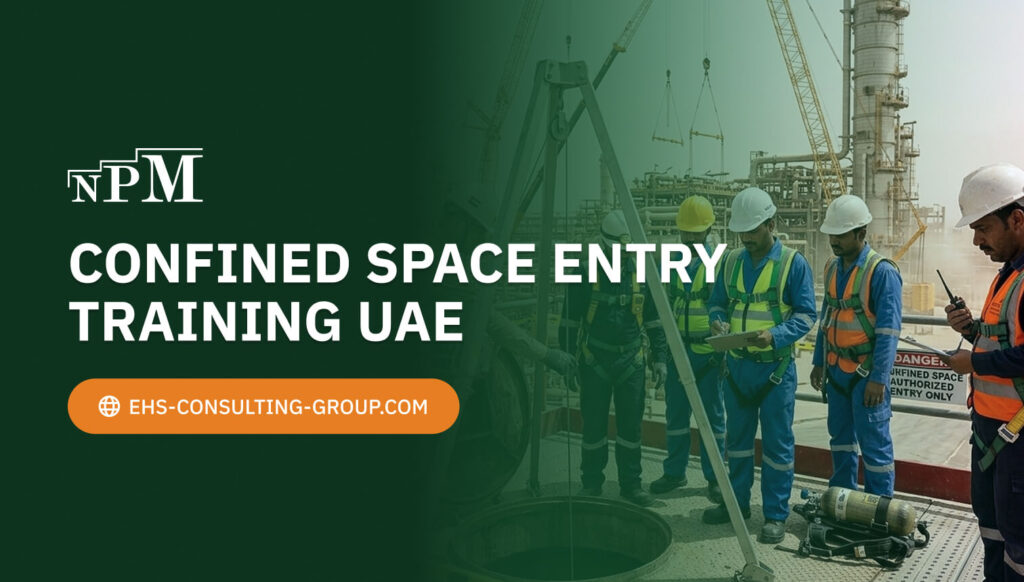
Confined Space Supervisor Responsibilities sit at the center of safe entry, control, and rescue readiness for tanks, silos, sewers, manholes, pits, and process vessels across UAE industrial sites. In high-risk operations such as refineries, petrochemical plants, construction projects, power generation facilities, and logistics terminals, the supervisor’s judgment is often the final barrier between routine work and a life-threatening incident. This article unpacks the role in depth—what the supervisor must know, decide, verify, record, and communicate—so HSE leaders and operational teams can align expectations, reduce ambiguity, and consistently meet both regulatory and international best-practice obligations.
Who This Affects

Although responsibilities coalesce around a single supervisory role, the implications ripple across multiple functions. Understanding where this role touches other teams helps eliminate blind spots during planning and execution:
- HSE Directors and Managers: Define policy for confined space management under ISO 45001 and local frameworks such as OSHAD, Dubai Municipality requirements, Civil Defence guidance, and ADNOC HSE Codes of Practice.
- Operations Supervisors and Permit-to-Work (PTW) Coordinators: Own the day-to-day controls around isolation, gas testing, shift handover, and revalidation.
- Maintenance, Inspection, and Turnaround Teams: Conduct vessel entry, cleaning, inspection, and non-routine work requiring hot work, abrasive blasting, coatings, or NDT.
- Contractors and Subcontractors: Interface with site PTW and rescue arrangements; align method statements, risk assessments, and equipment certifications.
- Emergency Response and Rescue Teams: Provide on-standby or on-scene capability, with competency aligned to the specific entry type and hazards.
- Process Safety Engineers: Ensure isolation philosophy, inerting/blanketing controls, and alarm setpoints support safe entry; validate against HAZID, HAZOP, LOPA, and Bowtie controls.
- Quality and Compliance Officers: Verify documentation control, traceability of calibrations, and adherence to ADNOC, MOHRE, and site-specific requirements.
Because the supervisor navigates between planning, verification, and field execution, clarity in remit and authority is crucial—particularly during shutdowns and brownfield modifications when work fronts multiply and risks compound.
Why This Matters

Confined spaces concentrate hazards—oxygen deficiency, toxic atmospheres (H2S, CO, VOCs), flammable gases, engulfment, entrapment, energized equipment, heat stress, and poor visibility—inside environments that restrict movement and complicate rescue. Even experienced crews get caught out when conditions shift following process upsets, incomplete isolations, or unexpected residue release. In the UAE, compliance with OSHAD requirements in Abu Dhabi and Dubai Municipality safety codes, alongside Civil Defence and MOHRE expectations, isn’t just administrative. It’s central to preventing fatalities and catastrophic incidents that can disrupt operations, trigger regulatory sanctions, and damage reputation.
Beyond legal duties, there is the systems view: a strong confined space program is a litmus test for an operation’s overall control of work. When supervisors apply the PTW system rigorously, verify isolations with engineering discipline, and maintain a high standard for gas monitoring and rescue readiness, they reinforce the entire safety culture. This alignment with ISO 45001’s risk-based thinking and with process safety frameworks (e.g., IEC 61511 for functional safety, API recommended practices in hydrocarbon service) provides durable resilience, not just a compliant checklist.
Key Points to Understand

Having established why the role matters, it’s useful to decode the role’s scope into core elements that guide day-to-day decisions and documentation. While every site will have its own PTW template and operational nuances, the following dimensions are consistently present in competent supervision.
1) Defining the Space and Its Hazards
A confined space is more than a “tight place.” It typically features limited access or egress, is not designed for continuous occupancy, and may harbor hazardous atmospheres or physical hazards. Supervisors must classify the space (e.g., permit-required) and identify credible hazards in context: hydrocarbon residues in a refinery tank, H2S pockets in a separator, methane in a wastewater digester, or oxygen displacement in nitrogen-blanketed vessels. This classification informs the permit category, ventilation needs, monitoring plan, and rescue level required.
2) Authority and Permit-to-Work Control
The supervisor authorizes entry under a formal PTW system, validates isolations, checks competency, and ensures the permit reflects the actual job steps. They confirm that simultaneous operations (SIMOPS) won’t compromise the entry—e.g., hot work nearby that could heat the space or power system tests that might unexpectedly re-energize equipment. In ADNOC-operated facilities, local PTW procedures detail isolation verification and handover discipline; supervisors should be fluent in these nuances.
3) Isolation Philosophy and Lockout/Tagout (LOTO)
Effective isolation is a technical discipline. Supervisors coordinate with operations and process safety to implement positive isolations (blinds/spades) where needed, verify zero energy state across mechanical, electrical, hydraulic, and pneumatic sources, and document valve line-ups. When inerting or purging was part of process prep, the supervisor confirms that residual gas flow or pressure cannot reintroduce hazards.
4) Atmospheric Testing and Continuous Monitoring
Gas testing is not a one-time box-tick. The supervisor ensures instruments are within calibration, bump tested before use, and capable of measuring relevant hazards (e.g., H2S range, LEL, oxygen). They set monitoring frequency or continuous monitoring thresholds for pre-entry, during work, and at breaks/shift changes. Recorded readings must be interpretable by entrants, attendants, and rescue personnel.
5) Ventilation Strategy
Ventilation—dilution or local exhaust—must be sized to the space volume and the contaminant load. The supervisor approves a ventilation plan that avoids short-circuiting airflows, introduces clean air (not process streams), and prevents ignition sources if flammable vapors are anticipated. For hot work entries, ventilation strategy and gas testing intervals are inseparable controls.
6) Entry Team Competency and Briefing
Entrants, attendants, and rescue team members must be trained and medically fit for the tasks. The supervisor confirms roles (who is authorized to enter, who observes, who can initiate evacuation), reviews method statements and risk assessments, and conducts a pre-entry briefing. Language and literacy differences common on multi-contractor UAE sites require concise, visual briefings and comprehension checks.
7) Rescue Planning and Integration with Site Emergency Response
Rescue must be feasible for the geometry, known hazards, and potential victim condition (e.g., harness retrieval vs. stretcher extraction). The supervisor validates availability, proximity, and capability of rescue resources, including retrieval systems, tripod/anchor points, atmospheric PPE (SCBA where needed), and medical support. A rescue plan on paper is insufficient if the equipment is missing or the team unfamiliar with site-specific conditions.
8) Documentation, Traceability, and Shift Handover
Good records protect people and the organization. Supervisors ensure traceable documentation for permits, gas test logs, isolation certificates, calibration records, rescue readiness checks, toolbox talks, and shift handovers. Changes to the job scope trigger a permit review or reissue, not a workaround on the shop floor.
9) SIMOPS and Change Management
Where entries overlap with other work fronts—welding, coating application, line flushing, hydrojetting—the supervisor orchestrates SIMOPS controls and change management so the confined space remains safe as conditions evolve. A change in ventilation route or a new solvent introduced next door can quickly upset assumptions.
| Responsibility | Supervisor Actions | When Required | Evidence/Records |
|---|---|---|---|
| Space classification | Confirm hazard profile, define permit-required status | Before planning and pre-entry | Hazard assessment, permit category field |
| Isolation and LOTO | Verify zero energy; ensure blinds/spades; lock/label | Pre-entry; after any process change | Isolation certificates, valve line-ups, photos |
| Atmospheric testing | Approve gas testing plan; verify calibration/bump tests | Pre-entry, periodic, continuous as needed | Gas logs, calibration stickers, instrument IDs |
| Ventilation | Size and position ventilation; verify clean air source | Pre-entry and during work | Ventilation plan, airflow calculations (if used) |
| Competency | Check training, medical fitness, role assignments | Pre-entry and at crew changes | Competency matrix, medical clearance, toolbox talk |
| Rescue readiness | Confirm equipment, team capability, access/egress | Pre-entry and as conditions change | Rescue plan, equipment checklists, standby logs |
| SIMOPS control | Coordinate adjacent work, manage ignition sources | Before and during work | SIMOPS register, PTW cross-references |
| Documentation | Ensure traceability, revalidate for scope changes | Throughout permit lifecycle | PTW pack, handover notes, close-out records |
Supervisors also benefit from curated guidance that consolidates lessons learned and regulatory interpretations; a helpful point of reference for structured documentation libraries can be found at CABINET NPM, which many teams use as a knowledge repository alongside site-specific procedures.
How This Works in Practice

Theory translates into decisions made under time pressure. Consider a petrochemical site preparing for internal inspection of a vertical vessel during a turnaround. The supervisor starts by confirming process isolation with operations—double block and bleed verified, blind installed downstream of a suspect valve, and all instrumentation lines positively isolated. Purging and gas freeing are completed, ventilation is set, and test readings confirm oxygen at 20.9%, LEL at 0%, H2S zero. The PTW is briefed to entrants and attendants, with a designated rescue team staged outside, tripod anchored to a rated point, and retrieval system checked.
Midway through entry, a coating contractor requests to start solvent-based application nearby. The supervisor pauses, checks the ventilation route to prevent solvent vapor backflow, updates the SIMOPS register, and adjusts gas testing intervals. A procedural purist might see paperwork burden; a seasoned supervisor sees the control loop tightening to keep conditions predictable.
On construction sites, the pattern is similar but hazards differ: sewage gases in manholes, unstable ground, water ingress, and traffic interface. Supervisors coordinate with road control plans, dewatering teams, and utility owners to prevent line surges. In power generation, condenser entries need rigorous isolation of vacuum systems and hot surfaces; in logistics and shipping, cargo hold inspections require oxygen checks and awareness of fumigants or off-gassing cargo.
Language and cultural diversity on multi-employer worksites add another layer. Effective supervisors anticipate misunderstandings by using visual aids during toolbox talks, assigning bilingual attendants when needed, and validating comprehension with short scenario-based questions rather than yes/no prompts. This mirrors the risk-based, competence-driven approach found in ISO 45001 and in ADNOC HSE expectations.
Finally, the link to process safety cannot be overlooked. Where nitrogen blanketing or inerting is used, the supervisor treats oxygen depletion as a primary hazard. If HAZOP or Bowtie reviews flagged overpressure or contamination risks, those insights inform both isolation strategy and monitoring setpoints. Supervision in practice is where management system intent becomes field reality.
Benefits and Practical Use Cases

Clarity in supervisory duties brings tangible improvements in safety performance, schedule reliability, and stakeholder confidence. While benefits vary by site, several patterns recur:
- Fewer permit deviations: Defined verification steps reduce rework and late-stage suspensions.
- Improved rescue effectiveness: Pre-staged, practiced responses cut time-to-extrication during drills and real events.
- Better SIMOPS integration: Early coordination with welding, coatings, scaffolding, and hydrojetting avoids hazardous overlaps and production delays.
- Stronger contractor alignment: Clear expectations lead to higher-quality method statements, better equipment readiness, and fewer PTW disputes.
- Evidence-ready compliance: Robust documentation stands up to audits by internal assurance, clients, and regulators (OSHAD, Dubai Municipality, Civil Defence, MOHRE).
Use cases illustrate where the supervisor’s rigor pays off:
- Refinery storage tank entry: Hydrocarbon residues and pyrophoric scale demand careful atmospheric control and ignition source management; supervisors often integrate gas monitoring with inert gas removal sequences verified against process data.
- Wastewater digester inspection: Methane and H2S peaks call for continuous monitoring and rescue in air-supplied PPE; ventilation plans must control odor and LEL risks without stirring sludge aerosols.
- Construction utility tie-ins: Manhole entries under active streets require traffic isolation, water level control, and utility owner permits; supervisors coordinate multiple authorities to maintain safe access.
- Power plant condenser access: Residual heat and vacuum hazards necessitate precise isolation and cooling verification, with temperature checks logged alongside gas testing.
- Offshore separators: Motion, limited space, and H2S risks increase complexity; supervisors ensure marine evacuation interfaces don’t compromise rescue response time.
Best Practices and Points of Caution

Experienced supervisors apply a set of habits that keep the control loop tight even when conditions shift. The following recommendations reflect lessons frequently cited during audits and incident reviews:
- Assume change until proven stable: Treat initial “safe” readings as a starting point; verify after breaks, hot work steps, and any adjacent activity changes.
- Prove isolation, don’t just tag it: Photographic records of blinds, valve positions, and breaker states support credible verification—especially at shifts and during SIMOPS.
- Own the ventilation path: Track airflow from source to exhaust; avoid drawing contaminants from nearby operations or recirculating through the space.
- Calibrate and bump test every time: Instruments drift; a fast bump test confirms sensors and alarms are functional before lives depend on them.
- Brief for understanding, not for signatures: Use simple diagrams, call-and-response checks, and role-play micro-scenarios; verify that attendants know evacuation triggers without hesitation.
- Stage rescue for the specific geometry: Practice retrieval around real obstructions; confirm anchor integrity and path widths before entry.
- Control for heat stress and ergonomics: Combine atmospheric hazards with thermal and physical strain in the plan—rest cycles, hydration, and safe postures matter.
- Document the “why”: In the permit pack, record the reasoning behind decisions (e.g., continuous vs. periodic monitoring). When conditions change, this context speeds safe adjustments.
Cautionary notes commonly surface in audits: complacency with “known” tanks; underestimating nitrogen displacement; ignoring the dynamic effects of coatings, cleaning, and hot work on atmospheres; and allowing schedule pressure to erode revalidation discipline. Supervisors who treat these as red flags—not routine noise—tend to sustain safe, predictable outcomes during the most demanding operations.
Frequently Asked Questions About Confined Space Supervisor Responsibilities
What qualifies a space as “permit-required” and how does that affect supervision?
A space is typically permit-required if it has limited entry/exit, is not intended for continuous occupancy, and presents actual or potential hazards (toxic, flammable, oxygen-deficient/enriched, engulfment, or other serious risks). This classification triggers formal PTW control, atmospheric testing, rescue planning, and documented supervision from preparation through close-out.
How often should atmospheric readings be taken during entry?
Pre-entry readings are mandatory, followed by periodic checks or continuous monitoring based on hazard severity, process history, and work activities (e.g., hot work, solvent use). Many sites require at least hourly checks, but continuous monitoring is advisable for flammables, H2S, or oxygen in higher-risk spaces. Always re-test after breaks and when work conditions change.
Who can serve as the attendant, and can they perform other tasks?
The attendant must be trained, competent, and solely responsible for monitoring the space and entrants, maintaining communications, and initiating evacuation/rescue. They should not perform other tasks that could distract them; their full attention must remain on the entry conditions and headcount.
What is the supervisor’s role in rescue planning?
The supervisor validates that the rescue plan is specific to the space and hazards, equipment is staged and functional, and the rescue team is present or on immediate standby as required. They also confirm communication methods, retrieval points, access routes, and medical readiness, and ensure the rescue team understands the latest gas readings and potential exposure limits.
How does isolation differ between mechanical and process hazards?
Mechanical isolation focuses on energy sources (electrical, hydraulic, pneumatic, kinetic), while process isolation prevents hazardous materials from entering the space. Positive isolation methods (e.g., blinds/spades) may be necessary where valve integrity is uncertain. Both must be confirmed and documented before entry.
What documentation is essential in the permit pack?
At a minimum: hazard assessment, PTW form, isolation certificates and line-ups, gas test logs with instrument IDs and calibration records, rescue plan and equipment checks, competency evidence for entrants/attendants/rescue, toolbox talk records, SIMOPS register, and handover notes if the job crosses shifts.
When should a permit be suspended or reissued?
Suspend or reissue when conditions deviate from the permit assumptions—e.g., new work nearby, ventilation changes, abnormal gas readings, equipment swaps, team changes, or scope additions. Revalidation ensures the documented controls match the real job environment.
How do UAE regulations fit with international standards?
UAE frameworks (OSHAD in Abu Dhabi, Dubai Municipality codes, Civil Defence, MOHRE, ADNOC HSE requirements) align with international benchmarks like ISO 45001 and recognized industry practices. Sites typically harmonize these sources in their PTW and confined space procedures; supervisors should be conversant with both the local legal minimum and the site’s elevated internal standards.
What are common pitfalls during shutdowns and turnarounds?
High work density and schedule pressure can erode revalidation discipline, SIMOPS coordination, and documentation quality. Frequent crew changes heighten the need for robust handovers, clear role assignments, and visual briefings. Increased hot work and solvent use can suddenly shift atmospheres without obvious warning.
Is a drill required before entry?
Many sites require periodic rescue drills; pre-entry checks should confirm the rescue team’s readiness for the specific geometry and hazards. Even if a full drill is not mandated before each entry, a targeted readiness verification (communications, retrieval points, route clearance) is a best practice.
Conclusion
The responsibilities attached to supervising confined space work span classification, isolation verification, atmospheric control, competency checks, rescue readiness, documentation, and SIMOPS management. What ties these elements together is not just procedural knowledge, but the discipline to detect change and act early. From refinery vessels and petrochemical tanks to construction manholes and power plant condensers, a competent supervisor integrates regulatory expectations with on-the-ground realities, keeping the permit conditions aligned with the actual job moment by moment. When that standard is met, organizations see fewer deviations, stronger compliance, and—most importantly—people going home safely after high-risk tasks.
To go further on this topic, NPM’s broader Confined Space Entry Training UAE page covers this in more depth.
Our References
NPM’s track record spans complex, high-hazard environments where confined space management is non-negotiable. Across refineries, petrochemical complexes, power generation assets, large construction programs, and logistics terminals, our teams have worked alongside owners, EPCs, and specialist contractors to embed robust control-of-work standards and supervisory practices. We understand how real operations unfold during turnarounds, brownfield tie-ins, and live-plant maintenance, and we have seen how small decisions—such as placing a ventilation duct to avoid short-circuiting or insisting on a revalidation after a nearby solvent job starts—can make all the difference. Our references highlight this practical emphasis: risk assessments integrated with HAZOP and Bowtie frameworks; isolation philosophies verified against process schematics; atmospheric monitoring programs scaled to hazard profiles; and rescue arrangements calibrated to the geometry and constraints of each space.
Because our portfolio is worldwide, it reflects a broad range of regulatory and cultural contexts, from hydrocarbon-rich environments to municipal utilities. That variety has sharpened our ability to help organizations harmonize local regulations with international expectations such as ISO 45001, and to translate high-level policy into field-ready procedures and competent supervision. Whether the setting is an offshore separator requiring H2S-aware entry, a wastewater digester with methane considerations, or a construction manhole under a live roadway, the same core principle applies: disciplined supervision backed by authentic competence and verifiable evidence. Our references demonstrate how that principle drives measurable improvements in compliance assurance and incident prevention while supporting efficient, predictable work execution.
For more information about our references, visit Our References.
Speak With NPM
If you’re refining your confined space supervision approach, aligning site procedures with UAE requirements, or stress-testing PTW controls before a turnaround, we’re available to discuss practical options. We welcome technical questions and are happy to share perspectives drawn from diverse industrial contexts. For any further questions or to speak with our team, Contact Us.