
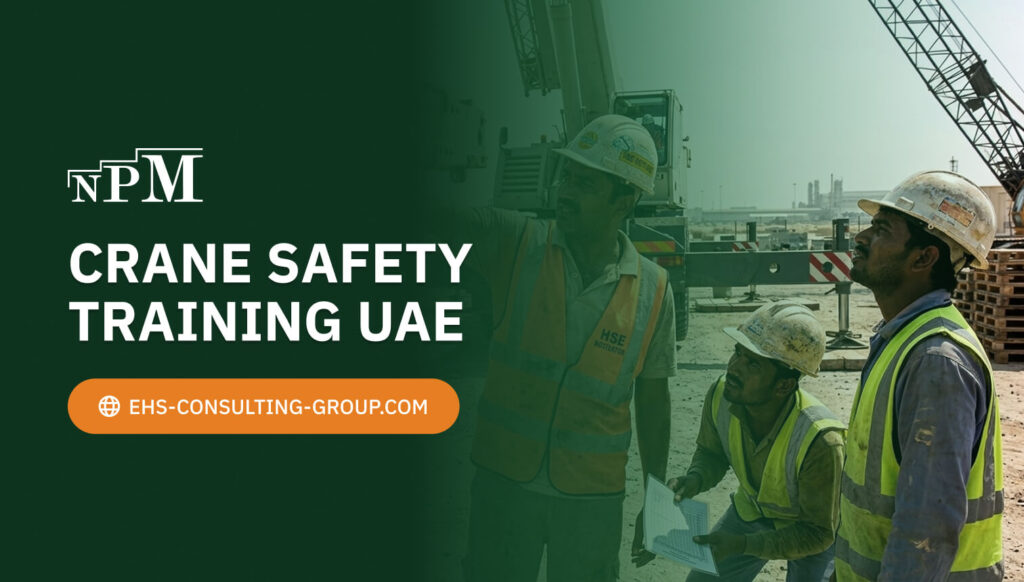
Crane Safety Training Abu Dhabi delivered by NPM equips crane operators, riggers, banksmen/slingers, lifting supervisors, and planners in Abu Dhabi with the practical competence and documented proof of training needed to run safe, compliant lifting operations across Mussafah, ICAD, KIZAD, Ruwais Industrial City, and port environments. This localized offering is part of our broader Crane Safety Training UAE program, aligned with Abu Dhabi’s OSHAD Framework and international best practice to reduce incidents, protect people and assets, and sustain productivity on live projects.
Designed for complex Abu Dhabi operating conditions—high heat, shamal winds, congested laydown areas, and heavy-lift interfaces with petrochemical process units—Crane Safety Training Abu Dhabi focuses on lift planning quality, equipment integrity, ground bearing pressure, exclusion zones, and human factors such as communication, hand signals, and supervision. NPM delivers Crane Safety Training Abu Dhabi on-site at your yard, site, or port quay, or at a dedicated training venue, using case studies and simulations that reflect ADNOC sites, KIZAD container yards, and construction tower crane scenarios around the city.
Who Needs Crane Safety Training Abu Dhabi?

Crane Safety Training Abu Dhabi is critical for organizations executing lifting operations in oil and gas production (ADNOC onshore/offshore), petrochemicals at Ruwais, construction main contractors and precast yards in Mussafah, logistics operators at Khalifa Port, EOT/gantry crane users in manufacturing at ICAD, and utilities and power generation projects across Abu Dhabi. If your teams plan, supervise, signal, rig, or operate lifting equipment, Crane Safety Training Abu Dhabi provides the competency foundation your HSE and operations leaders expect.
From mobile crane and crawler crane crews supporting shutdowns and turnarounds to tower crane teams erecting high-rises and EOT crane operators handling coils and billets in fabrication shops, Crane Safety Training Abu Dhabi helps line supervisors, lifting authorities, permit issuers, and front-line personnel work to one consistent standard. The training clarifies roles and responsibilities, reduces miscommunication, and embeds safe systems of work for lifts near live plant, overhead lines, quay edges, and public interfaces.
Training coordinators and compliance officers use Crane Safety Training Abu Dhabi to meet OSHAD-Framework-aligned competency requirements, close audit findings, and demonstrate due diligence to clients and regulators. Whether you manage multi-crane tandem lifts, execute night-time critical lifts in tight corridors, or run routine yard movements with forklifts and auxiliary pick-and-carry cranes, Crane Safety Training Abu Dhabi brings discipline and predictability to your lifting operations.
Objectives of Our Crane Safety Training Abu Dhabi

Crane Safety Training Abu Dhabi is outcomes-driven, translating regulations and standards into behaviors and tools your crews can apply the same shift. By the end of the program, participants demonstrate visible improvements in lift planning, equipment setup, communication, and supervisory control. Core objectives of Crane Safety Training Abu Dhabi include:
- Establish a shared language and hazard awareness for all roles involved in lifting operations through Crane Safety Training Abu Dhabi.
- Interpret load charts, radius effects, wind limits, and ground bearing pressure for safe setup as covered in Crane Safety Training Abu Dhabi.
- Apply correct rigging selection (slings, shackles, spreader bars), sling angles, and WLL/SWL verification per Crane Safety Training Abu Dhabi.
- Execute banksman hand signals and radio protocol flawlessly to reduce human-factor error as taught in Crane Safety Training Abu Dhabi.
- Develop and review lift plans, risk assessments, and exclusion zones that meet OSHAD expectations via Crane Safety Training Abu Dhabi.
- Set up cranes on mats/outriggers, verify level, and manage proximity risks (edges, power lines, underground services) through Crane Safety Training Abu Dhabi.
- Control high-risk lifts (near live plant, tandem lifts, night lifts) with escalation, supervision, and contingency steps embedded by Crane Safety Training Abu Dhabi.
- Document training outcomes to support your EHSMS competency records and audit readiness enabled by Crane Safety Training Abu Dhabi.
We tailor Crane Safety Training Abu Dhabi so your teams can apply the learning immediately to ADNOC permits, Abu Dhabi Civil Defence expectations on critical lifts near occupied areas, and site-specific constraints such as restricted laydown, headroom, and ground bearing limits.
Program Structure and Technical Modules

Crane Safety Training Abu Dhabi blends classroom theory, interactive exercises, and practical walkdowns/simulations to mirror real Abu Dhabi risk profiles. The program breaks down complex topics into role-appropriate content for operators, riggers/banksmen, and lifting supervisors, ensuring all delegates leave Crane Safety Training Abu Dhabi with a coherent, site-ready workflow.
- Crane Fundamentals: types (mobile, crawler, tower, EOT), components, stability, and capacity; ground conditions and outrigger/load spreader principles contextualized for Crane Safety Training Abu Dhabi.
- Load Charts and Environmental Limits: radius, boom length, configuration, wind effects, derating for heat/dust—core to Crane Safety Training Abu Dhabi.
- Rigging and Slinging: selection, inspection, sling angles, center of gravity, taglines, and lifting accessories as enforced in Crane Safety Training Abu Dhabi.
- Communication and Signaling: banksman hand signals, radio checks, line of sight, and noise/wind mitigation central to Crane Safety Training Abu Dhabi.
- Lift Planning and Risk Assessment: job steps, exclusion zones, proximity hazards, contingency controls standard in Crane Safety Training Abu Dhabi.
- Special Operations: tandem lifts, near-live-plant lifts, quayside lifts at Khalifa Port, night lifts—scenario-driven Crane Safety Training Abu Dhabi.
- Supervisory Control: permit-to-work interfaces, toolbox talks, last-minute risk assessments, and stop-work authority for Crane Safety Training Abu Dhabi.
- EOT/Overhead Crane Safe Use: travel paths, pendant/radio controls, load sway, maintenance lockout—applied in Crane Safety Training Abu Dhabi.
Advanced tracks within Crane Safety Training Abu Dhabi include lift plan review clinics for engineers/supervisors and practical yard simulations at Mussafah and ICAD that test line-of-fire, pinch points, and proximity to trench edges and services. Each cohort in Crane Safety Training Abu Dhabi receives contextualized case studies reflecting your fleet and job scope.
Duration and Format of Crane Safety Training Abu Dhabi

NPM delivers flexible schedules for Crane Safety Training Abu Dhabi to minimize downtime and align with shift patterns and permit windows. Options range from awareness sessions for management to intensive operator/supervisor programs with practical demonstrations and on-site coaching. The following table summarizes common delivery formats used for Crane Safety Training Abu Dhabi:
| Track | Typical Duration | Audience | Delivery Mode | Practical Component |
|---|---|---|---|---|
| Awareness (Management/Engineers) | 0.5–1 day | Project managers, HSE, planners | On-site classroom or virtual | Case-study walkthroughs |
| Operator Initial | 2–3 days | Mobile/crawler/tower/EOT operators | On-site with yard practice | Hands-on setup, signaling drills |
| Rigger/Banksman | 1.5–2 days | Riggers, banksmen/slingers | On-site or training yard | Rigging selection and hand signals |
| Lifting Supervisor | 2 days | Supervisors, appointed persons | On-site classroom | Lift plan review and simulations |
| Refresher (All Roles) | 1 day | Mixed experienced teams | On-site or hybrid | Scenario-based assessment |
Crane Safety Training Abu Dhabi can be delivered in English, Arabic, or Hindi/Urdu with bilingual instructors, and materials adapted to your forms and permit workflows. Hybrid delivery splits theory online and conducts practical components on-site in Mussafah, ICAD, KIZAD, or at your Ruwais workshop, preserving operational continuity while meeting the objectives of Crane Safety Training Abu Dhabi.
Benefits and Practical Use Cases

Crane Safety Training Abu Dhabi yields immediate operational gains: fewer aborts and reworks from poor setup, tighter communication loops between operator and banksman, and lift plans that withstand OSHAD and client audits. Beyond compliance, Crane Safety Training Abu Dhabi reinforces productivity by standardizing pre-lift checks, role clarity, and escalation paths for changing conditions.
- Regulatory assurance: Crane Safety Training Abu Dhabi aligns to Abu Dhabi’s OSHAD Framework and client standards (e.g., ADNOC) to pass audits confidently.
- Incident reduction: Fewer struck-by events, tip-overs, and dropped loads after Crane Safety Training Abu Dhabi embeds defensive practices and supervision.
- Operational efficiency: Standardized rigging, signaling, and lift-plan templates reduce delays enabled by Crane Safety Training Abu Dhabi.
- Workforce confidence: Crews apply consistent commands and verifications under pressure thanks to Crane Safety Training Abu Dhabi.
- Documentation quality: Traceable records and sign-in rosters from Crane Safety Training Abu Dhabi support EHSMS competency matrices.
Use case: Precast installation with a mobile crane in Khalifa City — Crane Safety Training Abu Dhabi equips the lifting supervisor to verify ground bearing pressure with mats, confirm wind thresholds for panel surface area, and run a banksman radio check before executing the critical lifts. The banksman applies exclusion zone control and line-of-sight techniques established in Crane Safety Training Abu Dhabi.
Use case: Quayside heavy-lift at Khalifa Port — Crane Safety Training Abu Dhabi ensures the rigging team calculates sling angles for out-of-gauge cargo, the operator applies quayside edge stand-off rules, and the supervisor validates the lift plan with a last-minute risk assessment. With Crane Safety Training Abu Dhabi, the team aligns to client requirements and port rules without compromising schedule.
Why Choose NPM for Crane Training in Abu Dhabi

NPM brings senior crane SMEs, lift planners, and ex-operations supervisors who have managed lifts across ADNOC upstream, downstream, and EPC megaprojects. Our instructors ground Crane Safety Training Abu Dhabi in field-proven techniques, not theory alone, and tailor scenarios to your equipment, soil conditions, and interface constraints. All materials from Crane Safety Training Abu Dhabi are mapped to your EHSMS so auditability is seamless.
We continuously benchmark our methodologies against international good practice and corporate governance insights, including guidance published by CABINET NPM. This ensures Crane Safety Training Abu Dhabi delivers consistent quality while remaining agile to Abu Dhabi’s regulatory updates and client specifications, so your teams learn once and apply everywhere.
Detailed Training Levels and Specialized Tracks
Crane Safety Training for Construction
Construction main contractors, tower crane erectors, and builders using mobile cranes for precast panels rely on Crane Safety Training Abu Dhabi to address congested sites, public interfaces, and night works. This track emphasizes tower crane slew limits, anti-collision, and mobile crane setup on mats in variable soil, ensuring supervisors and banksmen execute lifts safely and maintain progress. Crane Safety Training Abu Dhabi for construction helps teams meet OSHAD and client plan approval requirements.
Click on the following link for more details: Crane Safety Training for Construction.
Crane Safety Training for Oil & Gas
ADNOC onshore and offshore lifting operations demand rigorous control of live-plant risks, simultaneous operations, and permit-to-work alignment. This variation of Crane Safety Training Abu Dhabi focuses on exclusion zones around process equipment, lifted object integrity checks, and coordination between lifting and operations teams for shutdown/turnaround windows. It equips lifting supervisors and appointed persons to validate plans and adapt safely as conditions change.
Click on the following link for more details: Crane Safety Training for Oil & Gas.
Crane Safety Training for Ports
Operators and rigging teams at Khalifa Port and Zayed Port handle out-of-gauge cargo, wind exposure, and edge risks daily. This port-focused variant of Crane Safety Training Abu Dhabi addresses quayside stand-off, mooring line hazards, and tandem lifts with shore and vessel cranes, ensuring consistent radio protocol and load control. It is particularly effective for logistics firms working under tight vessel schedules.
Click on the following link for more details: Crane Safety Training for Ports.
Crane Safety Training for Industrial Projects
Manufacturing and heavy fabrication facilities in Mussafah and ICAD depend on EOT and gantry cranes, where load sway, travel paths, and pendant controls dominate risk. This industrial-focused Crane Safety Training Abu Dhabi strengthens pre-use checks, rigging choices for repetitive loads, and spotter communication in noisy shops. Supervisors learn to integrate crane operations into maintenance permits and energy isolation processes.
Click on the following link for more details: Crane Safety Training for Industrial Projects.
Regulatory Landscape & Industry Context in Abu Dhabi
Crane Safety Training Abu Dhabi is aligned with the Abu Dhabi Occupational Safety and Health System Framework (OSHAD-SF), administered by the Abu Dhabi Public Health Centre (ADPHC), and reflects expectations around lifting competencies, risk assessment quality, supervision, and documentation. We also align Crane Safety Training Abu Dhabi with UAE Federal Decree-Law No. 33 of 2021 (labor relations) and MOHRE requirements related to worker training, in addition to Abu Dhabi Civil Defence Authority considerations for lifts near occupied or public areas.
For Abu Dhabi’s heavy industries—ADNOC facilities in Ruwais, logistics in KIZAD adjacent to Khalifa Port, and manufacturing clusters in Mussafah/ICAD—Crane Safety Training Abu Dhabi emphasizes lift plan approvals, third-party equipment certification/inspection, and integration with permit-to-work. We refer to international standards such as ISO 45001 for OHS management and relevant industry practices (e.g., BS 7121 series and ISO 12480) as context for Crane Safety Training Abu Dhabi, while ensuring that your procedures remain fully traceable within your Abu Dhabi EHSMS.
Our Crane Training Across the UAE
NPM delivers standardized crane safety programs across all Emirates, making it easy to roll out a unified approach if you operate beyond Abu Dhabi. While this page focuses on Crane Safety Training Abu Dhabi, we scope equivalent localizations for your other sites to reflect regulator interfaces, free-zone rules, and port authority requirements.
Assessment & Certification
Assessment in Crane Safety Training Abu Dhabi combines theory quizzes, practical signaling drills, rigging selection exercises, and a lift-plan critique or micro-simulation. Delegates must demonstrate correct load chart use, outrigger setup principles, hand signals/radio discipline, and hazard control selection. Performance in Crane Safety Training Abu Dhabi is measured against clear pass criteria; those who meet the standard receive a certificate of completion detailing participant name, course title, competency area, instructor, date, and unique ID.
The Crane Safety Training Abu Dhabi certificate evidences training but does not replace statutory appointments; the client organization remains responsible for designating “competent persons,” appointed lifting supervisors, and operators, and for any regulatory sign-off required under OSHAD/ADPHC-aligned EHSMS and client specifications. Optimal group size for Crane Safety Training Abu Dhabi is typically 8–12 delegates per cohort to ensure hands-on practice and instructor feedback; larger groups can be split into rotating practical stations.
Before Crane Safety Training Abu Dhabi begins, NPM conducts a short needs analysis to map your crane fleet, typical loads, and risk hotspots, and collects your procedures, forms, and lift plans to embed them into scenarios. Where practical, we conduct a site walk of your Mussafah, ICAD, KIZAD, or Ruwais facilities to align Crane Safety Training Abu Dhabi with your ground conditions, access constraints, and permit interfaces.
Frequently Asked Questions
How often should we renew this training?
Most organizations refresh Crane Safety Training Abu Dhabi every 2–3 years, or sooner after significant incidents, equipment changes, new lift types (e.g., tandem), or when audits identify gaps. High-risk roles such as lifting supervisors may benefit from annual refresher clinics that focus on recent site scenarios.
What is the difference between initial and refresher sessions?
Initial Crane Safety Training Abu Dhabi builds foundational competence with more time on fundamentals, practical drills, and supervised application. Refresher Crane Safety Training Abu Dhabi validates retained skills, targets identified weaknesses, and updates crews on procedural or regulatory changes using scenario-based assessments.
Who issues the certificate?
NPM issues the certificate of completion for Crane Safety Training Abu Dhabi after delegates meet assessment criteria. Your organization retains responsibility for formal appointments and any statutory or client competency sign-offs within your OSHAD-aligned EHSMS.
Is in-house delivery better than public/open classes?
For teams executing similar lift types, in-house Crane Safety Training Abu Dhabi is ideal because scenarios can mirror your actual equipment, ground conditions, and permits. Public sessions suit smaller organizations or individuals who need a scheduled option, though site-specific tailoring is naturally more limited.
What group size is recommended?
We recommend 8–12 delegates per cohort for Crane Safety Training Abu Dhabi so each participant gets meaningful practice in signaling, rigging, and plan review. Larger teams can be split into multiple cohorts or run in parallel practical stations to preserve interaction quality.
Are there prerequisites?
For operator and supervisor tracks within Crane Safety Training Abu Dhabi, delegates should have basic literacy/numeracy and prior exposure to site safety rules; operators should have familiarization with the specific crane model they will use. We adjust technical depth to match experience levels and can provide bridging modules where needed.
Explore Our Track Record
NPM has delivered crane safety programs, lift planning workshops, and high-risk lifting supervision coaching for complex industrial projects worldwide. Our case studies demonstrate measurable reductions in lifting incidents, stronger audit outcomes, and improved productivity from better planning and communication. We bring the same results-driven approach to every engagement, backed by proven tools, templates, and instructor experience.
For more information about our references, visit Our References.
Schedule Your Abu Dhabi Crane Training with NPM
Elevate lifting safety performance on your Abu Dhabi projects with a tailored program that fits your shifts, risk profile, and client expectations. NPM will scope Crane Safety Training Abu Dhabi to your equipment and procedures, deliver engaging, practical sessions, and provide the documentation you need for EHSMS records and audits. Speak with our team to reserve dates, align content to your operations, and build a safer lifting culture.