
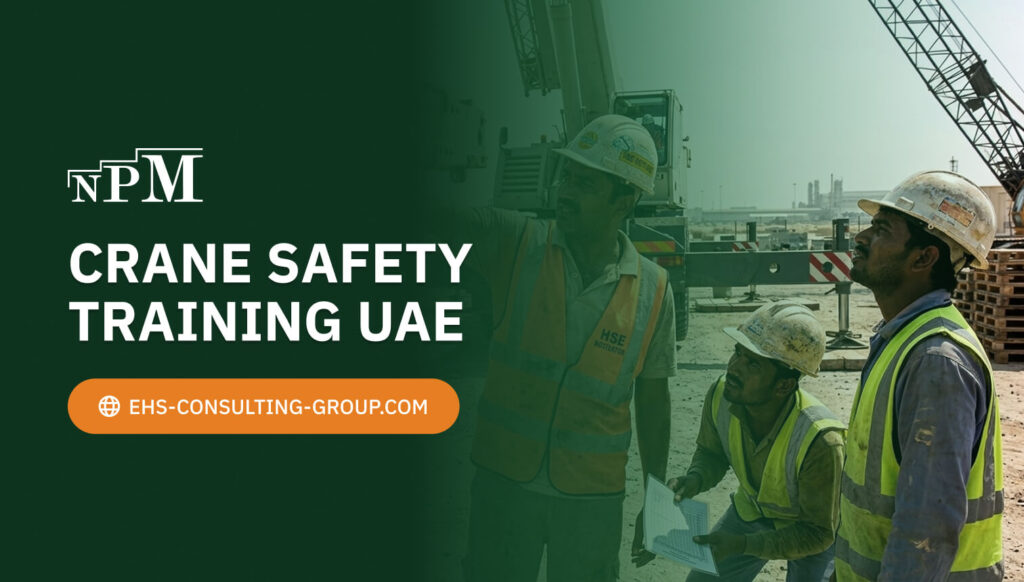
Crane Safety Training Dubai delivered by NPM equips your teams with the competence, confidence, and control to plan and execute safe lifting operations across construction sites, ports, logistics hubs, manufacturing plants, and oil & gas facilities in the emirate. This localized offering is part of our broader Crane Safety Training UAE portfolio, configured for Dubai’s regulatory environment and high-intensity industrial settings.
From lift planners and riggers to crane operators and supervisors, Crane Safety Training Dubai aligns classroom learning with high-fidelity, site-specific scenarios that mirror your operations in Jebel Ali Industrial Area, Dubai South, Dubai Investment Park, and free zones such as JAFZA and DAFZA. NPM’s trainers blend international standards with Dubai Municipality and Civil Defence expectations to ensure practical, auditable outcomes from day one.
Who Needs Crane Safety Training Dubai?

Crane Safety Training Dubai is essential for organizations operating mobile, crawler, tower, and overhead cranes across Dubai’s economy—construction megaprojects in Dubai Creek Harbour and Dubai Hills, oil & gas logistics through Jebel Ali Port, and heavy manufacturing within Dubai Industrial City (DIC) and Dubai Investment Park (DIP). HSE managers, training coordinators, and operations leaders send operators, riggers, signalers, and supervisors to this program to close competency gaps and reduce incident potential.
Crane Safety Training Dubai also supports EPC contractors, ports and terminals, 3PLs in Jebel Ali Free Zone (JAFZA), and utilities contractors working around DEWA substations, where precision lift planning and clear communications are mandatory under contractor management controls. NPM adapts scenarios to address congestion, mixed trades, night shifts, and multilingual crews common in Dubai worksites.
For organizations with mixed fleets—tower cranes on high-rises, gantry and overhead cranes in fabrication shops, and truck-mounted knuckle-booms in city logistics—Crane Safety Training Dubai provides targeted learning paths to ensure each role—from banksman to lift supervisor—can execute safe lifts, verify load paths, and document compliance properly.
Objectives of Our Crane Safety Training Dubai

Crane Safety Training Dubai helps participants translate standards and codes into disciplined site practice—recognizing hazards, reading load charts, selecting rigging, managing exclusion zones, and responding to deviations without delay. The goal is demonstrable competence measured through drills, written assessments, and supervised practicals that reflect your equipment and your site rules.
By the end of Crane Safety Training Dubai, delegates are proficient in lift planning fundamentals, roles and responsibilities, inspection and maintenance checks, hand signals and radio protocols, and emergency actions, all mapped to Dubai Civil Defence and Dubai Municipality expectations and compatible with ISO 45001-aligned HSE systems.
- Apply risk assessment and lift categorization (routine/non-routine/critical) to real Dubai job sites.
- Interpret crane load charts, boom angles, and radius effects; verify ground bearing pressure and matting.
- Select and inspect slings, shackles, hooks, and below-the-hook devices; maintain traceable rigging registers.
- Execute clear signaling and communications, including radio procedures for noisy port and construction environments.
- Establish lift zones, barricading, and spotter positions suitable for congested Dubai sites and night operations.
- Plan emergency response for near-miss, dropped load, and powerline contact scenarios under local rules.
Structured Modules and Practical Curriculum

Our training program is built around modular pathways that let you combine core foundations with role-specific tracks for operators, riggers, signalers, and supervisors. Crane Safety Training Dubai uses your procedures, PTW systems, and crane models to create realistic practicals that can be run at your yard, laydown area, or project site following a joint risk assessment.
To ensure consistency and auditability, Crane Safety Training Dubai maps each module to defined learning outcomes, assessment criteria, and logbook signoffs, providing a traceable record for contractor onboarding and refresher cycles.
| Module | Core Topics | Typical Duration | Audience | Practical Exercise |
|---|---|---|---|---|
| Lifting Fundamentals | Legislation, roles, lift categories, hazard ID | 3 hours | All delegates | Yes |
| Load Charts & Stability | Radius, boom angle, counterweights, ground pressure | 3 hours | Operators, supervisors | Yes |
| Rigging & Slinging | Slings, shackles, hooks, CoG, inspection & rejection | 4 hours | Riggers, operators | Yes |
| Communications | Hand signals, radios, emergency stops | 2 hours | Signalers, operators | Yes |
| Lift Planning | Method statements, drawings, exclusion zones | 3 hours | Supervisors, planners | Yes |
| Pre-Use Inspection | Checklists, defect reporting, lockout | 2 hours | All operators | Yes |
| Site Hazards in Dubai | Heat stress, wind, traffic interfaces, night work | 2 hours | All delegates | Scenario |
| Emergency Response | Dropped load, powerline contact, evacuation | 2 hours | All delegates | Drill |
Crane Safety Training Dubai can also integrate advanced segments on tandem lifts, barge operations, and tower crane climbing procedures for high-rise projects, ensuring supervisors have the depth to authorize and oversee complex lifts safely.
Duration and Format of Crane Safety Training Dubai

Crane Safety Training Dubai is available as 1-day awareness, 2-day operator and rigger foundations, and 3-day supervisor pathways, with blended delivery: interactive classroom, equipment walk-arounds, yard practicals, and scenario-based drills. NPM accommodates shift patterns, night work, and multilingual crews (English, Arabic, Hindi/Urdu) to minimize production impact.
For distributed teams, Crane Safety Training Dubai can bundle pre-course eLearning, remote toolbox briefings, and on-site assessments. Practical evaluations take place on the client’s cranes where feasible, enhancing relevance and post-training adoption.
- Pre-course discovery call to align objectives and select modules per role.
- Blended delivery at your Dubai facility or approved training yard, with equipment-specific practicals.
- Competency assessments (written and practical), debrief, and certification logistics.
Operational Gains and Real-World Use Cases

Crane Safety Training Dubai drives measurable reductions in near-misses, rework, and downtime by sharpening lift planning discipline, communication clarity, and rigging integrity. It also improves contractor onboarding speed, because validated competencies and standardized method statements reduce approval cycles on Dubai projects.
- Fewer stop-work events at mixed-trade construction sites through clearer zoning and signaling protocols.
- Improved time-on-hook at Jebel Ali Port and logistics yards via better pre-lift checks and ground bearing verification.
- Higher asset uptime and lower maintenance costs through improved pre-use inspections and defect reporting.
- Stronger audit readiness under client, Dubai Municipality, and Civil Defence oversight.
Why Organizations Choose NPM for Crane Training

NPM’s trainers bring deep field experience across high-risk lifts, heavy fabrication, and port operations, translating standards into practical controls your crews can sustain. Crane Safety Training Dubai from NPM is evidence-based, role-aligned, and supported by templates for lift plans, checklists, and toolbox talks that plug into your HSE system.
Our methodologies and governance are strengthened by group resources such as CABINET NPM, helping ensure that Crane Safety Training Dubai reflects current best practices, traceable documentation, and consistent delivery quality across complex, multi-site clients.
Detailed Training Levels and Specializations
Crane Safety Training for Construction
This pathway focuses on tower and mobile cranes used on high-rise and infrastructure sites, addressing wind management, tandem lifts, formwork handling, and congested urban operations. It is ideal for main contractors and specialist subcontractors who need rigorous banksman, rigger, and supervisor competencies; the practical outcome is tighter lift plans, safer rigging, and fewer stoppages. Crane Safety Training Dubai underpins this specialization with Dubai-specific procedures and site safety expectations.
Click on the following link for more details: Crane Safety Training for Construction.
Crane Safety Training for Oil & Gas
Designed for upstream, midstream, and downstream facilities and logistics, this stream emphasizes hazardous area interfaces, SIMOPS, and shore-base to offshore loadouts. Typically required for contractors operating in Jebel Ali and pipeline projects, it produces disciplined lift supervision and documentation. Many clients integrate this with Crane Safety Training Dubai to standardize contractor onboarding and permit-to-work alignment.
Click on the following link for more details: Crane Safety Training for Oil & Gas.
Crane Safety Training for Ports
Tailored to terminal operations and heavy-lift logistics, this program covers quay-side hazards, traffic choreography, communication in high-noise environments, and ground bearing near quay walls. It is typically scheduled during maintenance windows to upskill mixed crews and reduce berth delays. Operators often pair it with Crane Safety Training Dubai to ensure consistent standards across port and inland depots.
Click on the following link for more details: Crane Safety Training for Ports.
Crane Safety Training for Industrial Projects
For fabrication shops and manufacturing plants using overhead and gantry cranes, this level emphasizes pre-use inspections, sling angle calculations, and safe load travel across production lines. It is commonly required before commissioning, shutdowns, or major equipment moves, with the outcome being fewer dropped-object events and improved throughput. Integration with Crane Safety Training Dubai ensures uniform protocols for both shop and field lifts.
Click on the following link for more details: Crane Safety Training for Industrial Projects.
Regulatory Landscape & Industry Context in Dubai
Crane Safety Training Dubai is mapped to the emirate’s regulatory framework, including Dubai Municipality technical guidelines for construction safety, Dubai Civil Defence fire and life safety codes for site arrangements and emergency response, and UAE Federal Decree-Law No. 33 of 2021 (and executive regulations) governing labor and OSH obligations. For certified management systems, our content aligns with ISO 45001 and integrates seamlessly with your internal PTW and contractor management controls.
Within free zones like JAFZA, DAFZA, and Dubai South (including the Logistics District), Crane Safety Training Dubai addresses site-specific requirements, such as terminal traffic interfaces, permit gates, and equipment third-party inspection cycles. NPM calibrates training to meet client specifications commonly enforced by multinationals, EPCs, and port authorities in Jebel Ali Port and Port Rashid environments.
For industrial clusters such as Dubai Industrial City, Dubai Investment Park, and Dubai Silicone Oasis, Crane Safety Training Dubai highlights overhead crane risk controls, electrical proximity hazards, and hot climate considerations (heat stress management, wind limits), ensuring your lift plans and toolbox talks reflect Dubai’s ambient conditions and supervisory expectations.
Our Crane and Rigging Training Across the UAE
Beyond Dubai, NPM delivers cohesive crane and rigging programs across the UAE to support multi-site organizations seeking standardized competencies and documentation. If your operations span several Emirates, we coordinate scheduling, languages, and site-specific scenarios to keep delivery efficient while preserving local compliance detail.
Assessment & Certification
Crane Safety Training Dubai includes written assessments, verbal checks, and observed practical evaluations on actual or representative equipment. Participants demonstrate hazard recognition, load chart use, rigging selection, signaling, and compliance with site procedures before certification is issued.
Upon successful completion of Crane Safety Training Dubai, delegates receive a certificate of completion indicating participant name, course title, role track (operator/rigger/signal person/supervisor), modules completed, assessment results, training date and duration, and trainer signature. Where statutory or client-specific authorization is required, the client organization retains responsibility for final competency sign-off and on-the-job verification.
We recommend group sizes of 8–12 for optimal coaching during practicals. Before Crane Safety Training Dubai begins, NPM conducts a brief needs analysis and requests your procedures, sample lift plans/method statements, crane specifications, and photographs of typical lifts to craft relevant scenarios that accelerate adoption on your Dubai sites.
FAQ
How often should this training be renewed?
For most organizations, Crane Safety Training Dubai is refreshed every 2 years, with earlier refreshers triggered by incidents, new equipment, scope changes, or client/regulatory audit findings that indicate competency gaps.
What is the difference between initial and refresher sessions?
Initial Crane Safety Training Dubai builds full foundational knowledge and extensive practicals, while refreshers concentrate on updates, gap closure, and scenario drills tailored to lessons learned on your Dubai projects since the last session.
Who issues the certificate of completion?
NPM issues the certificate for Crane Safety Training Dubai upon successful assessment; where client or authority authorization is required, your organization retains responsibility for final on-the-job competency sign-off.
Should we choose in-house or public/open training?
In-house Crane Safety Training Dubai is best when you need equipment-specific practicals, proprietary procedures, and team coordination; open/public sessions suit smaller teams or individuals needing standardized fundamentals on short notice.
What group size is recommended for effective delivery?
For Crane Safety Training Dubai, 8–12 participants per class balances interaction and hands-on time during practicals, ensuring everyone receives coaching without diluting scenario realism.
Are there prerequisites for this course?
Crane Safety Training Dubai requires basic literacy and numeracy, medical fitness for field activity, and safety footwear/PPE for practicals; prior experience is helpful but not mandatory for entry-level tracks, while supervisor modules expect prior field exposure.
Explore Our Track Record
NPM has delivered complex crane and rigging training and competency programs worldwide, supporting clients across construction, oil & gas, ports, manufacturing, and logistics. Our approach combines high-fidelity scenarios, practical assessments, and robust documentation that stands up to audits and client scrutiny.
For more information about our references, visit Our References.
Reserve Your Dates and Build Competence
Crane Safety Training Dubai helps your teams lift safely, productively, and compliantly under Dubai’s regulatory expectations and demanding operating conditions. Speak with NPM to align modules to your roles, schedule on-site practicals, and standardize competency across contractors and sites.