
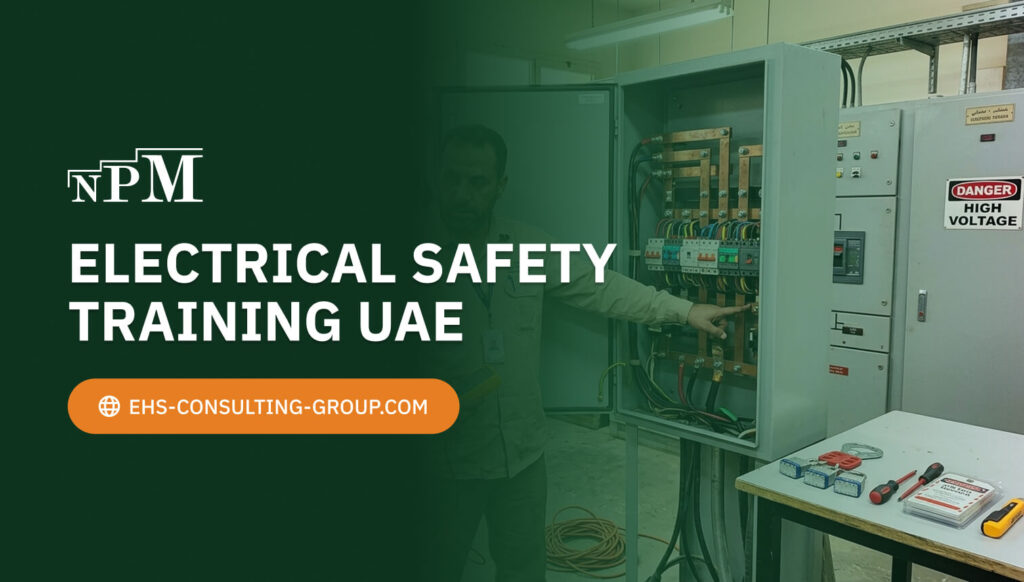
Electrical Safety Training for Construction delivered by NPM equips site teams, supervisors, and commissioning personnel to control shock, arc, and ignition risks in the fast-changing conditions of UAE construction sites. This industry-specific training blends practical demonstrations with UAE regulatory context so that mixed workforces—general operatives, electricians, MEP teams, and subcontractors—apply the right controls around temporary power, generators, overhead lines, underground services, wet environments, and energized equipment during fit-out and pre-commissioning. This construction-focused offering is part of our broader Electrical Safety Training UAE portfolio, designed to standardize electrical risk control across complex programs and multi-site contractors.
Who Needs Electrical Safety Training for Construction?

Electrical Safety Training for Construction is essential for main contractors, EPCs, and specialist subcontractors working on high-rise towers, infrastructure corridors, industrial plants, utilities interfaces, and fit-out projects across the UAE. On dynamic sites where temporary installations, distribution boards, extension leads, and generators are routinely relocated, the probability of shock, burns, and unplanned outages increases without disciplined controls. This program is designed for HSE managers, construction managers, site engineers, electrical supervisors, chargehands, QA/QC inspectors, and commissioning engineers who must verify compliance and safe energization. It is equally relevant to crane operators, MEWP/scaffold teams, excavation crews, and finishing trades who often work near live or potentially energized equipment. Electrical Safety Training for Construction recognizes multilingual crews typical of UAE projects and aligns practical instruction with real constraints such as tight pour windows, night shifts, dust, heat, and water exposure. Participants learn to evaluate risk during cable pulling, terminations, temporary lighting, testing and commissioning, and plant hook-ups; apply RCD/GFCI protection and routine inspection regimes; enforce lockout/tagout (LOTO) on site plant; respect permit-to-work boundaries; and coordinate with DEWA/ADDC/TRANSCO and Civil Defence requirements that influence temporary power and phased energization. By targeting the roles that authorize, perform, and supervise live work, Electrical Safety Training for Construction closes gaps that commonly cause delays, asset damage, and injuries during the most schedule-sensitive stages of construction.
Objectives of Our Electrical Safety Training for Construction

Electrical Safety Training for Construction has clear, measurable outcomes aligned to construction risk profiles and UAE compliance expectations. Participants learn to identify and control hazards inherent to temporary site power, generator earthing, wet environments, buried services, overhead lines, and energized testing. The program embeds decision-making frameworks for issuing or receiving permits to work, verifying isolation through test-before-touch, and selecting appropriate RCD ratings and IP protection for equipment exposed to dust and water. Importantly, Electrical Safety Training for Construction prepares supervisors to set field standards that are auditable under OSHAD Abu Dhabi and Dubai Municipality requirements, while integrating role-appropriate arc-flash awareness for LV/MV switchrooms present during fit-out and pre-commissioning. Teams leave with practical checklists, inspection routines for distribution boards and cords, escalation pathways for defective equipment, and a shared vocabulary to coordinate between main contractor and subcontractors during energization, troubleshooting, and reinstatement.
- Demonstrate hazard recognition for temporary installations, overhead/underground utilities, and wet conditions.
- Apply lockout/tagout for site plant and MEP systems; verify zero energy before work.
- Select and test RCD/GFCI protection; set inspection frequencies for leads, boards, and lighting.
- Coordinate permits to work, live work exceptions, and commissioning boundaries.
- Practice incident response to shocks, arcing, or equipment fires using site-ready protocols.
Training Program Structure and Modules

Electrical Safety Training for Construction is organized into modules that align with the lifecycle of a construction project—from excavation and superstructure to MEP installation, fit-out, and handover. We layer foundation knowledge (electrical principles, shock/arc mechanisms, and energy control) with targeted site applications including temporary LV distribution design intent, protection coordination at site boards, generator earthing/bonding, safe use of cords in wet zones, and overhead/underground service controls during lifting and excavation. Supervisors practice LOTO workflows tailored to construction plant and MEP systems, including proving de-energization, control of stored energy, and reinstatement checks. Electricians and commissioning teams receive additional depth on arc-flash awareness for LV/MV rooms, safe racking and testing practices, IR/continuity testing boundaries, and staged energization during T&C. Case studies cover typical UAE scenarios: tower crane slew near feeders, flooded basements affecting temporary boards, night-shift hot works with shared supplies, and fit-out contractors requesting temporary diversions. Electrical Safety Training for Construction also embeds practical demonstrations—RCD trip testing, cord/plug inspections, and live simulation of permit and isolation dialogues—so participants can immediately transfer learning to active workfaces.
Duration and Format of Electrical Safety Training for Construction

Electrical Safety Training for Construction is available in formats that suit construction schedules and subcontractor mobilization. For whole-site rollouts, we typically deliver a 1-day core program for mixed crews, supplemented by a 2-day practitioner option for electrical supervisors and commissioning engineers who need deeper coverage of isolation, verification, and temporary power reliability. Shorter 3–4 hour toolbox versions target a single risk theme (e.g., overhead lines, wet works, or temporary LV distribution board inspections) to support immediate site controls without disrupting production. Delivery can be on active sites—combining classroom learning with a supervised walkdown of your temporary installations—or virtual live sessions for pre-mobilization briefings. Where language diversity is high, we deploy bilingual trainers and translated materials (English/Arabic/Hindi/Urdu) to ensure comprehension across crews. Electrical Safety Training for Construction is capped to recommended group sizes to maintain interaction, scenario-based exercises, and practical demonstrations. Program options can be blended with micro-learning refreshers released at key milestones (pre-energization, fit-out commencement, night-shift ramp up) so managers reinforce the same standards throughout the project.
| Format | Typical Audience | Duration | Group Size | Delivery Mode | Primary Outcomes |
|---|---|---|---|---|---|
| Core Site Program | Mixed crews: operatives, supervisors, HSE | 1 day (6–7 hours) | 12–18 | Onsite + walkdown | Hazard control, RCD use, LOTO basics, incident response |
| Practitioner (Electrical/Commissioning) | Electrical leads, QA/QC, T&C engineers | 2 days (12–14 hours) | 8–14 | Onsite or virtual | Isolation verification, temp power reliability, arc-flash awareness |
| Focused Toolbox | Task teams (e.g., excavation, fit-out, crane ops) | 3–4 hours | 12–20 | Onsite | Target risk controls (overhead/underground, wet zones, boards) |
| Blended Refreshers | All site personnel | 15–30 min modules | Scalable | eLearning + toolbox | Reinforcement at project milestones |
Operational Benefits and On-Site Use Cases

Electrical Safety Training for Construction translates into immediate, measurable site improvements: fewer equipment-damage incidents from improper energization, consistent RCD protection and inspection outcomes across subcontractors, faster safe-to-start confirmations for wet trades, and stronger evidence for client or regulator audits. Supervisors who complete Electrical Safety Training for Construction standardize isolation and reinstatement, reducing rework and schedule slips that often occur during handovers between civil and MEP teams. Electricians adopt disciplined board labeling, cable management, and earth bonding routines that withstand heavy use, dust, and water, while general crews learn to identify and quarantine defective cords and tools before they cause harm. By aligning with ISO 45001-aligned safe systems of work, the training creates a closed-loop between risk assessment, permits, toolbox briefings, and field verification—helping construction managers prove due diligence and keep projects moving safely during critical-path activities such as pre-commissioning and fit-out energization.
- Reduce shock incidents during wet trades by mandating 30 mA RCDs and documented daily lead inspections.
- Prevent crane strikes on overhead lines with enforced exclusion zones, spotter protocols, and permit checks.
- Accelerate T&C by training teams to verify isolation, test-before-touch, and stage energization safely.
- Cut tool/equipment downtime by improving cord management, IP-rated selections, and tagging of defects.
- Strengthen audit readiness with consistent records of electrical inspections, LOTO logs, and permit traceability.
Why Choose NPM for Construction Electrical Safety

NPM designs and delivers Electrical Safety Training for Construction with a practitioner’s mindset—grounded in real UAE site conditions, supply authority interfaces, and the pressures of fast-track programs. Our trainers are construction-experienced engineers and HSE specialists who have commissioned LV/MV rooms, overseen temporary power networks, and audited subcontractor compliance under OSHAD, Dubai Municipality, and client specifications. We use your drawings, site photos, and equipment data to craft realistic scenarios, then validate controls during guided walkdowns of your actual distribution boards, cords, and generators. Electrical Safety Training for Construction from NPM includes multilingual facilitation, blended delivery, and post-training reinforcement artifacts (inspection checklists, toolbox scripts, and supervisor aids) that stick. We also maintain a technical knowledge base through CABINET NPM, ensuring our course content reflects current standards, lessons learned, and pragmatic field practices. The result is training your teams will use the same day—improving safety, uptime, and compliance without slowing production.
Related Industry-Focused Training Options
Many construction firms in the UAE operate across industrial verticals. These related offerings help your teams apply consistent standards when projects span manufacturing yards, oil and gas sites, or utility interfaces.
Electrical Safety Training for Manufacturing
Construction companies with offsite fabrication yards or joinery/steel workshops often need Electrical Safety Training for Construction complemented by manufacturing-focused controls such as machine-specific LOTO, fixed installation inspections, and EHS routines around CNC, welding bays, and compressed air systems. This is typically required when site teams rotate through workshop environments where exposure patterns differ from temporary site power. The practical outcome is seamless handoffs between workshop and site with fewer electrical incidents and better asset care.
Click on the following link for more details: Electrical Safety Training for Manufacturing.
Electrical Safety Training for Oil & Gas
EPC contractors delivering brownfield tie-ins or greenfield packages in hydrocarbons benefit from pairing Electrical Safety Training for Construction with oil and gas–specific content on hazardous areas, ignition control, SIMOPS, and permit-to-work hierarchies. This is typically required when construction crews mobilize to refineries, terminals, or upstream sites where API/NFPA references and control of hot work near process equipment govern electrical practices. The practical outcome is safer work in classified zones and fewer PTW conflicts.
Click on the following link for more details: Electrical Safety Training for Oil & Gas.
Electrical Safety Training for Utilities
Projects interfacing with substations, feeders, or district cooling plants benefit from coupling Electrical Safety Training for Construction with utilities-focused training on switching coordination, isolation boundaries, and stakeholder communications with supply authorities. This is commonly required during substation build-outs, feeder diversions, or network tie-ins where utility lockout and tagging conventions apply. The outcome is disciplined energization planning and safe, well-documented handovers.
Click on the following link for more details: Electrical Safety Training for Utilities.
Regulatory Landscape & Electrical Risks in the UAE Construction Sector
Electrical Safety Training for Construction is mapped to the UAE’s regulatory architecture and the realities of building and infrastructure delivery. In Abu Dhabi, OSHAD (Abu Dhabi Occupational Safety and Health System Framework) requires employers to implement safe systems of work, including electrical hazard controls, competency assurance, and documented inspections of temporary installations. In Dubai, Dubai Municipality’s Code of Construction Safety Practice establishes expectations for site electrical safety, while DEWA governs temporary power connections and protection arrangements; in Abu Dhabi, ADDC/TRANSCO interfaces influence temporary and permanent supplies. Civil Defence requirements intersect during fire pump testing and staged energization for life safety systems. International references—ISO 45001 for OHSMS, BS 7671 Section 704/IEC 60364-7-704 for construction and demolition sites, and NFPA 70E for electrical safety in the workplace—provide recognized good practice, with OSHA 1926 Subpart K serving as a comparative benchmark for contractor controls. Construction-specific hazards include overhead power lines near crane operations, underground service strikes during excavation, water ingress compromising temporary boards, uncontrolled use of extension leads, and ad-hoc diversions during fit-out. Electrical Safety Training for Construction addresses these with enforceable routines: RCD/GFCI selection and testing, IP-rated equipment for wet/dusty zones, bonding/earthing of generators and site structures, LOTO tailored to plant and HVAC systems, and permit-to-work clarity across multiple subcontractors. The result is operational compliance that keeps projects safe and auditable without derailing production schedules.
Our Electrical Training Across UAE Industries
NPM supports organizations that straddle multiple sectors, from high-rise and infrastructure delivery to industrial EPC and utility interfaces. We standardize electrical risk controls and competency across environments so your teams apply consistent practices regardless of the site they mobilize to.
Assessment & Certification
Electrical Safety Training for Construction includes multi-modal assessment so participants prove competency against construction realities, not just classroom theory. Delegates complete a pre- and post-course knowledge check to quantify learning gains, then work through scenario-based exercises drawn from your site risks (e.g., energizing a temporary LV board in a flooded basement, managing crane movements under overhead lines, or isolating an AHU for maintenance during fit-out). Electricians and supervisors demonstrate practical skills such as inspecting cords and boards, confirming RCD ratings and trip tests, applying LOTO and test-before-touch, and documenting reinstatement. Participants who successfully complete Electrical Safety Training for Construction receive an NPM certificate of completion detailing the course title, industry focus, learning hours, competency elements covered, date, trainer signature, and a unique verification ID. Where statutory or client-specific sign-off is required, your organization remains responsible for workplace authorization and competency designation; our assessments and records provide robust evidence to support that process. We recommend group sizes of 8–16 for practitioner cohorts and 12–18 for mixed-crew awareness, which preserves interaction and practical demonstration time. Before delivery, NPM conducts a short needs analysis to define target roles, languages, and critical site scenarios, and we request relevant drawings, single-line diagrams, site photos, and any existing temporary power standards to tailor Electrical Safety Training for Construction to your project.
Frequently Asked Questions
How often should construction crews renew this training?
For most projects, Electrical Safety Training for Construction should be renewed every 24 months, with targeted refreshers aligned to key milestones such as pre-commissioning or seasonal wet-weather risks. Re-training is also triggered by serious incidents, changes to temporary power configurations, major scope shifts, or onboarding of new subcontractor teams.
What is the difference between initial and refresher sessions?
Initial Electrical Safety Training for Construction establishes foundational knowledge, practical demonstrations, and role-specific drills, while refresher sessions focus on performance gaps observed on your site, changes in temporary installations, and reinforcement of critical behaviors like RCD testing and LOTO verification. Refreshers are shorter, scenario-heavy, and mapped to your current phase (e.g., fit-out or T&C).
Who issues the certificate of completion?
NPM issues the certificate for Electrical Safety Training for Construction, including learning outcomes and hours completed. Where your client or regulator requires formal workplace authorization, your organization remains responsible for competency sign-off and permits-to-work privileges.
Is in-house training better than public/open sessions?
For dynamic construction environments, in-house delivery of Electrical Safety Training for Construction is preferred because we can incorporate your drawings, temporary power layouts, and actual site photos into exercises, and conduct walkdowns. Open/public sessions are useful for pre-mobilization or when sending a small number of supervisors who need a baseline ahead of site-specific induction.
What group sizes work best?
Electrical Safety Training for Construction achieves the best outcomes with 12–18 participants for mixed crews and 8–16 for electrical/commissioning practitioners. These sizes allow hands-on inspections, RCD test demonstrations, and realistic permit/LOTO role-plays without losing engagement.
Are there prerequisites for attending?
No formal prerequisites are required for awareness-level Electrical Safety Training for Construction. For practitioner cohorts (electrical leads, QA/QC, commissioning), basic familiarity with site temporary power, distribution boards, and permits-to-work is recommended, and bringing recent drawings or photos improves relevance.
Can this be delivered to multi-site or JV projects?
Yes. Electrical Safety Training for Construction can be delivered in a hybrid format across multi-site or joint-venture projects: virtual sessions for baseline knowledge, followed by rotating onsite modules and walkdowns on priority sites. We coordinate schedules with your construction managers to minimize disruption.
What materials do we need to provide before training?
Before Electrical Safety Training for Construction, please share site layouts, temporary power single-line diagrams, equipment specs for generators/boards/RCDs, relevant PTW templates, and any incident learnings. This allows us to create realistic scenarios and checklists that fit your site conditions.
Explore Our Track Record
NPM has delivered electrical safety, commissioning readiness, and construction risk programs for complex building and infrastructure projects worldwide, from high-rise and rail to industrial EPC interfaces. Our references highlight measurable reductions in electrical incidents, improved energization planning, and stronger audit outcomes through competency-based training and practical site walkdowns.
For more information about our references, visit Our References.
Speak with Our Training Team
Elevate electrical risk control on your projects with Electrical Safety Training for Construction tailored to your drawings, equipment, and work phases. NPM will help you select the right format, align delivery to site schedules, and build evidence of competency your clients trust. Reserve your session or request a scoped proposal today.