
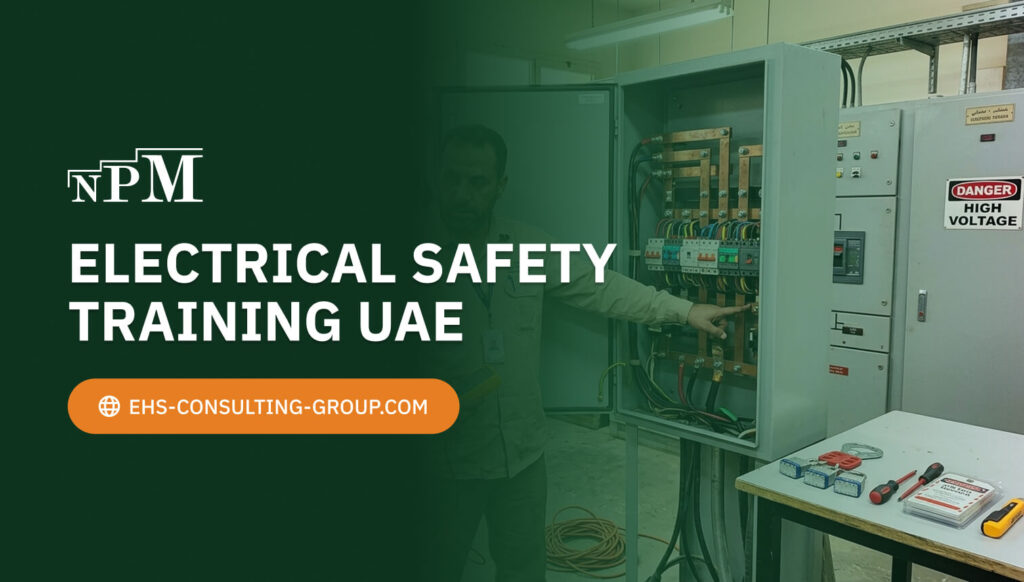
Electrical Safety Training for Industrial Facility teams is a foundational control for preventing shocks, arc flash injuries, and electrical fires across high-risk sectors such as oil and gas, petrochemical, power generation, construction, manufacturing, and logistics in the UAE. While robust engineering and protective devices are essential, competence at the point of work—where a technician isolates a motor control center, an operator resets a tripped breaker, or a contractor connects temporary power—often determines whether a task is completed safely. This article examines what comprehensive electrical safety learning should cover, how it fits into the wider HSE and process safety system, and how leaders can make it practical and effective without turning it into a checklist exercise.
Who Does This Affect?

Electrical hazards exist in every industrial environment that generates, distributes, stores, or uses electricity—even those that consider themselves “mechanical” or “process” driven. As such, the people who benefit most from structured competence development extend beyond the maintenance department. The following groups typically carry risk exposure and therefore require role-appropriate knowledge and behaviors:
- Operations personnel who interact with control panels, emergency stops, and routine resets on automated lines.
- Electrical and instrumentation technicians who perform isolation, testing, troubleshooting, and reinstatement tasks.
- Supervisors and permit-to-work (PTW) issuers who authorize energized work and manage concurrent activities.
- Contractors involved in shutdowns/turnarounds, temporary power distribution, or installation of switchgear and cable trays.
- Process engineers and safety engineers who perform risk assessments, specify safeguards, and interface with HAZOP/LOPA findings.
- Warehouse and logistics staff dealing with battery charging rooms, forklifts, dock equipment, and UPS systems.
- Construction teams managing tower cranes, hoists, site gensets, and temporary site distribution boards.
- HSE professionals responsible for competency frameworks under ISO 45001 and internal governance, aligning with UAE regulatory requirements.
In the UAE, facility owners and operators must ensure competency under frameworks such as OSHAD-SF (in Abu Dhabi), local Emirate-level HSE requirements (e.g., Dubai Municipality), Civil Defence expectations, MOHRE obligations, and sector-specific standards such as ADNOC HSE requirements. Recognizing who is affected helps target learning content so that it is relevant to actual tasks and real risk.
Why This Matters

Electrical work and interactions are unforgiving: a misjudged test, a missing lock, or a poor assumption about circuit status can lead to fatal outcomes. The stakes are magnified where flammable atmospheres may be present—refineries, gas compression stations, petrochemical units, paint lines, solvent storage areas—because ignition risks extend beyond personal injury to process-level consequences. Understanding the discipline’s core principles is essential for safeguarding people and continuity of operations.
From a governance perspective, electrical competence supports compliance with recognized standards and expectations. NFPA 70E offers a framework for safe work practices around electrical hazards; IEC standards (e.g., IEC 60364 for low-voltage installations; IEC 61439 for low-voltage switchgear; IEC 60079 for electrical equipment in explosive atmospheres) guide design and maintenance; IEEE 1584 informs arc flash calculations; and ISO 45001 requires organizations to manage worker competence as a central pillar of their occupational safety management system. In the UAE, regulators and authorities having jurisdiction may review training records, PTW systems, energy isolation procedures, and incident learning as evidence that an employer exercises due diligence. Getting this right is not optional; it is an operational necessity.
Key Points to Understand

Before translating principles into practice, it helps to clarify the technical foundations, administrative frameworks, and human factors involved. The following points form a cohesive map of what thorough electrical safety learning should embed throughout an industrial organization.
1) Hazard recognition beyond “electricity”
Electrical danger is not singular; it includes shock, arc flash, arc blast, thermal burns, and secondary injuries (falls, startle reflex). The nature of exposure varies with system voltage, available fault current, protective device characteristics, and physical environment. In facilities with hazardous areas, static discharge and equipment selection per IEC 60079 also matter. Recognizing this taxonomy helps align specific controls—insulation, barriers, labeling, PPE, test-before-touch, and task authorization—rather than relying on generic “electrical safety” messages.
2) Safe work concepts that anchor practice
Core concepts should be second nature for all personnel who may interact with live or potentially live parts:
- De-energize whenever practical, then verify absence of voltage with proven instruments and methods.
- Apply lockout/tagout (LOTO) with uniquely keyed locks, documented isolation points, and zero-energy verification.
- Use energized work permits only when justified by risk and necessity, subject to defined approvals.
- Establish approach boundaries and guard against induced or stored energy (e.g., capacitors, VFD DC bus, UPS systems).
- Maintain equipment labeling and single-line diagrams to support informed decision-making at the panel.
3) Standards, codes, and local compliance
NFPA 70E provides a widely referenced approach for work practices around electrical hazards, while IEC and IEEE standards inform the underlying engineering data. In UAE industrial settings, organizations also align with OSHAD-SF and ADNOC HSE expectations where applicable, and follow local authority guidance from Dubai Municipality and Civil Defence. A coherent training program explains how these references connect to site-specific procedures, such as the PTW system, LOTO policy, and emergency response plan.
4) Arc flash fundamentals and labeling
Where arc flash hazards exist—common around switchgear, MCCs, large transformers, and high-capacity bus ducts—understanding the basics of incident energy, arc duration, clearing times, and working distance is crucial. Practical learning emphasizes:
- Interpreting arc flash labels for PPE category, incident energy, and boundary distance.
- Selecting PPE and tools compatible with the predicted exposure.
- Controlling human error: body position, hand placement, and the discipline of securing enclosures.
- Housekeeping to minimize conductive dust and debris that exacerbate arc initiation.
5) Electrical equipment in hazardous areas
Hazardous area classification and equipment protection concepts (Ex d, Ex e, Ex i, etc.) link directly to ignition prevention. Personnel need to understand why substitutions and “temporary fixes” can defeat equipment certification, and how inspection and maintenance per IEC 60079 should be supported by competent persons. This becomes especially important in oil and gas and petrochemical facilities with extensive classified zones.
6) Integration with HAZOP, LOPA, and PTW
Process safety and electrical safety intersect. Findings from HAZOP or LOPA often influence safeguards connected to electrical control and protection systems (e.g., emergency shutdown circuitry, interlocks, isolation valves). Learning should help engineers, supervisors, and technicians interpret these links in day-to-day decisions—especially during bypass, override, or maintenance activities governed by the PTW system.
7) Documentation, evidence, and governance
Competency cannot be assumed; it must be demonstrated and maintained. Training records, assessments, authorization matrices, and refresher triggers all form part of the evidence set expected by auditors and authorities. Organizations increasingly centralize this evidence so it is controlled, accessible, and secure. As one example of record governance in industrial environments, some organizations adopt digital document control solutions such as CABINET NPM to manage controlled procedures, permits, and competency records. Regardless of the platform, a “single source of truth” that integrates training documents, authorization levels, and PTW artifacts strengthens compliance and operational consistency.
8) Role-based authorization and refreshers
Not everyone needs the same depth. Operators may require awareness of what not to touch, when to escalate, and how to respond to alarms. Authorized persons and senior technicians need deeper knowledge of calculations, testing methods, and switching sequences. Supervisors and PTW coordinators require clarity on approvals, justifications for energized work, and concurrent-scope risk controls. A role-based matrix brings this to life.
| Role | Core Competencies | Typical Hazards Encountered | Indicative Refresher Trigger |
|---|---|---|---|
| Operator | Panel awareness, E-stop use, basic fault escalation, housekeeping | Incidental contact, tripped circuits, nuisance resets | Every 24 months or after plant modification |
| Electrical Technician | LOTO, test-before-touch, meter use, arc flash PPE, switching checks | Shock, arc flash, induced energy, stored energy | Every 12–24 months or after incident/near miss |
| Permit Issuer/Receiver | PTW authorization, energized work permits, coordination of concurrent tasks | Conflicting scopes, inadequate isolation verification | Annually or with PTW system changes |
| Contractor Electrician | Site-specific rules, temporary power, hazardous area awareness | Unfamiliar systems, improvised connections | Per mobilization or major scope change |
| HSE/Process Engineer | Risk assessment, HAZOP/LOPA linkages, incident learning integration | Systemic/control failures, ignition risks | Every 24 months or after significant update to standards |
How This Works in Practice

Translating principles into consistent behaviors requires integration into existing processes rather than bolting on a separate “training initiative.” A practical approach begins with understanding the electrical risk profile of the facility. Leaders review single-line diagrams, arc flash studies where available, incident and near-miss history, and the status of labeling and isolation registers. From there, a job task analysis identifies where human performance makes the most difference—such as verifying voltage absence on MCC buckets, commissioning VFD cabinets, racking breakers, or energizing freshly installed cables.
Next, competence expectations are embedded into the permit-to-work and isolation processes. For example, a permit template might include an authorization check—only those endorsed for energized testing can perform it, with the correct PPE and tools. Isolation procedures incorporate independent verification steps and clear tagging protocols, consistent with site policy. Supervisors and PTW coordinators check for concurrent activities (e.g., hot work adjacent to temporary power) that could elevate risk. This alignment ensures that learning is constantly reinforced through routine approvals and verifications.
In oil and gas and petrochemical plants, integration extends to hazardous area considerations. Work planning must confirm equipment certification, gas testing requirements, and ignition source controls. Operations and maintenance leaders ensure that bypasses or overrides on safety-related systems are authorized and time-bound, reflecting HAZOP/LOPA intent. Where an IEC 61511-compliant safety instrumented system is present, technicians understand boundaries: what can be tested live, how proof testing affects process availability, and when to escalate.
For construction and temporary power scenarios, focus shifts to distribution board integrity, RCD/RCBO testing, cable management, and weatherproofing. Turnarounds and shutdowns require additional rigor in contractor management, tool control, and coordination of multiple high-energy tasks. Warehouse and logistics operations refine battery room procedures: ventilation, hydrogen monitoring, eyewash availability, and proper handling of chargers and leads. Power generation and desalination plants implement strict switching checks, communication protocols, and live switching competencies for HV yards and substations.
Finally, competence must be sustained. Refresher topics are integrated into toolbox talks, shift handovers, and incident reviews. Learning from internal and external events—especially near misses where a barrier failed—feeds into micro-modules that keep knowledge active. Documentation is periodically audited to verify that authorization levels reflect current capability and that updates to standards or local authority expectations are cascaded.
Benefits and Practical Use Cases

When electrical safety knowledge is well-embedded, the benefits are visible in both safety performance and operational stability. The outcomes are not abstract—they show up in fewer line stoppages from improper resets, more efficient maintenance planning, and lower incident potential around energized work.
- Reduced exposure: Clear understanding of de-energization and test-before-touch cuts the likelihood of shock and arc flash events.
- Better decision-making: Supervisors distinguish between tasks that can and cannot proceed under PTW, limiting unjustified live work.
- Stronger contractor control: Contractors mobilize with precise site-specific rules, reducing the tendency to improvise temporary connections.
- Improved asset reliability: Correct switching sequences and verified terminations reduce nuisance trips and premature equipment failures.
- Regulatory confidence: Authorities and clients see robust evidence of competence under ISO 45001 and local requirements—cleaner audits and simpler approvals.
Consider several concrete use cases:
- Refinery MCC maintenance: Technicians execute a planned isolation with two-person verification, test for absence of voltage, and reinstall with torque-verified connections, preventing a latent fault that would have triggered an arc upon re-energization.
- Logistics battery room: Operators follow ventilation checks, correct PPE, and proper lead handling; hydrogen alarms are tested and documented; a potential ignition source is identified and removed during a pre-task briefing.
- Construction temporary power: Distribution boards are inspected for IP rating and RCD functionality; cable routing avoids pinch points and water ingress; non-compliant adapters are confiscated at the tool crib.
- Power plant HV switching: A trained authorized person employs detailed switching plans, lock sequence control, and independent verification, avoiding an out-of-sequence energization that could damage transformers.
- Petrochemical Ex maintenance: A technician refuses to fit a non-certified gland in a Zone 2 area, escalating for the correct Ex component—averting a future ignition hazard.
Best Practices and Points of Caution

Consistency is achieved when good practice is institutionalized. The following considerations help sustain high standards and avoid common pitfalls:
- Use job task analysis to keep content relevant. Tailor learning to the equipment and scenarios workers actually face—MCCs, VFDs, UPS, switchyards, and Ex equipment—rather than generic slides.
- Emphasize verification. Build “test-before-touch” into muscle memory, with proven test instruments and procedures that include instrument self-checks.
- Anchor energized work to explicit justification. Energized work permits should be rare, risk-justified, and approved at the right level—no informal exceptions.
- Integrate arc flash data with labeling. Ensure labels reflect current system studies; refresh after protective settings, equipment upgrades, or reconfigurations.
- Manage contractors through pre-mobilization briefings and competency checks. Demand evidence of training and align them to your PTW, LOTO, and Ex maintenance rules.
- Support multilingual comprehension. In multicultural teams, use bilingual visuals and demonstrations to ensure critical points are internalized, not just heard.
- Audit documentation and authorizations. Periodically confirm that people doing the work hold current authorization and that records align with reality on the shop floor.
- Bridge process safety and electrical safety. When safety-related systems or bypasses are involved, connect HAZOP/LOPA intent to work controls so nothing critical is inadvertently defeated.
- Reinforce via operational routines. Toolbox talks, shift handover notes, and post-incident debriefs keep learning alive and adaptive.
Frequently Asked Questions About Electrical Safety in Industrial Facilities
How often should industrial personnel refresh their electrical safety knowledge?
Refresher frequency should reflect risk exposure, regulatory expectations, and change. Many facilities adopt a 12–24 month cycle for those working directly with electrical systems, with earlier refreshers triggered by incidents, plant modifications, or updates to standards, PTW, and LOTO policies. Awareness-level roles often follow a two-year cycle, reinforced through routine toolbox talks.
Is arc flash labeling required in the UAE?
Requirements can vary based on the authority having jurisdiction and corporate standards. Many UAE industrial operators adopt arc flash labeling as good practice aligned with international references like NFPA 70E and IEEE 1584, particularly in facilities with significant fault levels. Labels should be maintained to reflect current system configurations and protective device settings.
What is the difference between LOTO and an energized work permit?
LOTO is the default method for achieving a de-energized, zero-energy state before work proceeds. An energized work permit is an exception process allowing limited tasks on or near energized equipment when de-energizing is infeasible and risk-justified. Energized work requires higher authorization, defined controls, and specific PPE aligned to the hazard.
Do contractors need separate site-specific induction for electrical safety?
Yes. Even competent contractors must align with the host facility’s PTW, LOTO, and hazardous area procedures. A site-specific briefing clarifies isolation points, labeling conventions, authorization levels, and any additional local requirements (e.g., ADNOC expectations, OSHAD alignment, Civil Defence concerns). Evidence of contractor competency should be reviewed before access is granted.
How do hazardous areas change electrical work planning?
Hazardous areas introduce ignition risks. Equipment certification (per IEC 60079), suitable work permits, gas testing, and control of potential ignition sources become central. Even small deviations—like using non-certified components or leaving enclosures open—can undermine protective concepts. Competent inspection and maintenance are essential.
What documentation do auditors typically ask for?
Auditors often review the LOTO policy, PTW procedures, authorization matrices, training records with dates and scope, evidence of competence assessment, arc flash studies and labels (where applicable), single-line diagrams, and incident/near-miss learning evidence. They also check that documents are current, controlled, and consistently applied on the floor.
Is simulated or scenario-based learning useful for electrical safety?
Yes. Scenario-based exercises help internalize decisions under pressure—such as responding to an unexpected voltage presence, dealing with concurrent tasks, or preparing to rack a breaker. Simulations, whether tabletop or digital, are particularly valuable for supervisors and authorized persons who must apply judgment in real time.
How does ISO 45001 relate to electrical safety competence?
ISO 45001 requires organizations to ensure workers are competent on the basis of education, training, or experience, and to retain appropriate documented information. Electrical safety knowledge, authorization to perform certain tasks, and refresher controls should be part of the organization’s integrated OHS management system.
Conclusion
Electrical safety is not a narrow technical specialty reserved for a few experts; it is an everyday discipline practiced by operators, technicians, supervisors, and contractors. As explored above—spanning hazard recognition, LOTO, energized work permits, arc flash labeling, hazardous area controls, and the integration with PTW and process safety—effective learning aligns with real tasks and the organization’s governance framework. When a site anchors expectations in standards such as NFPA 70E, relevant IEC/IEEE references, and UAE regulatory requirements, and then reinforces them through documentation and authorization discipline, the result is fewer surprises and stronger operational control. Electrical Safety Training for Industrial Facility teams, when built around role-based risk and continuous reinforcement, enables people to make the right decision at the right moment—especially when the system leaves no margin for error.
To go further on this topic, NPM’s broader Electrical Safety Training UAE page covers this in more depth.
Explore NPM’s References
NPM’s experience with electrical safety and broader HSE, process safety, and regulatory compliance spans complex industrial environments worldwide. Our teams have supported operating assets and capital projects where electrical risks and process hazards intersect—refineries with extensive MCC infrastructure, petrochemical plants managing Ex-certified equipment, power generation facilities with HV yards and substations, construction programs deploying robust temporary power, and logistics operations with battery charging rooms and automated storage systems. Across these contexts, NPM has worked with leadership and front-line teams to align safe work practices with organizational governance, ensuring that what is expected on paper can be executed reliably in the field. The references we share illustrate how role-based competence, clear authorization, and disciplined PTW/LOTO systems translate into day-to-day resilience. They also demonstrate an ability to integrate learning with engineering changes, standards updates, and incident learning, so that knowledge keeps pace with evolving risks. For decision-makers and practitioners who want to understand how others have embedded electrical safety as part of a living management system—not as a one-off activity—our portfolio offers practical, real-world examples that can inform your own approach and accelerate implementation while avoiding common pitfalls.
For more information about our references, visit Our References.
Speak With NPM
If you would like to explore how these principles apply to your facility, NPM is available to discuss practical steps and considerations. We welcome questions from HSE leaders, plant managers, and technical teams seeking to strengthen electrical safety as part of everyday operations.
For any further questions or to speak with our team, Contact Us.