
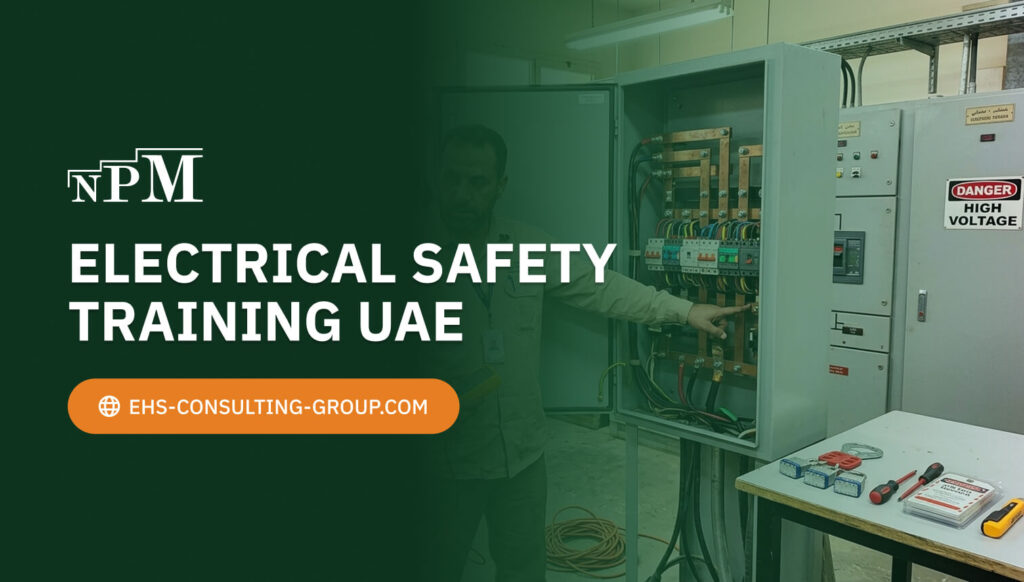
Electrical Safety Training for Manufacturing equips your production, maintenance, and contractor teams to recognize, control, and work safely around energized systems across assembly lines, CNC cells, robotics, conveyors, MCCs, and LV/MV distribution within fast-paced factories in the UAE. Delivered by NPM, this training focuses on practical, plant-floor application—lockout/tagout (LOTO), arc-flash risk controls, safe testing practices, and coordination with Permit-to-Work (PTW) and maintenance routines—tailored to discrete and process manufacturers alike. This industry-specific offering is part of our broader Electrical Safety Training UAE portfolio, developed to align with UAE regulatory expectations and leading international standards while fitting real shift schedules, changeovers, and production pressures.
Who Needs Electrical Safety Training for Manufacturing?

Manufacturing facilities depend on complex electrical systems—from machine control panels and distributed I/O to motor control centers, VFDs/soft starters, and high-energy process equipment—that can create serious shock, arc-flash, and fire risks if not managed competently. Who needs Electrical Safety Training for Manufacturing? Anyone who may interact with this equipment directly or indirectly: in-house electricians, E&I technicians, maintenance supervisors, mechanical and process technicians who perform isolations, controls/automation engineers, reliability engineers, production supervisors authorizing PTW, facilities teams responsible for utilities (compressors, chillers, boilers), and contractor supervisors working on installations, upgrades, or shutdowns. Participants also include safety officers and HSE managers who must verify competence, audit LOTO execution, and interpret arc-flash labels. The training is particularly critical for UAE manufacturing operations such as food and beverage plants with high-speed packaging lines, metal fabrication and machining shops with CNC clusters, plastic extrusion and injection molding with electrically heated zones, cement and glass works with MV distribution, and pharmaceutical/consumer goods facilities where GMP and EHS requirements intersect. Electrical Safety Training for Manufacturing helps each role understand safe boundaries (limited, instructed, qualified persons), apply test-before-touch and prove-dead procedures, select appropriate PPE based on hazard and task, and coordinate isolations with production to reduce downtime and incident risk without compromising throughput or product quality.
- Manufacturing electricians, E&I technicians, and controls/automation engineers who troubleshoot live circuits
- Maintenance, production, and facilities supervisors approving isolations and energization steps
- Operators working around conveyors, robotics, heated equipment, and automated cells
- Contractors and project teams performing installation, commissioning, or shutdown/turnaround work
- HSE managers and compliance officers overseeing PTW, LOTO audits, and regulatory inspections
Objectives of Our Electrical Safety Training for Manufacturing

Manufacturing environments combine rapid task cycles, frequent changeovers, and dense electrical controls in close proximity to operators—demanding a disciplined approach to hazard recognition and isolation. The objectives of our Electrical Safety Training for Manufacturing are to build demonstrable competency in shock and arc-flash risk assessment, safe isolation/LOTO, and energized testing practices specifically for machine-centric and line-based operations. Delegates learn to differentiate between machine electrical hazards (e.g., 24 VDC control vs. 480/400 VAC power), understand stored energy in drives and capacitors, recognize arc-flash boundary signage and labeling, and apply appropriate PPE per risk and task. We emphasize reliable LOTO for complex equipment with multiple feeds (e.g., main supply, control circuit, pneumatic/hydraulic interfacing), and how to plan isolations that minimize production impact. The program aligns with UAE regulatory frameworks while referencing NFPA 70E, IEC 60364, IEC 60204-1 (machinery electrical safety), and IEC 61482 (arc-rated PPE). Participants also practice practical diagnostics under supervision: verifying absence of voltage, confirming correct test instrument function, and documenting PTW steps to a defendable standard. The result is a safer, more efficient plant where maintenance and operations teams can resolve faults faster, avoid near misses, and pass audits with confidence.
- Recognize shock, arc-flash, and electrical fire hazards around manufacturing equipment and distribution systems
- Perform task-based risk assessments and select PPE appropriately, including arc-rated clothing and face shields
- Execute LOTO for single- and multi-source machinery, including verification, residual energy control, and group lockout
- Plan and complete safe energized diagnostic tasks using the test-before-touch principle
- Interpret arc-flash labels and boundaries, and integrate controls into PTW and SOPs
- Document isolations and restorations to meet UAE regulator expectations and internal EHS audits
Structured Curriculum and Manufacturing-Specific Modules

Our curriculum is engineered around the realities of manufacturing: tight turnaround windows, multi-discipline teams, and equipment ranging from legacy relay logic to modern safety PLCs and collaborative robots. Electrical Safety Training for Manufacturing uses scenarios drawn from packaging lines, CNC machining cells, injection molding, furnaces, HVAC and utilities, and high-bay warehouses with automated storage and retrieval systems. Delegates progress from fundamental hazard principles to applied isolation and energized testing techniques, reinforced by real equipment case studies and documentation workflows. We tailor examples to your machines and distribution (MCC line-ups, LV/MV panels, UPS and generator interfacing) and, where feasible, incorporate line walkdowns to bridge classroom concepts with shopfloor practice. The program balances regulatory alignment (OSHAD in Abu Dhabi, Dubai Municipality guidance, Ministry of Human Resources and Emiratisation requirements, and Civil Defence expectations for fire prevention) with international standards (IEC 60204-1 for machinery safety, IEC 61482 for arc-rated PPE, IEC 60364 for LV installations, ISO 45001 for safety management). Emphasis is placed on preventing common high-potential events: bypassed interlocks during troubleshooting, uncontrolled startup after maintenance, inadequate verification of isolation on multi-feed equipment, improper test instrument use, and poor coordination between contractors and operations during projects and turnarounds. By the end, participants can confidently isolate, test, and return equipment to service with full documentation, preserving safety and uptime.
Foundations: Electrical Hazards, Boundaries, and PPE
This module grounds participants in shock and arc-flash mechanisms, approach boundaries, equipment labeling, and PPE selection per task. To anchor Electrical Safety Training for Manufacturing in daily reality, we discuss how arc energy scales with fault current in typical UAE factory LV systems and how boundaries change near MCCs, bus ducts, and large motors. Delegates learn to read arc-flash labels, identify limited/restricted approach limits, and select PPE by exposure category.
Lockout/Tagout and Verification for Complex Machinery
Here we apply systematic LOTO to machines with multiple energy sources and feeds: main supplies, control power, VFD DC bus, pneumatics/hydraulics, and potential backfeed through interlocks. Electrical Safety Training for Manufacturing demonstrates step-by-step verification, group lockout control, and restoration sequencing to avoid mechanical runaways or trapped energy releases after re-energization.
Energized Diagnostics and Test-Before-Touch
Delegates practice establishing safe work areas, proving instruments on known sources, and confirming absence of voltage on control and power circuits. We contextualize Electrical Safety Training for Manufacturing with examples like diagnosing a failed VFD in a packaging line or validating power at a CNC spindle drive, emphasizing documentation that stands up to internal and external audits.
Contractor Interface, PTW, and Project Work
This module strengthens coordination between in-house teams and contractors during installation, expansion, or shutdown work. We integrate isolation plans into PTW, define roles and sign-offs, and address temporary power, cable pulls, and pre-energization checks. While not duplicating construction protocols, the content complements Electrical Safety Training for Manufacturing by clarifying boundaries when production continues alongside project activities.
Duration and Format of Electrical Safety Training for Manufacturing

Recognizing shift patterns, peak production windows, and maintenance turnarounds, we structure Electrical Safety Training for Manufacturing in formats that minimize disruption while maximizing hands-on learning. Options range from concise awareness sessions to immersive practitioner pathways. A typical delivery blends classroom instruction, equipment-focused case studies, and, when permitted, shopfloor walkdowns and controlled demonstrations. English delivery is standard, with Arabic, Hindi, or Urdu support available upon request. For multi-shift facilities, we schedule repeated sessions to reach all crews without overtime impacts, and for multi-site manufacturers, we can standardize content while customizing plant-specific modules and examples. We also offer a blended model: short pre-work microlearning to align terminology, followed by on-site practicals and scenario-based assessments using your equipment schematics and LOTO procedures. All materials—slides, checklists, LOTO templates, and attendance records—are provided in digital format to streamline your LMS or document control. Electrical Safety Training for Manufacturing is equally effective for in-house cohorts and cross-plant groups, and we recommend capping practical groups to ensure everyone performs verifications and instrument checks under trainer supervision.
| Track | Audience | Duration | Format | Recommended Max Group |
|---|---|---|---|---|
| Awareness | Operators, supervisors, non-electrical staff | 4–6 hours | Classroom + demonstrations | 20 |
| Practitioner | Electricians, E&I techs, maintenance teams | 1–2 days | Classroom + hands-on + walkdown | 12 |
| Authorized Person (Site-Specific) | Permit issuers, isolation authorities | 1 day | Workshop + simulations | 10 |
| Refresher/Update | Previously trained staff | 3–4 hours | Focused updates + case reviews | 20 |
For large UAE manufacturing campuses, Electrical Safety Training for Manufacturing can be staged over a week to cover shifts, or delivered in a hybrid format to reduce seat time while preserving hands-on verification of isolation, measurement, and documentation skills.
Operational Benefits and Use Cases in Manufacturing Plants

Electrical Safety Training for Manufacturing directly reduces risk and improves throughput by standardizing how your teams plan, isolate, verify, and return equipment to service. Fewer near misses in MCC rooms, clearer PPE usage around energized diagnostics, and consistent LOTO on multi-source machinery all translate to safer, faster maintenance and fewer quality disruptions. A common manufacturing failure mode—troubleshooting with interlocks defeated or without proving dead—drops significantly once teams adopt test-before-touch and correct instrument proving. PTW compliance improves through cleaner isolation plans and sign-offs; contractor risk reduces when scopes are integrated into site LOTO and pre-energization checks; and arc-flash exposure is controlled through labeling, boundaries, and task-appropriate PPE. Real-world scenarios addressed include changing a heater band on an extrusion line without residual energy, diagnosing a VFD fault on a conveyor while maintaining safe approach boundaries, isolating multiple feeds on a CNC cell, and coordinating temporary power during equipment moves. For HSE managers and plant engineers, this training also eases regulator interactions by improving records, traceability, and demonstrated competence.
- Fewer unplanned outages due to improper isolation or premature re-energization
- Improved PTW quality and faster approvals through clear, standardized LOTO steps
- Reduced arc-flash exposures in MCC rooms and at LV panels with proper boundaries and PPE
- Better contractor control and interface during shutdowns, retrofits, and expansions
- Audit-ready documentation that aligns with UAE expectations and international standards
By embedding Electrical Safety Training for Manufacturing into onboarding and periodic refreshers, organizations stabilize safe work practices, sustain compliance, and preserve equipment integrity across maintenance cycles and production peaks.
Why NPM for Manufacturing Electrical Safety Training

NPM delivers Electrical Safety Training for Manufacturing with a pragmatic, plant-floor lens informed by hundreds of factory engagements across sectors such as FMCG, pharmaceuticals, metal fabrication, plastics, and building materials. Our instructors combine electrical engineering credentials with deep experience in machinery safety, PTW systems, and UAE regulatory practice, ensuring guidance that is both technically sound and operationally viable. We map your existing procedures and PTW to standards including ISO 45001, IEC 60204-1, IEC 60364, and IEC 61482, and we harmonize with local frameworks (OSHAD, Dubai Municipality, Civil Defence fire prevention guidance) so you can satisfy internal audits and regulator reviews. Electrical Safety Training for Manufacturing is customized to your equipment and hazards using your one-line diagrams, machine manuals, and LOTO tags, and we design scenarios around your bottlenecks—balancing isolation thoroughness with changeover speed. Our materials support multilingual workforces, and our blended learning options reduce seat time without compromising the critical hands-on verifications that build competence. As part of a global knowledge ecosystem through CABINET NPM, NPM continuously updates training content with lessons learned from investigations, audits, and emerging standards, keeping your teams current and confident.
Related Electrical Safety Training for Other Sectors
Many manufacturers share interfaces with other sectors—utilities services, construction-like project works, or oil and gas suppliers. These related training offerings help organizations with multi-industry footprints align electrical safety practices across all operations.
Electrical Safety Training for Oil & Gas
Organizations focused on Electrical Safety Training for Manufacturing often also manage supplier yards, tank farms, or process units where hydrocarbon hazards and classified areas change how electrical work is planned. This program addresses oil and gas–specific risks, including hazardous area equipment, bonding/grounding, and high fault-level switchgear, to unify safe practices across your enterprise.
Click on the following link for more details: Electrical Safety Training for Oil & Gas.
Electrical Safety Training for Construction
Companies implementing Electrical Safety Training for Manufacturing may run brownfield projects, equipment relocations, or expansions that resemble active construction sites. This course focuses on temporary power, site distribution boards, wet trades exposure, and multi-contractor controls so your standards remain consistent when production and project work intersect.
Click on the following link for more details: Electrical Safety Training for Construction.
Electrical Safety Training for Utilities
Manufacturing plants with embedded utilities—substations, generators, chillers, and large HVAC—benefit from extending Electrical Safety Training for Manufacturing to utility-grade practices. The utilities program emphasizes MV isolation, switching, and coordination with grid operators to ensure safe, reliable plant services and aligned emergency response.
Click on the following link for more details: Electrical Safety Training for Utilities.
Regulatory Landscape and Shopfloor Realities in UAE Manufacturing
UAE manufacturing facilities operate under Emirate-level occupational safety frameworks (e.g., OSHAD SF in Abu Dhabi) and municipal codes (e.g., Dubai Municipality’s safety guidance), with Civil Defence oversight for fire and life safety and MOHRE requirements for worker protection. Electrical Safety Training for Manufacturing translates these obligations into practical controls on the factory floor—clear PTW governance, competent isolation authorities, documented LOTO steps, and verifiable training records. We reference international standards commonly applied in UAE factories: IEC 60204-1 for machinery electrical equipment, IEC 61482 for arc-rated PPE, IEC 60364 and IEC 61439 for LV installations and assemblies, and NFPA 70E as a widely adopted good-practice framework for arc-flash risk management. Typical facilities include FMCG and beverage bottling with extensive automation, metal fabrication with welding bays and CNCs, plastics extrusion/molding with heated elements and high-current drives, cement and glass with MV distribution and high-inertia motors, and pharmaceutical/consumer goods sites where cleanroom constraints intersect with electrical maintenance. Common risk drivers include crowded MCC rooms, legacy panels without clear labels, bypassed interlocks for troubleshooting, multiple energy sources on integrated machines, and contractor interfaces during shutdowns. Regulators and clients expect traceable training, risk assessments that inform PPE and boundaries, arc-flash labeling based on credible studies or conservative tables, and LOTO programs that stand up to audit. Electrical Safety Training for Manufacturing equips your teams to meet these expectations while minimizing downtime and preserving product quality.
Our Electrical Safety Training Across UAE Industries
While this page focuses on manufacturing, NPM delivers electrical safety programs across a spectrum of UAE industries with distinct hazards—from hydrocarbons and utilities to fast-evolving construction sites. We adapt core principles to the equipment, standards, and regulatory expectations specific to each sector, ensuring consistent competence across your organization’s footprint.
Assessment and Certification
Competence must be observed, not assumed. Electrical Safety Training for Manufacturing uses a layered evaluation approach: a pre-course diagnostic to gauge baseline understanding; formative checks during sessions; practical demonstrations in which delegates perform LOTO on representative equipment, prove instruments, and verify absence of voltage; and a final written assessment covering shock/arc-flash fundamentals, boundaries, PPE selection, and documentation steps. Scenario-based evaluations use your PTW and isolation templates where possible so competence maps directly to real work. Successful participants receive an NPM Certificate of Completion stating the participant’s name, course title (Electrical Safety Training for Manufacturing), learning hours, key topics, date of issue, and trainer sign-off. The certificate confirms training completion; statutory appointment or competency sign-off—such as designation as an Authorized Person—remains the responsibility of the client organization per internal governance and regulator requirements. For effective learning and observation, we recommend a maximum practical group size of 10–12 per trainer for practitioner tracks; awareness groups can be larger. Pre-training scoping includes a brief needs analysis, collection of relevant documents (one-line diagrams, MCC schedules, machine manuals, LOTO procedures), and design of site-specific scenarios to reflect your equipment, arc-flash labels, and PTW workflows. Electrical Safety Training for Manufacturing thereby ensures that what teams demonstrate during assessment is exactly what your audits and supervisors will expect during live operations.
Frequently Asked Questions
How often should training be renewed for factory personnel?
For most sites, Electrical Safety Training for Manufacturing should be refreshed every 24 months, or immediately after significant changes such as arc-flash study updates, equipment upgrades, incidents, or audit findings. High-turnover teams or those with frequent process modifications may benefit from annual refreshers focused on LOTO and energized diagnostics.
What is the difference between initial and refresher sessions?
Initial Electrical Safety Training for Manufacturing builds foundational knowledge and hands-on skills from the ground up, often including full LOTO simulations and boundary/PPE exercises. Refresher sessions validate retained competence, update teams on procedural or standards changes, and target gaps revealed by audits or incident learnings, usually in a shorter, focused format.
Who issues the certificate upon completion?
NPM issues the Certificate of Completion for Electrical Safety Training for Manufacturing, detailing the participant, course title, hours, and topics. Appointment as an Authorized/Competent Person, if required, remains with the client organization under its governance and regulator expectations.
Should we choose in-house or public sessions?
In-house delivery of Electrical Safety Training for Manufacturing allows customization to your equipment, PTW, and LOTO procedures, and is ideal for larger teams or multi-shift coverage. Public/open sessions suit organizations training a small number of individuals or seeking scheduling flexibility without on-site setup.
What group sizes work best?
For practical competence in Electrical Safety Training for Manufacturing, limit practitioner groups to 10–12 per trainer so each delegate performs instrument proving, isolation, and verification steps. Awareness sessions can accommodate up to 20 while maintaining interaction and case-based learning.
Are there prerequisites?
Awareness tracks of Electrical Safety Training for Manufacturing have no prerequisites. Practitioner tracks benefit from basic electrical knowledge and familiarity with your site’s PTW/LOTO process; sharing equipment diagrams and procedures in advance helps us tailor the practicals for maximum relevance.
Explore Our Track Record
NPM has developed and delivered electrical safety programs for complex industrial operations worldwide, from high-automation packaging plants to heavy manufacturing with MV distribution. Our references reflect measurable improvements in LOTO compliance, audit outcomes, and reduced maintenance-related incidents. We invite you to review selected projects to understand how NPM translates standards into practical, shopfloor-ready controls that protect people and uptime.
For more information about our references, visit Our References.
Speak with Our Team
Advance your plant’s safety and reliability with Electrical Safety Training for Manufacturing designed around your equipment, schedules, and regulatory obligations. NPM will help you scope the right track, integrate site-specific scenarios, and plan delivery that reaches every shift without disrupting production. Connect with us to discuss requirements, schedule sessions, or request a tailored proposal.