
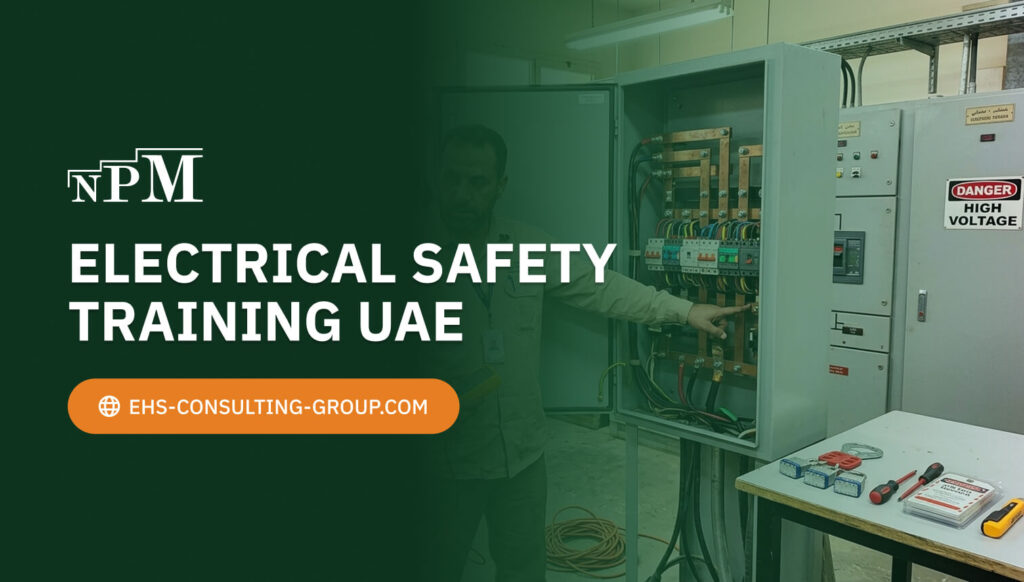
Electrical Safety Training for Oil & Gas delivered by NPM equips technicians, supervisors, and permit authorities working in upstream, midstream, and downstream operations to control arc-flash, shock, and ignition risks around LV/HV systems and hazardous areas. Built for refineries, gas plants, LNG terminals, offshore platforms, and pipeline facilities in the UAE, this program translates standards such as NFPA 70E, IEC 60364, IEC 60079, and API RP 500/505 into site-ready procedures that align with Permit to Work (PTW), SIMOPS, and isolation practices. This industry-specific offering is part of our broader Electrical Safety Training UAE portfolio and is tailored to your drawings, switchgear, Ex equipment, and turnaround schedules.
Who Needs Electrical Safety Training for Oil & Gas?

Within refineries, NGL fractionation units, offshore production platforms, and gathering stations, electrical tasks occur beside volatile atmospheres and critical safety instrumented systems, demanding competency that connects technical accuracy with process safety discipline. Electrical Safety Training for Oil & Gas is required for maintenance electricians, E&I technicians, electrical supervisors, operations coordinators authorizing isolations, PTW officers, instrument engineers interacting with intrinsically safe loops, and contractors performing tie-ins during shutdowns. It is equally relevant to facility managers overseeing MCC rooms, substation operations, and emergency switchboards; to integrity teams responsible for Ex inspections; and to construction teams executing brownfield modifications under live-plant constraints. Participants learn to plan isolations that respect hazard zones (Zone 0/1/2), segregate temporary power, manage bonding/earthing across skids and pipelines, and justify or reject energized work in line with NFPA 70E’s hierarchy of controls. On offshore assets with limited POB and helicopter windows, Electrical Safety Training for Oil & Gas also ensures task packaging reflects SIMOPS, gas testing, and ESD dependencies so that isolations do not impair fire and gas detection or life-safety systems. For organizations managing OEMs and EPC contractors, the program establishes common competency language, minimizing rework, stoppages, and non-conformities during audits by OSHAD, ADNOC’s Codes of Practice gatekeepers, or insurers. Whether your team manages HV switchgear and step-down transformers or services Ex d junction boxes near flare headers, Electrical Safety Training for Oil & Gas builds the discipline to prevent ignition and injury while sustaining production reliability.
Objectives of Our Electrical Safety Training for Oil & Gas

Electrical Safety Training for Oil & Gas turns regulatory requirements and best practices into precise work behaviors that withstand real operating pressures in the UAE—tight turnaround windows, elevated ambient temperatures, salt-laden offshore atmospheres, and diverse contractor workforces. Participants learn to identify arc-flash and shock boundaries, set approach limits, and select arc-rated PPE that reflects fault current and clearing times derived from your protective device coordination studies. They practice establishing positive isolations and LOTO with lock hierarchy and permit integration that consider process trip risk, SIS bypass authorization, and confined-space interfaces. The course demystifies hazardous area classification and Ex protection concepts, enabling competent selection and inspection of Ex d, Ex e, Ex i, and Ex n equipment per IEC 60079 and API RP 500/505. Electrical Safety Training for Oil & Gas also strengthens decision-making around energized testing, temporary power routing, and continuity/insulation testing in classified areas, and sharpens emergency response to electrical incidents without igniting hydrocarbon atmospheres.
- Translate NFPA 70E, IEC 60364, IEC 60079, and API RP 14F/14FZ into site-specific procedures and controls.
- Execute LOTO/isolations that protect people, process containment, and SIS integrity during maintenance and SIMOPS.
- Assess arc-flash/shock risk, define boundaries, and choose correct arc-rated PPE based on system data.
- Inspect and maintain Ex equipment and cabling to prevent ignition sources in Zone 1/2 areas.
- Integrate PTW, gas testing, and electrical safety steps to avoid ignition during temporary power and energized diagnostics.
Training Program Structure and Core Modules

Built as a modular pathway, Electrical Safety Training for Oil & Gas combines classroom learning with practical demonstrations on isolations, testing, and Ex inspection techniques that match your drawings, MCC schedules, and permit forms. The foundation covers electrical hazard recognition, arc-flash principles, and shock risk management, then advances to LOTO and complex isolation planning across distributed assets—wellheads, compressors, dehydration units, and tank farms. Specialized modules address hazardous area classification and equipment selection under IEC 60079, ensuring participants recognize flamepath integrity, ingress protection, temperature classes, and cable gland sealing. Electrical Safety Training for Oil & Gas includes energized work justification and temporary power controls that prevent inadvertent ignition or backfeeding, especially during shutdowns when multiple crafts converge. For offshore teams, the program maps procedures onto SIMOPS with crane lifts, hot work, and non-electrical tasks that may alter gas atmospheres. Case-based exercises utilize your single-line diagrams, protection settings, and actual incident learnings to reinforce decisions that align with NFPA 70E’s hierarchy of risk controls and UAE PTW protocols, resulting in competence that protects both human life and hydrocarbon containment.
Hazardous Areas and Ex Equipment Mastery
This module within Electrical Safety Training for Oil & Gas explains gas groupings, EPLs, equipment temperature classes, and the selection/maintenance of Ex d, Ex e, Ex i, and Ex n devices in Zone 1/2 areas. Delegates learn inspection levels (visual/close/detailed), common non-conformities (loose glands, missing fasteners, damaged seals), and how to document findings to IEC 60079-17 while coordinating with PTW and gas testing.
LOTO and Isolation Planning in Process Plants
Focused on refinery and gas plant realities, this part of Electrical Safety Training for Oil & Gas teaches development of isolation schemes for MCCs, transformers, and UPS/ESD supplies without compromising SIS or fire and gas coverage. It covers lock hierarchy, interlocks, zero energy verification, and temporary power risk controls during maintenance and turnarounds.
Arc-Flash and Shock Protection for HV/LV Systems
Participants apply Electrical Safety Training for Oil & Gas principles to interpret arc-flash labels, calculate approach boundaries, and select arc-rated PPE based on prospective incident energy. Practical exercises include racking procedures, safe test instrument use, and switching checklists for metal-clad switchgear, RMUs, and MCC buckets.
Permit to Work, SIMOPS, and Energized Work Decisions
Integrating PTW with NFPA 70E, this segment of Electrical Safety Training for Oil & Gas guides energized work permits, task risk assessments, and coordination with hot work, confined space, and lifting operations. It emphasizes gas monitoring, area classification impacts, and documentation to withstand regulator and insurance audits.
Electrical Incident Response and Learning
Through scenarios from refinery substations and offshore generator rooms, Electrical Safety Training for Oil & Gas trains responders to de-energize safely, manage arc-flash casualties, and preserve evidence for root cause analysis without adding ignition risk. Participants connect lessons to updates in isolation standards, PPE, and inspection schedules.
Duration and Format of Electrical Safety Training for Oil & Gas

NPM delivers Electrical Safety Training for Oil & Gas in formats that align to shift patterns, turnaround windows, offshore crew rotations, and vendor availability. Common pathways include a one-day awareness workshop for supervisors and permit authorities who must recognize electrical boundaries and energized work justifications; a two-day practitioner course for E&I technicians focused on LOTO, arc-flash/shock controls, and Ex inspection skills; and a three-day advanced option integrating HV switching, arc-flash label interpretation, and complex isolation planning across SIS, UPS, and emergency systems. Delivery can be on-site in your training rooms or offshore on-board facilities, as well as live-virtual modules for pre-work and refresher content. Electrical Safety Training for Oil & Gas can be offered in English and Arabic, with printed and digital materials aligned to your PTW, isolation forms, and equipment tags for immediate adoption. Typical class sizes of 8–16 ensure a strong instructor-to-delegate ratio, with practical rigs—LOTO kits, Ex enclosures, glanding practice, and measurement tools—used to anchor learning in real tasks. For multi-site operators, blended delivery reduces travel and ensures consistent competency standards across assets while preserving site-specific case studies, single-line diagrams, and SOP references in each cohort’s materials.
| Format | Typical Duration | Audience | Delivery Mode | Key Inclusions |
|---|---|---|---|---|
| Awareness | 1 day | Supervisors, PTW officers, HSE | On-site or Live-Virtual | Arc-flash/shock basics, energized work decisions, PTW alignment |
| Practitioner | 2 days | E&I techs, electrical fitters | On-site / Offshore | LOTO, isolations, Ex equipment inspection, temporary power controls |
| Advanced | 3 days | Electrical engineers, HV authorized persons | On-site / Blended | HV switching, arc-flash label use, coordination with SIS/UPS/ESD |
Operational Benefits and Use Cases

When delivered effectively, Electrical Safety Training for Oil & Gas produces measurable reductions in permit rejections, isolation errors, and near-misses around MCCs, switchgear, and Ex equipment—outcomes that directly protect people, assets, and uptime. Operators gain confidence that energized work authorizations are rare, robust, and fully justified, and that temporary power arrangements during shutdowns neither violate hazardous area boundaries nor compromise protective devices. Teams learn to read arc-flash labels and apply approach boundaries consistently, speeding safe switching operations while avoiding complacency. Electrical Safety Training for Oil & Gas also unifies contractor and in-house practices, reducing ambiguity when multiple OEMs and EPC teams converge on brownfield work. Practical, site-tuned case studies make it easy to copy the right behaviors into the next isolation plan, Ex inspection campaign, or fault-finding task—so that tasks start on time, documentation satisfies audits, and production restarts without surprises.
- Fewer permit delays due to clear energized work criteria and documented arc-flash/shock boundaries.
- Improved isolation quality—verified zero energy states, correct lock hierarchy, and SIS/ESD interface control.
- Higher Ex inspection fidelity and closure of ignition-critical defects before they propagate.
- Consistent competence across multi-national crews; smoother regulator, client, and insurer audits.
- Safer temporary power use during shutdowns and turnarounds with reduced backfeed and ignition risk.
Why Choose NPM for Oil & Gas Electrical Competency Development

NPM’s trainers are seasoned E&I practitioners with offshore and onshore experience across refineries, gas plants, LNG terminals, and pipeline pump/compressor stations, ensuring Electrical Safety Training for Oil & Gas is grounded in the realities of hot work interfaces, SIMOPS, and production pressures. We map course content to your drawings, labels, PTW forms, and SOPs so the procedures practiced in class mirror what your teams must execute on the job. Bilingual delivery (English/Arabic) and blended options make it practical to train crews on rotation while maintaining consistent standards across assets. Our methodology integrates NFPA 70E, IEC 60079, IEC 60364, API RP 500/505, and ADNOC/Dubai Municipality/OSHAD expectations into a single, auditable framework that stands up to client and insurer scrutiny. As part of a broader professional ecosystem, we work in coordination with CABINET NPM, enabling robust governance and quality assurance processes behind every delivery. From the first needs analysis to post-training action plans, NPM keeps the focus on operational reliability—reducing electrical risk without slowing the work that keeps hydrocarbons moving safely to market.
Related Electrical Safety Training Variants
Beyond oil and gas assets, NPM supports organizations with adjacent operations—fabrication shops, EPC construction sites, and captive utility networks—offering targeted variants that align with each environment’s hazards and regulatory context.
Electrical Safety Training for Manufacturing
For oil and gas groups that operate machine shops, fabricators, or skid-pack assembly lines, Electrical Safety Training for Manufacturing focuses on LV panel work, machinery lockouts, and energized troubleshooting in indoor facilities where arc-flash and entanglement hazards intersect. This complements Electrical Safety Training for Oil & Gas by aligning factory practices with site PTW and isolation standards for seamless handover of packaged equipment.
Click on the following link for more details: Electrical Safety Training for Manufacturing.
Electrical Safety Training for Construction
Capital projects and brownfield modifications expose crews to temporary power, generators, and rapidly changing electrical layouts. Electrical Safety Training for Construction helps EPC and maintenance contractors integrate LOTO, cable management, and energized work controls into site PTW during SIMOPS—bridging practices with Electrical Safety Training for Oil & Gas to prevent ignition in nearby classified areas.
Click on the following link for more details: Electrical Safety Training for Construction.
Electrical Safety Training for Utilities
Many operators run captive power plants, desal units, or high-capacity substations. Electrical Safety Training for Utilities develops HV switching competency, arc-flash risk evaluation, and switching programs for generation and transmission equipment, aligning with Electrical Safety Training for Oil & Gas so that utility operations protect process safety across the site.
Click on the following link for more details: Electrical Safety Training for Utilities.
Regulatory Landscape & Operational Risks in the Oil & Gas Sector
UAE operators must align electrical safety with multiple frameworks: OSHAD (Abu Dhabi Occupational Safety and Health System Framework) for governance and competency; Dubai Municipality technical guidelines and approvals; UAE Civil Defence fire and life-safety codes; and MOHRE requirements for worker welfare and training. For oil and gas facilities, ADNOC Codes of Practice, as well as international references—NFPA 70E for electrical safe work practices, IEC 60364 for electrical installations, IEC 60079 for explosive atmospheres, IEC 61892 for offshore installations, and API RP 500/505 for hazardous area classification—are the benchmarks that shape LOTO, arc-flash, and Ex inspection programs. Electrical Safety Training for Oil & Gas connects these standards to operating realities: live MCC work during process upsets, preserving SIS and ESD functions during isolations, gas testing around energized diagnostics, and controlling portable electrical equipment in Zone 1/2. Typical facilities—refineries, gas processing/LNG, offshore platforms, tank farms, and pipelines—confront salt corrosion, sand ingress, and heat that degrade enclosures and cables; the training emphasizes inspection regimes and material selection to keep temperature classes and integrity in check. By aligning PTW, energized work permits, and temporary power management with regulator and insurer expectations, Electrical Safety Training for Oil & Gas arms supervisors and technicians with documentation and decision standards that stand up in audits and incident investigations, protecting both people and hydrocarbon containment.
Our Training Across UAE Industries
NPM delivers sector-specific electrical safety programs for a wide range of industrial environments. While this page focuses on Electrical Safety Training for Oil & Gas, we also tailor content for manufacturing, construction, and utility operations to maintain consistent competency across diversified portfolios.
Assessment & Certification
NPM evaluates learning through a mix of knowledge checks and hands-on demonstrations that reflect real tasks performed on your assets. Written quizzes confirm understanding of arc-flash boundaries, energized work criteria, and hazardous area equipment selection; scenario-based exercises require delegates to interpret single-line diagrams, identify correct isolation points, and propose LOTO plans that do not compromise SIS/ESD/UPS integrity. Practical assessments include safe instrument use, zero-voltage verification, and Ex inspection observations (e.g., gland sealing, IP ratings, fastener integrity) documented to IEC 60079-17 conventions. Electrical Safety Training for Oil & Gas culminates in a final case study where participants justify or reject energized work under NFPA 70E hierarchy principles and define PTW steps that integrate gas testing and cross-permit coordination. Successful delegates receive an NPM Certificate of Completion stating participant name, course title “Electrical Safety Training for Oil & Gas,” duration, key learning outcomes, assessment method, and the recommended renewal interval; where statutory or company-specific authorization is required (e.g., HV switching), the client organization remains responsible for final competency sign-off and authorization. Recommended cohort size is 8–16 participants to balance interaction and assessment time, with pre-training scoping (needs analysis, collection of drawings, PTW forms, and recent incidents) allowing us to embed your scenarios and equipment references into the exercises. This ensures that certification reflects the actual decisions your workforce makes around MCCs, switchgear, Ex equipment, and temporary power during shutdowns.
Frequently Asked Questions
How often should this certification be renewed for oil and gas teams?
For high-risk roles, we recommend renewing Electrical Safety Training for Oil & Gas every two years, or sooner after changes to electrical infrastructure, PTW procedures, arc-flash studies, or following any electrical incident or near miss. Offshore crews or HV-authorized persons may benefit from annual refreshers focusing on switching, energized work justification, and Ex inspection updates.
What is different between initial and refresher training?
Initial Electrical Safety Training for Oil & Gas builds foundational hazard recognition, LOTO proficiency, and Ex equipment understanding with full practical assessments. Refresher sessions emphasize updates to NFPA 70E/IEC 60079, lessons learned from your incidents and audits, and targeted skills practice (e.g., isolation planning across SIS/ESD/UPS), keeping experienced technicians current without repeating basic theory.
Who issues the certificate upon completion?
NPM issues the Certificate of Completion for Electrical Safety Training for Oil & Gas, detailing participant name, course title, duration, outcomes, and assessment method. Where company authorization or statutory licensing is required (e.g., HV switching authority), the client organization retains responsibility for formal authorization and sign-off.
Should we choose in-house or open/public sessions?
In-house delivery is ideal for operators who want Electrical Safety Training for Oil & Gas built around their drawings, permits, incident learnings, and equipment. Open/public sessions suit organizations seeking foundational knowledge for smaller groups or individuals; advanced, site-specific topics (SIS interfaces, temporary power in Zone 1/2, arc-flash label interpretation) are best handled in-house.
What group size is most effective?
We recommend 8–16 participants per class for Electrical Safety Training for Oil & Gas. This size allows meaningful practical assessment, discussion of your single-line diagrams and PTW forms, and individual feedback during LOTO drills and Ex inspections, while minimizing disruption to shift coverage.
Are there prerequisites for attending?
Participants should have basic electrical familiarity and site PTW awareness; technicians will benefit from experience with MCCs, instrumentation loops, or Ex equipment. For advanced Electrical Safety Training for Oil & Gas modules (e.g., HV switching), prior company authorization or completing the practitioner level is recommended.
Discover Our Past Projects
NPM has designed and delivered electrical and process safety programs worldwide for complex assets across upstream, midstream, and downstream operations. Our track record includes integrating NFPA 70E/IEC 60079 with client PTW systems, building Ex inspection regimes, and coaching HV-authorized persons in live and simulated environments. Explore examples of how we translate standards into operational results that withstand regulator and insurer scrutiny.
For more information about our references, visit Our References.
Ready to Empower Your Electrical Workforce?
Minimize ignition and injury risk while protecting uptime with Electrical Safety Training for Oil & Gas tailored to your assets, permits, and operating realities. NPM can scope an in-house or blended plan that fits your rotations, shutdowns, and multi-site needs, and reinforce consistent practices across contractors and crews. Speak with our team to review objectives, documentation, and scheduling.