
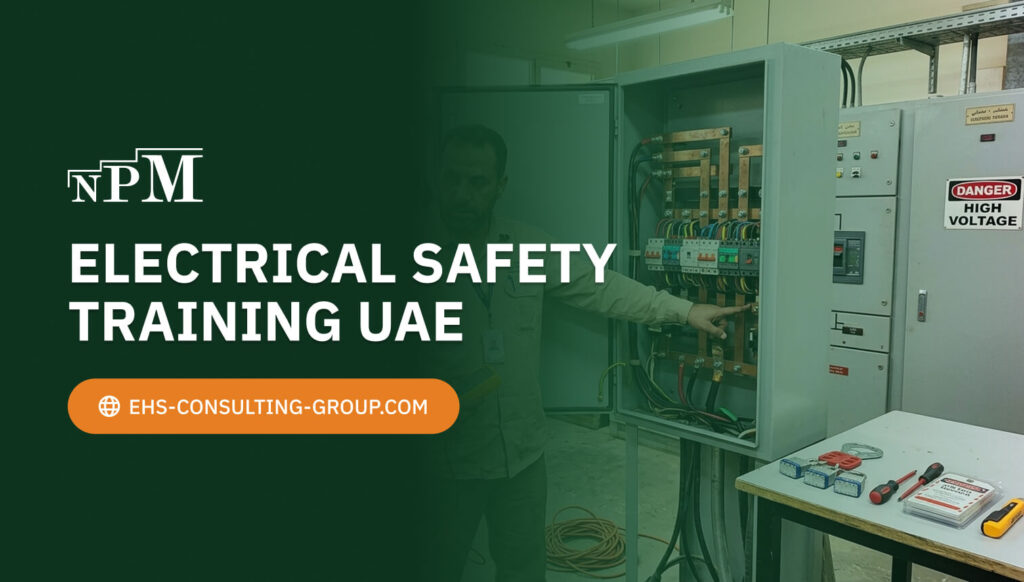
Electrical Safety Training for Utilities delivered by NPM equips generation, transmission, and distribution teams across the UAE with the competence to work around HV/LV systems, substations, switchyards, feeders, overhead lines, and industrial consumers safely and compliantly. This industry-tailored program aligns with NFPA 70E, IEC 60364, IEEE guidance, and UAE authority requirements (OSHAD Abu Dhabi, Dubai Municipality, and Civil Defence), and turns policy into practical behaviors on live systems. As part of NPM’s integrated offering, this utilities-specific pathway complements our broader Electrical Safety Training UAE portfolio, enabling HSE managers and operations leaders to standardize safe work practices across complex, multi-site networks while reducing outage risks, contractor incidents, and arc-flash exposure. Electrical Safety Training for Utilities is built around real operating scenarios including switching orders, lockout/tagout (LOTO) with permitting, arc-flash risk evaluation, ground fault recognition, step-and-touch voltage control, and emergency energization/de-energization protocols—so your teams leave with immediately applicable skills, not just theory.
Who Needs Electrical Safety Training for Utilities?

Utilities in the UAE operate 24/7 networks where switching activities, isolation, testing, and restoration create unique electrical exposures that demand rigorous, role-specific competence. Electrical Safety Training for Utilities is designed for transmission and distribution technicians, substation engineers, network controllers, generation O&M crews, asset integrity teams, and contractors performing works under utility permits. For these roles, the difference between a controlled switching plan and an improvised energization can be measured in protection trips, equipment damage, and worker injury. Our approach connects standard requirements (NFPA 70E, IEC 60364, DEWA/TRANSCO/ADPower procedures) with your actual job plans—covering switching sequences, interlocks and key exchanges, live-line tools, voltage detection and proving dead, LOTO, and job safety planning with clear roles and communications. Electrical Safety Training for Utilities also addresses how to reconcile utility permit-to-work (PTW) systems with contractor safe systems, ensuring everyone shares a single source of truth before any conductor is approached. For utilities that rely on third-party maintenance teams during outages or emergency repairs, the training clarifies demarcation, documented isolation, and return-to-service validation, so restoration targets aren’t met at the expense of safety. Because crews cycle around shifts and seasonal peak loads, Electrical Safety Training for Utilities is structured to accommodate staggered attendance while maintaining consistent learning outcomes.
Typical roles and teams addressed
Electrical Safety Training for Utilities is applicable to grid operations controllers, substation/switchgear technicians, cable jointers and line crews, generation plant electricians, relay/protection engineers, commissioning teams, and authorized/competent persons designated under your electrical safety rules. It also includes supervisors, planners, and HSE advisors who authorize switching or approve isolation/energization plans.
Objectives of Our Electrical Safety Training for Utilities

Electrical Safety Training for Utilities has one purpose: to hardwire safe decision-making into utility work where system stability, public safety, and worker protection intersect. Delegates learn to interpret single-line diagrams, feeder arrangements, busbar configurations, and protection coordination to plan and verify safe states before touching equipment. They practice job safety planning, test-before-touch, application of grounds, arc-flash hazard identification, and selection of PPE by incident energy category, always reconciling written switching orders with field reality. We devote significant time to LOTO and PTW integration because high-reliability utilities depend on flawless control of energy states—especially when multiple crews, contractors, or emergency responders are present. Electrical Safety Training for Utilities also emphasizes communication protocols—control room to field, and between field teams—so switching steps, inhibit/override conditions, and interlocks are both understood and recorded. Finally, delegates apply these behaviors to realistic UAE scenarios such as desert substation operations in high heat, coastal corrosion considerations, and urban cable faults near sensitive loads.
- Translate standards (NFPA 70E, IEC 60364, IEEE 1584) into actionable utility procedures for switching, isolation, testing, and restoration.
- Plan and execute LOTO with PTW, including demarcation between utility and customer installations, and contractor controls under utility authorization.
- Identify arc-flash boundaries, select correct PPE, and use field measurements to validate safe approach distances in substations and switchyards.
- Apply live-line work fundamentals, induced voltage controls, and equipotential grounding practices on overhead and underground systems.
- Conduct effective tailboards/job safety briefings, manage simultaneous operations, and document changes to switching plans.
Training Program and Module Pathways

Electrical Safety Training for Utilities is organized as a modular pathway built around your asset base—generation, substations, HV/MV distribution, overhead lines, and customer interfaces—so participants receive only the content that matters to their role. We begin with a foundations module that aligns your electrical safety rules with recognized standards (NFPA 70E/IEC 60364) and the expectations of UAE authorities (OSHAD, Dubai Municipality, Civil Defence). Then we shift to substation and switchgear hazards, covering racking procedures, interlocks, arc-resistant gear, test instruments, and proving dead protocols. Delegates progress to job safety planning, LOTO/PTW, and switching order execution, using your actual procedures and single-line diagrams to practice permit flow, tagging, and verification. For field crews, we include live-line awareness, inducted voltage management, step-and-touch control, grounding, and emergency response to inadvertent energization. Electrical Safety Training for Utilities concludes with scenario-based exercises—cable faults, transformer change-outs, emergency backfeeds, and black start contingencies—so participants practice the full chain from planning to restoration. Optional refreshers and supervisor-focused clinics reinforce authorization duties, incident analysis, and leadership of electrical safety rules.
Core modules and focus areas
Our modules can be mixed-and-matched for generation plants, water and power co-generation sites, and transmission/distribution networks. Electrical Safety Training for Utilities can also incorporate customer substation interfaces for large industrial consumers where demarcation and switching responsibilities must be crystal clear to prevent backfeed hazards and nuisance trips.
| Module | Primary Audience | Delivery Format | Typical Duration |
|---|---|---|---|
| Foundations: Electrical Safety Rules & Standards | All utility roles | Classroom or virtual live | 4 hours |
| Substations & Switchgear Safety | Substation techs, protection engineers | Classroom + facility walkdown | 6–8 hours |
| LOTO, PTW & Switching Orders | Authorized/competent persons, controllers | Scenario-based workshop | 6 hours |
| Arc-Flash Risk & PPE Selection | All field crews and supervisors | Classroom + PPE lab | 4 hours |
| Overhead/Underground Works & Grounding | Line crews, cable jointers | Practical field clinic | 6 hours |
| Emergency Response & Incident Learning | Supervisors, HSE, O&M leads | Tabletop + after-action review | 3–4 hours |
Duration and Format of Electrical Safety Training for Utilities

Electrical Safety Training for Utilities is delivered by NPM in flexible formats to suit round-the-clock networks and geographically dispersed assets. Typical delivery is a two-day blended course (12–14 hours) covering foundational rules, substation/switchgear safety, LOTO/PTW/switching, and arc-flash risk, followed by optional field clinics on grounding and live-line awareness. For large utilities, we structure rolling cohorts to capture all shifts without compromising coverage, offering on-site delivery at substations, depots, and generation sites, or hybrid sessions combining virtual classrooms with local practicals. Class sizes are calibrated to utility tasks: we recommend 10–16 delegates for interactive workshops and 6–8 for hands-on practicals around equipment mock-ups to keep coaching focused on safe body positioning, test instrument use, and communication discipline. Electrical Safety Training for Utilities can be localized to your electrical safety rules and permit flow; we preload your PTW forms, tagging schemes, and single-line diagrams into exercises so learners practice with the exact documentation they will use on the job. For multi-operator grids and shared substations, we can deliver joint sessions that align responsibilities at demarcation points, avoiding ambiguity during faults, switching, or restoration.
Electrical Safety Training for Utilities is also available as compressed refresher modules (4–6 hours) targeted to high-risk tasks prior to outages or seasonal load peaks, and as supervisor clinics focused on authorization decisions, incident prevention, and coaching.
Practical Benefits and High-Value Use Cases

Utilities face competing pressures: uptime, demand variability, asset aging, and a contractor-heavy ecosystem. Electrical Safety Training for Utilities addresses these pressures by reducing human error and strengthening control of hazardous energy, so outages are shorter, incidents rarer, and equipment integrity maintained. By aligning switching practices with PTW and LOTO, your teams cut through ambiguity, prevent inadvertent backfeeds, and avoid permit conflicts when multiple crews converge on the same asset. The program trains consistent tailboard briefings and point-of-work risk assessments that catch site-specific hazards—confined substations, corrosion at terminations, humidity/condensation effects—before work begins. Electrical Safety Training for Utilities also enhances protection of the public and third parties by embedding safe barricading, grounding, and exclusion zones around street cabinets, risers, and pole-top activities in urban and remote settings. For leadership, the benefits include fewer lost-time incidents, stronger regulator confidence, reduced PPE misuse, and higher-quality incident learning that feeds continuous improvement of electrical safety rules.
- Pre-outage readiness: sharpen switching/LOTO skills and communications before major planned works.
- Emergency repairs: reinforce test-before-touch, proving dead, and grounding discipline under time pressure.
- Contractor integration: align external teams to your rules, tags, and authorization boundaries.
- New assets/commissioning: ensure safe energization, protection checks, and interlock verification.
- Customer substations: clarify demarcation, metering CT/PT handling, and safe restoration after trips.
Why Choose NPM for Utility Electrical Safety Training

NPM delivers Electrical Safety Training for Utilities with depth earned from work across generation, transmission, and distribution environments, translating standards and corporate rules into safe, repeatable field behavior. Our specialists are adept at blending control-room perspectives with field realities: we train crews to challenge assumptions, confirm isolation boundaries, and document every handover clearly. Electrical Safety Training for Utilities from NPM uses your PTW forms, tagging schemes, single-line diagrams, and work packs, so competency builds around your systems—not generic materials. We also address the realities of UAE operations: high heat, sand and dust ingress, coastal corrosion, and dense urban excavation risk. For multi-site organizations, we coordinate rolling cohorts to reach every shift without impacting system reliability. Finally, our scenario design mirrors your incident profile—arc-flash close calls, nuisance trips, protection misoperations—so the training focuses where it matters most and delivers measurable risk reduction.
Related Electrical Safety Courses for Complex Operations
These complementary offerings help utilities manage cross-sector risks when operating mixed assets, working at customer sites, or supervising contractors from adjacent industries.
Electrical Safety Training for Manufacturing
Utilities that also operate district cooling plants, water treatment, or in-house workshops will benefit from cross-training aligned to manufacturing environments. While Electrical Safety Training for Utilities addresses grid hazards, this course focuses on LV/MV panels, motor control centers, and process equipment typical of plants and workshops, improving LOTO and machine isolation when your teams work beyond substations. Click on the following link for more details: Electrical Safety Training for Manufacturing.
Electrical Safety Training for Oil & Gas
For utilities supporting offshore/onshore customers or sharing substation interfaces with oil and gas operators, this program adds hazardous area classification (IECEx/ATEX), ignition source control, and SIMOPS coordination to your electrical safety toolbox. It complements Electrical Safety Training for Utilities by clarifying demarcation and safe energization where process safety and electrical rules intersect. Click on the following link for more details: Electrical Safety Training for Oil & Gas.
Electrical Safety Training for Construction
When utilities supervise or collaborate with EPC contractors on new substations, overhead lines, or cable laying, construction-specific electrical safety becomes critical. This course extends beyond Electrical Safety Training for Utilities to address temporary power, excavation near live cables, and safe commissioning during build phases. Click on the following link for more details: Electrical Safety Training for Construction.
Regulatory Landscape and Operating Conditions for UAE Utilities
Electrical Safety Training for Utilities is aligned with the UAE’s regulatory ecosystem and the practical realities of network operation. In Abu Dhabi, OSHAD frameworks (now integrated under Abu Dhabi Public Health Centre oversight) set expectation for electrical safety management, while Dubai Municipality and Dubai Civil Defence enforce safety requirements within their jurisdictions, complementing ISO 45001 management systems. Utilities must also reflect NFPA 70E for electrical safe work practices, IEC 60364 for low-voltage installations, IEC 61936/EN 50110 for operation of electrical installations, and IEEE 1584 for arc-flash studies that inform PPE and approach boundaries. In practice, grid operators and independent power producers coordinate switching orders, PTW, and isolation boundaries with large industrial customers to eliminate backfeed paths through parallel supplies and emergency generators. Electrical Safety Training for Utilities addresses scenarios frequent in the UAE: extreme heat impacting PPE wearability and inspection, coastal corrosion driving failure modes at terminations, dust ingress compromising switchgear protection, and dense urban environments where cable strikes must be prevented through permits, scanning, and competent supervision. For governance insights that complement HSE systems, we recognize the value of industry-aligned frameworks such as CABINET NPM, which underscores disciplined policy deployment—a critical ingredient in reliable utility operations.
Electrical Safety Training for Multi-Industry Networks in the UAE
While this page focuses on Electrical Safety Training for Utilities, many network operators interface daily with manufacturing plants, oil and gas facilities, and construction projects. Explore our targeted training for these sectors to harmonize expectations at demarcation points and during joint works.
Electrical Safety Training for Manufacturing
Electrical Safety Training for Manufacturing addresses factory floors, MCCs, drives, and process equipment typical of discrete and process manufacturing. It is particularly relevant where utilities hand over power at customer substations feeding production lines, and where NFPA 70E, IEC 60204-1, and Dubai Municipality inspection regimes meet utility PTW. For operators coordinating shutdowns with manufacturing clients, this program helps ensure lockout, verification, and restoration steps are synchronized to prevent backfeeds and unintended starts. Click on the following link for more details: Electrical Safety Training for Manufacturing.
Click on the following link for more details: Electrical Safety Training for Manufacturing.
Electrical Safety Training for Oil & Gas
Electrical Safety Training for Oil & Gas covers offshore platforms, onshore processing plants, and pipelines where hazardous areas, API and IECEx/ATEX requirements, and SIMOPS constraints define the risk profile. When utilities supply or interconnect with these facilities, coordination with operators and adherence to ADNOC codes, Civil Defence expectations, and NFPA 70E becomes paramount to avoid ignition sources and mis-synchronization during energization. This program is invaluable for joint substation operations, emergency backfeeds, and brownfield expansions near live process units. Click on the following link for more details: Electrical Safety Training for Oil & Gas.
Click on the following link for more details: Electrical Safety Training for Oil & Gas.
Electrical Safety Training for Construction
Electrical Safety Training for Construction focuses on EPC, transmission line builds, and substation greenfield projects where temporary power systems, excavation near live cables, and commissioning introduce acute hazards. With MOHRE safety requirements, Dubai Municipality permits, and NFPA 70E/EN 50110 as anchors, this training enables safer tie-ins, pre-energization testing, and coordination between utility authorizations and contractor PTW systems—especially during phased energizations and live-adjacent works. It is essential for avoiding cable strikes, managing temporary feeders, and establishing robust exclusion zones. Click on the following link for more details: Electrical Safety Training for Construction.
Click on the following link for more details: Electrical Safety Training for Construction.
Assessment and Certification Process
Electrical Safety Training for Utilities uses multiple assessment layers to confirm competence. Delegates complete a written assessment focused on safe work practices, PTW/LOTO decision-making, arc-flash hazard identification, and switching order interpretation. Scenario-based evaluations then test real-world judgment: participants must plan isolations from actual or simulated single-line diagrams, perform job safety briefings, specify PPE by incident energy, and identify controls for step-and-touch voltage. For practical clinics, instructors observe test-before-touch technique, proving dead, grounding, and communication discipline under time pressure to mimic fault restoration environments. Successful participants receive an NPM certificate of completion detailing modules covered, training hours, and assessment outcomes. The client organization retains responsibility for statutory authorization and sign-off (e.g., appointment as Authorized/Competent Person) in line with their electrical safety rules and UAE regulatory requirements. We recommend 10–16 delegates per cohort for interactive learning and 6–8 for practicals to ensure hands-on coaching and safe supervision.
Prior to delivery, NPM conducts a short needs analysis to align Electrical Safety Training for Utilities with your asset portfolio, permits, and incident learning. Where possible, we incorporate site-specific scenarios, single-line diagrams, tagging systems, and PPE categories to maximize relevance and immediate transfer to the field.
FAQ: Utility-Focused Training Answers
How often should utility teams renew this training?
We recommend refreshing Electrical Safety Training for Utilities every two years, or immediately after significant changes in network configuration, protection schemes, PTW updates, or following an incident/near miss involving electrical work. Regulatory audits or asset introduction (e.g., new substations, upgraded switchgear) are also appropriate triggers.
What’s the difference between the initial course and a refresher?
The initial Electrical Safety Training for Utilities establishes full competence across rules, switching, LOTO, and arc-flash controls with scenario practice. Refreshers concentrate on high-risk tasks and new learnings: changes in procedures, lessons from incidents, and targeted skill checks on proving dead, grounding, and job safety planning.
Who issues the certificate of completion?
NPM issues the training certificate upon successful assessment for Electrical Safety Training for Utilities, listing modules, hours, and assessment results. Your organization maintains responsibility for formal authorization under your electrical safety rules and UAE authority requirements.
Should we choose in-house or open/public sessions?
In-house delivery is best for utilities because Electrical Safety Training for Utilities depends on your specific PTW forms, tagging, and single-line diagrams. Open/public sessions suit smaller teams needing foundational awareness, but they cannot mirror your exact switching orders or authorization processes.
What group size works best?
For classroom and scenario-based learning, 10–16 delegates allow rich discussion without diluting engagement. For practical clinics tied to Electrical Safety Training for Utilities—grounding, proving dead, test instrument use—6–8 delegates per instructor ensures safe supervision and quality coaching.
Are there prerequisites?
Basic electrical familiarity and awareness of your utility’s electrical safety rules help. For advanced segments of Electrical Safety Training for Utilities—switching orders, authorization decisions—participants should be nominated or already performing those roles, with access to current single-line diagrams and PTW documentation.
Explore Our Track Record
NPM delivers complex HSE, process safety, and electrical safety training and consulting worldwide, supporting utilities, energy producers, and industrial networks with measurable improvements in competence and risk control. Our trainers bring field credibility and system-level insight to every engagement, and our scenarios are built from real operating challenges. Whether standardizing electrical safety rules, elevating authorization quality, or improving outage readiness, NPM’s references demonstrate sustained results.
For more information about our references, visit Our References.
Discuss Your Utility Training Needs
Ready to raise electrical safety performance across your network? Electrical Safety Training for Utilities from NPM can be delivered on-site, virtually, or in hybrid formats, tailored to your PTW, tagging, and switching processes. Speak with our team to scope modules, set cohort schedules around shifts, and incorporate your incident learnings into targeted scenarios.